
Bamboo Doors in India: Rapidly Renewable Choice (India 2026)
Engineered and laminated bamboo doors are strong, rapidly renewable and increasingly available in India — here is how they perform, what they cost and where they suit.
Few materials make a sustainability claim as cleanly as bamboo doors India buyers are now being offered. Bamboo is a grass, not a tree — some species shoot up three to four feet a day and reach harvest maturity in three to five years, against twenty to forty for hardwood. That single fact makes engineered bamboo one of the most rapidly renewable structural materials available, and India happens to be the world's second-largest bamboo grower. When that fast-growing stalk is split, treated, glued and pressed into laminated or composite boards, it becomes a genuinely strong, dimensionally stable door material with a distinctive honey grain. This Studio Matrx guide explains how bamboo doors are made, how they really perform in Indian humidity, what they cost, and where they earn their place — without the greenwash. For the full material landscape, this sits within the eco-friendly door materials and sustainable doors story, and the cluster pillar is the complete door guide.
What an engineered bamboo door actually is
A raw bamboo culm is hollow and round, so you cannot saw a door leaf straight out of it the way you can from a timber log. Engineered bamboo solves this by reconstituting the fibre. Strips are cut from the culm wall, boiled or carbonised to remove starch (which deters borers and fixes colour), dried, then bonded under heat and pressure into solid boards. Two formats dominate.
- Laminated (strand-laminated or strip-laminated) bamboo glues flattened strips edge-to-edge and face-to-face, giving a dense board with a visible linear grain — used for solid leaves, stiles and rails.
- Bamboo composite / reconstituted bamboo shreds the culm into fibre bundles, mixes them with resin and compresses them; very hard and stable, often used as a skin or for high-wear surfaces.
- Bamboo plywood / bamboo flush doors use a bamboo-veneer or bamboo-mat face over a core, giving the look at a lower price — comparable in build to engineered wood doors but with a rapidly renewable face.
Because the fibre runs in controlled directions, engineered bamboo resists the warping that troubles solid wooden doors, while delivering hardness in the league of seasoned hardwood.
Why bamboo counts as rapidly renewable and strong
The sustainability case rests on growth speed and yield, but durability matters just as much — a door that lasts thirty years beats one replaced twice in the same period, whatever it is made of. Bamboo scores on both. The diagram below shows the closed loop that makes it attractive on embodied-carbon grounds; for the rupee-cost angle of lifespan, see engineered wood lifecycle costing.
Strength and stability
Good-quality strand-laminated bamboo reaches hardness and bending strength comparable to oak or teak, and engineered formats are more dimensionally stable than most solid timber because the cross-banded fibre cancels out the seasonal movement of any single grain direction. For doors, that means less risk of the leaf swelling tight or twisting in its frame across a humid Indian year.
The honest caveats
Bamboo is not magic. Quality varies enormously with the species (Moso and Bambusa are common), the treatment, and above all the adhesive. Cheap, under-treated bamboo can harbour borer and powder-post beetle, and starch left in the culm attracts pests. And the "eco" label is only real if the resin is low-emission and the chain of custody is sound — verify with a third-party label rather than the seller's word.
Durability and moisture behaviour in Indian conditions
This is where bamboo doors stand or fall in India. Bamboo is hygroscopic — it absorbs and releases moisture — so the engineering and the placement matter more than the marketing.
| Location | Bamboo door suitability | Why |
|---|---|---|
| Internal rooms, bedrooms, studies | Excellent | Stable, dry, hardwearing; the natural home for bamboo |
| Living and dining, dry urban climates | Very good | Stays true with normal RH swings |
| Bathrooms, utility, wet areas | Poor | High humidity swells unprotected bamboo; choose WPC or FRP |
| External / main entrance | Conditional | Only with marine-grade adhesive, full edge sealing and an overhang; otherwise UV and rain degrade it |
| Coastal / heavy-monsoon zones | Use with caution | Salt and prolonged damp punish all timber-family doors; non-timber options are safer |
The rules of thumb are simple. Indoors and in dry-to-composite climates, a well-made laminated bamboo door performs beautifully for decades. For wet rooms and exposed external openings — especially in warm-humid and coastal India — bamboo needs marine-grade bonding, sealed end-grain and weather protection, and even then a rot-proof alternative is often the wiser call. UV will grey an unfinished face over time, so an external bamboo door wants a maintained protective finish; pair it with a weather-resistant door strategy if you must use it outside.
Indian availability — the bamboo mission and where to buy
Bamboo product supply in India has improved sharply, helped by the National Bamboo Mission (NBM) under the Ministry of Agriculture and the advocacy of the National Mission on Bamboo Applications / NMBA lineage, which positioned bamboo as an industrial material rather than just a craft input. The 2017 amendment removing home-grown bamboo from the Indian Forest Act's definition of "tree" was a turning point — it freed farmers to grow and trade bamboo without felling permits, expanding raw supply for boards and doors.
In practice you will find bamboo doors and bamboo-ply through engineered-board manufacturers, North-East India producers (Assam, Tripura, Mizoram, Meghalaya), and a growing set of green-material suppliers. Availability is still thinner than for teak or plywood doors, and lead times can be longer outside metros. Look for a GreenPro (CII-IGBC) or ECOMARK (BIS) label, and check the formaldehyde grade — bamboo's renewability is undone if it is bonded with high-emission urea-formaldehyde, so prefer E1, E0 or no-added-formaldehyde grades discussed in our eco-friendly door materials guide.
Look, finish and design fit
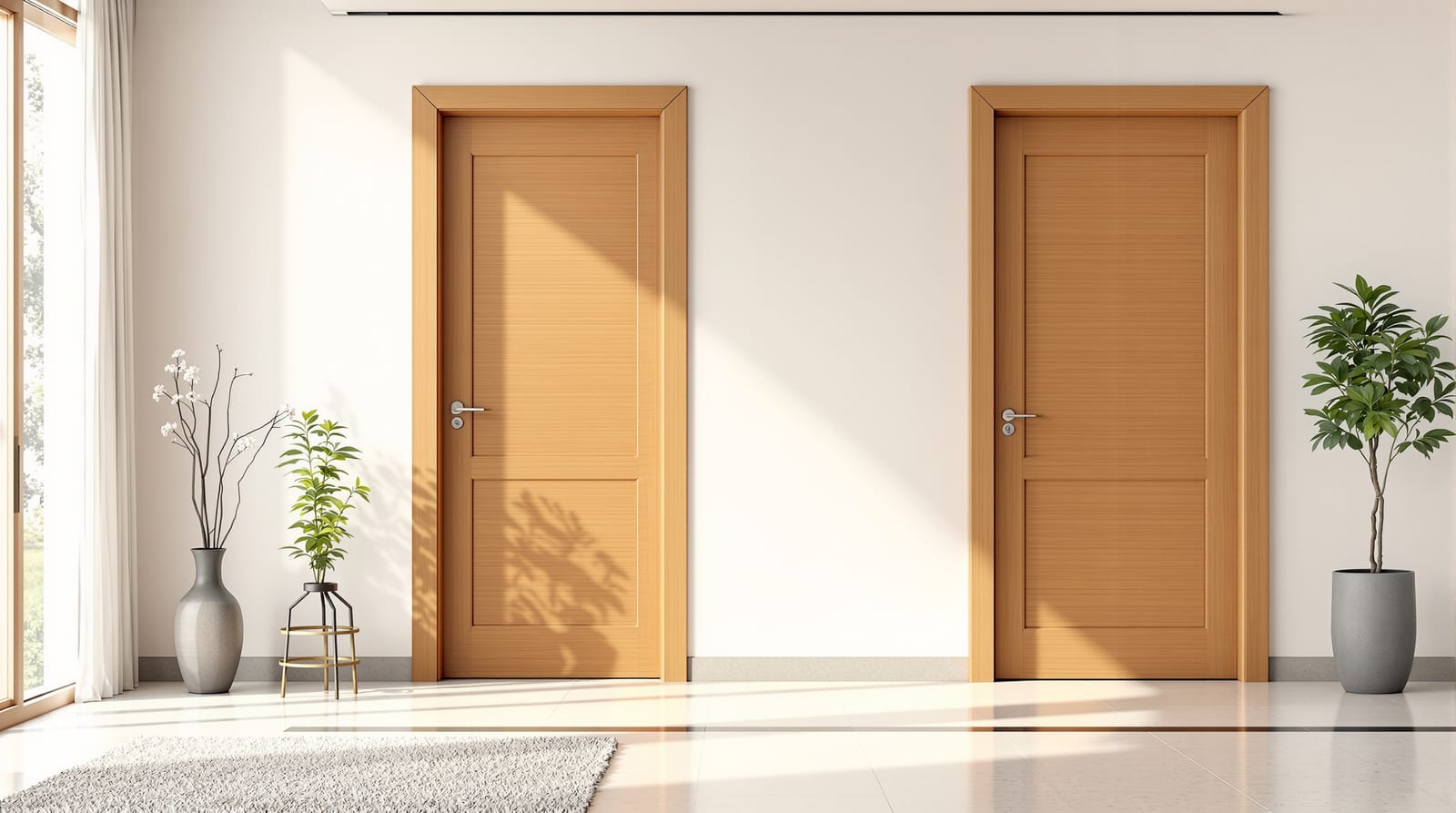
Bamboo's signature is its fine, regular linear grain and warm honey-to-amber colour (carbonised bamboo runs darker, like aged caramel). It reads as clean, contemporary and natural — at home in minimalist, Japandi, biophilic and modern-Indian interiors. It takes clear matte or satin finishes well, showing off the grain; heavy opaque paint hides the very feature you paid for. Edges can be exposed to reveal the characteristic strip lamination as a design detail. For finishing choices, keep to low-VOC, water-based coats to protect the indoor-air-quality benefit.
Cost: what bamboo doors run in India
As a rule of thumb, bamboo doors sit between budget flush doors and premium hardwood. GST is 18%. Prices are indicative 2026 bands and vary by format, finish, size and region.
| Door type | Indicative price (₹) | Notes |
|---|---|---|
| Bamboo-ply / bamboo-faced flush door | 4,500–9,000 | Bamboo look over a core; best value |
| Solid laminated bamboo leaf (internal) | 9,000–18,000 | Dense, stable, hardwood-class hardness |
| Bamboo composite / reconstituted leaf | 12,000–22,000 | Very hard; premium contemporary finish |
| External-grade sealed bamboo door | 18,000–35,000+ | Marine adhesive, sealed edges, protective finish |
Against those numbers, a cheap hollow flush door is cheaper upfront but shorter-lived; quality bamboo competes on whole-life value and a far better sustainability profile. To compare against other materials side by side, run the door material comparison tool, and to put a number on the carbon saving, the door embodied carbon calculator.
Where bamboo doors suit best
Choose bamboo when you want a genuinely rapidly renewable, low-carbon material with hardwood-class hardness and a clean contemporary look, for internal doors in dry-to-composite climates and green-building projects chasing IGBC Green Homes or GRIHA material credits. It also pairs naturally with sustainable door specifications and the wider eco-friendly materials palette. Think twice for bathrooms, exposed coastal entrances and heavy-monsoon external openings, where a rot-proof non-timber door is the more durable — and therefore more sustainable — choice.
Frequently asked questions
Are bamboo doors strong enough for a main entrance door?
Good strand-laminated and composite bamboo matches oak or teak for hardness, so strength is rarely the issue. The constraint is weathering: only use bamboo externally with marine-grade adhesive, fully sealed edges, an overhang and a maintained protective finish. In coastal or heavy-monsoon India, a rot-proof FRP or WPC door is usually the safer external choice.
Is bamboo really more sustainable than wood?
Genuinely, yes — bamboo regrows in three to five years versus decades for hardwood, regenerates without replanting, and stores biogenic carbon. But the benefit only holds if it is bonded with a low-emission adhesive and durable enough to last. Verify with a sustainable door lens and a third-party label, not the seller's claim.
How do bamboo doors handle Indian humidity and monsoon?
Engineered bamboo is more dimensionally stable than solid timber, so it resists warping well in normal indoor humidity swings. Unprotected bamboo will swell in sustained wet conditions, however, so keep it out of bathrooms and unsheltered exteriors unless it is marine-bonded and sealed. See weather-resistant doors for protective detailing.
Where can I buy bamboo doors in India?
Through engineered-board makers, North-East India producers (Assam, Tripura, Meghalaya) and green-material suppliers, supported by the National Bamboo Mission. Availability is thinner than teak or plywood and lead times longer outside metros. Insist on a GreenPro or ECOMARK label and an E1/E0/no-added-formaldehyde grade.
Do bamboo doors get attacked by borer or termites?
Properly treated and carbonised bamboo, with starch removed and a borer-resistant treatment applied, resists pests well. Cheap, under-treated bamboo can harbour powder-post beetle, so buy from a reputable maker and avoid bargain stock with no treatment certificate.
What finish should I use on a bamboo door?
A clear or lightly tinted matte/satin coat shows off the linear grain — opaque paint hides bamboo's best feature. Use low-VOC, water-based finishes to protect indoor air quality, and keep the protective coat maintained on any externally exposed bamboo to slow UV greying.
Export this guide
Related Guides — Deep-dive reading
Eco-Friendly Door Materials: A Sustainability Guide (India 2026)
Rubberwood, bamboo, agri-fibre board, reclaimed timber, FSC plywood and recycled WPC scored on renewability, carbon, emissions, durability and recyclability.
Home Doors & EntrancesSustainable Doors Guide: Eco-Friendly Doors (India 2026)
What makes a door genuinely sustainable in India — certified renewable material, low emissions, low embodied carbon, durability and recyclability.
Home Doors & EntrancesGreen Building Materials Guide (India): Low-Carbon, Healthy & Sustainable Choices (2026)
What actually makes a building material green - low embodied carbon and energy, recycled and renewable content, local sourcing, durability, recyclability, low VOC and water efficiency - mapped honestly across the whole Indian building, with the lifecycle nuance no label can give you.
Building MaterialsRelated Tools — Try Free
Door Material Comparison Tool
Compare 2–4 door materials on cost, durability, maintenance, security and moisture resistance.
Comparison ToolCross-Ventilation Analyzer
Estimate airflow and air changes per hour (ACH) from room size, window areas, layout, and local wind — with NBC 2016 Part 8 compliance check.
Ventilation CalculatorDoor Cost Calculator
Estimate the all-in cost of a door — leaf, frame, hardware, fitting and GST — by type, material and size.
Door Calculator