
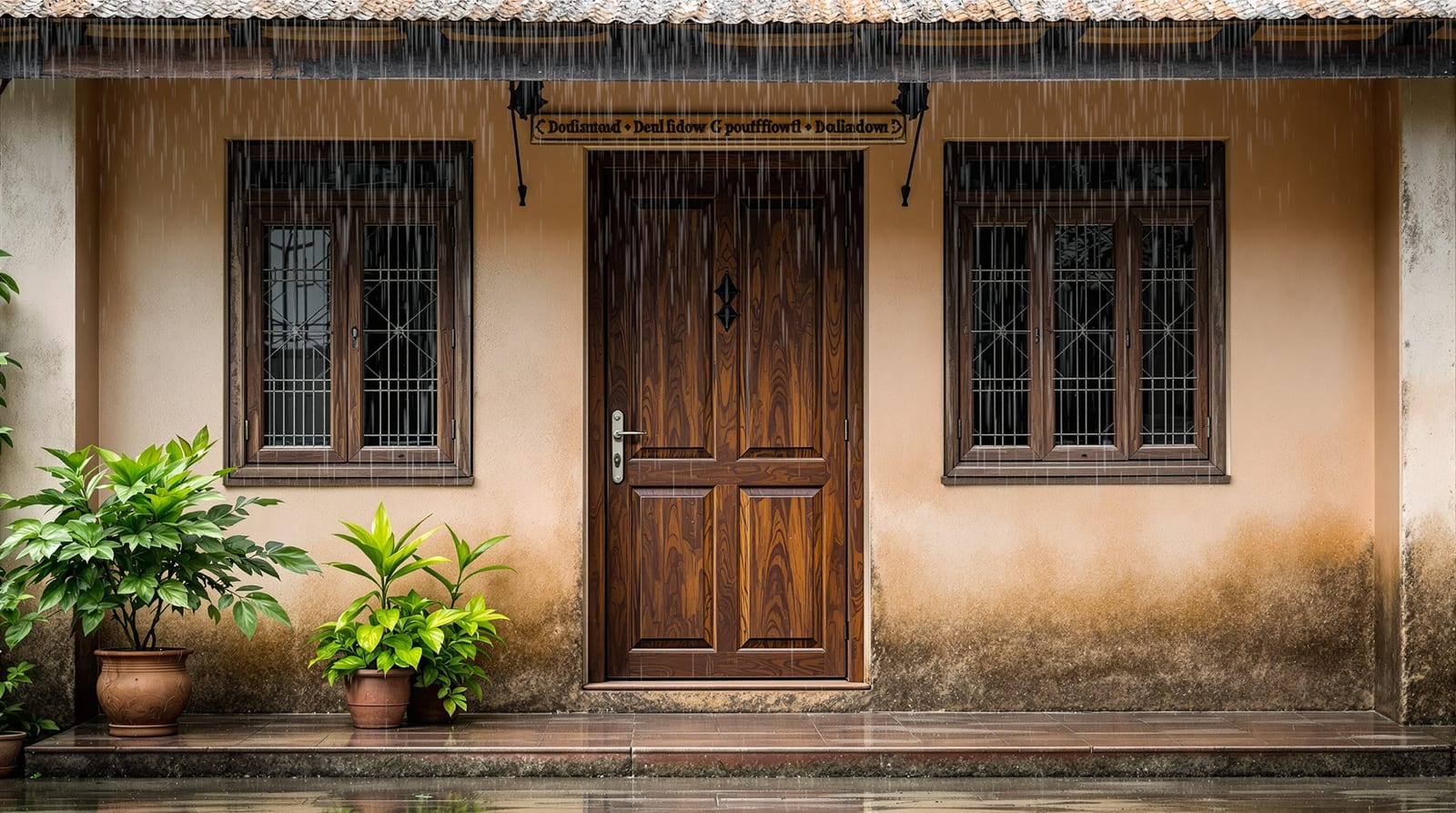
Weather-Resistant Doors: Rain, Sun & Coastal (India 2026)
How to choose external doors that shrug off Indian rain, sun and humidity — the right materials, finishes and weather detailing for every climate zone.
A front door in India faces a brutal year: lashing monsoon rain, a sun that warps and bleaches, and — on the coast — salt-laden air that corrodes metal and rots cheap timber. Weather-resistant doors are external doors engineered to take all of that and still close cleanly, look good and keep the inside dry for decades. The right door is a combination of three things working together: a material that does not rot, swell or corrode; a finish that survives UV and moisture; and the small but decisive detailing — a weather bar, a drip groove, perimeter and threshold seals — that physically steers water and wind away from the gap. This guide walks through how external doors are tested against water, air and wind, which materials genuinely last in each Indian climate zone, and the detailing that separates a door that lasts thirty years from one that bows and stains in three. And remember the quiet truth of sustainable building: a durable door that never needs replacing is itself the greenest choice.
How external doors are tested against the weather
A truly weatherproof door has to pass three separate challenges, and a good specification will quote a rating for each. Treat any door that only addresses one as half-finished.
- Water penetration — can wind-driven rain be pushed past the seals and into the home? This is the headline test for the Indian monsoon, where horizontal rain hits a door at speed.
- Air permeability — how much air leaks through the closed door at a given pressure? Low leakage keeps conditioned air in, dust and humidity out, and is measured in m³/h per metre of joint at a reference pressure (a blower-door style test).
- Wind resistance — can the door and frame take the structural load of a gust without deflecting, leaking or failing? In coastal and cyclone-prone India this is governed by IS 875 (Part 3), which sets design wind loads by region.
Get all three right and the door performs in a storm; ignore any one and the other two are undermined. Water penetration in particular is the quiet villain — a beautifully finished teak door with a 4 mm bottom gap behaves like a much worse door when the rain comes in sideways. Our door water resistance and door wind load performance guides go deeper on the test methods and ratings.
Best materials for Indian weather
Material choice is the single biggest decision for a weather-resistant door, because no amount of detailing rescues a material that swells, rots or corrodes. The table below ranks the realistic options for external use across Indian conditions.
| Material | Rain / humidity | UV / heat | Coastal / salt | Verdict for external use |
|---|---|---|---|---|
| FRP / fibreglass | Excellent (will not rot or swell) | Good with UV-stable gelcoat | Excellent (salt-proof) | Best all-rounder for harsh, wet, coastal sites |
| WPC (wood-plastic composite) | Excellent (waterproof core) | Moderate — needs UV-stable finish | Excellent (no corrosion) | Strong value choice for bathrooms, balconies, coast |
| uPVC | Excellent (impervious) | Good (UV-stabilised grades) | Excellent (no corrosion) | Reliable for monsoon zones; choose lead-free, UV grade |
| Marine-grade aluminium | Excellent | Excellent | Good if anodised / powder-coated | Coastal + cyclone; needs the right finish + thermal break |
| Treated / seasoned teak | Good if sealed + detailed | Good (silvers gracefully) | Moderate | Premium look; demands maintenance + weather detailing |
| Untreated softwood / cheap flush | Poor (swells, delaminates) | Poor | Poor | Not for external use — fails fast |
As a rule of thumb, for an exposed coastal or heavy-monsoon door, lead with FRP, fibreglass or WPC — they simply do not rot, swell or corrode. Marine-grade aluminium (anodised or powder-coated to resist salt pitting) is the choice for large coastal openings and cyclone wind loads, but it needs a thermal break in an AC home. Treated teak remains the premium aesthetic, but it is a maintenance commitment: it must be properly seasoned, sealed on all six faces, and protected by good detailing. Compare the full material picture in door materials comparison and best door material, and read the product specifics in FRP doors, WPC doors and aluminium doors.
The detailing that keeps water and wind out
The right material gets you most of the way; the detailing does the rest. These four features physically steer water and wind away from the door gap, and the diagram shows how they work together on a typical external door section.
Weather bar and drip groove
A weather bar is a raised threshold or rebated bar at the bottom of the opening that the door closes against, forcing wind-driven rain to climb a step before it can reach the inside — see door weather bar. A drip groove is a small channel cut into the underside of a projecting sill or the leaf bottom: water running down the face reaches the groove and drips off cleanly instead of tracking back underneath by surface tension. Both are cheap to specify and decisive in a monsoon.
Perimeter and threshold seals
Compression weatherstrips around the frame and a drop-down or brush seal at the threshold close the gaps that leak both water and conditioned air. They are the same seals that make a door quieter and more energy-efficient — see door seals and weatherstripping. For coastal sites, also detail the frame itself: door frame damp-proofing and a proper waterproofing of the threshold keep the wall-to-frame junction dry.
Finishes that survive Indian sun and rain
The finish is the door's raincoat, and in India's UV it does the hardest job. A failed finish lets water into the substrate, which is where rot and delamination start. The table summarises what holds up.
| Finish | Best on | UV / weather behaviour |
|---|---|---|
| UV-stable gelcoat / factory laminate | FRP, WPC, uPVC | Excellent — colour-fast, low maintenance |
| Powder coating / anodising | Marine-grade aluminium | Excellent for salt; re-coat after years of coastal exposure |
| Exterior PU / spar-grade varnish | Teak, hardwood | Good but needs re-coating every 2 to 3 years outdoors |
| Penetrating timber oil | Teak, hardwood | Lets timber silver gracefully; frequent re-application |
| Ordinary interior paint / melamine | (none) | Fails fast outdoors — peels, chalks, lets water in |
As a rule of thumb, prefer factory-applied, UV-stable finishes (gelcoat, laminate, powder coat, anodising) for low-maintenance weather resistance, and accept that any timber finish is a recurring maintenance task — re-coat before the surface dulls, not after it cracks. Whatever you choose, seal timber on all six faces including the top and bottom edges, which are the unseen water entry points. For colour and application detail see door painting guide and door frame finishing.
Choosing by climate zone and coast
India is not one climate, and the right weather-resistant door depends on your zone. Hot-dry zones (Jaipur, Ahmedabad) punish finishes with UV and heat but see little rain — prioritise UV-stable finishes and a thermal break on metal. Warm-humid coastal zones (Chennai, Kochi, Mumbai coast) are the harshest: combine salt, humidity and driving monsoon rain, so lead with FRP, WPC or anodised marine-grade aluminium and full weather detailing. Composite zones (Delhi, Nagpur) need an all-rounder that handles both a hot summer and a wet monsoon. Cyclone-exposed coasts add structural wind load — design the door and fixings to the IS 875 (Part 3) wind pressure for the region, and check the overall weathering behaviour in door weathering and durability.
Use the door condensation risk checker to test whether your zone and door spec risk surface condensation, and the eco door material selector to match a durable, sustainable material to your exposure. Whichever door you choose, durability is sustainability — a weatherproof door that lasts decades avoids the carbon and rupee cost of replacement, which threads back to sustainable doors and the full picture in the complete door guide. Weather-resistant doors carry a premium over a basic flush door (plus 18% GST), but on an exposed Indian site it pays back many times over in repairs you never have to make.
Frequently asked questions
Which door material is best for the Indian monsoon and coast?
For heavy monsoon and coastal sites, lead with FRP, fibreglass or WPC — they do not rot, swell or corrode, and salt air does not touch them. Marine-grade aluminium (anodised or powder-coated) suits large coastal openings and cyclone wind loads. Treated teak is the premium look but a maintenance commitment, and untreated softwood or cheap flush doors fail fast outdoors.
What is a weather bar and a drip groove, and do I need them?
A weather bar is a raised bar at the threshold that the door closes against, forcing wind-driven rain to climb a step before it can reach inside. A drip groove is a small channel on the underside of a sill or leaf so water drips off cleanly instead of tracking back. Both are cheap and decisive in a monsoon, so yes — specify them on any exposed external door.
Do weatherproof doors really keep wind-driven rain out?
A well-specified door does, but only if material, finish and detailing all work together. Water penetration testing checks exactly this: whether wind-driven rain can be pushed past the seals. Perimeter weatherstrips, a threshold or drop seal, a weather bar and a drip groove together close the paths that horizontal monsoon rain exploits.
How do I weatherproof an existing teak door?
Seal it on all six faces — including the hidden top and bottom edges — with an exterior PU or spar-grade varnish, and re-coat every two to three years before the finish dulls. Add perimeter weatherstripping and a threshold drop seal, fit a weather bar at the sill, and ensure the leaf bottom or sill has a drip groove. Keep the frame-to-wall junction damp-proofed.
Does wind load matter for a door in India?
On coastal and cyclone-prone sites, yes. IS 875 (Part 3) sets design wind loads by region, and a door and its frame and fixings must resist the gust pressure without deflecting, leaking or failing. Large glazed doors and exposed openings need to be specified to that wind pressure, which is why marine-grade aluminium systems are common on cyclone coasts.
Export this guide
Related Guides — Deep-dive reading
Door Weathering and Durability in India 2026: A Guide
How UV, monsoon, humidity and salt break doors down, how external doors are tested, and which materials and finishes survive the Indian climate.
Home Doors & EntrancesCoastal Region Door Buying in India 2026: Salt-Air Guide
Why cheap flush and MDF doors fail near the sea, and which water-resistant materials and corrosion-proof hardware actually last.
Home Doors & EntrancesAluminium Doors in India: Profiles, Glazing, Cost & uPVC vs Steel (2026)
Framed glazed aluminium doors — sliding, openable and French-style — for balconies, utility and modern facades: powder-coat vs anodised vs wood-finish profiles, IS 733/1285 sections, thermal-break options and ₹/sq ft costs.
Home Doors & EntrancesRelated Tools — Try Free
Door Material Comparison Tool
Compare 2–4 door materials on cost, durability, maintenance, security and moisture resistance.
Comparison ToolMaterial Decision Framework (M-Score)
Score 30+ Indian construction materials across cost, durability, climate fit, maintenance, and sustainability.
MaterialsWindow Material Comparison Tool
Compare uPVC, aluminium, wood, steel and composite windows on cost, life, upkeep and insulation.
Compare