
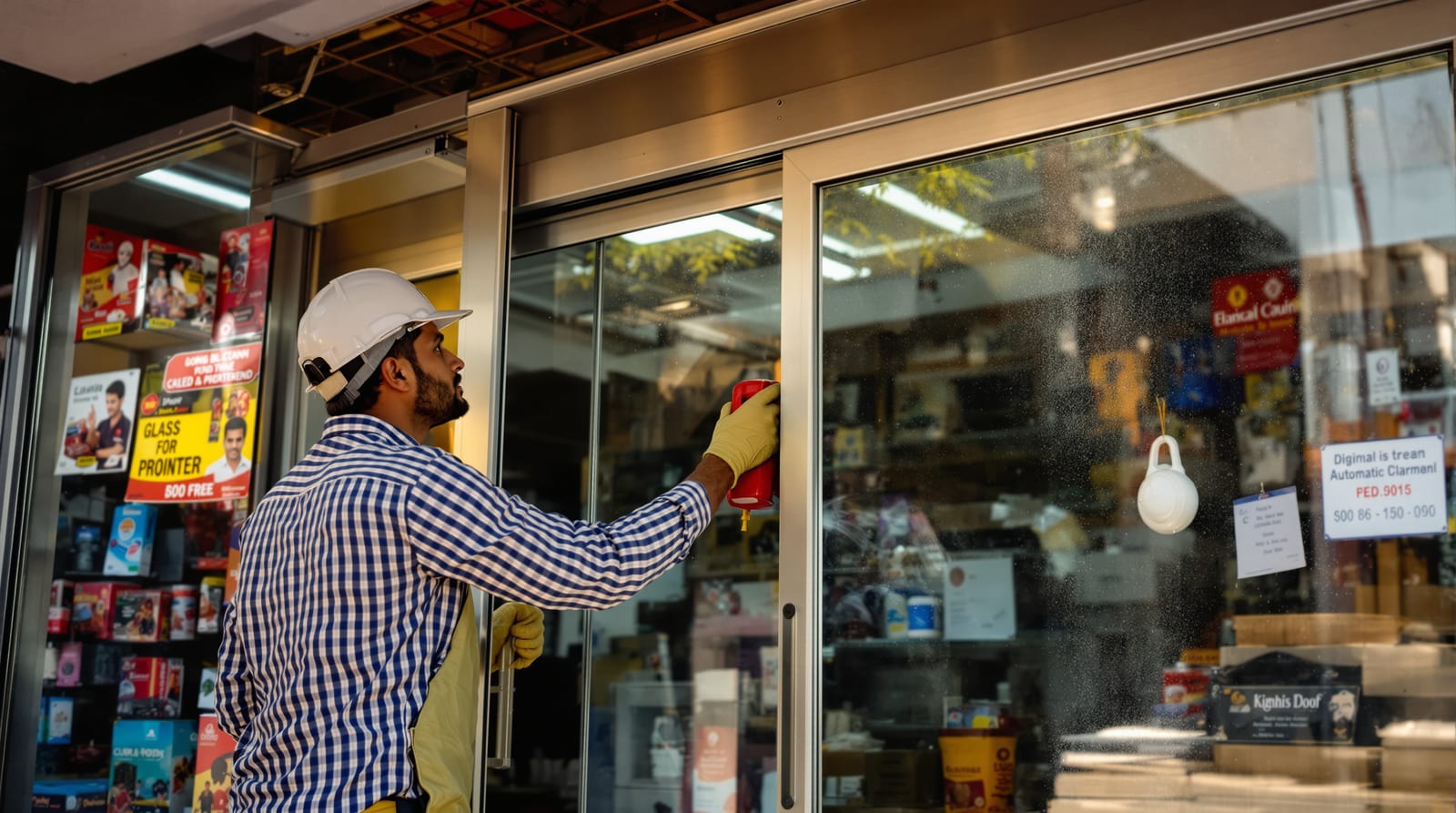
Automatic Door Troubleshooting: Fix Sensor Doors (India 2026)
Why your automatic sliding or sensor door won't open, keeps opening or stops mid-travel — safe homeowner checks and when to call AMC.
Automatic doors feel effortless until the morning they refuse to cooperate — the leaf stays shut as you walk up with both hands full, or it gapes open all day letting the AC leak out. The good news: a lot of automatic door troubleshooting is genuinely homeowner-safe. A wiped sensor lens, a cleared track, the right mode switch position, and a power reset solve the majority of everyday glitches in Indian homes, clinics and shops. The catch: anything past the sensor and switches — the motor, drive belt or controller board — sits behind a live overhead operator, and that is technician territory. This guide draws the line clearly so you fix what is safe and call your AMC for the rest. Difficulty: easy to moderate. Time: 10-40 minutes for the safe checks.
Safety first — isolate the power
An automatic door operator is a mains-powered machine with a motor that can move a heavy glass or metal leaf with force. Before you touch anything inside the top cover, near the belt, or behind the leaf:
- Switch the door to OFF or LOCK on its mode key/switch.
- Trip the dedicated MCB for the door at your DB (distribution board), or unplug it if it runs off a socket.
- Wait a few seconds for the controller to power down fully.
- For toughened/laminated glass leaves, never lever, hammer or force a stuck panel — toughened glass shatters into thousands of pieces. Call a pro for any glass fault.
The only tasks you should do with power ON are reading the mode switch, watching the sensor LED, and testing whether the door responds to your hand wave. Everything physical happens with power isolated.
Step-by-step: the safe homeowner checks
Work through these in order — stop the moment the door behaves normally.
1. Read the symptom honestly. Won't open at all? Stays open? Opens slowly or stutters? Stops mid-travel and reverses? Each points somewhere different (see the table below).
2. Check the mode switch. Most operators have a key switch or program selector: AUTO, OPEN (hold-open), EXIT-ONLY, LOCK/OFF, and sometimes PARTIAL/winter. A door "stuck open" is very often just left in OPEN/hold mode; a door that "won't open" may be in LOCK or EXIT-ONLY. Set it to AUTO and retest.
3. Clean the sensor. Wipe the overhead motion sensor and any side safety sensors with a dry microfibre cloth. Dust, cobwebs, monsoon grime, an insect, or a stuck festival sticker can blind it. Watch the sensor LED as you wave your hand — it should change colour/blink on detection.
4. Clear the track and threshold. Sweep grit, gravel, a pebble, a coir-mat fibre, or a dropped coin out of the floor track. A single obstruction makes the door stall, reverse or beep. On sliding doors, run a finger along the bottom guide.
5. Check for obstructions in the safety beam. A potted plant, signage stand, parked trolley or hanging curtain in the doorway can hold the door open or trigger it endlessly. Move objects out of the detection zone.
6. Power/MCB reset. Isolate power at the MCB, wait 30-60 seconds, switch back on. Many controller glitches (after a voltage spike or power cut — very common in India) clear with a clean reboot. Listen for the door's self-test cycle (a slow open-close on startup).
7. Look at the rollers/track for grime, not repair. If the door drags or grinds, dirty or hard-water-crusted rollers and tracks may be the cause. Cleaning the visible track is fine; do not dismantle the roller carriage — note it for the technician.
8. Retest and decide. Door normal? Done. Still faulty after these checks? It is a motor, belt, controller or sensor-hardware issue — call your AMC.
Symptom → likely cause → who fixes it
| Symptom | Likely cause | Homeowner check | Needs technician |
|---|---|---|---|
| Won't open at all | Power off / MCB tripped / mode = LOCK | Reset MCB, set AUTO | Blown controller, dead motor |
| Keeps opening (won't close) | Object in detection zone, sensor set to hold | Clear zone, check mode | Faulty/misaligned sensor, controller |
| Opens slowly / sluggish | Voltage dip, dirty track, worn belt | Clean track, reset | Loose/worn drive belt, motor wear |
| Stops mid-travel / reverses | Obstruction in track, safety beam triggered | Clear track & beam | Encoder/sensor fault, controller |
| Sensor not detecting | Dirty or blocked sensor lens | Clean lens, watch LED | Failed sensor, wiring fault |
| Beeps / fault LED on | Self-protect lockout after error | Power reset | Logged controller error code |
| Slams or closes hard | Speed/force setting drifted | Nothing safe to adjust | Recalibrate operator settings |
| Grinding / scraping noise | Grit on track, dry rollers | Clean visible track | Worn rollers, bearing failure |
Tools & materials you'll need
For the safe checks only — you should not need to open the operator housing.
| Item | Use | Indicative ₹ |
|---|---|---|
| Dry microfibre cloth | Clean sensor & lens | ₹50-150 |
| Soft brush / small broom | Clear floor track | ₹100-250 |
| Torch | Inspect track & rollers | ₹150-500 |
| Door mode key | Switch AUTO/LOCK | usually supplied |
| Mild silicone spray (track) | Non-greasy track lube | ₹150-350 |
Avoid oil-based lubricants on tracks — they attract dust and turn to grime, especially in dusty, humid Indian conditions. A light silicone spray is safer.
What needs a technician — and your AMC
Stop and call your annual maintenance contract (AMC) provider or the door brand's service line if, after the safe checks, you see any of these:
- Motor or drive belt: humming with no movement, a loose/slipping belt, or the leaf moving by hand only — these live behind the live operator cover.
- Controller board: persistent fault LED or beep that survives a power reset; erratic behaviour; a logged error code.
- Sensor hardware: a clean sensor that still doesn't detect, or one that triggers randomly — likely a failed unit or wiring fault.
- Glass leaf damage: any chip, crack or off-track toughened-glass panel — never DIY toughened glass.
- Calibration: door slamming, closing too hard, or speed drifted — operators need their force/speed re-set with the programming tool, not by hand.
A typical AMC for a single automatic door in India runs roughly ₹4,000-12,000 a year depending on city, door type and visit frequency, usually covering periodic service plus priority callouts. Out-of-warranty part replacements (sensor, belt, controller board, motor) are extra and can range from a few hundred rupees for a sensor to ₹8,000-30,000+ for a motor or controller, plus 18% GST on goods. For shops and clinics where the door runs all day, an AMC almost always pays for itself versus emergency callouts.
Why automatic doors fail more in India
- Voltage swings and power cuts stress the controller — fit a stabiliser if your supply is dirty.
- Dust and monsoon grime blind sensors and clog tracks faster than in temperate climates.
- Hard water on glass and tracks leaves mineral crust that increases drag.
- High footfall in shops/clinics wears belts and rollers; schedule service before peak seasons.
How an automatic sliding door works
The overhead housing is the part you never open: the motor drives a belt that pulls the leaf along the track, while the controller reads the sensor and decides when to open. Your safe zone is the sensor lens, the mode switch, the floor track and the power supply — everything else belongs to a trained technician.
When it's simply the wrong fix
Automatic doors are not like a sticking wooden door you can plane down. There is nothing to sand, fill or screw tighter on the powered side. If the safe checks don't restore normal operation, resist the urge to open the housing — a mis-set force value can make the door dangerous, and tinkering can void your warranty or AMC. For mechanical, non-powered door problems, our door troubleshooting hub and the door repair guide cover hinges, locks and frames you can DIY. To understand the technology before buying or upgrading, see touchless sensor doors. Keeping tracks and seals clean year-round is covered in our door maintenance guide and, for glass leaves specifically, glass doors. For the bigger picture of every door type in your home, start with the complete door guide.
Not sure whether your fault is DIY or AMC? Run it through our door problem diagnoser, and if a part replacement looms, sanity-check the bill with the door repair cost estimator.
Frequently asked questions
Why does my automatic door keep opening on its own?
Usually something is sitting in its detection zone — a plant, a trolley, a hanging banner or a person lingering nearby — or the mode switch is set to OPEN/hold. Clear the doorway and set the switch to AUTO. If it still won't stay shut, the sensor may be misaligned or faulty, which is an AMC job.
Is it safe to reset an automatic door myself?
Yes — a power reset is one of the safest fixes. Switch off the mode key, trip the door's MCB (or unplug it), wait 30-60 seconds, then power back on and let it run its self-test. Do not open the overhead housing; that needs power isolated and a technician.
My sensor door doesn't detect me anymore — what's wrong?
First clean the sensor lens with a dry microfibre cloth — dust, cobwebs or a stuck sticker often blind it. Watch the sensor LED as you wave your hand; if it doesn't react after cleaning, the sensor unit or its wiring has likely failed and a technician should replace it.
How much does an automatic door AMC cost in India?
Roughly ₹4,000-12,000 a year for a single residential or small-shop door, depending on city, door type and number of visits. Part replacements (sensor, belt, controller, motor) are billed separately and add 18% GST. For high-traffic clinics and shops, an AMC usually costs less than repeated emergency callouts.
The door opens very slowly or stutters — can I fix it?
Clean the floor track of grit and do a power reset first, in case a voltage dip confused the controller. If it stays sluggish, the drive belt may be worn or loose, or the motor is tiring — both are inside the live operator and need a technician, not a homeowner.
Can I lubricate the motor or belt myself?
No. The motor and belt sit inside the powered housing and need the right specification and tension set with tools. You can safely clean the visible floor track and apply a light silicone spray there, but leave anything inside the overhead unit to your AMC technician.
Export this guide
Related Guides — Deep-dive reading
Lift Door Problems Explained (India): Why Doors Cause Most Faults
Doors cause over 70 percent of home-lift stoppages. Read the symptom, find the cause, and know which fixes are owner-safe and which belong to a licensed technician.
Home Lifts & AccessibilityGate Automation Maintenance in India (2026): Keep a Sliding or Swing Gate Working and Safe
A homeowner's upkeep guide for an automatic sliding or swing gate — clearing the track, lubricating rollers and hinges, testing the safety photocells and manual release, caring for the controller and its backup battery, and knowing exactly where the DIY line stops and a qualified technician begins.
SecuritySliding Door Track Cleaning: Easy DIY Fix (India 2026)
Why Indian sliding doors get stiff — dust, grime and hard-water scale in the track — and the step-by-step clean-dry-lubricate routine that fixes it.
Home Doors & EntrancesRelated Tools — Try Free
Door Problem Diagnoser
Tell us the symptom and get the likely cause, the fix, DIY difficulty and indicative cost for any door fault.
Diagnostic ToolMonsoon-Readiness Checklist
Pre-rain home audit across 9 categories — terrace, drains, waterproofing, electrical, HVAC, pest, vehicles, documents.
Seasonal AuditWindow Cleaning Cost Calculator
Estimate professional window cleaning cost per visit and per year by access and frequency.
Window Calculator