
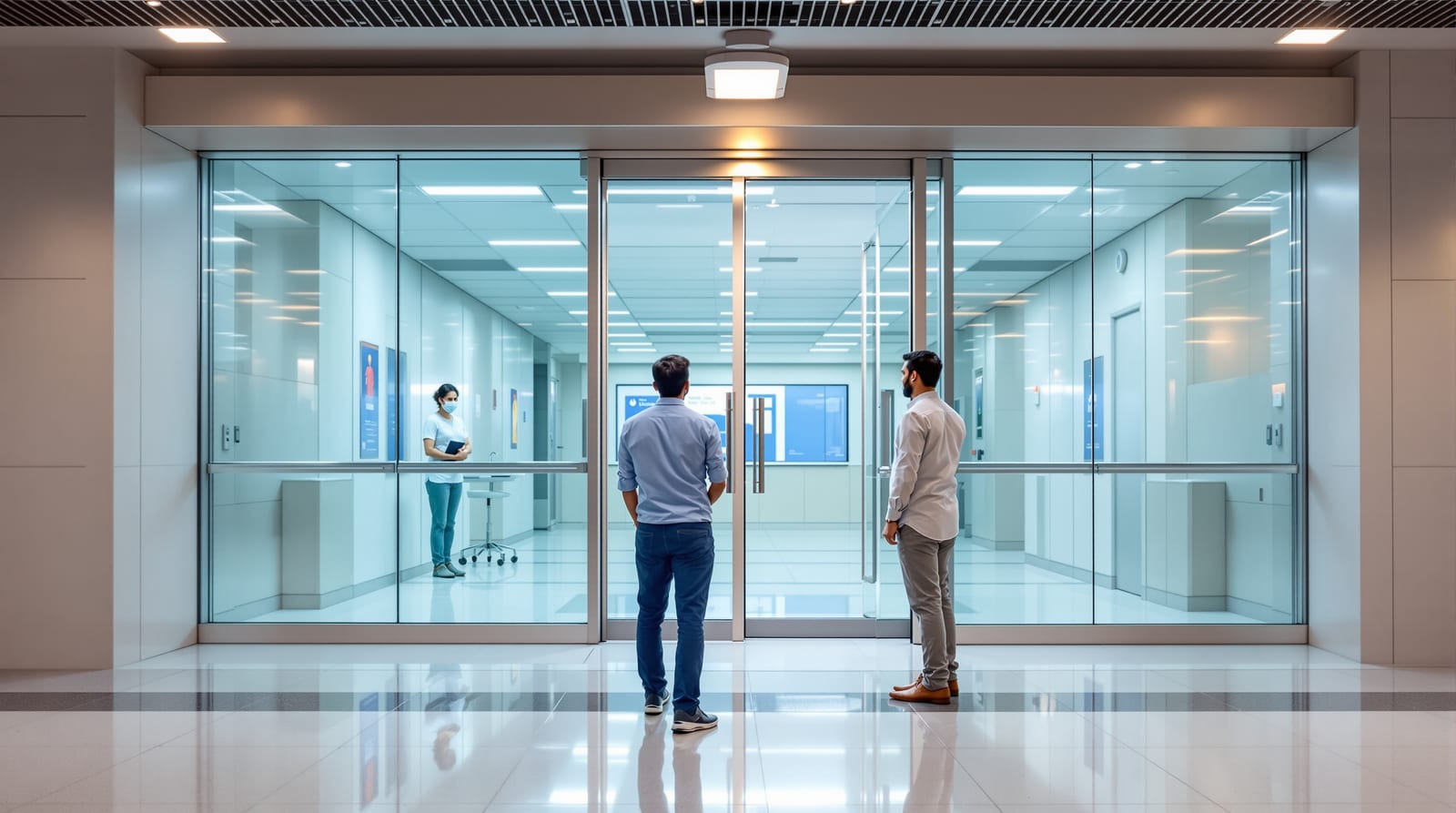
Touchless Sensor Doors: Wave-to-Open Hygiene India 2026
How microwave-and-infrared sensor-activated doors work, get tuned and stay safe across hospitals, labs, food plants and offices in India.
Touchless sensor doors are not a special door leaf at all — they are ordinary automatic operators paired with activation sensors that open without anyone touching a handle, push-plate or switch. That distinction matters when you specify: you are buying a door product (sliding, swing or telescopic leaf with a glazed or solid face) plus a sensing-and-control layer on top. Confuse the two and you over-pay for the leaf while under-specifying the sensors that actually deliver the hygiene and throughput benefits. After COVID-19, demand surged in Indian hospitals, diagnostic labs, food and pharma plants, and grade-A offices precisely for that sensing layer: hands never meet a contaminated surface, traffic flows, and the door product stays generic.
This guide explains how the sensors work, how a competent installer tunes them, how presence safety keeps the door from striking people, what battery backup buys you, and how to retrofit touchless activation onto doors you already own. Automatic-door operators in India should be commissioned against the safety intent of IS/EN 16005 (the de-facto reference Indian installers cite for power-operated pedestrian doors) and tested as a complete assembly.
What touchless sensor doors actually are
Touchless activation removes the human-to-surface contact at the trigger. There are two broad families, often combined:
- Automatic (self-opening): a header-mounted motion sensor detects an approaching person and opens the door before they reach it. No deliberate action is needed. Standard for high-traffic entrances, OT corridors and clean-room airlocks.
- Touchless on-demand: the door is normally shut for access control, draught or hygiene compartmentalisation. The user waves a hand at a no-touch switch, or uses a foot/elbow activator, to release it. Common on single offices, ICUs, isolation lobbies and toilets.
Both ride on the same operator. The choice is about intent — do you want the door open to anyone who approaches, or open only on a deliberate but contact-free gesture?
How the sensors work
Two sensing principles dominate, and good installs use them together for different jobs.
Microwave motion (Doppler) sensors
A microwave sensor emits a low-power radio field and reads the Doppler shift from anything moving toward or away from it. It is excellent at detecting approach from a distance, works through dust, and ignores stationary objects. Its weakness is the flip side: a person who stops moving (waiting at the threshold) becomes invisible to it, so it should never be used alone to hold a door open over a moving leaf.
Infrared (PIR / active IR) presence sensors
Passive infrared (PIR) reads body heat; active infrared (AIR) bounces a beam off the floor and detects when a body interrupts or reflects it. AIR is the standard presence/safety sensor: mounted in the header looking down at the threshold and the leaf's swing/slide path, it sees a stationary person and keeps the door from closing on them. Most quality combined sensors marry microwave (for activation at a distance) with active-IR curtains (for presence safety at the threshold) in one housing.
Wave-to-open and foot/elbow switches
A wave (no-touch) switch is a short-range IR or capacitive sensor — typically 1-15 cm sensing distance — that triggers when a hand passes in front of it. Foot switches and elbow push-plates are simple electromechanical or capacitive activators for hands-full or strict-hygiene zones (food, labs, OT scrub areas). They are cheap, robust and unambiguous, which is why infection-control teams often prefer them over motion sensing inside a clean suite.
| Sensor type | Senses | Best for | Limitation |
|---|---|---|---|
| Microwave (Doppler) | Movement | Distance activation, dusty sites | Blind to a still person |
| Active infrared (AIR) | Presence at floor | Threshold safety / presence hold | Affected by sun glare, reflective floors |
| Passive infrared (PIR) | Body heat | On-demand activation indoors | Slower, range varies with temperature |
| Wave (no-touch) switch | Hand at short range | Hygiene on-demand opening | Must be reached; needs signage |
| Foot / elbow switch | Physical/near touch | Hands-full, strict clean zones | Not fully contactless (elbow) |
Tuning: the part installers earn their fee on
Out-of-the-box sensors are rarely right. Commissioning is where a door behaves well or becomes a nuisance. A competent technician adjusts:
- Detection field size and angle — narrow it so the door does not fire for passers-by walking parallel, or for traffic in a cross-corridor.
- Sensitivity — high enough to catch a slow-moving wheelchair user, low enough to ignore a curtain flapping in the air-conditioning.
- Hold-open time — long for a maternity or trolley route, short for an energy-sensitive freezer anteroom.
- Immunity masking — block the sensor from seeing rain, snow-equivalent monsoon spray, swaying foliage, or a glossy granite floor reflecting the IR beam (a classic India site problem).
- Opening/closing speed and cushioning — slower near the end of travel so the leaf does not slam.
Always have the installer demonstrate the door with a slow walker and a stationary person standing in the path before sign-off. For airlock pairs (clean-room/OT), confirm the interlock so both leaves are never open together. See our pharma cleanroom doors and hermetic doors guides for the interlock and pressure-cascade detail.
Safety: presence detection is mandatory, not optional
A power-operated door is a moving machine near people, and the single most important specification is presence safety. The activation sensor tells the door to open; a separate presence/safety sensor (active-IR curtain, or for swing doors a guard rail and slow soft-stop) must prevent the leaf striking or trapping anyone. Per the safety intent of IS/EN 16005 an installer should:
- fit presence sensing covering the full swing or slide path, including the secondary closing edge;
- ensure the door reverses or holds on detecting an obstruction;
- protect finger-trap zones on sliding doors;
- mark glazed leaves with manifestation (a visibility band) so people do not walk into a held-open glass leaf.
For high-traffic public entrances also weigh revolving doors and balanced doors, which solve different draught and wind problems.
The hygiene case
The driver behind most touchless retrofits is infection control. A door handle is a high-touch fomite; removing the touch removes a transmission point. That logic is strongest in:
- Hospitals & OTs — hands-free entry keeps scrubbed staff sterile; pair with operation theatre doors and hospital doors, and use foot/elbow switches inside the sterile core.
- Diagnostic labs & pharma — touchless airlocks support GMP and reduce cross-contamination; align with pharma cleanroom doors.
- Food processing (FSSAI) — washdown-rated touchless activation in handling zones; see food-grade doors.
- Offices & malls — contactless entrances as an amenity and an energy measure.
Be honest with clients: touchless activation reduces handle contact but is not infection control on its own — air management, the door's own surface finish and cleaning regime matter as much.
Battery backup and fail-safe behaviour
An automatic door is on the life-safety path. Specify what it does when mains fails. Two intents:
- Fail-safe (fail-open): the door opens or can be pushed open by hand for egress — the default for escape routes.
- Fail-secure (fail-closed): stays locked on power loss — only where access control overrides egress, and never on a designated fire-exit leaf.
A battery/UPS backup module keeps the operator working through short outages — essential in Indian sites with frequent supply dips. It typically runs the door for a set number of cycles or drives one final safe open-and-hold so the path stays clear. Confirm that on fire alarm the door defaults to the building's fire strategy. For escape-route interaction, read fire exit doors.
Retrofitting touchless activation
You rarely need a new door. Retrofit kits add touchlessness to existing leaves:
1. Wave-switch swap on an existing automatic door — replace the push-plate with a no-touch wave sensor. Hours of work, lowest cost.
2. Operator add-on to a manual swing door — bolt-on swing operator + activation and presence sensors converts a hinged door to automatic. Needs a sound frame and clear swing path.
3. Foot-switch addition — wire a floor switch in parallel for hands-full clean zones.
Always verify the existing leaf weight and frame suit a powered operator, and re-commission presence safety after any retrofit.
Cost bands (India 2026)
All figures are indicative; GST is 18% and specialty/auto-door work is project-engineered — get a vendor spec against your site and the safety norm. As a rule of thumb, price the operator and sensing separately from the leaf.
| Item | Indicative band (₹) | Note |
|---|---|---|
| No-touch wave switch (retrofit) | 2,500 - 12,000 | Supply-only; add wiring |
| Foot / elbow switch | 1,500 - 8,000 | Robust clean-zone option |
| Combined microwave + AIR header sensor | 8,000 - 30,000 | The activation + safety brain |
| Swing-door auto operator (retrofit) | 35,000 - 90,000 | Installed, single leaf |
| Automatic sliding door, sensor + operator + glazed leaves | 1,10,000 - 3,50,000+ | Installed; width/finish drive cost |
| Battery/UPS backup module | 12,000 - 45,000 | Per operator |
For whole-project budgeting see specialty door cost and door cost India 2026, and model options with the specialty door selector and specialty door cost estimator. For the full picture across every door type, start at the complete door guide and the specialty doors pillar; for plain auto entrances, automatic sliding doors.
Frequently asked questions
Is a touchless door a different kind of door?
No. It is a standard sliding, swing or telescopic door fitted with an automatic operator and contact-free activation sensors. You specify the leaf (material, glazing, fire/hygiene rating) and the sensing layer separately — they are two purchases on one assembly.
Microwave or infrared — which sensor do I need?
Usually both. Microwave (Doppler) detects approaching movement from a distance to open the door; active infrared watches the threshold to detect a stationary person and keep the leaf from closing on them. Quality header units combine the two. Wave switches and foot switches are for deliberate hands-free on-demand opening.
Are touchless doors safe with children and wheelchair users?
Only if presence safety is correctly commissioned to the intent of IS/EN 16005. Insist on a demonstration with a slow walker and someone standing still in the path before you sign off, and check the door reverses on obstruction.
What happens during a power cut?
It depends on how it is set. Escape-route doors should be fail-safe (openable by hand) and ideally carry a battery/UPS backup that keeps the door cycling or holds it open. Access-controlled doors may be fail-secure, but never on a fire-exit leaf — follow the building's fire strategy.
Can I retrofit touchless opening to my existing door?
Yes. Options range from swapping a push-plate for a wave switch on an existing automatic door, to bolting an operator and sensors onto a manual swing door. Confirm the leaf weight and frame suit a powered operator, then re-commission presence safety.
Do touchless doors prevent infection?
They remove a high-touch handle as a contamination point, which helps — but they are one layer, not a complete control. Combine them with the right door surface finish, airlocks where needed, air management and a cleaning regime. In strict clean zones, foot or elbow switches are often preferred over motion sensing.
Export this guide
Related Guides — Deep-dive reading
Fail-Safe vs Fail-Secure Locks: The Guide (India 2026)
Why fail-safe vs fail-secure is the single most important access-control decision, and how to get it right for every door.
Home Doors & EntrancesAutomatic Swing Door Operators: Retrofit Guide India 2026
How to retrofit a normal hinged door to open by itself — full-energy vs low-energy operators, activation, safety and cost for Indian buildings.
Home Doors & EntrancesSecurity for People Living Alone in India (2026): Calm, Practical Habits When There Is No Second Person to Notice
Living alone is an ordinary and growing part of Indian life - the student in a new city, the working single, the elder whose children are abroad, the person after a separation. It does not call for fear. It calls for a few deliberate habits, because there is no second person in the home to notice trouble, raise the alarm, or catch an accident. This is calm self-reliance, layer by layer.
SecurityRelated Tools — Try Free
Access-Control Battery-Backup Calculator
Size the standby battery so an access system keeps running through a power cut, with an egress life-safety note.
Battery BackupAcoustic Privacy (STC) Visualizer
Indian healthcare acoustic visualizer — compare wall assemblies and noise sources, see received SPL after STC attenuation, and check FGI 2018 / IS 1950 / NABH speech-privacy compliance with live dual-canvas waveform.
Acoustic ToolDoor Cost Calculator
Estimate the all-in cost of a door — leaf, frame, hardware, fitting and GST — by type, material and size.
Door Calculator