
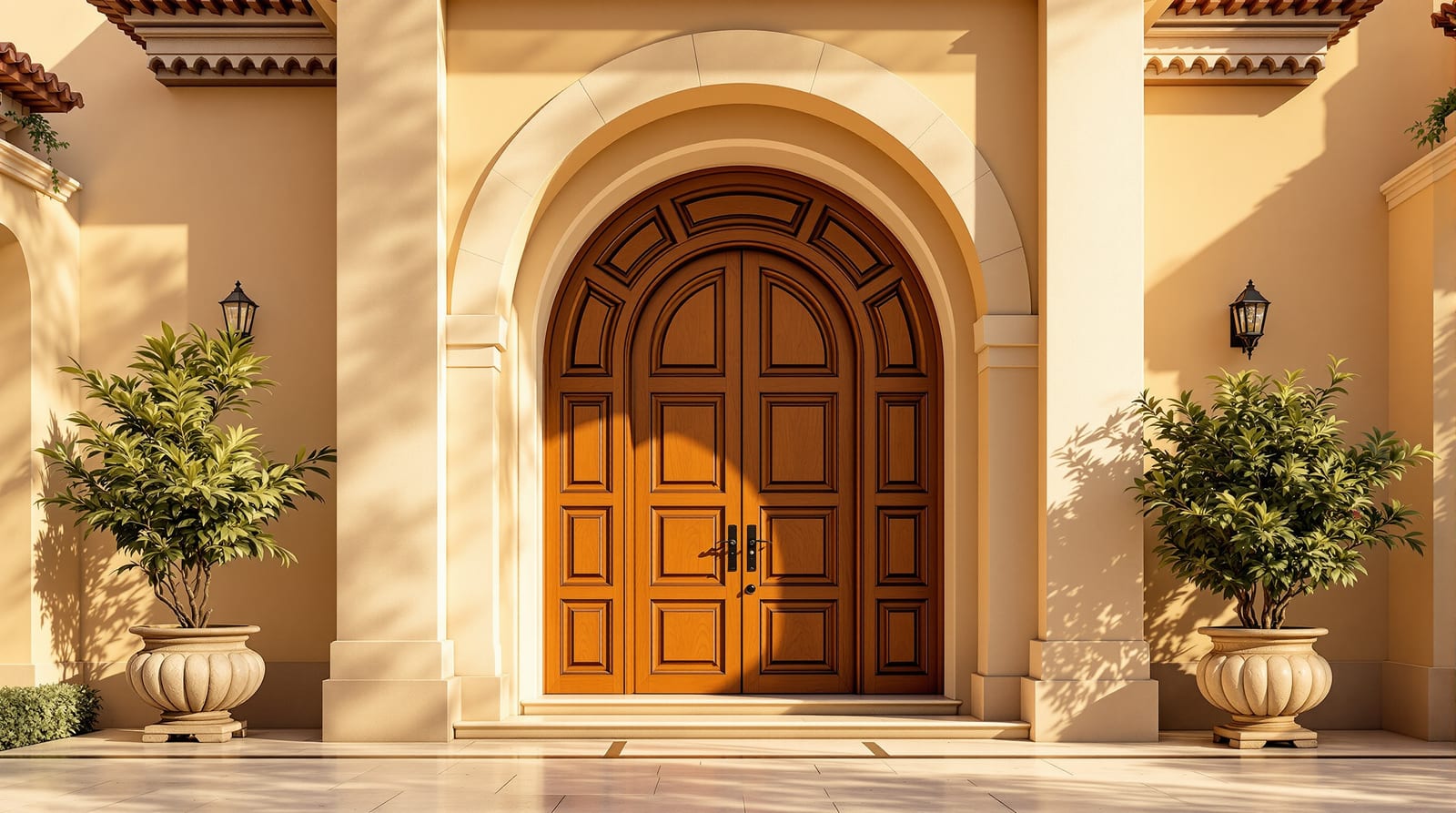
Arched Doors for Indian Homes: Styles, Cost & Construction Reality (2026)
Full-arch, segmental, Mughal and arch-top fanlight doors — what suits Indian villas and entrances, and the cheaper way to fake the curve.
A curved-top door does something a rectangle never can: it draws the eye upward and signals "this is a special threshold." That is why arches show up on heritage havelis, Mughal gateways, colonial bungalows and, today, on Mediterranean-styled farmhouse villas across Goa, Pune and the Bengaluru outskirts. But an arched door is also where romance collides with construction reality — a true masonry arch with a curved frame is one of the most skilled, costly things a carpenter and mason will build for your house, and most "arched doors" you admire are quietly faking the curve. This guide walks you through the styles, where they actually suit, the honest construction trade-offs, and what the curve adds to your bill.
If you are still choosing your front-door look, read the main door design guide and the traditional Indian doors guide alongside this — arches sit firmly in the design-feature category, not a separate material.
What counts as an "arched door"
The term covers a spread of geometries, and they are not interchangeable in cost or feel. There are two fundamentally different ways to get a curve:
1. A true arched leaf — the door shutter itself is curved at the top, swinging inside a curved frame and a curved (arched) masonry opening. This is the real, expensive thing.
2. An arched-top illusion — a normal rectangular door leaf, with a fixed arched fanlight (transom) glazed or jali-filled above it. The opening is arched; the moving door is rectangular. This is far cheaper and far more common in Indian homes.
Most buyers want the look of an arch and are happy with option 2 once they understand the maths. Keep that distinction in mind through the whole guide.
The arch styles, and where each suits
| Arch type | Look & origin | Best placement | Build complexity | Relative cost |
|---|---|---|---|---|
| Full semicircular (Roman) arch | Perfect half-circle springing from the door width; classic, formal, Mediterranean/colonial | Villa main entrance, courtyard, double-height foyer | High (needs tall opening; rise = half the width) | ₹₹₹₹ |
| Segmental / shallow arch | A flat, gentle curve — only a slice of a circle; subtle and modern | Standard-height main door, internal feature door | Medium (curve is gentle, fits 7 ft openings) | ₹₹₹ |
| Gothic / pointed arch | Two curves meeting in a point; church/cathedral, dramatic vertical pull | Tall entry, chapel-style or rustic stone villas | High (precise geometry, taller opening) | ₹₹₹₹ |
| Keyhole / Mughal (multifoil/ogee) arch | The scalloped or onion-shaped Indo-Islamic profile; haveli, palace | Heritage-style main door, pooja room, courtyard arch | Very high (carved, multifoil, skilled labour) | ₹₹₹₹₹ |
| Arch-top leaf with curved frame | Rectangular-feeling door whose top corners curve up to a low arch | Bedroom feature door, study, boutique interiors | Medium-high | ₹₹₹ |
| Rectangular leaf + arched fanlight above | Square door, separate fixed arched transom (glass/jali) over it | Almost any opening — the budget arch | Low-medium | ₹₹ |
The segmental arch is the sweet spot for most Indian homes. A full semicircle needs the rise (the height of the curve) to equal half the door's width, so a 4 ft wide door demands an extra ~2 ft of opening height above the normal 7 ft lintel — pushing you past 9 ft. Many homes simply do not have that wall height above a ground-floor door, which is exactly why the arched fanlight approach wins: you keep a normal 7 ft door and add the arch in a fixed panel above.
Where arched doors genuinely belong
Arches read as "considered" only in the right setting. They suit:
- Villas and farmhouses in Mediterranean, Tuscan, Spanish-colonial or Portuguese (Goan) idioms, where stucco walls and terracotta want a curved opening.
- Traditional and heritage homes — havelis, courtyard (chowk) houses, and restorations where a Mughal or scalloped arch is part of the vocabulary. See the traditional Indian doors guide for the carving language that pairs with these.
- The main entrance, where you want a single dramatic gesture. An arched wooden door with a stone or lime-plaster surround is a strong, photogenic threshold.
- The pooja room, where a small scalloped or temple-style arch (gopuram-influenced) frames the deity. Keep it modest in scale; the pooja room door guide covers the spiritual and Vastu framing.
- Courtyards, verandahs and arcades, where a row of segmental arches creates rhythm.
Arches usually look out of place on a flat, contemporary, glass-and-steel facade — there a minimalist rectangular door reads more honestly. Forcing a heavy carved Mughal arch onto a 2BHK flat door also tends to look applied rather than integral.
The construction reality (read this before you commit)
This is where most arched-door dreams meet the site. A genuine arched door demands four curved things working together — and curves cost.
The masonry opening
A true arch needs an arched opening in the wall. That means either a built masonry arch (brick voussoirs over a timber centring formwork, struck after the mortar cures) or a pre-cast/poured RCC arched lintel. Both are skilled, slower work than dropping a straight RCC lintel. A botched arch sags or cracks; you want a mason who has done them before. This is why builders quietly prefer the fanlight route — the structural lintel stays straight and the "arch" above it is non-structural infill.
The curved frame (chowkat)
A normal door frame is four straight timber lengths. A true arched frame needs the top member(s) cut, steamed or laminated to the curve — far more wastage and labour. For a Mughal multifoil profile, the head is effectively carved. Expect frame cost well above the ₹350-900/ft-run benchmark for straight sal/teak frames.
The curved leaf
A rectangular shutter is straightforward joinery. A curved-top shutter needs the top rail shaped to the arc, the panels and any glazing cut to curve, and the whole thing to still swing true without binding on the curved frame. Tolerances are tight; this is master-carpenter work.
Why wood wins for true arches
Solid timber (and good engineered wood) can be shaped, steam-bent or laminated to a curve, takes carving for Mughal profiles, and ages well — which is why wood is the default for any true arched leaf. uPVC, aluminium and steel doors come from straight extruded or pressed sections; getting a genuine curved leaf in them is a costly custom job, so in those materials you almost always see the arch only as a fixed fanlight above a rectangular door. If you want the curve in the moving shutter, budget for wood. The wooden door designs guide covers species and finishes; designer door pricing explains where bespoke labour pushes the bill.
Cost premium and complexity
There is no fixed "arched door rate" — the curve is a labour-and-wastage premium stacked on top of a normal door. As rough 2026 indicators (material plus make; frame, hardware and fitting extra; +18% GST typical; varies by city and vendor):
- Arched fanlight above a normal door (the budget arch): add roughly ₹3,000-12,000 over a plain door for the fixed arched transom (curved frame section + glazing or jali). A standard quality wooden door plus a glazed arched fanlight might land around ₹18,000-40,000 fitted.
- Segmental arched leaf in solid wood: expect a 20-40% premium over an equivalent rectangular solid-wood door of the same size — so a ₹15,000-25,000 rectangular door becomes roughly ₹20,000-35,000+.
- Full semicircular or Gothic arched main door in good timber, with the matching curved masonry/RCC opening: commonly ₹40,000-1,00,000+ for the door, frame and curved opening together, before hardware.
- Carved Mughal/multifoil arched main door (haveli-style): genuinely bespoke — ₹1,00,000 to several lakh, depending on carving density and timber (Burma/CP teak at ₹800-1,500+/sq ft).
Add the masonry/RCC cost of forming a curved opening (centring formwork, slower work) which a regular straight lintel does not carry. For a like-for-like comparison against rectangular options use the door cost benchmark and run numbers in the door cost calculator. The cheap takeaway stands: the arched fanlight gives 80% of the drama for a fraction of the cost.
The budget arch: the moving leaf stays rectangular below a straight structural lintel, and the curve lives entirely in a fixed, non-load-bearing fanlight above. This avoids a curved frame and a curved masonry opening.
Maintenance and practical notes
- Monsoon swelling: a curved-top solid-wood leaf swells and shrinks like any timber. Because the arc is precision-fitted, swelling can make it bind at the curve more visibly than a rectangular door. Seal all edges (including the curved top), keep a uniform finish, and budget for one re-fit after the first monsoon. The best door material guide covers coastal and humid-climate timber choices.
- Glazing in fanlights: arched glass is custom-cut and costlier to replace than a flat rectangular pane — keep a drawing/template on file. Toughened glass should meet IS 2553; glazing workmanship to IS 3548.
- Termite and finish: same discipline as any solid-wood door — pressure-treated or naturally durable timber (teak, sal), and a maintained finish. A carved Mughal arch has more crevices that collect dust and need careful cleaning.
- Hardware: hinges sit on the straight sides, so standard butt hinges work; just ensure the leaf clears the curved frame head through its full swing. Use the door swing planner to check clearance, and the door hardware guide for fittings.
- Future replacement: a rectangular door is a commodity you can re-order; a curved bespoke leaf is not. Keep the carpenter's template and timber details so a future replacement matches.
Vastu and the threshold
In Vastu, the main entrance carries weight regardless of its shape — best oriented N, E or NE, the largest door in the house, opening inward and clockwise, with a raised threshold (dehleez) and ideally an even number of panels. An arch does not change these principles; it is a stylistic layer over them. The scalloped Mughal arch and temple-gopuram arch carry auspicious associations in traditional practice, which is part of their appeal on pooja-room and main doors. Treat this as tradition and design intent rather than a rule — and for the orientation and threshold detail, follow the dedicated Vastu main door guide.
Frequently asked questions
Is a true arched door much more expensive than a rectangular one?
Yes. The curve adds a 20-40% premium even on a simple segmental leaf, and a full semicircular or carved Mughal main door with its curved frame and masonry opening can run from ₹40,000 to several lakh. The cheap alternative — a rectangular door with an arched fanlight above — adds only a few thousand to ₹12,000 and gives most of the visual effect.
Can I get an arched uPVC, aluminium or steel door?
The moving leaf in those materials comes from straight extruded or pressed sections, so a genuinely curved shutter is a costly custom order. In practice you get the arch as a fixed fanlight above a rectangular door in those materials. For a true curved leaf, wood is the practical choice because it can be shaped, bent or laminated to the curve.
Will an arched wooden door swell and stick in the monsoon?
It can, like any solid-wood door, and because the curved top is precision-fitted, binding can be more noticeable. Seal every edge including the curve, keep the finish maintained, and plan for one re-fit after the first wet season. Engineered or well-seasoned timber moves less than green wood.
Do I need extra wall height for an arched door?
For a full semicircular arch, yes — the rise equals half the door width, so a 4 ft door needs roughly 2 ft of extra height above the normal 7 ft lintel. A segmental (shallow) arch needs much less, and an arched fanlight can be sized to whatever height you have above the door. Check your wall height before committing to a full arch.
Where do arched doors look best in an Indian home?
On villa and farmhouse main entrances in Mediterranean, colonial or Goan-Portuguese styles, in courtyards and verandahs, on heritage-style havelis, and at the pooja room. They tend to look applied on flat contemporary flat facades, where a clean rectangular modern door suits better.
For the full picture, return to the home doors complete guide — and if you want a quote for a bespoke arched main door, the designer door price guide explains what drives custom labour costs.
Export this guide
Related Guides — Deep-dive reading
The Complete Home Door Guide for Indian Homes (2026): Types, Materials, Cost, Security & Vastu
Everything an Indian homeowner needs to specify the right door for every opening — from main entrance to bathroom — with real 2026 prices, IS/NBC standards and Vastu sense.
Home Doors & EntrancesDouble Doors in India (2026): Two-Leaf Entrances, Proportions, Hardware & Cost
When a double-leaf door makes sense for Indian main entrances, pooja rooms and master suites, plus active/inactive leaf hardware, the Vastu note on even panels, security at the meeting stile and the rupee premium over a single door.
Home Doors & EntrancesMain Door Cost in India 2026: Teak, Wood, Pivot & Steel All-In Prices
What a main entrance door really costs in India in 2026 — by material (teak, solid wood, engineered, steel, pivot), the full all-in maths of leaf + frame + carving + hardware + smart lock + fitting + GST, worked budget and premium examples, what drives the price, and the kerb-appeal return.
Home Doors & EntrancesRelated Tools — Try Free
Door Material Comparison Tool
Compare 2–4 door materials on cost, durability, maintenance, security and moisture resistance.
Comparison ToolCross-Ventilation Analyzer
Estimate airflow and air changes per hour (ACH) from room size, window areas, layout, and local wind — with NBC 2016 Part 8 compliance check.
Ventilation CalculatorDoor Cost Calculator
Estimate the all-in cost of a door — leaf, frame, hardware, fitting and GST — by type, material and size.
Door Calculator