
Tadao Ando's Façade Signature: Silky Off-Form Concrete and the Tie-Hole Grid
How Tadao Ando turned exposed concrete into the world's most disciplined façade language — the tatami-proportioned formwork panel, the rhythmic six-hole grid, and walls that frame light, water and sky instead of opening to the street.
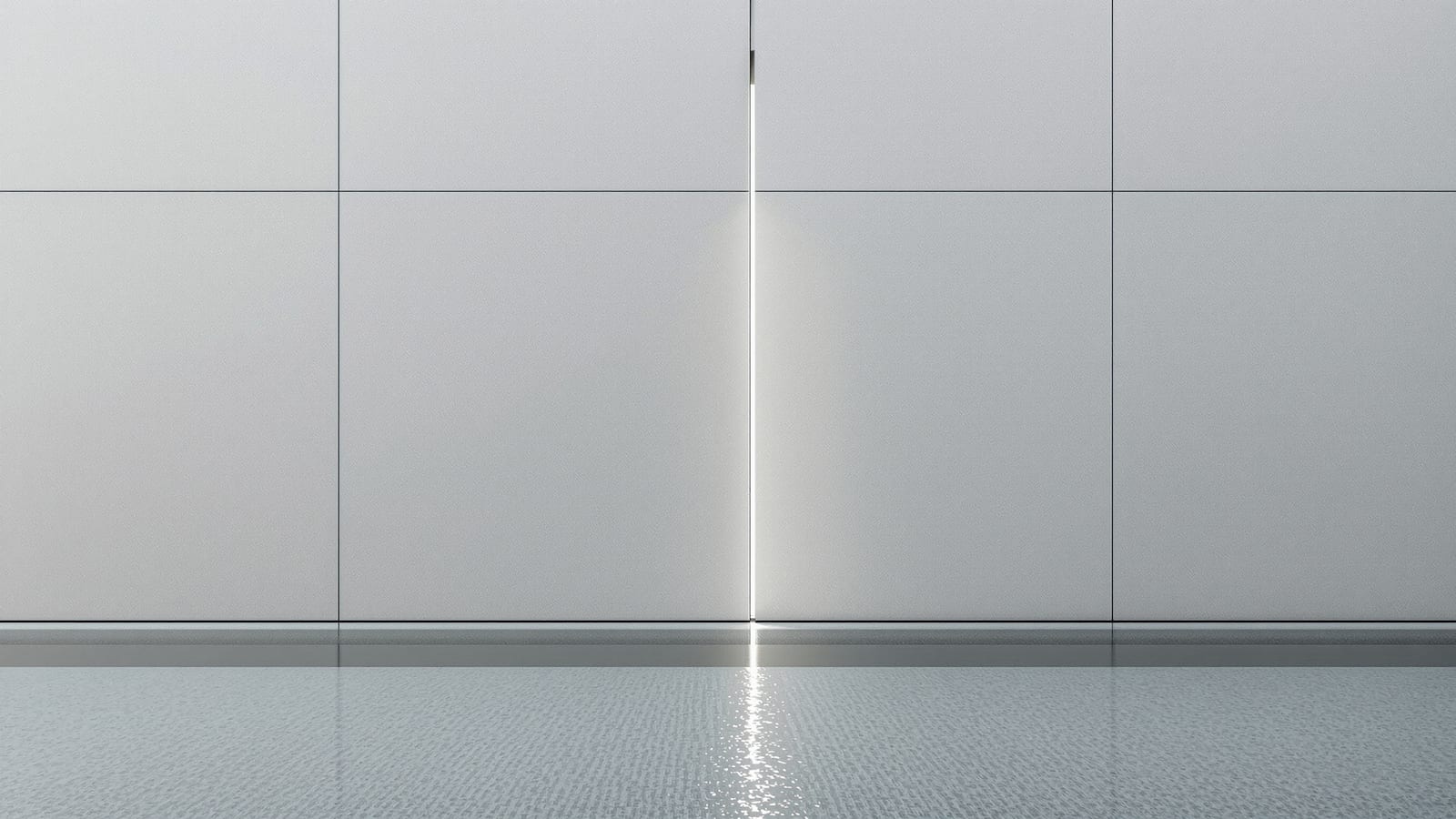
Stand in front of a Tadao Ando wall and the first thing you notice is what is missing. No cladding. No mouldings. No string courses, no rusticated base, no decorative panels. Just a single vast plane of grey concrete, so smooth it looks poured from milk, broken only by a faint quiet grid of small round dimples. It is one of the most recognisable façades in modern architecture, and it is made of almost nothing — one material, done with a precision that borders on obsession.
That restraint is deceptive. The blankness is not laziness or brutalist roughness; it is the end of an enormous amount of control. Ando's concrete is not the streaky, pockmarked grey of an ordinary Indian slab. It is fair-faced, silky, sometimes almost waxy to the touch, and the tiny holes that pattern it are not accidents — they are the single, deliberate ornament he allows himself. A great Ando façade is the architectural equivalent of a haiku: a few elements, perfectly placed, with the empty space doing as much work as the marks.
This is part of our Building Façades series — specifically our Masters of the Façade set, which studies how a single great architect handled the face of a building. We cover his life at Tadao Ando; this guide stays narrowly on the façade. Ando's signature is the global benchmark for exposed concrete, so this guide sits right beside our concrete facades guide — read that one for the brutal reality of executing fair-faced concrete in India's climate. It is also worth reading against Le Corbusier's facade signature: Ando revered Corbusier and inherited his love of raw concrete, but where Corbusier left béton brut (raw concrete) deliberately rough and board-marked, Ando refined the same material into something silky, planar and minimal — the opposite surface from the same idea.
1. The one-material façade
Most façades are an assembly: structure, then cladding, then trim, then paint. Ando collapses all of that into a single act. The wall that holds the building up is also the wall you see, inside and out. There is no skin over a frame — the concrete is the architecture.
This is why his elevations feel so calm. A conventional building's face is busy because every joint between materials is a line, every change of plane a shadow. Strip the building down to one continuous material and those lines vanish. What remains is the monolithic plane (a single, seamless, apparently solid surface), and your eye has nowhere to catch except on the things Ando wants you to see: the edge where wall meets sky, a single slot of light, the reflection in a pool of water.
Achieving this means the concrete has to be perfect, because there is nothing to hide behind. On an ordinary building, a bad pour gets plastered and painted. On an Ando building, the pour is the finish. That single decision — exposed concrete as the final surface — is the source of both the beauty and the brutal difficulty of his work.
2. Fair-faced, off-form, smooth-formed: the vocabulary
Three terms describe Ando's surface, and they matter.
Fair-faced concrete means concrete whose as-cast surface is good enough to be left exposed with no plaster, render or paint over it. Off-form (or off-the-form) means that surface is taken directly off the formwork — whatever texture the mould had, the concrete inherits. Formwork (called shuttering on Indian sites) is the temporary mould — usually plywood panels braced with timber and steel — into which wet concrete is poured.
Now the crucial distinction. Board-formed concrete uses rough timber boards as the mould, so the finished wall carries the grain and joints of the timber — the rugged look of Corbusier and much mid-century brutalism. Smooth-formed concrete uses a slick, sealed sheet — typically high-grade plywood with a plastic or phenolic film face — so the finished wall is glassy and grainless. Ando is the master of the smooth-formed variety. His walls have no wood grain; they have the even, low-sheen surface of polished stone.
That smoothness is not a coating applied afterwards. It is the negative of an extremely good mould. The wall is as smooth as the plywood was, as flat as the panels were aligned, as unblemished as the pour was careful. Everything in an Ando façade is decided before the concrete is even mixed.
The panel-and-tie-hole grid
This is the technical heart of the whole signature, so it gets its own section.
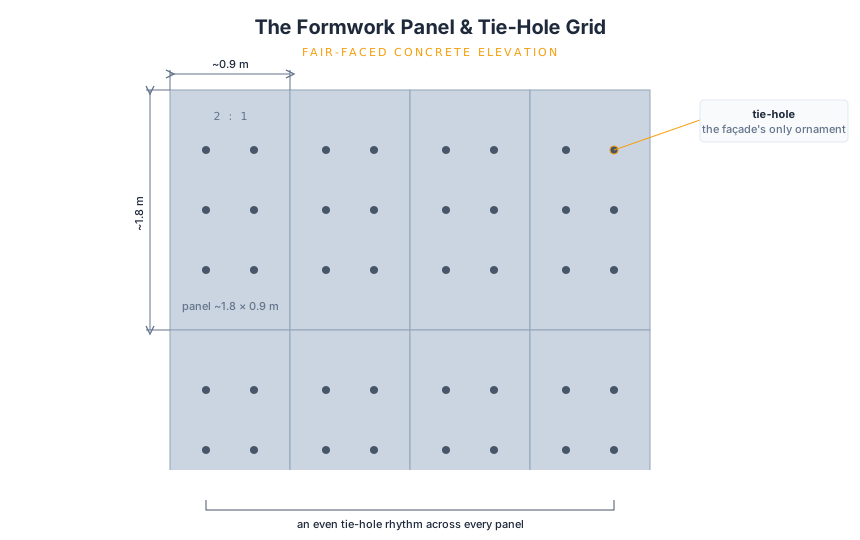
To pour a smooth concrete wall, you build a mould on both faces and clamp the two faces together so the wet concrete cannot push them apart. The clamps are form ties — slender steel rods that pass straight through the wall from one form face to the other, holding them at a fixed distance. Around each tie, at the form face, sits a small plastic or steel cone (a form-tie cone) that keeps the rod off the surface. When the formwork is stripped, the rod is broken back, the cone is removed, and what is left is a small, clean, recessed circular hole. That recess is the tie-hole.
Every concrete building has tie-holes. Most architects fill them, sand them flush and paint over them to make the wall look monolithic. Ando does the opposite. He leaves them, places them with absolute regularity, and turns the unavoidable scar of construction into the façade's one piece of decoration.
The order comes from the panel. Ando's standard formwork panel is sized close to the proportion of a traditional Japanese tatami mat and the shōji screen — roughly 1.8 metres by 0.9 metres, a tall rectangle in a clean 2:1 ratio. He repeats that single panel across the entire elevation like tiles, and within each panel he places a fixed, regular pattern of tie-holes — characteristically six per panel, two columns of three, evenly spaced. Because the panel is a constant module, the tie-holes fall into a perfectly even field across the whole wall. The grid of holes you read on an Ando façade is really the grid of his formwork panels made visible.
So the panel does two jobs at once. It is the practical unit of construction — the size of plywood sheet his carpenters handle and align. And it is the proportional system that orders the elevation: door heights, window slots, wall lengths and floor levels are all tuned to land on panel lines and tie-hole rows, so nothing looks arbitrary. The wall is, quietly, a grid — the same instinct as a Japanese room laid out in tatami modules.
How is the silkiness actually achieved? Four disciplines, all of them unforgiving:
- The form liner. High-grade plywood with a sealed plastic or phenolic film face, joints taped and sealed so not a drop of cement paste (laitance) bleeds out. Any leak leaves a stain or a fin; any gap leaves a line.
- The mix. A well-graded, workable mix with enough fine material to fill the form face cleanly and reach into every corner without segregating, so the surface comes out dense and even-coloured rather than blotchy.
- The pour and vibration. Poured in controlled layers and vibrated just enough to release trapped air and close blowholes — but not so much that the mix segregates. Over- or under-vibrating both show on the face forever.
- Alignment and curing. Panels aligned to millimetres so seams are invisible; consistent curing so the colour does not vary patch to patch.
Get all four right, every time, and you get an Ando wall. Get any one wrong and you get an ordinary, blotchy, streaked concrete wall — which is exactly what most sites produce, in Japan or India. The signature is not the grey colour. It is the discipline.
3. The wall as the façade
For Ando, the façade is usually a wall before it is a face — a planar, often blank, often windowless plane that defines space and frames the world, rather than a surface punched with openings.
This is the deepest difference from a Western elevation. A classical or modernist street front is a composition of windows: rhythm of voids, proportion of openings, framing of glass. Ando's street fronts are frequently the opposite — long, solid, almost openingless concrete planes that turn their back on the street. The drama is saved for the inside, where the same walls frame a courtyard, a slot of sky, a sheet of water.
The wall does several jobs. It is privacy — a hard, calm shield against a noisy, dense city. It is composition — a pure rectangle of grey against the sky, with the panel grid as its only incident. And it is a frame — by being blank, it makes a single opening, when it finally comes, overwhelmingly powerful. An Ando wall is loud precisely because it says so little.
4. Light as material
If concrete is Ando's body, light is his soul. He treats daylight not as something that floods in through windows but as a material to be cut, slotted and aimed — sculpted by the very blankness of the walls.
Because his planes are mostly solid, the openings he does make become events. A slit window — a tall, narrow vertical slot where two walls almost but don't quite meet — admits a blade of light that moves across the concrete through the day. A gap between wall and roof drops a line of light down a surface. A top-light brings the sun into a buried room. The concrete, being even and grainless, becomes the perfect screen for this light to play on; a rough or busy wall would scatter and waste it.
The most famous instance is the cross of light at the Church of the Light, where the opening itself becomes the building's entire iconography. We will come to it below. The principle is general: in an Ando building, the wall is the canvas and light is the only paint.
5. Geometry, nature and water
Ando's third move is to set his hard geometry against soft nature — and to use the façade as the frame between them. This draws on the Japanese ideas of shakkei (borrowed scenery — composing a view of distant nature as if it belonged to the building) and ma (the meaningful interval, the charged emptiness between elements).
A blank wall slides open to reveal a still pond and a row of cherry trees. A long horizontal slot frames a strip of sky. A reflecting pool at the base of a wall doubles the concrete and dissolves its weight. The façade is not decorated with nature; it is the precise, silent frame that makes you see the nature. The emptiness of the wall and the fullness of the view need each other — that tension is the ma.
This is also why water recurs in his work. A sheet of still water mirrors the smooth wall above it, so the most disciplined surface he can make is paired with the most uncontrollable one, and the boundary between them — the monolithic plane meeting its own reflection — becomes the quiet drama of the façade.
6. The signature devices, summarised
| Device | What it is | Why Ando uses it | Where to see it | Lesson for India |
|---|---|---|---|---|
| Smooth off-form concrete | Fair-faced concrete left exposed straight off a sealed plywood mould, silky and grainless | One honest material is the whole building; no cladding, no paint, nothing to hide behind | Almost every Ando building | Aspirational — needs world-class formwork and supervision; rarely achievable on ordinary sites |
| Panel-and-tie-hole grid | Tatami-proportioned panels (~1.8 × 0.9 m) repeated, each with ~6 recessed tie-holes | Turns the unavoidable scar of construction into the façade's only ornament and proportional system | Church of the Light; Naoshima museums | Borrow the order — set out tie-holes and panel joints on a deliberate grid even on cheaper walls |
| Blank planar wall | Long, solid, near-windowless concrete plane to the street | Privacy and calm; saves all drama for the inside | Azuma (Row) House, Sumiyoshi | Excellent for hot, dense, noisy Indian plots — open inward, not outward |
| Slit / cross of light | A narrow opening where walls almost meet, admitting a blade of moving light | Makes light the event; the wall is the canvas | Church of the Light; Koshino House | Light through a calm wall reads beautifully in strong Indian sun |
| Wall + water | A reflecting pool mirroring a smooth wall | Doubles the plane, dissolves its weight, frames sky | Church on the Water; Fort Worth | Powerful but maintenance-heavy in dusty, algae-prone climates |
| Inward-opening courtyard | The face is blank; life opens onto an internal court | Privacy, microclimate, framed nature | Azuma House; many houses | Maps directly onto the traditional Indian courtyard house |
| Standard panel module | One repeated panel sizing every dimension | Orders the whole elevation so nothing is arbitrary | All works | Transferable to any material — let one module govern the façade |
7. Real buildings, not renders
Theory is cheap. Here is how the façade actually works in five verified Ando buildings.
Row House (Azuma House), Sumiyoshi, Osaka — 1976. Ando's breakthrough, and the purest statement of the blank façade. Inserted into a tight row of old houses, the street front is a flat, windowless rectangle of fair-faced concrete pierced by a single doorway — nothing else. Behind that blank face the narrow house is split into three, with an open courtyard in the middle that brings light, air and sky to every room. The lesson is total: the public face gives nothing; the life is all inward. For a dense Indian plot, this is almost a manual.
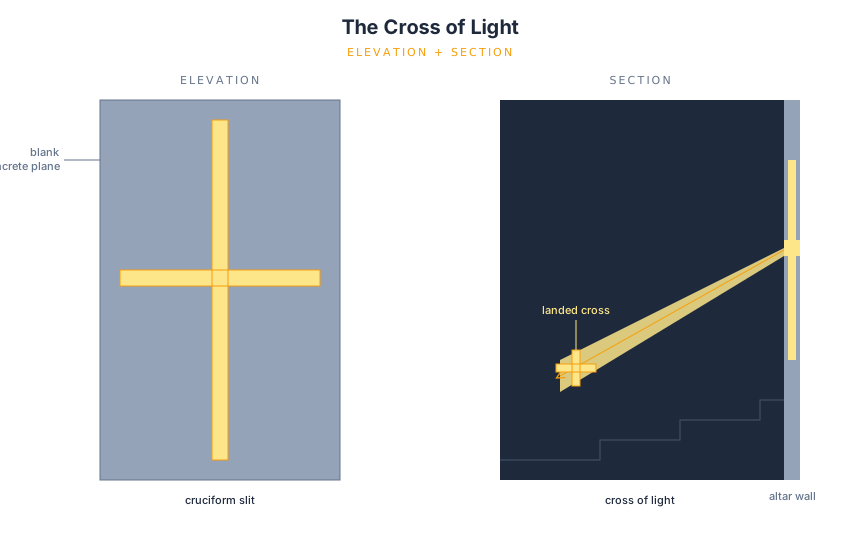
Church of the Light, Ibaraki, Osaka — 1989. The most concentrated façade idea in modern architecture. One end wall of an otherwise dark, blank concrete box is sliced by a full-height cruciform slit — a cross cut clean through the concrete, roughly 25 cm wide, top to bottom and side to side. In the dim interior the only thing you see is that cross blazing with daylight: a cross of light floating in the dark. The wall is the iconography; the opening is the altar. Concrete, glass-less slit, light — and nothing else.
Church on the Water, Tomamu, Hokkaido — 1988. Here the façade dissolves. A glazed wall faces a large, still, artificial pond with a free-standing steel cross rising from the water. The glass wall slides fully open, so the concrete-framed sanctuary loses its boundary and the pond, the cross and the landscape become the altarpiece — shakkei made literal. The thick 900 mm concrete walls anchor the calm; the moving water and sky are the event.
Modern Art Museum of Fort Worth, Texas — 2002. Ando's signature at civic scale. Five long pavilions of massive planar architectural concrete — some walls reaching around 40 feet — sit in a 1.5-acre reflecting pool, each concrete box wrapped in an outer skin of glass. The water mirrors the great smooth planes; the glass softens their weight and shades the galleries from the Texas sun. The same grammar as a tiny house — blank plane, water, light — scaled up to a museum.
Chichu Art Museum, Naoshima — 2004. The wall becomes the landscape. The museum is buried into a hillside, so from above only stark geometric concrete courts and slots show through the greenery, like a calm ruin. There is almost no conventional façade at all; the building reveals itself as sheer planes of fair-faced concrete lit entirely by daylight slotted in from above. This is Ando's restraint taken to its limit — a façade that hides, and lets light and concrete do everything.
Together with his 1995 Pritzker Prize, these buildings define the off-form concrete benchmark the rest of the world measures itself against.
8. What his approach teaches India
Now the honest part — and it matters, because Ando is the most copied and most botched façade idea in the world.
Ando's smooth off-form concrete is the global gold standard, but it is extraordinarily hard and expensive to execute. That silky grey wall is the output of world-class formwork, premium film-faced plywood, a tightly controlled mix, disciplined vibration, millimetre alignment and relentless supervision. On an ordinary Indian site — variable cement, hand-mixed or poorly graded concrete, reused warped shuttering, monsoon interruptions, crews who have never poured a fair-faced wall — the result is not an Ando wall. It is a blotchy, honeycombed, streaked grey wall, which then has to be plastered anyway. The bare grey plane is the easiest thing to imitate and the hardest thing to get right.
And there is the climate. India's monsoon is merciless to raw exposed concrete. Rain running down an unprotected plane streaks it; in our humidity and dust, north and shaded faces grow algae and black biological staining within a season or two. Ando's perfection sits in a maintained, often drier context; a literal bare-concrete façade on most Indian sites will look stained and aged fast, not silky and timeless. Our concrete facades guide goes deep on this execution reality — read it before you commit to exposed concrete anywhere with weather on it.
So do not borrow the bare grey wall. Borrow the discipline:
- One material, done supremely well. The lesson is mastery of a single surface, whatever it is — fair-faced concrete where you genuinely have the team for it, or honest plaster, exposed brick, or stone where you don't. Ando-ness is commitment, not concrete.
- The calm blank plane. A large, quiet, unbroken surface with one deliberate incident reads as luxurious in any material. Restraint is the transferable idea.
- Light as the event. A single well-placed slot or top-light through a plain wall is dramatic and cheap, and it reads beautifully in India's strong sun.
- The inward-opening private façade. This is Ando's most directly useful idea for India. The blank-street-face, open-to-an-inner-court model suits hot, dense, dusty, low-privacy plots perfectly — and it is exactly our own traditional courtyard house. It is, in the language of critical regionalism, a modern idea that fits the local climate and culture rather than fighting them.
- The disciplined grid. Even on a cheaper wall, set out joints, tie-holes and openings on a deliberate module. Order is free; it just takes a drawing.
Note too that Ando has built very little in India — his work is overwhelmingly in Japan and the wider world. So this is not "do what Ando did here." It is "learn what his approach teaches," adapted to our materials, our crews and our weather.
What this means for you
If you are drawn to the Ando look, separate the surface from the substance. The surface — flawless bare grey concrete — is a high-risk, high-cost, high-maintenance proposition in India that almost always disappoints unless you have a genuinely expert concrete contractor and a climate-aware detail. The substance — one honest material, a calm and largely blank plane, life turned inward to a courtyard, and light used as the single dramatic event — is available to any project at any budget, in any material.
Pick one material and commit. Keep the face quiet and let one thing — a slot of light, a framed tree, a sheet of water, a single beautiful door — carry the whole composition. Open inward for privacy and climate. And set everything out on a deliberate grid. Do that, and you will have learned the real Ando lesson, which was never about the colour grey. It was about doing very little, extremely well.
When you are ready to take this further, read our concrete facades guide for the execution reality, revisit Le Corbusier's facade signature for the rougher concrete tradition Ando refined, and return to the full Building Façades series to see where this fits.
Sources
- The Pritzker Architecture Prize, Tadao Ando, 1995 Laureate — biography and jury citation.
- Church of the Light, Ibaraki, Osaka (1989): documentation of the cruciform slit and cross of light (ArchDaily AD Classics; Wikipedia, Church of the Light).
- Row House in Sumiyoshi / Azuma House (1976): the blank concrete street façade and inner courtyard (Wikipedia; WikiArquitectura).
- Church on the Water, Tomamu, Hokkaido (1988): glazed wall, reflecting pond and steel cross; thick concrete walls (Wikipedia; ArchEyes).
- Modern Art Museum of Fort Worth (2002): planar architectural concrete pavilions in a reflecting pool (The Modern Art Museum of Fort Worth; Arch2O).
- Chichu Art Museum, Naoshima (2004): buried fair-faced concrete lit by daylight (Benesse Art Site Naoshima; Wikipedia).
- Tadao Ando's fair-faced concrete and form-tie technique: tatami-proportioned formwork panels, film-faced plywood liners, and the regular grid of tie-holes as ornament (technical accounts of Ando's off-form concrete; Witold Rybczynski, "The Form Tie Detail").
- Studio Matrx in-house: Tadao Ando biography, concrete façades, Le Corbusier façade signature.
Export this guide
Related Guides — Deep-dive reading
Church of the Light: How Tadao Ando Built a Room Out of Nothing but a Cross
In a suburb north of Osaka, Tadao Ando took three concrete cubes, a wall tilted fifteen degrees, and a single cruciform slit in the east wall — and made one of the most powerful rooms of the twentieth century. A study of the 1989 chapel: its tatami-scaled concrete, the argument over the glass, and why a building that subtracts almost everything still tells us where architecture is going.
The Future of ArchitectureLouis Kahn's Façade Signature: Wrapping Ruins, Brick Arches, and Monumental Light
How Louis Kahn shaded the glass behind giant geometric screen walls, asked the brick to be an arch, and built monumental façades of fair-faced concrete and light — and what that hot-climate logic teaches Indian builders today.
Building FacadesPlaster, Render and Texture-Paint Facades in India: The Honest Guide to the Country's Default Wall Finish
A building-physics guide to cement and lime render, exterior emulsion and weatherproof paints, and textured coatings — how these everyday facades are built, why they crack, streak and grow algae, and what actually keeps them looking good in the Indian monsoon.
Building FacadesRelated Tools — Try Free
Brise-Soleil Visualizer
Interactive horizontal-louvre cut-off angle calculator — sun altitude, louvre depth, and spacing inputs with a live shadow preview. Computes θ = arctan(spacing/depth) for façade shading, ECBC envelope compliance, hospital daylight design, and tropical sun-control detailing.
Sun Shading ToolRainwater Tank Sizer
How big should your rainwater tank be? Computes annual harvest, recommended tank capacity in litres, water-bill savings, and payback — for 10 Indian cities.
RWH CalculatorBefore & After Studio
Generate AI before-and-after renders to preview how your redesign could look.
DesignAI