
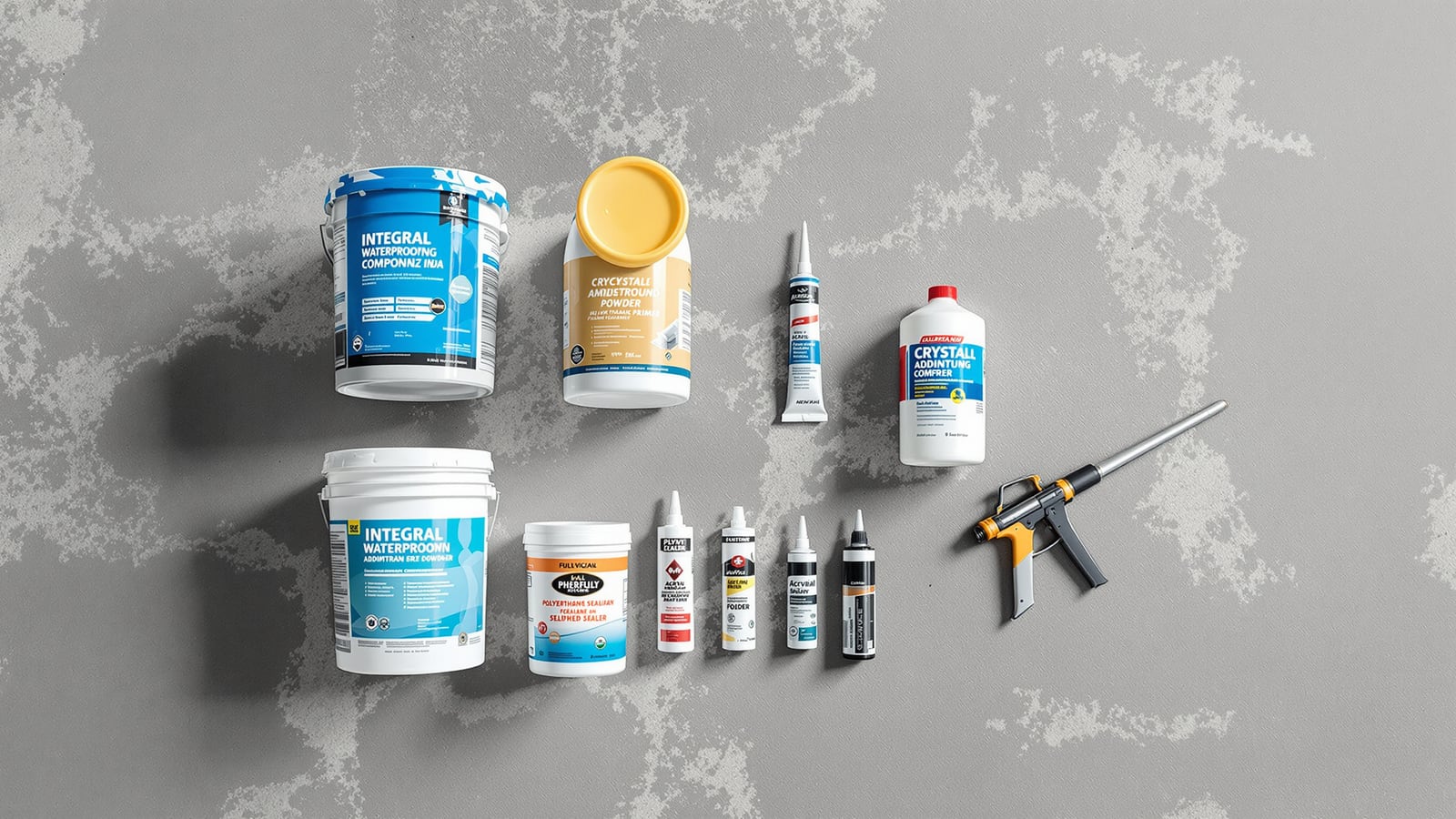
Bathroom Waterproofing Chemicals in India: Compounds, Admixtures & Sealants
A brand-neutral guide to the integral compounds, crystalline admixtures, acrylic bonding agents, primers and PU/silicone sealants that keep an Indian bathroom dry — what each does, where it goes, dosage and ₹ cost.
Most Indian bathroom leaks are not caused by a bad membrane — they are caused by the wrong chemical, the wrong dosage, or a chemical skipped entirely to save a few hundred rupees. The membrane you see is only the visible layer. Underneath it, a small family of chemicals is quietly doing the real work: tightening the concrete, gluing new layers to old, blocking capillary water and sealing the joints that tiles alone can never close.
This guide walks through that family product by product — what each one is, the job it does, where it goes in the build-up, how much you actually need (dosage matters more than brand) and what it costs in ₹. It is brand-neutral: Dr. Fixit, Fosroc, Pidilite, MYK Laticrete, Sika and BASF are named only as familiar examples so you know what to ask for at the counter.
For the full membrane-and-detailing picture, read the pillar Bathroom Waterproofing Guide (India). This page zooms into the chemicals themselves.
The five jobs chemicals do in a bathroom
Think of waterproofing not as one product but as five distinct jobs. A well-detailed bathroom uses a chemical for each — and the failures almost always trace to a job left undone.
| Job | Chemical family | Typical product form | Where it goes |
|---|---|---|---|
| Make the concrete/plaster itself water-tight | Integral waterproofing compound | Liquid or powder, mixed in | Screed, plaster, RCC slab |
| Self-heal hairline cracks internally | Crystalline admixture | Powder, dosed into concrete | Structural slab, sunk portion |
| Glue new layers to old surfaces | Acrylic / SBR bonding agent | White latex liquid | Between slab, screed, coating |
| Seal & prime before the membrane | Bonding primer | Thin acrylic liquid | On cured screed, pre-coating |
| Close the joints tiles can't | PU / silicone / MS sealant | Cartridge gun | Corners, drains, pipe collars |
The single most common site mistake is treating the surface coating as the whole system and skipping the integral compound and the sealant. A membrane over a porous, un-dosed screed with open joints is a raincoat with holes in the pockets.
1. Integral waterproofing compounds
These are added into the concrete or plaster mix at the time of batching, so the mass of the material becomes water-resistant rather than relying only on a skin. They work by reducing the water-cement ratio needed for workability and by plugging the capillary pores that let water wick through set concrete.
- Where used: the sunk-portion filling, the sloped screed, internal/external plaster on wet walls, and the RCC slab itself.
- Form: liquid (poured into the mixer) or integral powder. Liquid types are the norm on Indian sites.
- Dosage: typically 200 ml per 50 kg bag of cement — roughly 1% by weight of cement. Always follow the drum; over-dosing can retard set and weaken the mix.
- Governing code: integral compounds are covered by IS 2645 (Integral Cement Waterproofing Compounds). Ask for an IS 2645-marked product.
- ₹ cost: about ₹90–160 per litre; a 200 ml dose per bag adds only ₹20–35 to a bag of cement — the cheapest insurance in the whole build-up.
- Examples: Dr. Fixit Pidiproof LW+, Fosroc Conplast series, Sika Latex-type integrals.
The catch: an integral compound densifies the mix but does not bridge cracks or seal joints. It is a base layer of defence, never the whole answer.
2. Crystalline waterproofing admixtures
Crystalline technology is the clever one. Dosed into the concrete (or applied as a slurry coat), the active chemicals react with moisture and free lime to grow insoluble crystals inside the pores and micro-cracks. When new water arrives later — say during the monsoon — dormant chemicals reactivate and grow fresh crystals, giving a limited self-healing ability for hairline cracks up to about 0.4 mm.
- Where used: structural slabs, the sunk area of the WC/bath, water tanks, and any concrete that must stay dry from within. Ideal where you cannot easily re-access the surface later.
- Form: grey powder admixture (dosed into concrete) or a brush/spray slurry on cured concrete.
- Dosage: admixture types run about 0.8–1.2% by weight of cement; slurry coats are applied at roughly 0.8–1.0 kg/m² in two coats.
- ₹ cost: ₹120–260 per kg — dearer than integral compounds, justified where self-healing and permanence matter.
- Examples: Fosroc Preprufe/Krystaline-type, Sika WT-200 P, MYK crystalline ranges, Kryton (imported).
Crystalline chemistry pairs naturally with cementitious membranes — see Cementitious Waterproofing (India) for how the two layers combine on the sunk slab.
3. Acrylic bonding agents & SBR latex
Fresh cement does not stick well to cured, dusty concrete — the bond is where old and new layers separate and water tracks in. Bonding agents fix this. Acrylic bonding agents and SBR (styrene-butadiene rubber) latex are milky liquids either brushed onto the old surface as a bond coat or mixed into the new cement slurry to make it flexible, adhesive and less permeable.
- Where used: between the slab and screed, as the gauging liquid for cementitious membranes, in repair mortars, and as a bond coat before plastering wet walls.
- Dosage: as a bond coat, dilute roughly 1 part latex to 1–2 parts water; as a slurry gauging liquid, mix per the coating's data sheet (often 0.5–2 litres per bag of the powder component).
- ₹ cost: ₹80–200 per litre depending on solids content (SBR usually dearer than plain acrylic).
- Examples: Dr. Fixit Pidicrete URP, Fosroc Nitobond SBR/AR, BASF MasterEmaco bonding agents.
SBR-modified coatings also gain crack-bridging flexibility, which matters in India where slabs move with heat and monsoon swings.
4. Bonding primers
A primer is the thin, low-viscosity acrylic coat that seals a porous screed and gives the membrane a clean, dust-free surface to grip. Skipping it is a false economy: the membrane may look fine on day one and delaminate within a year.
- Where used: on the cured, cleaned screed immediately before the waterproof coating; also over old tiles when overlaying.
- Dosage: roughly 6–10 m² per litre, single coat, allowed to become tacky before the membrane.
- ₹ cost: ₹120–250 per litre.
- Tip: for very smooth or glazed substrates, use a bonding/adhesion primer rather than a plain sealing primer.
5. PU, silicone & MS joint sealants
Membranes cover surfaces; sealants close joints and movement gaps — exactly the places a rigid coating cannot follow. In a bathroom the critical joints are wall-to-floor corners, the tile-to-drain gate, pipe penetrations, and the tile-to-sanitaryware line at the WC and washbasin.
| Sealant | Best for | Paintable? | Life (indoor wet) | ₹ per 300 ml cartridge |
|---|---|---|---|---|
| Silicone (neutral cure) | Tile joints, sanitaryware line, glass shower | No | 8–12 yrs | ₹250–500 |
| Polyurethane (PU) | Structural joints, drain collars, movement gaps | Yes | 10–20 yrs | ₹350–700 |
| MS polymer (hybrid) | Corners needing paint + flexibility | Yes | 10–15 yrs | ₹400–800 |
| Acrylic sealant | Low-movement dry-side gaps only | Yes | 3–6 yrs | ₹120–250 |
- Use neutral-cure (not acetoxy) silicone around fittings — acetoxy silicone releases acetic acid that can corrode metal and etch some stones.
- Anti-fungal silicone is worth the small premium in India's humid, poorly ventilated bathrooms; it resists the black mildew that colonises grout lines.
- Tile-joint sealers (a penetrating liquid brushed over cementitious grout) are a separate, cheap step — about ₹300–600 per bottle covering a small bathroom — that stops grout from soaking up water and staining.
For how these joint details prevent the specific failure paths, see Bathroom Leak Prevention (India).
Putting it together: a chemical budget for one bathroom
For a typical 40 sq ft (≈3.7 m²) Indian bathroom floor plus 7 ft wall band, here is a realistic chemical-only spend. Membrane labour and tiling are extra.
| Item | Quantity | ₹ range |
|---|---|---|
| Integral compound (screed + plaster) | 1–2 L | ₹120–300 |
| Crystalline slurry (sunk slab) | 4–5 kg | ₹600–1,300 |
| Acrylic/SBR bonding agent | 2–3 L | ₹250–600 |
| Bonding primer | 1 L | ₹150–250 |
| PU/silicone sealant | 2–3 cartridges | ₹700–1,800 |
| Tile-joint sealer | 1 bottle | ₹300–600 |
| Total chemicals | — | ₹2,100–4,850 |
Against a bathroom that costs ₹80,000–2,00,000 to build, spending under ₹5,000 on the right chemistry is trivial — yet it is exactly this line item that gets value-engineered away, and exactly this bathroom that leaks into the flat below within two monsoons.
Practical buying and mixing rules
- Match the chemical to the substrate and job — not the brand on the poster. A crystalline product cannot seal a moving joint; a silicone cannot densify a screed.
- Respect dosage. More integral compound does not mean more waterproof; over-dosing retards set and can weaken concrete. Measure with the drum's cup, not by eye.
- Check the IS mark. Integral compounds should carry IS 2645. Ask for a data sheet and test certificate for imported or premium products.
- Mind the pot life. Two-component and PU products cure fast in Indian summer heat — mix only what you can apply in 30–45 minutes.
- Ventilate. PU and solvent primers off-gas; keep the bathroom aired during and after application, especially in an enclosed apartment.
- Never mix families. Don't apply silicone over uncured PU or a fresh acrylic membrane over a solvent primer without the recommended wait — read both data sheets.
Get the chemistry right underneath, and the membrane, tiles and grout you can see will do their job for a decade or more. Skip it, and no amount of visible finish will keep the flat below dry.
References
- National Building Code of India (NBC) 2016, Part 6 & Part 9 — dampness, water supply, drainage and wet-area detailing.
- IS 2645 : 2003 — Integral Cement Waterproofing Compounds — Specification.
- IS 1172 : 1993 — Code of Basic Requirements for Water Supply, Drainage and Sanitation.
- IS 456 : 2000 — Plain and Reinforced Concrete — Code of Practice (admixtures and durability).
- IS 9103 : 1999 — Concrete Admixtures — Specification.
- CPWD Specifications and CPHEEO Manual on Water Supply & Sanitation — Government of India — for wet-area and plumbing detailing practice.
Export this guide
Related Guides — Deep-dive reading
Cementitious Waterproofing India: Coatings, Coats & Cost (2026)
How cement-based waterproofing coatings work in Indian bathrooms — one- vs two-component, polymer-modified slurries, surface prep, number of coats, curing, where they suit sunken slabs and wet areas, and where their low flexibility lets you down, with rupee costs.
BathroomsBathroom Leak Prevention India: Detailing the Junctions That Stop Water Reaching the Flat Below
Bathroom leaks almost never come from a broken pipe — they come from a badly detailed junction. Here is how to get the wall-floor corner, pipe penetrations, floor trap, nahani trap and door threshold right, plus the flood test that catches a leak before you tile.
BathroomsConstruction Chemicals Guide (India): Admixtures, Adhesives, Sealants, Grouts & More (2026)
The anchor guide to construction chemicals for Indian homes - what these small-dose products do, the main families from concrete admixtures to adhesives, sealants, grouts, waterproofing and curing compounds, and how to buy and use them safely.
Building MaterialsRelated Tools — Try Free
Bathroom Sealant Calculator
How many tubes of silicone sealant a bathroom needs and the cost — by joints to seal, lengths and bead size, with an anti-fungal note.
Bathroom CalculatorBathroom Waterproofing Calculator
Work out waterproofing material (kg/L) and cost for a bathroom by area, wall band, system type and coats — cementitious, acrylic, PU or SBR.
Bathroom CalculatorBathroom Cost Calculator
Estimate the all-in cost of building or renovating a bathroom — by size, quality tier and city, with a category-wise breakdown.
Bathroom Calculator