
Body Jets Shower India: Body Spray Massage Systems, the Flow & Pressure They Really Need, and What It Costs (2026)
Wall-mounted horizontal body jets turn a shower into a spa massage — but every jet is a thirsty extra outlet. How many jets, at what heights, the big pump and geyser they force, the pipe sizing and concealed valves you must plan before tiling, the water and running cost, and exactly who it is worth it for.
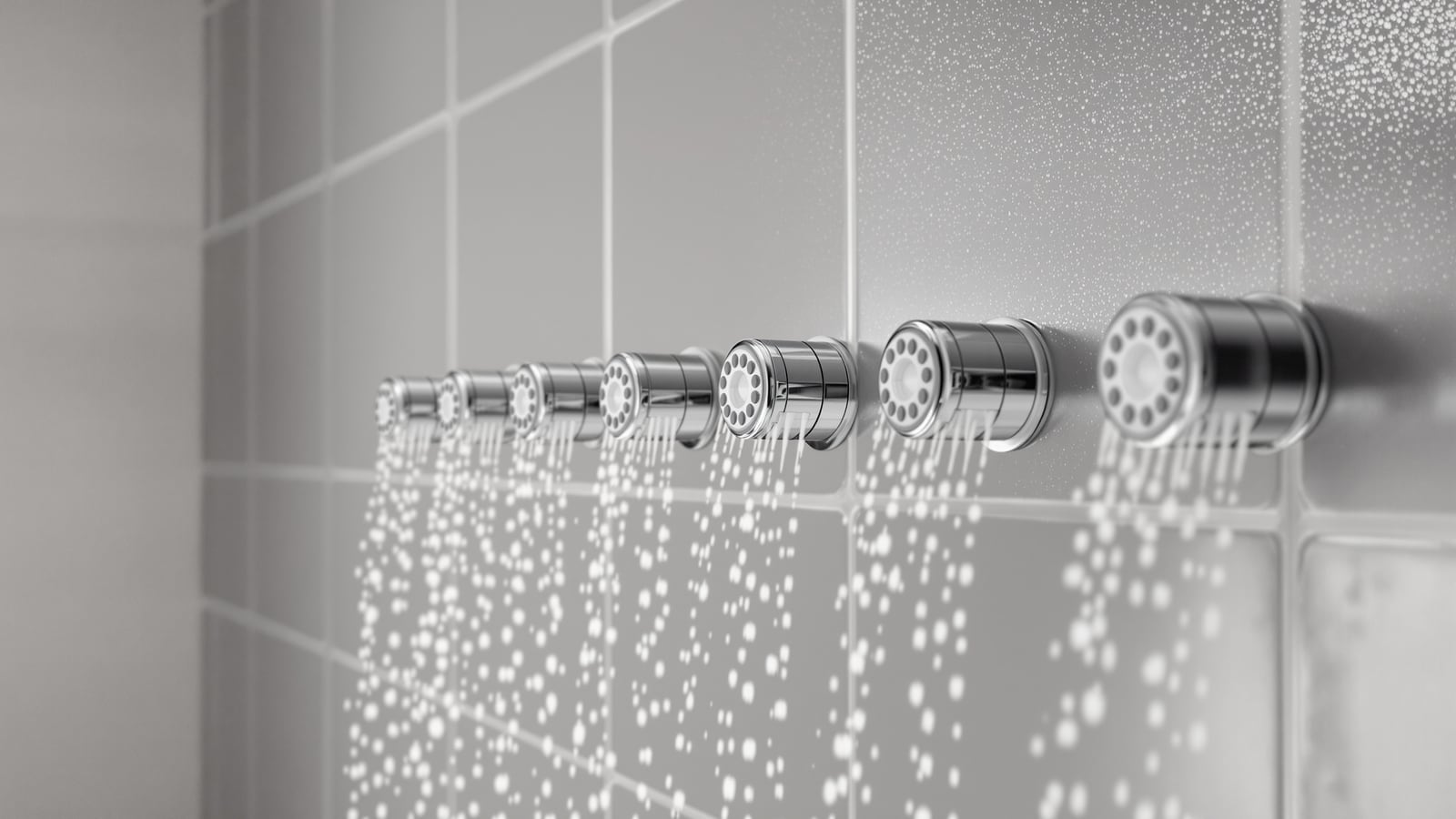
Stand in a good spa shower and the water does not just fall on you — it hits your back and shoulders from the side, several firm jets at once, a warm hydro-massage that loosens a day out of your muscles. That is what body jets (also called body sprays) do: small wall-mounted nozzles set in a vertical column, aimed horizontally at the bather, running together off one valve. They are the single most seductive upgrade in a luxury shower, and also the one most likely to disappoint in an Indian home — because every jet you add is another thirsty outlet, and four or six of them running at once demand more flow and pressure than a typical tank-and-geyser setup can deliver.
This guide is India-first: the pump and geyser body jets actually force you to buy, the pipe sizing and concealed valves you must get right before the tiles go on, and an honest read on cost and who it is worth it for. Read it up to the shower systems guide for India for the full overhead-plus-hand-shower picture, and alongside the thermostatic shower guide, the spa bathroom design guide and the luxury bathroom design guide.
Body jets are a plumbing decision before they are a fitting decision. Buy the jets last. Size the pump, the geyser and the pipes first — or you will install a beautiful spa wall that dribbles.
What body jets are — and how they differ from a rain shower
An overhead rain shower and a hand shower wet you from above. Body jets attack from the side, at body height, and their job is massage, not rinsing. A few things set them apart:
- They run in a set, not alone. One jet does nothing useful. Body jets are specified in columns of 3, 4, 6 or 8, and the whole column fires together — so their water demand is additive.
- They are directional. Each nozzle aims a concentrated stream at a specific muscle group — lumbar, mid-back, shoulders. Better jets swivel a few degrees so different heights of user can aim them.
- They want pressure, not just volume. A rain head feels good at low pressure — it just needs volume to fall. A body jet needs pressure to punch a firm stream across half a metre of air; feed it weak gravity flow and it produces a limp trickle that feels like nothing.
That last point is the crux of the whole guide, so let us deal with it head-on.
The India constraint: the flow and pressure body jets demand
Here is the arithmetic that catches people out. A single modern body jet flows roughly 4–8 litres per minute (LPM) to feel like a proper massage. Run a column of four together and you are asking for 16–32 LPM — and that is before you add the overhead rain head (itself 8–12 LPM) if the diverter lets them run at once. A comfortable domestic tap is happy at 6–9 LPM. So a body-jet shower can demand three to five times the flow of an ordinary shower, all at once, at a pressure high enough to throw the stream.
Two things have to be true at the same time:
- Enough flow (litres per minute): the whole set of jets, added up, must be delivered simultaneously without the pressure collapsing.
- Enough pressure (bar): typically 2–3 bar at the valve for jets to feel firm. Gravity from a terrace tank one floor up gives only about 0.3 bar — nowhere near enough.
In most Indian homes fed by an overhead tank, neither is available off the tap. That means body jets almost always force two purchases you must budget from day one: a pressure-boosting pump sized for the total jet flow, and a larger storage geyser so you do not run out of hot water mid-massage. This is the real, non-negotiable cost of body jets in India.
Plan the pipes and concealed valves before you tile
Body jets are almost always concealed — nozzles flush on the tiled wall, the pipework and valve buried behind. That means every decision is a first-fix decision, made before waterproofing and tiling. Get it wrong and fixing it means breaking the wall.
- Feed pipe size. The manifold feeding a bank of jets must carry the full combined flow. A 15 mm (½ inch) supply that is fine for one tap will choke a four-jet column; body-jet manifolds typically need a 20–25 mm (¾–1 inch) feed so the last jet is not starved. Under-sizing the pipe is the most common reason the top and bottom jets differ in strength.
- Balanced manifold. All jets should tee off a common horizontal manifold at equal branch lengths, so each gets similar pressure. A daisy-chain where water reaches jets in series makes the far jet weak.
- A diverter, not everything-at-once. Running jets plus rain plus hand shower simultaneously multiplies demand beyond what most homes can feed. A diverter valve lets you send full pressure to the jets or the rain head, so each feels strong. A thermostatic diverter also holds one safe temperature across every outlet — see the thermostatic shower guide.
- Waterproofing around every penetration. Each jet is a hole through the tile and membrane. All of them must be sealed into the waterproofing layer; a leaking concealed jet body rots the wall silently. Coordinate with your waterproofing sequence.
- Access for service. Hard water scales jet nozzles and valve cartridges. Keep the diverter reachable through its plate, and choose jets whose nozzle faces unscrew for descaling.
How many jets, and at what heights
More jets is not automatically better — it multiplies your flow demand and your cost. Match the count to your pump and to who uses the shower.
- Number. For most homes, 3 or 4 jets in a single vertical column is the sweet spot: a real massage without an unfeedable demand. Six or eight jets, or twin columns, belong only in showers with a serious pump and a large geyser.
- Heights. Aim jets at the muscle groups, not randomly. Because Indian households span very different heights, either fit swivel jets or set the column to suit the main users. A typical three-jet column: lumbar/lower back ~700 mm, mid-back ~1000 mm, shoulders ~1300 mm from the finished floor. Add a fourth at ~1150 mm for taller users.
- Aim and spacing. Jets should converge slightly on where the bather stands, roughly 400–600 mm off the wall. Avoid aiming any jet at head height unless the user wants it — a firm stream to the face is unpleasant.
- One wall or opposed. A single column on the back wall is simplest. Opposed columns on two walls give an all-round massage but roughly double the flow demand.
| Jets | Typical total flow | Feels like | Pump / geyser needed |
|---|---|---|---|
| 3 jets | ~15–20 LPM | Solid back massage | Modest booster pump, 25 L geyser |
| 4 jets | ~20–28 LPM | Full spa massage | Good booster pump, 25–35 L geyser |
| 6 jets | ~30–45 LPM | Enveloping, twin-height | Strong pump, 35–50 L geyser |
| 8+ / opposed columns | 45+ LPM | Commercial spa | Pressurised system, large/solar storage |
Water use, running cost and the honest downside
Body jets are a genuine luxury of resources. A four-jet massage at ~24 LPM over a 10-minute shower uses about 240 litres — several times an ordinary shower, and every one of those litres, if hot, is energy off your geyser or solar. In a water-stressed Indian city, that is worth a conscious choice.
- Water. Expect roughly 3–5x an ordinary shower's consumption when the jets run. Use a diverter so jets and rain do not both run, and treat body jets as an occasional indulgence, not the daily default.
- Energy. Heating that much water needs a bigger geyser or solar storage; an instant/instantaneous heater simply cannot deliver the sustained hot flow and will fade to cold. This ties directly to the water-heater sizing in the luxury bathroom design guide.
- Society and supply limits. Apartment towers with shared pumps and pressure-reducing valves may cap what any one flat can draw; check before committing. A booster pump on your own line is often the only workable answer.
What it costs, and who it is worth it for
| Item | Typical India range (2026) | Note |
|---|---|---|
| Single body jet (nozzle + concealed body) | ₹1,500–₹6,000 each | Multiply by jet count |
| Set of 4 jets | ₹8,000–₹30,000 | Plus the manifold |
| Concealed diverter / thermostatic diverter | ₹15,000–₹60,000+ | Splits jets vs rain, holds temperature |
| Pressure-boosting pump | ₹8,000–₹30,000 | Almost always required |
| Larger storage geyser (25–50 L) | ₹12,000–₹35,000 | Upsize over a standard 15 L |
| Extra pipework, chasing, waterproofing, labour | ₹15,000–₹50,000 | First-fix, before tiling |
The realistic all-in figure for a proper body-jet wall in India is well into the low lakhs once the pump, geyser and concealed works are counted — the jets themselves are the cheapest part.
- Worth it for: a master or spa ensuite in a home you are keeping, where you already have (or will fit) a booster pump and a large hot-water store, and where a hydro-massage genuinely earns its keep for sore backs and unwinding. It sits naturally in a spa bathroom or luxury bathroom scheme.
- Skip it for: gravity-fed flats with no room for a pump, water-scarce locations, rentals, or any bathroom where the plumbing cannot be opened up at first-fix. In those cases a strong single overhead rain shower plus a good hand shower — covered in the shower systems guide — delivers most of the pleasure for a fraction of the demand.
The honest rule: body jets reward the household that plans the pump, geyser and pipework first and treats the massage as an occasional luxury. Bolt them onto weak plumbing and you buy a spa wall that only whispers.
References
- National Building Code of India (NBC 2016) — Part 9 (Plumbing Services): water-supply pipe sizing, fixture flow demand and hot-water provisions relevant to multi-outlet showers.
- IS 1172 — Basic requirements for water supply, drainage and sanitation: domestic water demand and supply guidance.
- CPHEEO Manual on Water Supply & Treatment — design pressures, flow rates and pipe-sizing method for domestic supply and boosting.
- IS 1701 — Mixing valves for water services: relevant to diverters and thermostatic control feeding body jets.
- IS 12183 / IS 302-2-35 — electric storage and instantaneous water heaters: sizing a hot-water source able to sustain high-flow body-jet showers.
- IGBC / GRIHA green-building guidance — water-efficiency benchmarks worth weighing against high-flow shower fittings.
Export this guide
Related Guides — Deep-dive reading
Bathroom Water Supply India: Cold & Hot Feed, Pipe Sizing, Pressure & Booster Pumps (2026)
How water actually reaches your fixtures in an Indian home — gravity-fed cold from the overhead tank, hot from the geyser, the pipe sizes that decide whether your shower gushes or dribbles, isolation valves at every fixture, booster pumps and hard-water protection, all mapped to IS 1172.
BathroomsShower Systems Guide India: Overhead, Rain, Hand Shower, Body Jets, Mixers & Water Pressure
The complete guide to shower systems for Indian bathrooms — overhead and rain showers, hand showers and body jets, the mixer and diverter that drive them, the hard truth about water pressure from overhead tanks, geyser sizing for hot water, and how to waterproof the shower zone. Choose the right system for your pressure and budget.
BathroomsWater Pressure Booster Pump India: Fix Weak Shower Flow Before You Buy a Rain Head (2026)
Gravity from an overhead tank cannot run a rain shower or body jets — especially on the top floor. This is the honest India-first guide to pressure booster pumps: pressure-switch vs flow-switch, single-fixture vs whole-house sizing by head and LPM, dry-run protection, noise, mounting, electricals and real rupee ranges.
BathroomsRelated Tools — Try Free
Plumbing Pressure-Test & Leak Checklist
Pre-closure pressure and leak test — 9 categories, 60+ checkpoints across water supply, drainage, fixtures, waterproofing, hot water, tanks.
Pre-Closure TestRainwater Tank Sizer
How big should your rainwater tank be? Computes annual harvest, recommended tank capacity in litres, water-bill savings, and payback — for 10 Indian cities.
RWH CalculatorCross-Ventilation Analyzer
Estimate airflow and air changes per hour (ACH) from room size, window areas, layout, and local wind — with NBC 2016 Part 8 compliance check.
Ventilation Calculator