
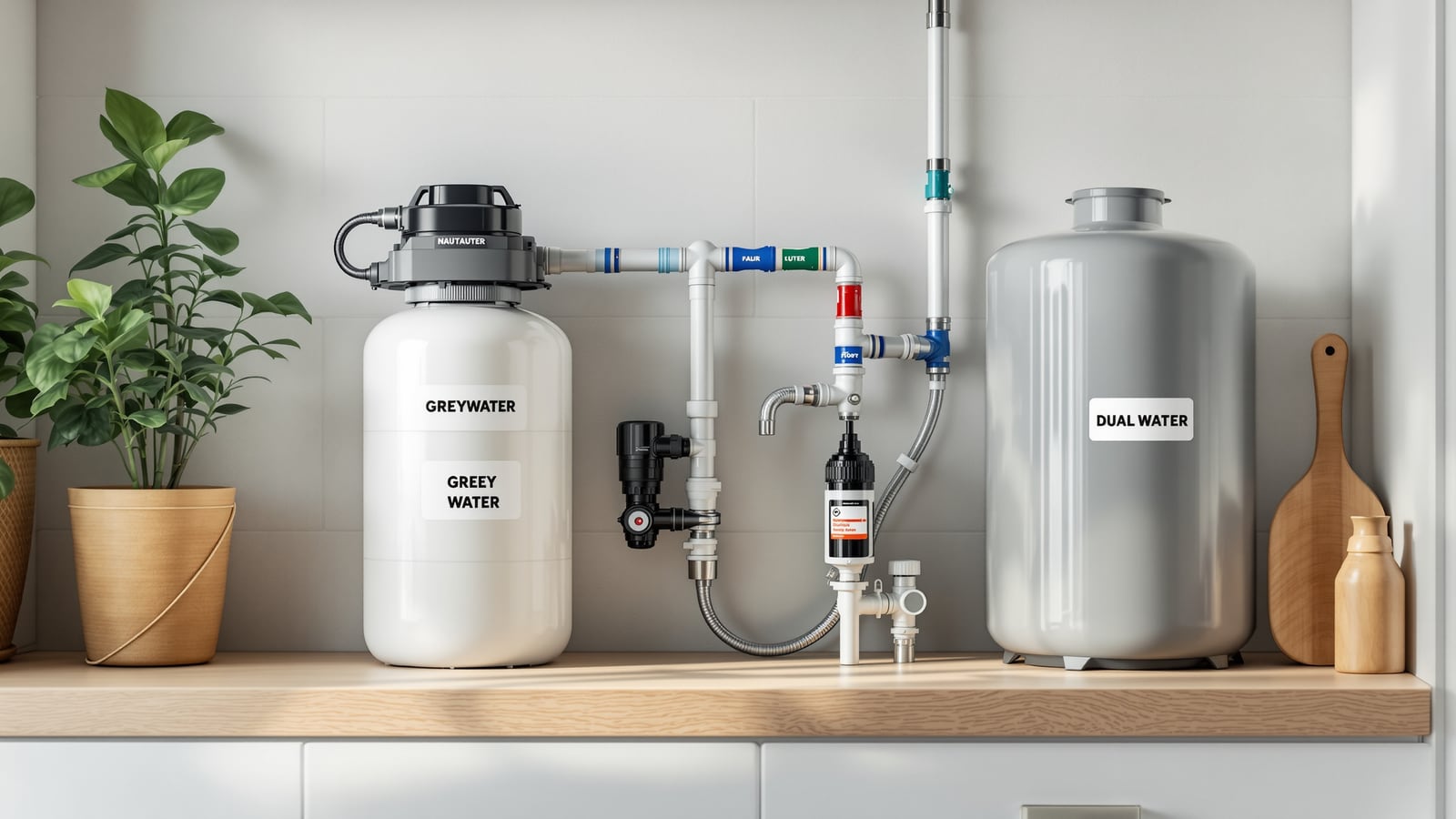
Greywater Recycling India: Reusing Bathroom Water for Flushing & Gardens
How to recycle the basin and shower greywater from an Indian bathroom — simple diversion versus filtered and disinfected systems, the separate drainage you must plan at construction, storage, dual-plumbing to the WC cistern, and honest numbers on cost, payback and health.
In a water-scarce Indian city, the cleanest way to save water is to use it twice. A large share of what leaves your bathroom is not sewage at all — it is greywater, the relatively clean runoff from the wash basin and the shower. Caught before it mixes with the WC waste, that water can flush the toilet and irrigate the garden, cutting fresh-water draw by a third or more. This guide is honest about the catch: greywater recycling is real engineering, not a plug-in gadget, and its single hardest requirement — a second drainage line — has to be decided before the tiles go down.
This is a component guide in the Studio Matrx bathroom hub. Read it alongside the eco-friendly bathroom guide for India for the wider water, energy and materials picture, and plan the pipework early using the bathroom planning guide for new homes.
Greywater recycling is 90% plumbing decision and 10% product. If you separate basin and shower drainage from the WC line at construction, the rest is easy to add later. If you do not, retrofitting means breaking floors.
Greywater vs blackwater: only reuse the clean stream
The whole system rests on one distinction. Greywater is wastewater with no faecal contamination — from the basin, shower and (in a utility area) the washing machine. Blackwater is the WC discharge, heavily contaminated and bound straight for the sewer or a septic tank / STP. This guide is strictly about bathroom greywater from the basin and shower. Never route WC blackwater into a reuse system: it is a health hazard, it fouls filters instantly, and it is against every plumbing norm.
Even greywater is not drinking water. It carries soap, hair, skin oils, toothpaste and traces of body waste, so it degrades fast if stored raw and must be handled with care.
| Stream | Source in bathroom | Contamination | Reuse suitability |
|---|---|---|---|
| Greywater | Wash basin, shower | Soap, hair, oils, lint | Flushing, gardening after filtering |
| Dark greywater | Kitchen sink | Grease, food solids | Poor — clogs, odour; usually excluded |
| Blackwater | WC / health faucet run-off | Faecal, pathogens | None — sewer / septic / STP only |
Simple diversion vs filtered treatment
Greywater systems sit on a spectrum from crude to engineered. Pick the level your household, budget and end-use actually need — over-building is as common a mistake as under-building.
- Direct diversion (simplest). A diverter valve on the basin/shower waste sends greywater straight to the garden through a subsoil or mulch bed. No storage, no pump — the soil does the filtering. Cheapest and lowest-maintenance, but you must use it within about 24 hours (raw greywater turns septic and smelly) and it only suits gardening, not flushing.
- Filtered gravity system (mid). Greywater passes a coarse screen and a sand/gravel or media filter, drops into a small tank, and gravity-feeds a garden line. Good where the tank can sit below the bathroom drain and above the garden.
- Filtered + pumped + disinfected (full). Screen → settling → media/membrane filter → disinfection (chlorine dosing or UV) → storage → pump to the WC cisterns and garden. This is what you need to reuse greywater indoors for flushing, because water sitting in a cistern near living space must not smell or breed pathogens.
- Packaged greywater recycling unit. Compact factory units combine filtration, disinfection, a small tank and pump in one enclosure sized for a home. Convenient and code-friendlier, but they still need the separate drainage feeding them.
A blunt rule: garden reuse can be simple; flushing reuse must be treated and disinfected. The moment recycled water re-enters the house, health and odour standards rise sharply.
The plumbing you must plan at construction
This is the part no product can fix afterwards. A normal Indian bathroom drops the basin, shower and WC into one common waste that leaves as blackwater. Greywater recycling needs a second, separate drainage line that collects only the basin and shower and takes it to the greywater tank — laid, sloped and tested before the floor is tiled. Retrofitting it means breaking the slab, so decide it at the drainage design stage.
You also need a dual-plumbing run: a recycled-water supply line back up to the WC cistern, kept entirely separate from the potable line, with no cross-connection possible. Two rules protect health here — a physical air gap or an approved backflow preventer so recycled water can never siphon into the mains, and clear marking so no one mistakes the line.
- Separate greywater drain — basin + shower only, ~75–110 mm, self-cleansing slope (roughly 1:40–1:60), P-trap on each fixture to hold the water seal. See plumbing traps.
- Dual-plumbed reuse supply — a distinctly coloured/labelled pipe to the WC cisterns, never teed into drinking water.
- Mains top-up + overflow — the WC cistern keeps a fresh-water backup for when the greywater tank is empty; the tank overflows to the sewer when it is full.
- Backflow protection — air gap or non-return valve at every cross-over point (a code requirement, not optional).
Filtration, disinfection and storage
Three technical points decide whether the system stays sweet or becomes a smelly liability.
- Filtration. Start with a removable coarse screen or lint trap (hair and lint are the usual clog culprit in a shower line), then a sand/anthracite or activated media filter, or a membrane in packaged units. Filters need periodic backwash or cleaning — build in access.
- Disinfection. For any indoor reuse, disinfect. Chlorine tablet dosing is cheap and common; UV is chemical-free but needs power and clean upstream water. Without it, stored greywater grows bacteria within a day.
- Storage — keep it short. Size the tank for about a day's reuse, not a week. Raw or lightly treated greywater held too long goes septic. A common home tank is 200–500 litres for a family bathroom; oversizing invites odour.
- Overflow and drain-down. The tank must overflow to the sewer and be fully drainable for cleaning. Include a bypass so you can send greywater straight to the sewer during a holiday or when the system is serviced.
Health, code and apartment rules
Greywater is legitimate and encouraged in Indian green building, but it is governed water. The CPHEEO manuals (Ministry of Housing and Urban Affairs) give the public-health basis for handling and reusing it, and NBC 2016 Part 9 plus IS 1172 cover the drainage and plumbing separation and backflow protection. Green-rating systems reward it directly: IGBC Green Homes and GRIHA both award water-efficiency points for greywater reuse, so the system lifts the whole home's score.
Practical health discipline: use greywater within about 24 hours, do not spray it (subsoil or drip irrigation, not overhead sprinklers on edible leaves), keep plant-safe low-sodium biodegradable soaps if it feeds the garden, and never let recycled water touch the potable supply. In an apartment, the society and the STP arrangement usually decide what is possible — many complexes already run a central STP whose treated output is dual-plumbed to flushing, which is greywater recycling at building scale; a private in-flat system needs the committee's clearance.
Cost, payback and the honest verdict
The economics turn entirely on your water tariff and how scarce water is where you live. In a metro that buys tanker water at a steep rate, payback is quick; where municipal water is cheap and reliable, the case is more about resilience and green credit than rupees.
| System level | Indicative cost (₹) | Best for | Payback |
|---|---|---|---|
| Direct garden diversion | 3,000–15,000 | Homes with a garden | Months (labour saved on watering) |
| Filtered gravity, garden | 20,000–50,000 | Independent house | 2–4 years in water-scarce city |
| Full treated + flushing | 60,000–1.5 lakh | New villa, green rating | 3–7 years; longer where water is cheap |
| Packaged home unit | 1–2.5 lakh | Retrofit-friendly homes | Varies with tariff |
Add the near-zero retrofit cost of laying the separate drainage at construction — a few thousand rupees of extra pipe — and you keep the option open even if you fit the treatment years later. Pair the reuse with a dual-flush WC so the water you recycle also goes further, and design the whole room around efficiency using the eco-friendly bathroom guide.
The honest verdict: greywater recycling is one of the highest-impact water measures an Indian home can make, but it is a construction-stage decision, not an afterthought. Split the drainage early, start with simple garden reuse, and add treatment and flushing when the water bill — or the tanker queue — makes the case.
References
- CPHEEO Manual on Sewerage and Sewage Treatment / Water Supply, Ministry of Housing and Urban Affairs — greywater handling, treatment and reuse guidance.
- National Building Code of India (NBC 2016), Bureau of Indian Standards — Part 9 Plumbing Services, drainage separation and backflow protection.
- IS 1172: Code of Basic Requirements for Water Supply, Drainage and Sanitation, Bureau of Indian Standards.
- IGBC Green Homes rating — water-efficiency and wastewater-reuse credits, Indian Green Building Council.
- GRIHA rating — water management and reuse criteria, GRIHA Council.
- Central Ground Water Board / CPCB guidance on treated wastewater reuse for non-potable applications.
Export this guide
Related Guides — Deep-dive reading
Home Greywater Recycling Systems: Simple Reuse at Home
How a single house can recycle its bath, basin and laundry water for flushing and gardens — without a full sewage treatment plant. What to build, how to size it, where to reuse it, and the mistakes that turn a clever system into a smelly one.
Sewage Treatment PlantsBathroom Drainage India: Waste vs Soil Pipes, Slope, Sizes, Traps & Venting (2026)
How a bathroom's waste and soil pipes actually work — the difference between waste lines (basin, shower) and the soil line (WC), the fall you need, pipe sizes in mm, floor slope to the floor trap, how it all joins the stack, and how traps and venting stop blockages and smells.
BathroomsPlumbing Systems: The Ultimate Guide for Indian Homes & Buildings
The wide-angle pillar for the Studio Matrx Plumbing Knowledge Hub — what plumbing is, the two halves of every system (water supply and drainage/DWV), the whole-house water journey from source to fixture to drain, the main system types, and where conservation, building services and maintenance fit — with links down to every deeper guide.
PlumbingRelated Tools — Try Free
Rainwater Tank Sizer
How big should your rainwater tank be? Computes annual harvest, recommended tank capacity in litres, water-bill savings, and payback — for 10 Indian cities.
RWH CalculatorApartment Video Door System Planner
Enter flats, entrances, floors and guard desk for a first-pass building intercom plan — door stations, indoor monitors, guard station, the right architecture and an indicative cost band.
Building PlannerApartment vs Villa Interior Planning Guide
Compare ceiling height, structural flexibility, lighting, storage, and services between apartments and villas.
Planning Guide