
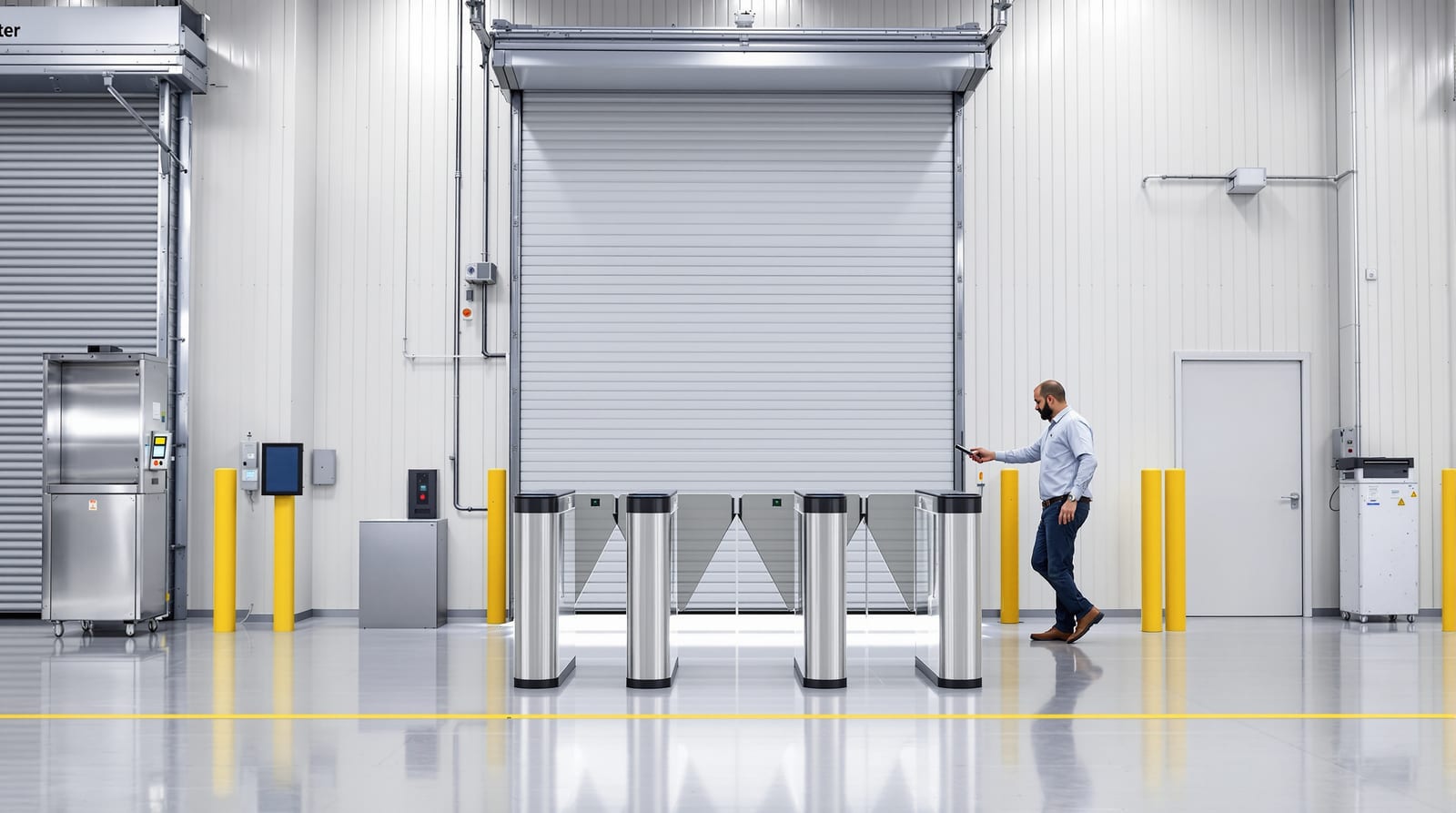
Warehouse Access Control in India 2026: Gates to Docks
How to design rugged, anti-tailgating access control for Indian warehouses and factories — personnel gates, dock doors, drivers, and WMS integration.
A modern Indian warehouse is a contradiction: it must stay porous enough to move thousands of pallets, trucks and contract workers a day, yet locked down tight against pilferage, unauthorised entry and safety incidents. Good warehouse access control resolves that contradiction by treating the site as a set of zones — public approach, driver yard, personnel entry, storage floor, high-value cage, hazardous store, and the dock line between inside and out — each with its own rule about who gets through, how, and when. This guide walks facility and security managers through designing that system for Indian conditions: dust, heat, power-cuts, high staff churn, and the non-negotiable legal duty to keep escape routes free. For the underlying technologies, pair this with our access control systems guide and the cluster's complete door guide.
Why warehouses need a different access model
Offices control a handful of glass doors for a stable, badged headcount. A warehouse instead juggles permanent staff, daily contract labour, third-party drivers, courier riders, auditors and vendors — often hundreds of distinct people a week, many never seen again. It also has openings an office never does: roller shutters, dock levellers, sectional doors and wide vehicle gates. The design problem is throughput under churn: you must enrol and de-enrol people fast, prove who was where for shrinkage investigations, and never let a credential become a single point of failure that stalls a shipment.
The governing principle is zoning by risk. Map the site, rate each area, and grant the minimum access each role needs. A picker needs the floor and the canteen, not the bonded store. A driver needs the yard and a specific dock, never the storage aisles. A maglock on the high-value cage is a different decision from a turnstile at the gate — and a shutter on an escape route is a life-safety decision before it is a security one.
| Zone | Typical risk | Access method | Who is allowed |
|---|---|---|---|
| Perimeter / vehicle gate | Intrusion, theft-by-vehicle | Boom barrier + ANPR/RFID, guard | Cleared vehicles, drivers |
| Personnel entry | Tailgating, ghost workers | Turnstile + card/biometric | Enrolled staff, contractors |
| Storage floor | Pilferage | Card reader on doors | Floor roles, supervisors |
| High-value / bonded cage | High-value theft | Biometric + two-person rule | Named custodians only |
| Hazardous / chemical store | Safety, compliance | Card + interlock, training gate | Trained, authorised only |
| Dock line | Loss at handover | Dock-door control + CCTV | Dock crew, assigned drivers |
Personnel gates and turnstiles
For people, the workhorse is the turnstile paired with a reader. Tripod turnstiles are the budget choice; full-height turnstiles (the rotating "cage") stop climb-over and tailgating outright and suit unmanned night shifts; speed gates (swing/sliding optical lanes) move large crowds at shift change but cost more and tailgate more easily without sensors. Whatever the lane, the credential decides the security level — see card access systems, RFID door access and face recognition access control.
Anti-tailgating
Tailgating — a second person slipping through on one swipe — is the classic warehouse breach. Defences, in rough order of strength: full-height turnstiles (mechanical, near-foolproof), optical lanes with directional infrared beam-break sensors, anti-passback rules in the controller (a card that entered cannot enter again until it has exited), and CCTV overwatch with analytics. For high-value zones, add a two-person rule so the controller refuses to unlock until two authorised cards present together.
Ruggedised readers
Indian warehouses are dusty and hot, and reader failure stops the line. Specify an IP65 (or better) ingress rating for outdoor and dock-side readers, a wide operating-temperature range, and a metal or polycarbonate housing. Capacitive fingerprint sensors struggle with the dry, calloused or grimy hands common on a floor; card, fob or face often read more reliably in that environment. Position readers under cover where you can, and budget for spares — a dead reader at a single-lane turnstile is a queue, not an inconvenience.
| Reader type | Throughput | Dust/grime tolerance | Notes |
|---|---|---|---|
| RFID card / fob | High | High | Cheap to re-issue; cards can be shared/lost |
| Fingerprint | Medium | Low | Hygiene + dirty-hand failures on the floor |
| Face recognition | High | High | Touchless, fast; DPDP duties on data |
| Mobile / BLE | High | High | No card to lose; needs phones + coverage |
Vehicle and dock-door access
The yard is where the most value crosses the line. At the gate, an automatic boom barrier driven by ANPR (number-plate recognition) or a long-range RFID windshield tag clears known vehicles without a guard leaving the cabin; everyone else stops for manual verification. Tie a gate event to the gate-pass in your system so a truck cannot leave without a closed-out movement.
At the dock, control the openings, not just the people. Sectional doors, roller shutters and dock levellers can be interlocked so a shutter only opens once a vehicle is parked and the loading job is authorised, and CCTV covers every handover. The dock is also where fire-egress law bites hardest, because shutters are big, motorised, and tempting to keep shut.
Contractor, visitor and driver management
The people who cause the most administrative pain are the temporary ones. A visitor management system (VMS) at the gate registers contractors and visitors, captures ID and photo, prints a time-limited badge, and — crucially — issues a temporary credential that auto-expires at end of day or job, so nobody is left with live access after they leave. See visitor management systems. Tie contractor entry to a safety induction: the access record can require a valid induction or work-permit before the turnstile releases.
Drivers are a special case — they belong in the yard and at one dock, never on the floor. Issue them a separate driver credential or QR pass scoped to the yard zone, log arrival against the appointment, and use the dock-door interlock so they cannot wander inside. Couriers and last-mile riders get an even narrower, kiosk-style check-in. Across all three, the audit trail is the payoff: when stock goes missing, a clean log of who was in which zone and when is your first investigative tool — covered in access control audit logs.
Integration: attendance, WMS and BMS
Access control earns its keep when it stops being an island. The same card swipe that opens the personnel gate can feed payroll attendance, killing the "ghost worker" and proxy-punch problem in one move. Pushed the other way, integration with your WMS lets a dock door open only when a confirmed inbound/outbound job exists for that bay, and a gate-out event close the gate pass automatically.
For larger sites, hook the access controllers into the building management system so a fire alarm releases maglocks and shutters on escape routes, and so HVAC, lighting and intrusion alarms coordinate by occupancy — see access control and BMS integration. Choose controllers that speak open protocols (Wiegand/OSDP for readers, an API or ONVIF/REST layer upstream) so you are not locked to one vendor. Model the spend before you commit using our access control cost estimator and the access control system designer.
| Component (per door/lane, installed) | Indicative ₹ band |
|---|---|
| Networked controller / panel | ₹8,000 – ₹30,000 |
| Ruggedised card/face reader | ₹3,000 – ₹15,000 |
| Tripod turnstile | ₹35,000 – ₹90,000 |
| Full-height turnstile | ₹1,20,000 – ₹3,50,000 |
| Boom barrier + ANPR | ₹1,50,000 – ₹6,00,000 |
| UPS / battery backup for controllers | ₹10,000 – ₹50,000+ |
Figures are indicative bands before 18% GST; large sites are project-engineered and quote-driven, so engage an integrator early.
Power, reliability and the fire-egress law
Three Indian realities decide whether your system actually works. Power-cuts: every controller and reader must sit behind a UPS or battery backup, and the door hardware's fail mode must be deliberate. Maglocks are fail-safe — they release on power loss — which is exactly what you want on an escape route but a theft risk on a perimeter cage during an outage; electric strikes can be fail-safe or fail-secure. Decide each opening on its own merits with our fail-safe vs fail-secure guide and the fail-safe vs fail-secure selector.
Free egress is the law. Under NBC 2016 fire and life-safety provisions, any access-controlled door, gate or shutter on a designated escape route must allow people to get OUT without a credential, and must release automatically on a fire-alarm signal. Never wire a maglock or motorised shutter on an exit path without that fire-alarm release and a manual break-glass override — it is both a legal duty and the difference between an incident and a tragedy.
Data privacy. Biometric templates and CCTV footage are personal data under the DPDP Act 2023. Collect only what you need, secure it, set retention limits, and tell people. For face or fingerprint at scale, document your lawful basis. When in doubt — on wiring, interlocks, hazardous-area certification, or fire release — bring in a licensed electrician and a qualified integrator; isolate power before any work. For the broader picture see our office access control and door automation guides.
Frequently asked questions
How do I stop tailgating at a busy shift change?
Full-height turnstiles physically prevent it and suit unmanned shifts; for high-throughput optical lanes, add directional infrared beam-break sensors plus anti-passback rules in the controller, and back it with CCTV analytics. For high-value zones add a two-person rule.
Which readers survive a dusty, hot Indian warehouse?
Specify IP65-or-better outdoor/dock readers with a wide temperature range and a rugged housing. Card, fob or face readers usually outperform fingerprint on the floor, where dry, calloused or grimy hands cause read failures. Keep spares for single-lane gates.
Can access control feed our attendance and WMS?
Yes — that is the main payoff. The personnel-gate swipe can push attendance to payroll (ending proxy-punch and ghost workers), and WMS integration can gate dock-door opening to confirmed jobs. Choose controllers with open protocols (OSDP/Wiegand, API/ONVIF) to avoid lock-in.
What happens to the doors during a power-cut?
It depends on the hardware's fail mode by design. Maglocks are fail-safe (release on power loss) — right for escape routes but a risk on perimeter cages — while electric strikes can be either. Put every controller on UPS/battery backup and choose each opening's fail mode deliberately.
Are there legal rules for shutters and gates on exits?
Yes. NBC 2016 requires free egress on escape routes: any access-controlled door, gate or motorised shutter on an exit path must let people out without a credential and must release automatically on a fire alarm, with a manual override. This overrides any security preference.
How do we manage drivers and contractors safely?
Use a visitor management system to register them, capture ID, and issue time-limited credentials that auto-expire. Scope drivers to the yard and one dock via zoning and dock-door interlocks, gate contractor entry on a valid safety induction or work permit, and keep a full audit log for investigations.
Export this guide
Related Guides — Deep-dive reading
Fail-Safe vs Fail-Secure Locks: The Guide (India 2026)
Why fail-safe vs fail-secure is the single most important access-control decision, and how to get it right for every door.
Home Doors & EntrancesAccess Control Maintenance in India (2026): Readers, Locks and Fail-Safe Egress
How to keep a card, keypad, fingerprint or face access-control system reading reliably and locking securely — and, above everything, how to test that its doors still release on a fire alarm and on power loss, so an access-controlled door never becomes a life-safety trap.
SecurityAccess Control System Cost in India (2026): Priced Per Door, Per System, Per User
What a building-scale access control system actually costs in India — broken down per controlled door (reader, electric lock, controller, cabling and power) and per system (software, licences, integration and AMC) — with the standalone-versus-networked split, how the bill scales with the number of doors and the credential you choose, and the non-negotiable rule that escape-route doors must fail safe.
SecurityRelated Tools — Try Free
Gate Access Planner
Size a vehicle gate or boom barrier — lanes needed at peak and the right credential speed (RFID, ANPR, manual).
Gate FlowSecurity System Cost Estimator
Estimate the all-in capex with GST, annual running cost and 5-year total cost of ownership of a home or building security system.
Cost EstimatorAccess-Control Battery-Backup Calculator
Size the standby battery so an access system keeps running through a power cut, with an egress life-safety note.
Battery Backup