
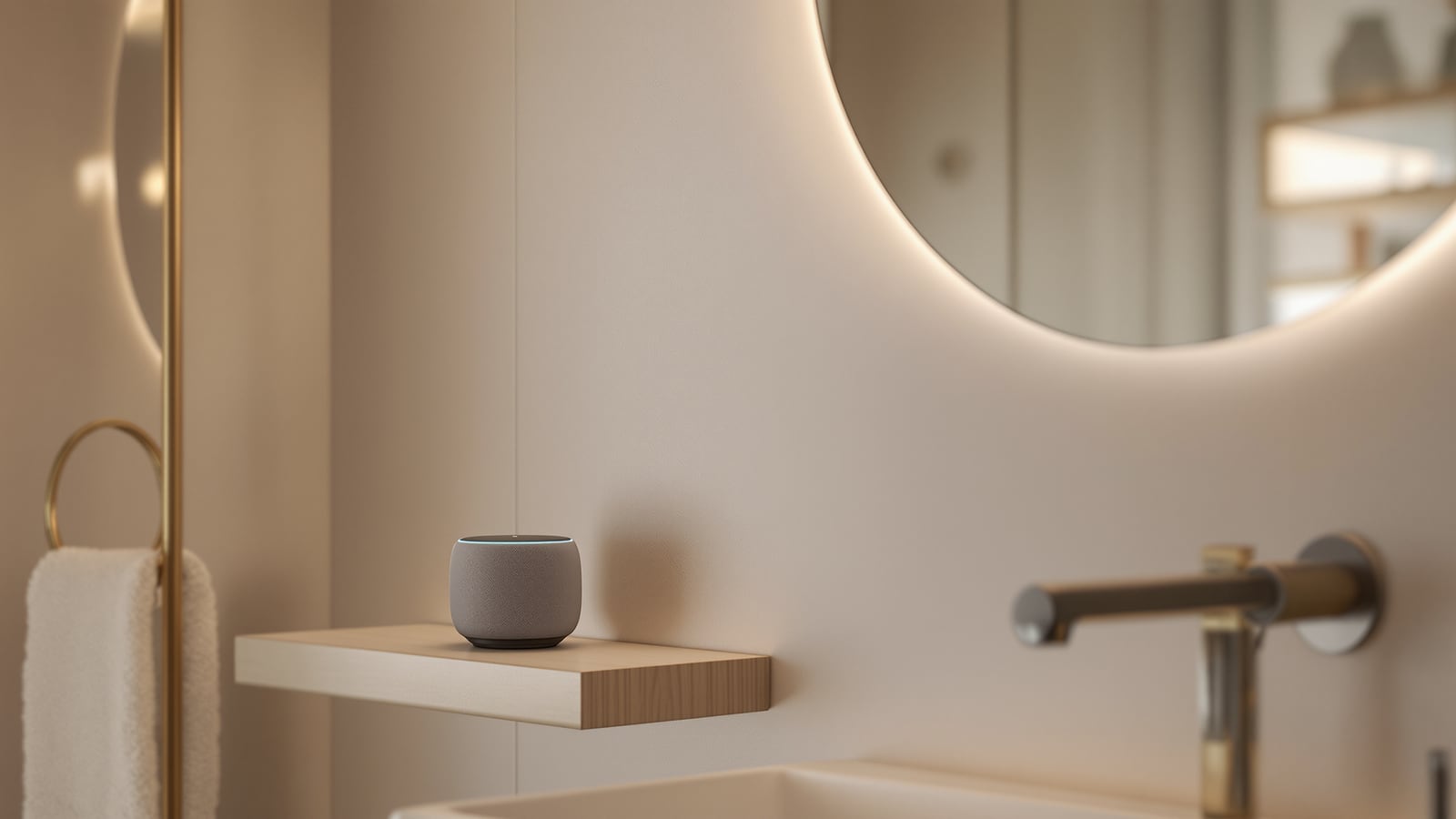
Voice Controlled Bathroom India: Waterproof Smart Speaker, Hands-Free Lights, Shower & Geyser, Privacy & Cost
A practical India-first guide to voice control in the bathroom — a splash-rated smart speaker or voice-enabled mirror that turns lights, music, exhaust fan, geyser and even the shower on and off hands-free — plus the microphone and privacy questions, the humidity and IP durability the device must survive, whether your Wi-Fi even reaches the wet corner of the house, which tasks genuinely benefit, the real accessibility win for elderly and disabled users, and what it all costs.
There is a moment every Indian homeowner recognises: hands wet, soap-slick or shampoo-covered, and you want the light brighter, the music louder, the exhaust fan on, or the water a little warmer — and you either touch a switch you should not touch with wet hands, or you drip across the floor to reach it. Voice control answers exactly that moment. A splash-rated smart speaker or a voice-enabled mirror sits on the wall, hears "turn on the lights," "play some music," "start the geyser," and does it while your hands stay where they are. For a growing slice of Indian homes — premium apartments, villas, and any household with an elderly or disabled member — this has stopped being a gadget and become a genuinely useful, sometimes life-changing, part of the connected bathroom.
The catch is that a bathroom is the worst room in the house for a microphone-carrying, mains-powered, network-dependent electronic device. It is the most humid, hardest-water, most privacy-sensitive corner of the home, and often the farthest from your Wi-Fi router. Put a voice assistant there without thinking about IP durability, mic privacy, network reach and which tasks actually benefit, and you get a device that mishears you over the shower, fogs and fails in a monsoon, or listens where you least want to be heard. This guide explains what voice control in the bathroom really does, what genuinely benefits from it, how to keep it alive and private in Indian conditions, and what it costs.
This sits inside the Studio Matrx bathroom hub. For the full connected-bathroom picture read the smart bathroom guide for India and the wider smart home guide; to put voice onto the fixtures themselves, pair this with smart bathroom lighting and the smart bathroom mirror; and if your priority is an ageing parent, read it alongside accessible bathroom design for India, where hands-free control is not a luxury but independence.
Decide the jobs before the device. Voice control is worth it only where hands-free genuinely helps — lights, music, exhaust, geyser, timers — and only if you first protect the mic's privacy, put the device in the dry zone, confirm Wi-Fi reaches the wall, and defend it against humidity. Get those four right and it earns its keep; skip them and it is an expensive novelty that mishears you over the shower.
What "voice control" in the bathroom actually means
There is no single "voice bathroom." You are assembling two layers: a device that hears you, and the fixtures it can command. Know both before you buy.
- The listener. Either a standalone waterproof/splash-rated smart speaker (Alexa or Google Assistant built in), a voice-enabled smart mirror with a mic and speaker behind the glass, or your existing phone/watch paired to a Bluetooth speaker. The standalone speaker is the common, robust choice.
- The muscle. Voice can only switch things that are themselves smart: smart switches or a smart relay behind the light circuit, a smart plug or Wi-Fi geyser for the water heater, a smart exhaust-fan switch, smart LED mirror lighting, and — at the top end — a digital shower valve with app/voice control. The speaker is useless without at least one of these wired in.
- The bridge. The assistant's cloud (Amazon/Google) plus your home Wi-Fi tie the two together. Every command is a round trip: your voice to the cloud and back to the fixture. No network, no voice control — an Indian reality worth dwelling on, because bathrooms sit at the far edge of home Wi-Fi.
Which tasks actually benefit — and which do not
Not every bathroom job is worth speaking to. Hands-free earns its keep only where your hands are genuinely busy, wet, or unable. Be honest about this before you spend.
| Task | Voice worth it? | Why |
|---|---|---|
| Lights on / off / dim | Yes | Wet hands, no touching switches; dimming a warm scene for a soak |
| Music / radio / podcast | Yes | The single most-used feature; no phone at risk near water |
| Exhaust fan on / timer | Yes | Hands-free after a hot shower; "run the fan for 20 minutes" |
| Geyser / water heater on | Yes | Start it from the toilet before you shower; saves the pre-heat wait |
| Timers, alarms, weather, news | Yes | Genuinely handy while brushing or shaving |
| Shower start / temperature | Only with a digital valve | Premium only; convenient but rarely essential |
| Flush / bidet / taps | Rarely | Novelty; mechanical or sensor controls are simpler and cheaper |
- The daily winners are light, sound, fan and heat. These are the four things you reach for with wet or busy hands, several times a day. If a voice setup does only these well, it has paid for itself.
- Starting the geyser by voice suits Indian homes with load-shedding-era habits of switching the heater on 10-15 minutes before a bath — say it from the bedroom or toilet and skip the wait. Pair a smart plug or Wi-Fi geyser and keep its own thermostat and safety cut-out intact.
- Voice-started showers need a digital/thermostatic shower valve and are firmly premium territory. Lovely to demo, but a good thermostatic mixer with a lever does the same job for a fraction of the cost.
- Voice flush or taps are mostly novelty. A sensor tap or a simple dual-flush is cheaper, more reliable and needs no cloud. Don't voice-enable a task that a 200-rupee mechanism already solves.
Privacy and the microphone — the question India asks first
An always-listening microphone in the bathroom is the concern that stops most buyers, and rightly so. It deserves a clear-eyed answer, not a shrug.
- How it listens. Mainstream assistants (Alexa, Google) process audio locally for the wake word and only stream to the cloud after they hear it. But they can and do mis-trigger, and the recording then leaves your home. In the bathroom, of all rooms, that matters.
- What you can do. Choose a device with a physical mic-mute switch and use it. Mute during private moments and un-mute to give a command. Review and auto-delete voice history in the app, and turn off "save recordings for improvement." Keep firmware updated.
- Prefer local where you can. Local-control ecosystems (for example a Home Assistant or Zigbee/Matter setup, or push-button-then-listen devices) reduce cloud exposure. A Bluetooth speaker paired to your phone, with no built-in mic, is the most private option of all — you lose true hands-free wake-word control but keep music and phone-based voice.
- Site it, and children, sensibly. Do not point a camera-bearing device into the bathroom at all. For a shared or children's bathroom, weigh whether an always-on mic belongs there, and default it to muted.
Humidity, IP durability and Wi-Fi — the three Indian survival tests
A voice device that thrives in a dry study can die in an Indian bathroom in a couple of monsoons. Three physical realities decide whether it lasts.
- Humidity is the quiet killer. Steam and monsoon damp corrode circuit boards and clog the mic mesh over time. Keep the device out of the direct steam path, and pair it with a properly sized bathroom exhaust fan and good ventilation so the room dries fast after every bath.
- IP rating and placement beat everything. Choose a speaker rated at least IPX4 (splash-resistant) if it will live near water; IPX7 exists for shower-zone units. But the smarter move is placement — mount any listener in the dry zone, away from the shower and health-faucet arc, so its rating is a backstop, not the front line.
- Mains safety still applies. Any mains-powered device or its smart switch must sit on a bathroom circuit with 30 mA RCCB / earth-leakage protection per IS 732 and NBC 2016 wet-zone rules — read the bathroom electrical safety guide before wiring anything. A low-voltage speaker on a USB adaptor still needs the adaptor kept out of the wet zone.
- Wi-Fi must physically reach the wall. This is the most-missed check. Stand where the device will go and run a signal test on your phone. Bathrooms are behind thick walls at the building's edge; if the signal is weak, add a mesh node or repeater nearby before you buy, or the assistant will "not respond" mid-shower.
The accessibility win — where voice control truly matters
For most homes voice control is convenience. For an elderly, arthritic, low-vision or wheelchair-using member, it is independence — and this is the strongest reason on this page to fit it.
- No switch to find or reach. Someone who cannot bend to a low switch, grip a knob with arthritic hands, or see a control in dim light can still say "lights on," "warm water on," "fan off." That removes a daily dependence on another person.
- Fewer wet-floor trips. Reaching across a wet bathroom for a switch is a leading fall risk for older users. Voice control keeps them where they are — pair it with the grab bars, seating and non-slip surfaces in the accessible bathroom design guide.
- Routines and reminders help too. A voice assistant can run a "bath time" routine — light, fan, warm water, a favourite radio station — on one spoken phrase, and can call a family member's phone hands-free in a fall, if paired with the right skill and, ideally, a dedicated emergency device.
- Keep a manual fallback. Voice must never be the only way to control a fixture. Wi-Fi drops, the cloud has outages, a voice can fail in illness. Every voice-controlled light, fan and heater should keep a physical switch that works when the network does not.
What it costs in India
Voice control scales from a few thousand rupees to lakhs, depending on how much "muscle" you make smart. The listener is cheap; making the fixtures respond is where the money goes.
| Setup | Typical cost (₹) | What you get |
|---|---|---|
| Bluetooth speaker + phone assistant | 2,000 - 6,000 | Music and phone-based voice; no built-in mic, most private |
| Splash-rated smart speaker (Alexa/Google) | 4,000 - 12,000 | Standalone hands-free voice, always-listening mic |
| + Smart switches for lights & fan | 600 - 2,500 each | Voice/app control of existing circuits |
| + Smart plug or Wi-Fi geyser control | 1,200 - 6,000 | Voice-started water heater |
| Voice-enabled smart mirror | 25,000 - 1,00,000+ | Mic, speaker, display and lighting in one |
| Digital/voice shower valve | 60,000 - 3,00,000+ | Premium hands-free shower start and temperature |
- Start small and prove the value. A splash-rated speaker plus one or two smart switches for lights and the exhaust fan is a few thousand rupees and covers the daily winners. Live with that before spending on mirrors or digital showers.
- Budget for the network, not just the device. A mesh node or repeater to get Wi-Fi to the bathroom (₹2,000 - 6,000) is often the real enabling cost, and it benefits the whole home.
- Weigh it against a good LED mirror or timer switch. For many buyers, smart bathroom lighting on a simple timer or motion sensor, plus a Bluetooth speaker, delivers most of the benefit without an always-on mic. Reserve full voice for the accessibility case, or where you will truly use it every day.
Fit voice control for the right reasons — the daily hands-free wins and, above all, the independence it gives an older or disabled family member — and plan the mic privacy, IP durability, wet-zone placement and Wi-Fi reach first, and a voice-controlled bathroom becomes one of the most quietly useful upgrades in the Studio Matrx connected home. Fit it as a showroom trick and it is an expensive speaker that mishears you over the shower.
References
- National Building Code of India (NBC) 2016, Part 8 (Building Services) — electrical installations and wet-area zoning relevant to powered bathroom devices.
- IS 732: Code of Practice for Electrical Wiring Installations — earthing and 30 mA RCCB / earth-leakage protection for bathroom circuits.
- IEC 60529 (IP Code), adopted in India as IS/IEC 60529 — the IP / IPX ingress-protection ratings referenced for splash- and water-resistant devices.
- Bureau of Indian Standards (BIS) — product safety and marking for electrical appliances and adaptors used in Indian homes.
- Harmonised Guidelines and Standards for Universal Accessibility in India (CPWD / MoHUA) — accessible-design principles supporting hands-free control for elderly and disabled users.
Export this guide
Related Guides — Deep-dive reading
Smart Bathroom Mirror India: Touch Display, Voice, Defogger, Cost & Is It Worth It
A practical India-first guide to smart bathroom mirrors — the embedded touch display showing time, weather and news, the Bluetooth speaker, voice assistant, mood-lighting scenes and defogger — plus the power and optional data point behind the glass, the IP and electrical safety it demands, how hard water and monsoon humidity decide whether it lasts, and whether it is really worth the money over a good LED mirror.
BathroomsSmart Toilet India: Electronic Bidet Seats, Washlets, Cost & The Point Beside the WC
A practical India-first guide to smart toilets and electronic bidet seats — warm-water wash, warm-air dryer, heated seat, auto lid, deodoriser and night light — plus the electrical point, water tapping and IP protection you must plan beside the WC, and how hard water and voltage swings decide whether yours lasts.
BathroomsDigital Shower India: Smart App-Controlled Showers, Presets, Costs & Whether It's Worth It (2026)
A digital or smart shower sets an exact temperature and flow from a control panel or phone app, with the mixing brain hidden in the ceiling or wall. How they work, presets per user, remote start and warm-up-pause water saving, the electrical and plumbing you need, and the hard-water and voltage caveats that decide whether it survives an Indian bathroom.
BathroomsRelated Tools — Try Free
Electrical Safety & Load Audit
Home electrical audit — 10 categories, 65+ checkpoints across earthing, RCCB, MCB, wiring, switchboards, appliance circuits, DG/inverter backup.
Safety AuditChild & Elder Home-Safety Audit
Room-by-room safety audit for households with children or seniors — 10 categories, 70+ checkpoints tagged by audience.
Safety AuditBefore vs After — Cost Reality Check
Compare what you expected to pay vs what you actually paid, category by category.
Reality Check