
Smart Bathroom Lighting India: App & Voice Control, Tunable White, Scenes & Safe Wiring
A practical India-first guide to smart bathroom lighting — app and voice control, tunable-white grooming and relax-bath scenes, occupancy and time automation, dimming, and how to layer mirror, cove and spot lighting safely in a wet, humid, load-shedding home.
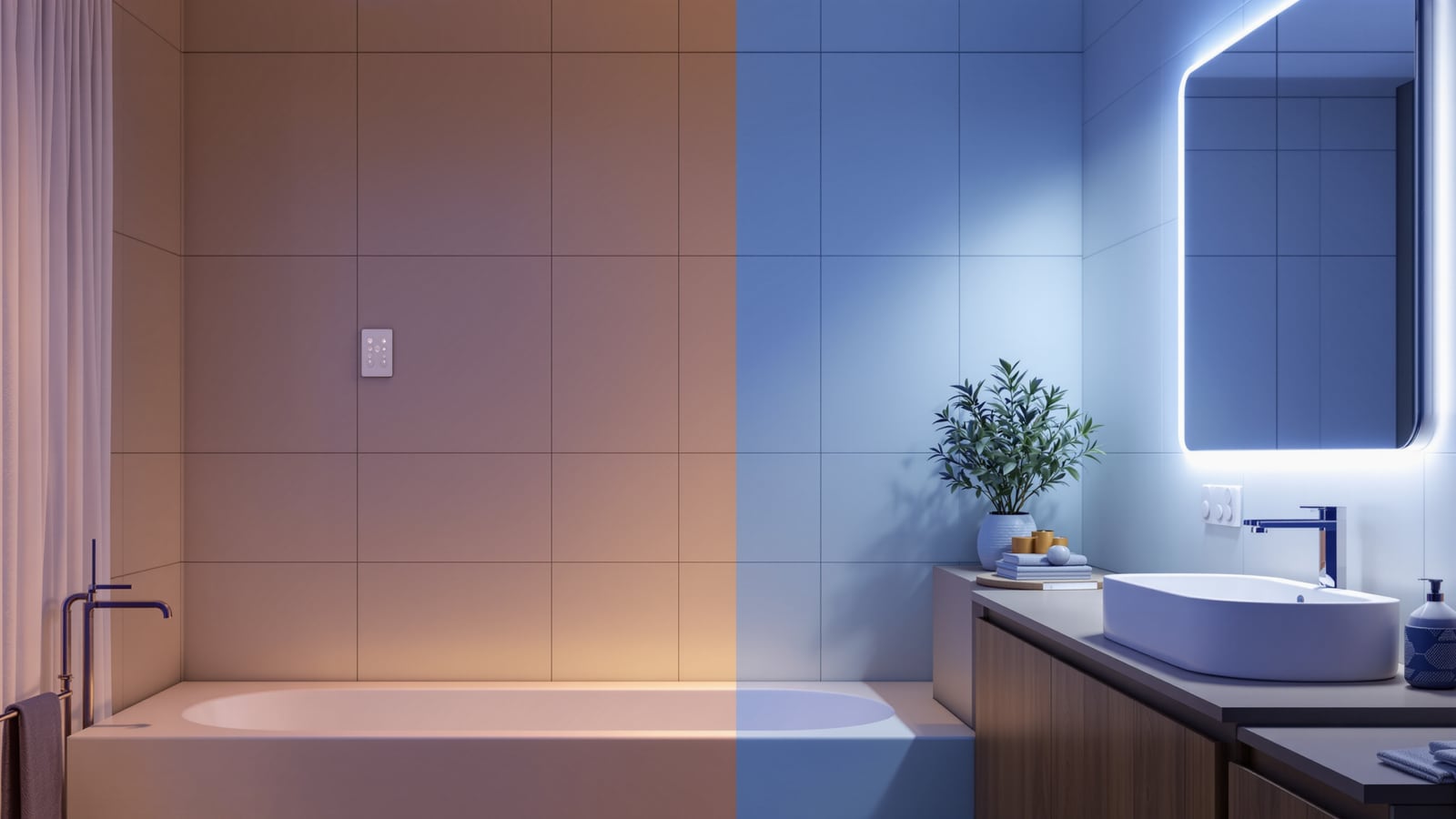
The bathroom is the one room where the light you want changes completely through the day. At 7 a.m. you want a crisp, cool, shadowless light to shave, apply make-up or check your skin. At 10 p.m., soaking in the tub or winding down, that same light feels like an interrogation. Ordinary switches force one compromise for both. Smart bathroom lighting solves this properly: one set of fixtures that shifts colour temperature, brightness and grouping on cue — from a wall keypad, your phone, your voice, or entirely on its own as you walk in.
Done well, it is one of the highest-satisfaction upgrades in an Indian home because you use the bathroom several times a day and feel the difference every time. Done badly — smart bulbs on a switch someone keeps turning off, a fitting that fogs up, an app that will not connect after a power cut — it is a daily irritation. This guide explains what smart bathroom lighting actually gives you, how to layer it across mirror, cove and spot lighting, and the India-specific wiring, IP-zone, neutral-wire and reliability realities that decide whether it is a joy or a regret.
This guide sits inside the Studio Matrx bathroom hub. For the fundamentals of fixtures, layers and lux read the bathroom lighting guide for India; for the wider connected-bathroom picture see the smart bathroom guide for India; for sensor-first control read the guide to motion-sensor bathroom lighting; and to fit all of this into a whole-home system see the smart home guide.
Decide the scenes you want first — a bright grooming scene and a warm relax-bath scene are enough for most homes — then choose fixtures that dim smoothly and a control layer that survives a power cut. The hardware is easy; the neutral wire, the IP zone and the hard-reset behaviour are what you must get right.
What "smart" adds to bathroom lighting
Smart lighting is not just a bulb you switch on with an app. The genuinely useful capabilities are:
- Tunable white (CCT). A single fitting shifts from warm (about 2700K) through neutral (4000K) to cool daylight (5000–6500K). This is the star feature for a bathroom: cool and bright to groom, warm and low to relax. Ignore RGB colour — it is a party trick in a bathroom; tunable white is what you use every day.
- Dimming. Smooth, flicker-free dimming from full down to a soft 5–10% night level. A dim warm glow for a 3 a.m. visit means you never hit the harsh main light.
- Scenes. One tap or one phrase recalls a saved combination — which fittings are on, at what brightness and colour. "Grooming", "Relax", "Night" and "Cleaning" cover almost every household.
- Automation. Lights respond to occupancy sensors, time of day and door contacts without you touching anything — walk in and the right scene appears, walk out and it fades off after a delay.
- App and voice control. Adjust from your phone, or say "warm bathroom lights" to Alexa or Google Home. Useful, but treat voice and app as extras on top of a physical control, never the only way to switch a light on.
The three layers, made smart
Good bathroom lighting is layered, and each layer earns its keep once it can be dimmed and tuned independently. For the full treatment of the layers themselves see the bathroom lighting guide; here is how they behave when smart.
- Mirror lighting. The most-used layer and the one that most benefits from tunable white — cool for make-up and shaving, warm for evenings. Either a backlit LED mirror with built-in CCT control, or vertical fittings either side of the mirror on a smart channel.
- Cove and ambient. Concealed LED strip in the false-ceiling cove or under a floating vanity, giving soft indirect light. Kept warm and dimmable, this is the whole "relax-bath" mood in one channel. If you are still planning the ceiling, coordinate this with your false ceiling design so the strip and driver have a service point.
- Spotlighting. Recessed downlights over the WC, shower or a feature wall. Smart control lets you keep only the shower spot on for a quick wash, or bring everything up for cleaning.
Two ways to make lights smart
There are two architectures, and choosing wrongly is the most common mistake in Indian bathrooms.
| Approach | How it works | Best for | Watch out for |
|---|---|---|---|
| Smart bulbs / smart fittings | The bulb or LED mirror has the radio and dimming built in; the wall switch must stay ON permanently | Retrofits, rented flats, single fittings | Anyone flipping the wall switch off kills control; needs a smart or retained switch |
| Smart switch / dimmer module | A smart module behind the switch or in the ceiling controls ordinary dimmable LEDs | New builds, whole-bathroom control, keeping normal-looking switches | Needs a neutral wire at the switch box; must be rated for the load and damp location |
| Smart relay/dimmer in false ceiling | DIN or module dimmers near the driver, wired to a keypad | Cove strips, multiple channels, clean walls | Needs an accessible, dry, ventilated service point above the ceiling |
For a bathroom, the smart switch or in-ceiling module route is usually better: your wall switch still works normally for guests and elders, but the same circuit is app- and voice-controllable and automated. Smart bulbs suit a rented flat or a single mirror you cannot rewire.
The neutral-wire caveat — the one that catches people
Most smart switches and dimmer modules need a permanent live and a neutral at the switch box to power their own electronics. A lot of older Indian wiring runs only the live (phase) loop to the switch and takes the neutral straight to the fitting — so the switch box has no neutral. Without it, many smart switches simply will not work, or work unreliably with LED loads.
- On a new build or full renovation, tell your electrician to bring a neutral to every switch box you may want to make smart. It costs almost nothing at the wiring stage and is expensive to add later.
- On a retrofit with no neutral, use either a smart switch designed as no-neutral (with limits and possible LED flicker), or move the smart module into the ceiling/junction box beside the driver where a neutral is available, or use smart fittings and keep a retained wall switch.
- Match the dimmer to the LED driver. A dimmable smart module still needs dimmable LED drivers; pairing a smart dimmer with a non-dimmable driver causes flicker, buzz or no dimming. Confirm compatibility before you buy the fittings.
Safety, IP zones and wet-area rules
A bathroom is a special location under wiring practice, and smart hardware does not change the physics. Follow IS 732 for wiring and the NBC 2016 provisions for bathrooms, and treat the room as protected IP zones.
- Keep switches and modules out of the wet zones. Smart switches, dimmer modules and any socket belong on the dry side, ideally just outside or by the door. Never mount a switch within reach of the shower or tub.
- Match IP to position. A mirror light on the dry wall wants IP44 or better; a spot over the shower or in the ceiling above a wet zone wants IP65. Buy the fitting for where it goes, not the cheapest one.
- RCCB / earth leakage protection. The bathroom circuit must be on a 30mA RCCB (residual-current device) and properly earthed. This protects you regardless of how "smart" the lights are.
- Low voltage in the wettest spots. For strip and spot lights right at the shower or tub, prefer SELV (extra-low-voltage) LED run from a driver mounted in a dry location.
Automation that actually helps
The point of smart is that you stop thinking about it. Sensible automations for an Indian bathroom:
- Occupancy in. A PIR/microwave occupancy sensor triggers the grooming scene by day and a dim warm scene after 10 p.m. — the classic hands-free entry. Detailed choices are in the motion-sensor bathroom lighting guide.
- Auto-off with delay. Lights fade off a few minutes after the room empties — the single biggest energy saver in a shared or guest bathroom where lights get left on.
- Time-of-day colour. Cool bright mornings, warm dim nights, set automatically so you never adjust colour by hand.
- Circadian night-light. A very dim warm floor or under-vanity glow from 11 p.m. to 5 a.m. so no one wakes fully at night.
Reliability: power cuts and the hard reset
This is where Indian conditions bite, and where cheap kit fails.
- Behaviour after a power cut. When power returns, a well-designed smart light should come back to the state it was in, or stay off — never blaze on at full at 3 a.m. Check the "power-on behaviour" setting exists before you buy; set it to "off" or "restore last state".
- Local control that survives the router. Wi-Fi-only bulbs die when your internet or router is down — and Indian broadband and power both drop. Prefer systems with a local hub (Zigbee, Thread/Matter) so switches and scenes keep working offline, with the cloud/app as a bonus, not a dependency.
- A physical control always. Every smart light must have a way to turn on that does not need a phone — a keypad, a retained switch — so a guest, a child or an elder is never locked out by a dead app.
- Hard-reset and re-pair. Know how each device factory-resets and re-pairs, because after enough power cuts or a router change you will need it. Buy from a brand with in-India support and firmware updates, not a no-name import.
- Protect the driver. LED drivers and modules dislike heat and voltage swings. Mount them in a ventilated, dry, accessible spot, and protect sensitive circuits where mains quality is poor.
What it costs in India
Indicative 2026 supply costs; installation and wiring extra. Treat as planning ranges, not quotes.
| Component | Typical cost (₹) | Notes |
|---|---|---|
| Smart tunable-white bulb (per lamp) | 500 – 1,500 | Retrofit, needs retained switch |
| Backlit tunable LED mirror (600–900mm) | 8,000 – 30,000 | Grooming layer; built-in CCT + touch dimming |
| Smart switch / dimmer module (per gang) | 1,500 – 5,000 | Needs neutral; keeps normal switch feel |
| IP65 smart spot (per fitting) | 900 – 3,000 | For wet-zone / ceiling positions |
| Occupancy/PIR sensor | 800 – 3,500 | Hands-free automation |
| Local hub (Zigbee/Thread/Matter) | 3,000 – 9,000 | Offline reliability; shared across the home |
| Typical one-bathroom smart lighting | 12,000 – 60,000 | From a mirror + smart switch up to full layered scenes |
A sensible starter that gives you 80% of the benefit: a tunable backlit mirror plus a smart dimmer on the cove/ambient circuit, both tied into a hub with an occupancy sensor. That alone delivers the grooming-vs-relax split and hands-free entry. Layer in spots and voice later. To fold the lighting into a wider connected home — including linking it to your smart bathroom fixtures — see the smart home guide.
Smart bathroom lighting is not about gadgetry — it is about a bathroom that gives you exactly the light you want at 7 a.m. and at 10 p.m. from the same fittings, without you thinking about it. Get the scenes, the neutral, the IP zones and the reliability right, and it quietly becomes the feature of the room you would least want to give up.
References
- National Building Code of India (NBC) 2016 — Part 8 (Building Services) provisions for electrical installations, lighting and special locations such as bathrooms.
- IS 732: Code of Practice for Electrical Wiring Installations — general wiring, earthing and protection requirements, including bathrooms as special locations.
- IS 3646: Code of Practice for Interior Illumination — recommended illuminance levels and lighting design principles.
- IS/IEC 60529: Degrees of Protection Provided by Enclosures (IP Code) — how IP ratings such as IP44 and IP65 are defined and tested.
- IS 12640: Residual Current Operated Circuit Breakers (RCCBs) — earth-leakage protection devices for wet-area circuits.
- Bureau of Indian Standards (BIS) and Central Electricity Authority (CEA) safety regulations — for current electrical safety and installation rules in India.
Export this guide
Related Guides — Deep-dive reading
Lighting Controls & Dimming Design: Zones, Scenes & Switches (2026)
How to plan lighting control so an Indian home's light is flexible — split each room's layers onto separate switches, choose dimmers that actually work with LEDs, add two-way switching where you need it, and layer scenes on top. The design decisions you must settle before the electrician wires.
LightingBathroom Lighting India: The Complete Guide to Layers, Lux, Colour Temperature & IP Safety Zones (2026)
How to light an Indian bathroom properly — the three layers of ambient, task and accent light, the right lux levels and a neutral ~4000K colour temperature for grooming, the IP safety zones near water that decide which fitting goes where, waterproof fixtures, dimming and scenes, mirror lighting done right, motion sensors and energy.
BathroomsBathroom Mirror Lighting India: Shadow-Free Vanity Light, Colour Temp, CRI & Cost (2026)
Why a single ceiling downlight throws ugly shadows on your face, how vertical sconces either side of the mirror beat a light bar above, when a backlit mirror is glow not task light, plus the colour temperature, CRI, mounting height, IP rating and 2026 rupee costs that actually get make-up and shaving right.
BathroomsRelated Tools — Try Free
Circadian Light Meter
Patient-centric circadian lighting visualizer for Indian healthcare design — time-of-day × intensity → CCT, melanopic lux (EML / mEDI), melatonin suppression, and an alertness curve. Calibrated against WELL v2 L03 Circadian Lighting Design, CIE S 026:2018, Brainard 2001, and Lucas et al. 2014.
Circadian ToolElectrical Safety & Load Audit
Home electrical audit — 10 categories, 65+ checkpoints across earthing, RCCB, MCB, wiring, switchboards, appliance circuits, DG/inverter backup.
Safety AuditFalse Ceiling Cost Estimator
Live ₹/sqft across 8 ceiling types — POP, gypsum, designer, metal, PVC, wooden — with cove and spot lighting for 20 Indian cities.
Cost Calculator