
Smart Bathroom Guide for Indian Homes: Mirrors, Geysers, Toilets & More
The device-by-device honest guide to a smart bathroom in India — defogging mirrors, scheduled geysers that are the single biggest energy saver, bidet seats, humidity-driven exhaust fans, leak detection and the waterproofing and electrical safety rules you must not skip.
The bathroom is the trickiest room to make "smart," and the most rewarding when you get it right. It is wet, it is small, and it hides the one appliance that quietly dominates your electricity bill in winter: the geyser. Get the geyser smart and you save real money every month. Get carried away with touchscreen mirrors and heated toilet seats and you spend a fortune on features you will show off once. This guide goes device by device, honest about Indian plumbing, Indian wiring and Indian prices — and it takes the safety warnings seriously, because water plus electricity is not a place to cut corners.
In a bathroom, the smartest device is almost never the flashiest. A ₹3,000 scheduling controller on your geyser will save you more, every winter, than a ₹40,000 smart mirror ever will.
Plan this alongside the ultimate guide to smart homes in India and the home automation guide for India. The energy logic behind geyser scheduling is expanded in the smart home energy management guide, and the same brands and choices apply in the kitchen — see the smart kitchen guide for India.
How to think about a smart bathroom
Rank bathroom smarts the same way you rank kitchen ones: safety and energy first, comfort second, novelty last. The geyser is your biggest lever. Humidity control protects your walls and your health. Leak detection protects your home. Everything else — mirrors, bidets, faucets — is comfort that is lovely if the budget allows but never the priority.
Smart water heater / geyser: the biggest energy saver
Start here, because this is where a smart bathroom pays for itself. In most Indian homes the geyser is the single largest electricity draw in winter, and the classic waste is leaving it on far longer than needed, or heating a full tank for one bath. A smart geyser or a smart plug controller on an existing geyser fixes this in the most impactful way possible: scheduling.
Set the geyser to heat for 20-30 minutes just before your usual bath time and switch off automatically. You get hot water exactly when you want it and never pay to keep a tank hot all morning. Brands: AO Smith and Racold sell app-connected geysers with scheduling and heat-time learning; alternatively, a ₹1,200 smart plug on any ordinary 15-litre geyser gives you 90 percent of the benefit for a fraction of the price. Add a wattage-measuring plug and you can see exactly what each bath costs.
Verdict: the highest-value smart device in the whole bathroom, and the one that returns its cost fastest — often within a single winter.
Smart mirror: defogging, lighting and display
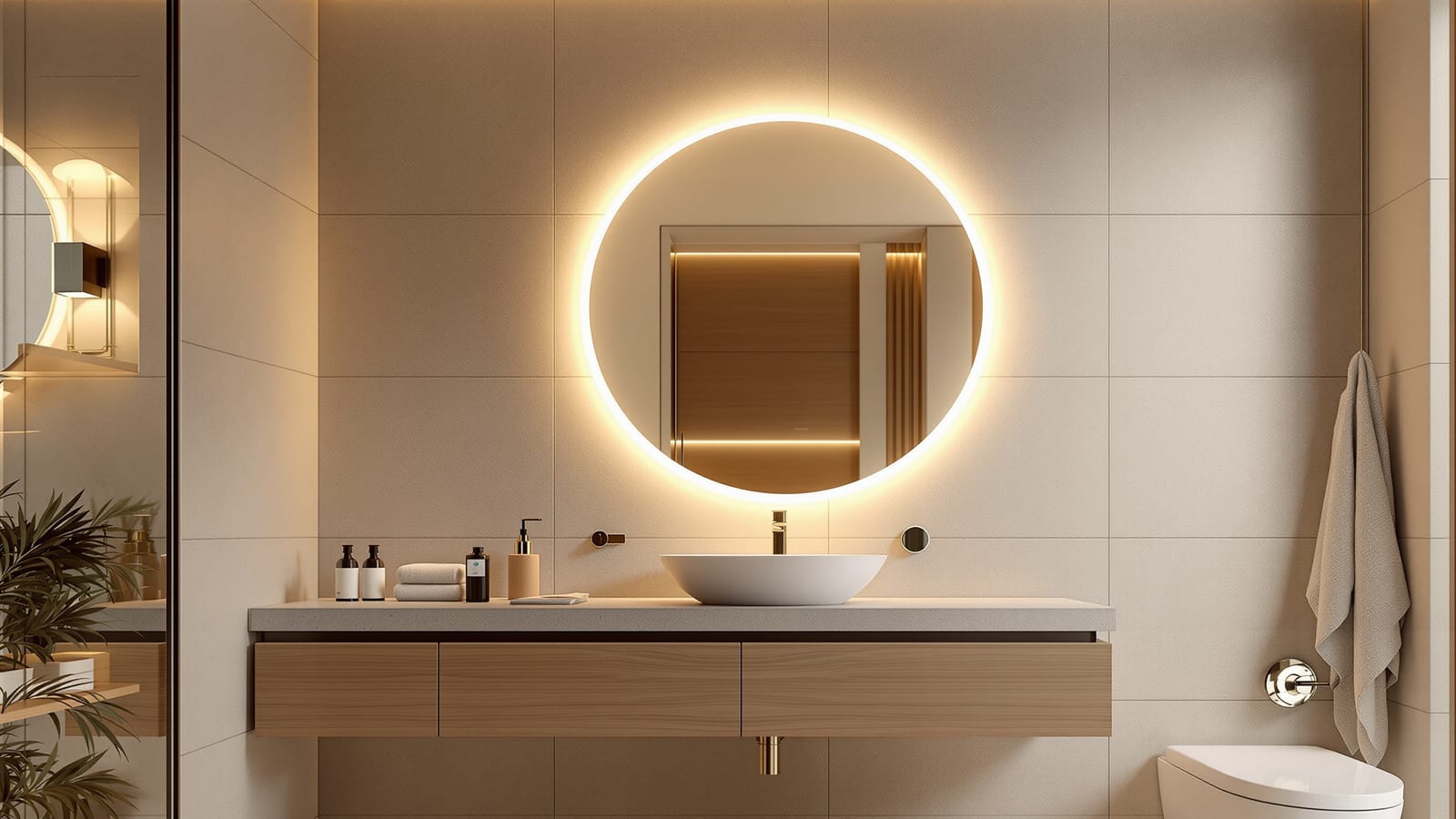
A smart mirror can mean three very different things. The genuinely useful features are the anti-fog heating pad (no more wiping after a hot shower) and adjustable backlighting with tunable white for grooming and makeup. These are worth it and reasonably priced. The built-in touchscreen display — showing news, weather, time — is where the price balloons and the usefulness collapses; you glance at it for a week and then never again. Brands: Kohler, Jaquar and several online sellers offer LED-backlit anti-fog mirrors at sensible prices; full "smart display" mirrors cost several times more. Verdict: buy the defog-plus-light mirror, skip the screen.
Smart toilet and bidet seat: Indian relevance
Full smart toilets (Kohler, Toto) with heated seats, auto-flush, warm-water wash and air-dry are lovely in a luxury bathroom, but two India-specific cautions matter. First, they need a dedicated water supply and a power socket near the WC — retrofitting both into an Indian bathroom is often the real cost. Second, our variable water pressure and hard water can trouble the wash nozzles. A more sensible middle path for most homes is a smart or electronic bidet seat that fits onto your existing Indian or European WC and adds a warm-water wash and heated seat for a fraction of the price. Given that many Indian households already use a health faucet, a full smart toilet is a genuine luxury indulgence, not a necessity. Verdict: bidet seat is a reasonable comfort upgrade; a full smart toilet is a luxury only if plumbing and power are already provisioned.
Smart shower and thermostatic control
A thermostatic shower or digital shower holds your water at a set temperature so the blast of cold or scalding hot when someone opens a tap elsewhere disappears. Jaquar, Grohe and Kohler sell thermostatic mixers; fully digital app-controlled showers are premium and rare here. The thermostatic mixer itself is a worthwhile comfort and safety feature (protects children and elders from sudden hot water); the app-controlled digital shower is mostly novelty in India today. Verdict: a thermostatic mixer is worth it in a well-used bathroom; the connected digital shower is skippable.
Smart exhaust fan and humidity automation
This is an underrated winner. Indian bathrooms battle mildew, and the fix is running the exhaust fan long enough after a shower — which people forget. A humidity-sensing exhaust fan (or an ordinary exhaust fan wired through a smart switch with a humidity sensor) turns on automatically when moisture rises and off when the air clears. This quietly protects your paint, ceiling and grout from black mould, and improves air quality. Verdict: genuinely useful, cheap, and it solves a real Indian problem. Pair it with occupancy lighting for a fully hands-free bathroom.
Smart faucets and leak detection
Smart or sensor faucets (touchless taps) reduce water waste and are hygienic, especially in shared or elder-friendly bathrooms; they are a modest, sensible upgrade rather than a must-have. Far more important is leak detection: a small water-leak sensor on the floor near the WC, under the washbasin and behind the geyser catches slow leaks and overflow before they seep into walls or the flat below. Given how much Indian bathroom trouble comes from unseen seepage, this cheap sensor earns its place. Verdict: leak sensor yes; sensor faucet is a nice-to-have.
Occupancy lighting and exhaust automation
A motion or occupancy sensor that switches the bathroom light (and optionally the exhaust) on entry and off after you leave is one of the small delights of a smart home. Set the night mode to a dim warm 10 percent so a 3am visit does not blast you awake — the same trick from the smart lighting guide for India. This saves the power wasted by lights left on and means clean, hands-free operation with wet hands.
Waterproofing and electrical safety: do not skip this
A bathroom is a wet zone, and mixing water with electronics demands respect. Three non-negotiables:
- IP rating. Any device in or near the wet zone must carry a suitable ingress-protection rating. Look for IP44 minimum for splash zones and IP65 or higher for anything close to the shower spray. An indoor-rated gadget will corrode and fail — or worse — in bathroom humidity.
- RCCB / earth leakage protection. Every bathroom circuit — geyser, mirror, bidet, fan — must be protected by an RCCB (residual current circuit breaker) so any earth leakage trips the supply instantly. This is a life-safety requirement, not an optional extra, and it should be verified by a licensed electrician per the National Electrical Code.
- Proper earthing and sealed points. Ensure genuine earthing on the geyser and all metal-bodied devices, and use sealed, gasketed switch and socket points. Keep sockets outside the immediate shower zone.
| Bathroom zone | Minimum protection | Notes |
|---|---|---|
| Shower spray zone | IP65+, no sockets | Only sealed low-voltage fittings |
| Splash zone (basin, WC) | IP44+ | Sealed points, away from direct spray |
| Dry zone (mirror wall) | IP44, on RCCB | Anti-fog mirror wiring must be earthed |
| Geyser circuit | RCCB + earthing | Licensed electrician; verify per NEC |
Never treat any of this as DIY if you are unsure — hire a licensed electrician. The cost of getting it right is trivial next to the risk of getting it wrong.
What is worth it versus what to skip
| Device | Verdict | Why |
|---|---|---|
| Smart geyser / geyser scheduling plug | Buy first | Biggest energy saver; pays back in one winter |
| Humidity-sensing exhaust fan | Worth it | Cheap; stops mould, a real Indian problem |
| Water leak sensor | Worth it | Cheap insurance against seepage |
| Anti-fog + backlit mirror | Worth it | Defog and grooming light are genuinely used |
| Thermostatic shower mixer | Worth it if used often | Comfort and scald safety |
| Occupancy bathroom lighting | Worth it | Hands-free, saves power, night-safe |
| Bidet seat | Optional comfort | Reasonable if you want a warm-water wash |
| Full smart toilet | Luxury only | Needs power and water; hard-water risk |
| Smart-display mirror | Skip | Screen unused after a week |
| App-controlled digital shower | Skip for now | Novelty in India today |
Cost bands for planning
Treat these as 2026 planning bands, not quotes.
| Device | Typical India price (2026) |
|---|---|
| Smart plug for existing geyser | ₹800 - ₹1,500 |
| Connected geyser (AO Smith, Racold) | ₹12,000 - ₹28,000 |
| Anti-fog backlit mirror | ₹6,000 - ₹25,000 |
| Smart-display mirror | ₹30,000 - ₹80,000 |
| Electronic bidet seat | ₹12,000 - ₹35,000 |
| Full smart toilet (Kohler, Toto) | ₹60,000 - ₹3,00,000 |
| Thermostatic shower mixer | ₹12,000 - ₹40,000 |
| Humidity-sensing exhaust fan | ₹1,500 - ₹6,000 |
| Water leak sensor | ₹800 - ₹2,500 |
| Occupancy sensor + smart switch | ₹1,500 - ₹4,500 |
For a whole-home estimate tuned to your rooms, use the smart home cost calculator, and see the full breakdown in the smart home cost guide for India.
The bottom line
If you do only one smart thing in your bathroom, schedule the geyser — it saves the most, fastest. Then add a humidity-driven exhaust fan and a floor leak sensor to protect the room itself, an anti-fog mirror with good light for daily comfort, and occupancy lighting for night safety. Treat bidet seats and thermostatic showers as pleasant comfort upgrades, and skip the smart-display mirror and the app-controlled shower. Above all, respect the wet-zone rules: correct IP ratings, an RCCB on every circuit and a licensed electrician. A smart bathroom done honestly is safer, drier and cheaper to run — not a showroom of screens.
References
- Bureau of Energy Efficiency — Standards and Labelling (star ratings for water heaters)
- IEC 60529 — Degrees of protection provided by enclosures (IP Code)
- BIS IS 732 — Code of Practice for Electrical Wiring Installations (earthing and protection)
- Central Electricity Authority — safety regulations and National Electrical Code guidance
- AO Smith India — water heater product documentation
- Jaquar — bathroom fittings and smart products
Export this guide
Related Guides — Deep-dive reading
Smart Toilet India: Electronic Bidet Seats, Washlets, Cost & The Point Beside the WC
A practical India-first guide to smart toilets and electronic bidet seats — warm-water wash, warm-air dryer, heated seat, auto lid, deodoriser and night light — plus the electrical point, water tapping and IP protection you must plan beside the WC, and how hard water and voltage swings decide whether yours lasts.
BathroomsSmart Bathroom Mirror India: Touch Display, Voice, Defogger, Cost & Is It Worth It
A practical India-first guide to smart bathroom mirrors — the embedded touch display showing time, weather and news, the Bluetooth speaker, voice assistant, mood-lighting scenes and defogger — plus the power and optional data point behind the glass, the IP and electrical safety it demands, how hard water and monsoon humidity decide whether it lasts, and whether it is really worth the money over a good LED mirror.
BathroomsBathroom Electrical India: Loads, IP Zones, RCD Protection & the Complete Wiring Plan
The complete guide to bathroom electrical planning for Indian homes — the loads and points (geyser on a dedicated 16 A circuit, exhaust, mirror and lights, shaver socket, smart WC), the IP zones 0/1/2 that fix where fittings can sit near water, mandatory 30 mA RCD/RCBO earth-leakage protection, earthing, keeping switches outside the wet zone, cable sizing and getting conduits right before plastering — all per IS 732 and NBC 2016.
BathroomsRelated Tools — Try Free
Electrical Safety & Load Audit
Home electrical audit — 10 categories, 65+ checkpoints across earthing, RCCB, MCB, wiring, switchboards, appliance circuits, DG/inverter backup.
Safety AuditShower Water Flow Calculator
Shower water use per shower, day and month by head type, plus a pressure-adequacy check for your tank height or pump and low-flow savings.
Bathroom CalculatorSmart Bathroom Cost Calculator
Budget the smart fittings for a bathroom — smart WC, sensor faucet, LED mirror, digital shower, leak detector and more — with a per-item breakdown.
Bathroom Calculator