
Digital Shower India: Smart App-Controlled Showers, Presets, Costs & Whether It's Worth It (2026)
A digital or smart shower sets an exact temperature and flow from a control panel or phone app, with the mixing brain hidden in the ceiling or wall. How they work, presets per user, remote start and warm-up-pause water saving, the electrical and plumbing you need, and the hard-water and voltage caveats that decide whether it survives an Indian bathroom.
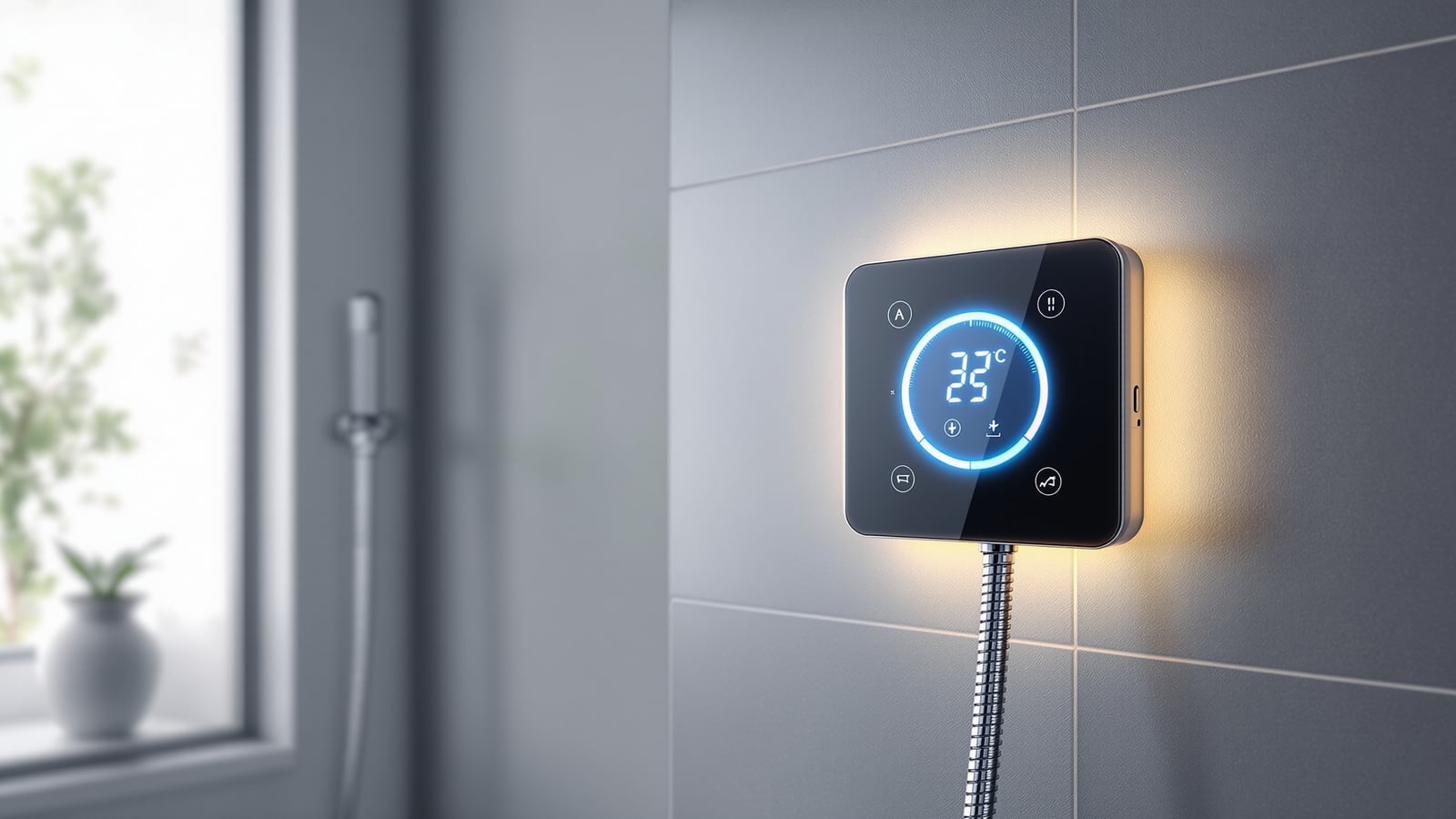
Turn on an ordinary shower and you begin the familiar dance — nudge the lever, wait, adjust, get blasted cold, then scalded, then finally right, only for the temperature to swing again when someone flushes downstairs. A digital shower replaces that guesswork with a number. You press a button or tap your phone, ask for exactly 40 degrees at 70 percent flow, and a hidden electronic mixing unit blends the hot and cold to hit it precisely and hold it there. This guide covers both digital showers (a wired control panel does the thinking) and smart showers (the same idea plus Wi-Fi, an app and voice control) — because in the showroom they blur together, and the plumbing behind the wall is almost identical.
This is written India-first: the geyser-and-overhead-tank plumbing you actually have, the fluctuating voltage and hard water that punish electronics, the rupee ranges you will actually be quoted, and the apartment-society realities that decide where the processor can live. Read it up to the shower systems guide for India for the wider picture of rain heads, diverters and body jets, and alongside the smart bathroom guide for India, which places the digital shower inside a whole connected bathroom.
A digital shower is a comfort-and-water-saving upgrade sitting on top of ordinary electronics that dislike Indian voltage and hard water. Buy the shower for the presets and the warm-up-pause; budget separately for a stabiliser and a softener, or the experience quietly degrades within a year.
How a digital shower actually works
Strip away the touchscreen and a digital shower is three parts.
- The processor (mixing unit). A box, roughly 250 x 200 x 90 mm, that takes your hot and cold feeds, blends them with a motorised thermostatic valve, and pushes the blended water to the outlets. It hides in the ceiling void above the shower, in an adjacent cupboard, or in the wall behind the head — anywhere within a few metres, reachable for service.
- The control interface. A slim panel on the shower wall (a dial, buttons or a touchscreen), plus optionally a phone app and a voice assistant. This is only a controller — no water passes through it, so it carries low-voltage signal wires, not pipes.
- The outlets. A rain head, a hand shower, sometimes body jets, each fed through the processor and switched electronically instead of by a manual diverter.
Because the brain is electronic, it can do things a manual mixer never could: remember an exact temperature to the degree, switch outlets at a tap, run a timed sequence, and talk to the rest of the home. A quality unit uses a genuine thermostatic blend, so — like a thermostatic mixer — it holds temperature within a degree or two even when a WC is flushed or a tap opened elsewhere, and cuts flow fast if the cold supply fails. That safety behaviour matters as much as the gadgetry.
Digital vs smart: what the extra money buys
Every smart shower is a digital shower; not every digital shower is smart. The dividing line is connectivity.
| Feature | Basic digital shower | Smart (connected) shower |
|---|---|---|
| Set exact temperature and flow | Yes, on the panel | Yes, panel + app |
| Presets per user | Usually 2–4 | Unlimited, named per person |
| Remote / advance start | Rare | Yes, from phone or voice |
| Warm-up-and-pause (eco) | Sometimes | Yes, plus usage tracking |
| Wi-Fi, app, voice assistant | No | Yes |
| Firmware updates | No | Yes (and new failure modes) |
| Works if router/cloud is down | Yes | Panel still works; app may not |
| Typical India price (unit only) | ₹35,000–₹90,000 | ₹90,000–₹3,00,000+ |
The honest takeaway: the presets and the thermostatic hold are the features people love day to day, and both exist on a good non-Wi-Fi digital unit. Pay the smart premium only if remote start, per-user profiles or integration with a wider smart bathroom in India genuinely matters to you. A shower that depends on a cloud account to turn on is a shower with more ways to fail.
The features that actually earn their keep
- Presets per user. Each person saves their perfect temperature, flow and outlet. Tap your name (or the app recognises your phone) and the shower starts exactly right — no dialing in, no cold-shock roulette. For a family bathroom this is the single best reason to buy one.
- Remote and advance start. Start warming the water from bed or the kitchen so it is ready when you step in — a real morning-time saver, though it can waste water if you dawdle.
- Warm-up-and-pause. The shower heats to the set temperature, then automatically pauses the flow and beeps; you strip and step in, then resume with no cold blast and no water run to drain while you wait. On a geyser-fed Indian bathroom this can save several litres per shower.
- Precise, repeatable temperature. No more nudging a lever. Useful for children and elders who cannot tolerate swings, and it removes the scald risk of a manual mixer robbed of cold when a tap opens elsewhere.
- Flow and time limits. Cap flow or run a countdown to curb long showers — meaningful in cities on tanker water.
- Usage data (smart only). See litres per shower and nudge the household down. Genuinely useful; also the feature people ignore after week two.
What you must provide: electrics and plumbing
This is where Indian installs succeed or fail. A digital shower is an electrical appliance in a wet zone, so plan it like one.
| Requirement | What the shower needs | Indian reality to plan for |
|---|---|---|
| Power supply | 230 V to a low-voltage transformer, or direct low-voltage feed to the processor | Wire on its own MCB; keep it off the geyser circuit |
| RCD / earth leakage | 30 mA RCD protection, proper earthing | Mandatory under IS 732; insist the electrician fits and tests it |
| Voltage stability | Clean, steady 230 V | Fit a voltage stabiliser or the control board dies early |
| Hot + cold feeds | Balanced pressure, both to the processor | Overhead tank gives low head — a pressure pump may be needed |
| Water pressure | Often 1.0–1.5 bar minimum for full rain-head flow | Gravity tanks alone often fall short; size a booster pump |
| Processor location | Ceiling void or cupboard within a few metres, on a service hatch | Leave an access panel; never bury it in a sealed slab |
| IP-rated interface | Panel rated for wet-zone splashing | Check the IP rating; keep the processor itself dry |
Two rules that save grief. First, the processor must stay accessible — a solenoid or cartridge will eventually need service, and a unit sealed behind tiled masonry means breaking the wall. Leave a hatch. Second, keep the electrics and the water physically separated: the processor is water-tight around its valve but its electronics are not meant to be flooded, so mount it where a leak drains away, not onto the board. All wet-zone wiring must follow IS 732 and the electrical provisions of NBC 2016, with a dedicated RCD.
The India caveats that decide if it lasts
Three local realities do more damage than any design flaw.
- Voltage swings and load-shedding. Indian mains sag, spike and cut out. The electronic mixing valve and control board hate this. A servo voltage stabiliser (or at minimum a good surge-protected supply) on the shower circuit is not optional in most towns — it is the difference between a five-year life and a fried board in eighteen months.
- Hard water. High TDS and calcium scale the thermostatic cartridge and solenoids, exactly as they scale a geyser element. Scaling makes the valve sluggish, then inaccurate, then stuck. If your supply is hard, plan a water softener or accept a descaling service every year or two. This is the same battle described for every mixer — see the thermostatic mixer guide.
- Service and spares. A manual mixer, anyone can fix. A digital processor needs the brand's spare cartridge, solenoid or board, and a technician who has seen one. Before buying, confirm the brand has service reach in your city and that spares are stocked in India — an imported unit with no local support is a liability the day it faults.
Cost, and is it worth it
Budget the whole system, not just the box in the brochure.
| Line item | Typical India range (2026) |
|---|---|
| Digital / smart processor + panel (unit) | ₹35,000 – ₹3,00,000 |
| Rain head, hand shower, valves, rail | ₹15,000 – ₹80,000 |
| Voltage stabiliser (shower circuit) | ₹3,000 – ₹12,000 |
| Pressure / booster pump (if needed) | ₹8,000 – ₹25,000 |
| Water softener (whole-bathroom or point) | ₹15,000 – ₹60,000+ |
| Electrical + plumbing labour, hatch, RCD | ₹10,000 – ₹30,000 |
| Realistic installed total | ₹80,000 – ₹5,00,000+ |
Is it worth it? Be honest about why you want one:
- Worth it if a busy family will genuinely use presets and warm-up-pause daily, if you value the precise thermostatic comfort, if you are already building a connected smart bathroom, or in a luxury bathroom in India where the experience is the point.
- Skip it if the bathroom is a rental or guest room, if your locality has rough voltage and no easy service, or if all you actually want is a steady temperature — a plain thermostatic mixer delivers the safety and comfort at a fraction of the cost and with nothing to crash.
A digital shower is a lovely thing when the supporting infrastructure — clean power, softened water, accessible processor, local service — is in place. Bolt one onto an unprotected, hard-water, gravity-fed bathroom and it becomes an expensive way to reinvent a leaking, scaling problem. Get the boring foundations right first; the magic follows.
References
- National Building Code of India (NBC) 2016, Part 8 (Building Services) — electrical installations and wet-area service provisions relevant to bathroom appliances.
- IS 732 — Code of Practice for Electrical Wiring Installations, including earthing and RCD requirements for wet zones.
- IS 1701 — Mixing valves (thermostatic and non-thermostatic) for hot and cold water supply, the basis for the blending valve inside a digital processor.
- IS 1172 — Code of Basic Requirements for Water Supply, Drainage and Sanitation, for pressure and supply planning.
- Bureau of Indian Standards (BIS) — for IP-rating conventions and product safety marks; confirm the panel's ingress rating for wet-zone use.
- CPHEEO Manual on Water Supply and Treatment — guidance on water hardness/TDS relevant to softening decisions for showers and heaters.
Export this guide
Related Guides — Deep-dive reading
Thermostatic Mixer India: Anti-Scald Showers, Set-Temperature Valves & What They Really Cost (2026)
How a thermostatic mixer holds one safe temperature no matter what happens to the pressure — the wax cartridge explained, why it needs balanced hot and cold supply, geyser vs instant-heater realities, exposed vs concealed, rupee ranges, and exactly who should pay the premium.
BathroomsThermostatic Shower India: Set-Temperature Valves, Anti-Scald Safety & What They Cost (2026)
How a thermostatic shower holds your temperature when someone opens a tap, the balanced hot-and-cold pressure it needs, geyser vs instant-heater compatibility in India, exposed vs concealed valves, pairing with rain, hand and body jets, and the real rupee premium.
BathroomsShower Systems Guide India: Overhead, Rain, Hand Shower, Body Jets, Mixers & Water Pressure
The complete guide to shower systems for Indian bathrooms — overhead and rain showers, hand showers and body jets, the mixer and diverter that drive them, the hard truth about water pressure from overhead tanks, geyser sizing for hot water, and how to waterproof the shower zone. Choose the right system for your pressure and budget.
BathroomsRelated Tools — Try Free
Electrical Safety & Load Audit
Home electrical audit — 10 categories, 65+ checkpoints across earthing, RCCB, MCB, wiring, switchboards, appliance circuits, DG/inverter backup.
Safety AuditShower Water Flow Calculator
Shower water use per shower, day and month by head type, plus a pressure-adequacy check for your tank height or pump and low-flow savings.
Bathroom CalculatorShower Pump Calculator
Check whether your shower needs a pressure-boost pump and what size — available vs required pressure from your tank height or supply.
Bathroom Calculator