
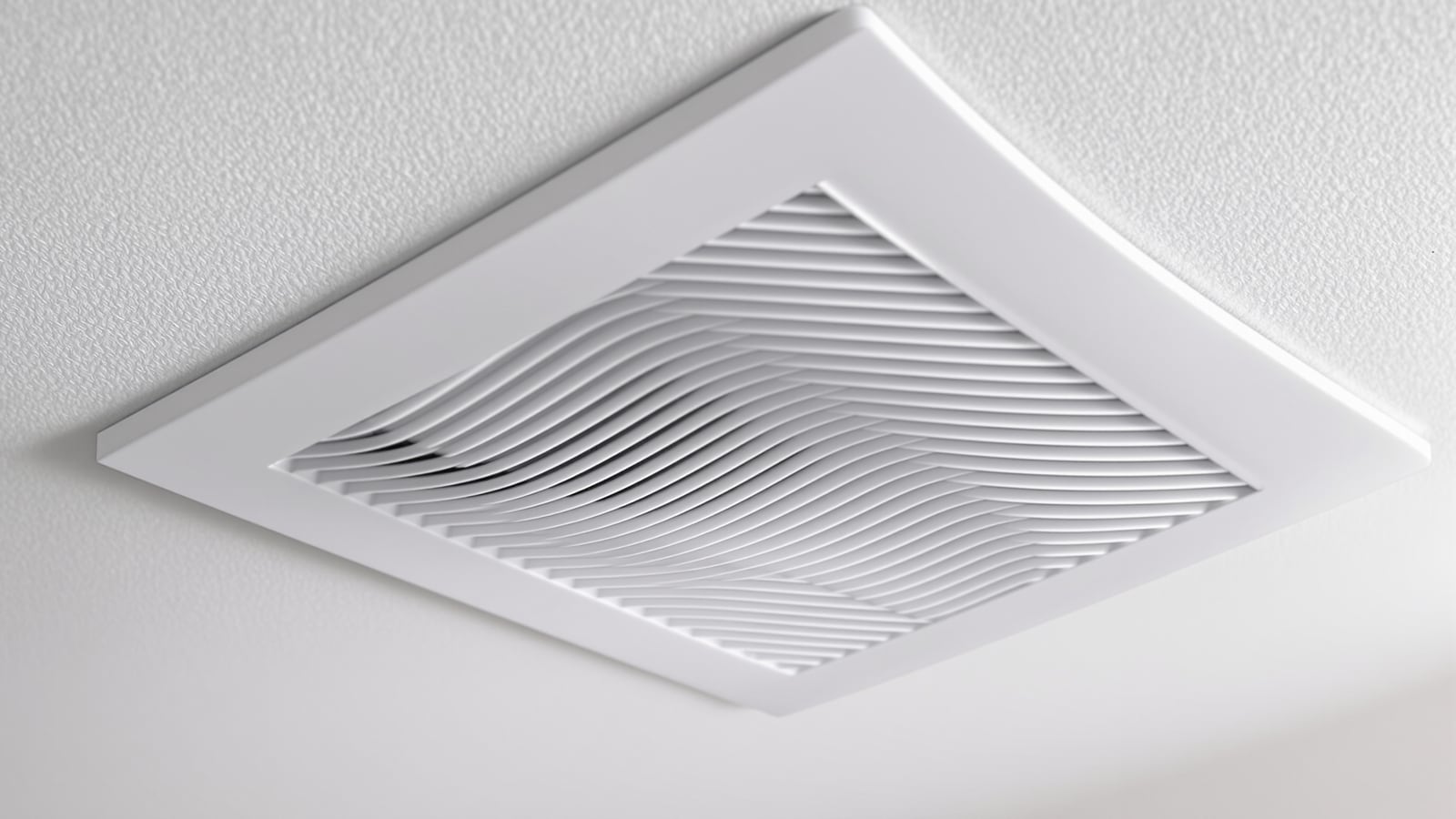
Bathroom Exhaust Fan India: CFM Sizing, Wall vs Ceiling vs Inline, Ducting, Sones & Cost
How to specify a bathroom exhaust fan that actually clears steam in an Indian home — sizing by CFM from room volume and air changes, choosing wall, ceiling or inline, ducting it to outside air (never into a false-ceiling void), and picking backdraft-damper, humidity-sensor and timer models at the right noise and IP rating.
Open the window and the steam clears, the story goes. In an Indian home that story is mostly fiction: internal bathrooms have no window at all, monsoon air outside is already saturated, and the small ventilator that does exist opens onto a shaft or duct that never sees a breeze. So the steam stays. It films the mirror, soaks the false ceiling, feeds the black mould in the grout and, twice a day through a Mumbai or Chennai monsoon, leaves the room wet more often than it is dry. The fix is a bathroom exhaust fan — but only if it is the right size, ducted to real outside air, and left running long enough to finish the job.
Most fan failures are not the fan. They are a fan that was bought by price, undersized for the room, and dumped into a false-ceiling void that just recirculates the damp air. This guide sizes the fan properly, chooses between wall, ceiling and inline, and gets the moist air all the way out of the building. It sits under the complete bathroom ventilation guide for India; read it alongside preventing bathroom condensation and, because most fans live in the ceiling, the bathroom false ceiling guide.
A fan is only as good as its duct. An oversized fan blowing into a sealed false-ceiling void does nothing but move damp air in a circle — size it right, then give it a clear path to the outside.
Size it: CFM from volume and air changes
An exhaust fan is rated in CFM — cubic feet of air moved per minute. You do not guess it; you calculate it from the room's volume and how many times an hour you want to replace all the air, the air changes per hour (ACH). For a bathroom, aim for 8 to 10 ACH — the shower generates a lot of vapour in a short burst and you want the room swept clean quickly.
The arithmetic is simple:
- Room volume (cubic feet) = length × width × height, all in feet.
- Required CFM = (volume × ACH) ÷ 60.
For a typical 7 ft × 5 ft bathroom with a 10 ft ceiling: volume = 350 cu ft; at 8 ACH that is 350 × 8 ÷ 60 ≈ 47 CFM; at 10 ACH ≈ 58 CFM. So a 50–60 CFM fan suits an ordinary Indian bathroom. A common quick rule for standard ceilings — 1 CFM per square foot of floor area, minimum 50 CFM — lands in the same place and is fine for a first pass, but the volume method is what you use when ceilings are high or the room is large.
| Bathroom size (approx.) | Volume | CFM at 8 ACH | Practical fan to buy |
|---|---|---|---|
| Small / powder (5 × 4 ft) | ~200 cu ft | ~27 CFM | 50 CFM (minimum sensible) |
| Standard (7 × 5 ft) | ~350 cu ft | ~47 CFM | 50–60 CFM |
| Large (9 × 6 ft) | ~540 cu ft | ~72 CFM | 80 CFM |
| Master with tub / enclosed shower | ~700+ cu ft | ~95 CFM | 100+ CFM, or a dedicated fan per fixture |
Two Indian adjustments matter. Undersizing is the single most common mistake — a 6-inch, sub-30-CFM window fan bought for ₹600 cannot clear a proper shower; buy for the volume, not the price tag. And in a large or L-shaped bathroom, one fan far from the shower leaves a dead pocket of steam — put the fan over or immediately adjacent to the shower/tub, where the vapour is born, not by the door.
Wall, ceiling or inline: pick by where the air can go
Where the fan sits is decided by your wall, your ceiling and where the duct can exit. Three families cover almost every Indian bathroom.
| Type | Where it mounts | Best for | Watch-outs |
|---|---|---|---|
| Wall / window | On an external wall or in the ventilator opening | Bathrooms with an outside wall; simplest retrofit | Only works on an external wall; needs a backdraft shutter or it lets outside air, insects and shaft smells in |
| Ceiling (axial/centrifugal) | In a false ceiling, ducted to outside | The default for modern flats; hides the fan, quiet | Useless without a real duct to outside — must not discharge into the ceiling void |
| Inline / duct fan | In the duct run, often remote in the void or shaft | Long duct runs, internal bathrooms, two grilles on one fan | Costlier; needs access for service; more ducting to seal |
The rule that ties them together: the fan must discharge to genuine outside air. A ceiling fan that blows into the sealed plenum above a gypsum false ceiling simply pushes wet air sideways to condense on the slab, rot the framing and grow mould you cannot see. Internal bathrooms — extremely common in Indian apartments — almost always want a ceiling or inline fan ducted through a chase to the external wall, shaft or roof cowl, with the duct kept as short and straight as possible.
Ducting: the part everyone skips
The duct decides whether the fan works. Get it right and a modest 50 CFM fan clears the room; get it wrong and a 100 CFM fan achieves nothing.
- Terminate outside, always. External wall louvre, ventilation shaft that actually vents, or a roof cowl. Never into the false-ceiling void, never into a plumbing shaft you are not sure is open at the top.
- Keep it short and straight. Every bend and every foot of flexible duct adds resistance and steals CFM. Rigid or semi-rigid duct beats floppy flexible; if you must use flexible, pull it taut — sags collect condensate and breed mould.
- Size the duct to the fan. A 100 mm (4-inch) duct suits fans up to ~50–70 CFM; step up to 150 mm (6-inch) for larger fans. Choking a big fan through a small duct throttles it.
- Slope and insulate. Give a slight fall to the outside so condensate drains out, not back into the fan. In humid climates, insulate ducts that cross cold voids so vapour does not condense inside the pipe.
- Fit a backdraft damper. A gravity or spring shutter at the fan or the wall terminal stops outside air, insects, lizards and shaft odours from flowing back in when the fan is off. On external walls this is essential.
Features worth paying for: humidity, timer, damper, sones, IP
A basic fan runs while the switch is on. The upgrades earn their keep because the danger is the moisture that lingers after you leave.
- Humidity-sensor (hygrostat) models switch on automatically when relative humidity climbs and run until the room dries — ideal for a monsoon bathroom or one shared by people who forget the switch.
- Timer / run-on models keep running for a set 5–20 minutes after the light or switch goes off, clearing the residual steam that would otherwise settle on the ceiling. If you buy one feature, buy this.
- Backdraft damper (covered above) — non-negotiable on external walls.
- Noise in sones. Fans are rated in sones — lower is quieter. Aim for ≤1.5 sones for a fan you will actually leave running; ≤1.0 is genuinely quiet. Cheap window fans are often 3–4 sones and get switched off because they roar.
- IP rating and zone. A fan directly over or near the shower is in a wet zone and should be at least IP44/IP45; keep the mains switching outside the bathroom or on an isolator per IS 732. A ceiling fan set back in the dry area is less exposed but humidity still demands a sealed, moisture-rated unit.
Install and cost
Wiring must follow IS 732 — a dedicated, earthed circuit, and switching that respects bathroom zones (no reachable switch from the bath or shower). Fan safety follows IS 302. Mount the fan level, seal the grille to the ceiling so air is drawn through the duct and not the void, and test that the backdraft damper actually closes.
| Item | Typical India range (₹) | Notes |
|---|---|---|
| Basic window/wall exhaust fan (~6 in) | ₹600 – ₹1,800 | Fine only for small, external-wall bathrooms |
| Quality ceiling fan, 50–100 CFM, low-sone | ₹1,800 – ₹4,500 | The sensible default for a flat |
| Humidity-sensor / timer model | ₹3,000 – ₹7,000 | Auto run-on is worth it |
| Inline / duct fan | ₹4,000 – ₹9,000+ | Long runs, internal bathrooms |
| Ducting, damper, wall louvre, insulation | ₹1,500 – ₹4,000 | The part that makes any fan work |
| Electrician + fitting | ₹1,000 – ₹3,000 | More if a chase must be cut |
Budget for the whole system, not just the box on the shelf. A ₹1,200 fan strangled by a sagging flexible duct into a sealed void is money wasted; a ₹3,500 fan on a short insulated duct to a damped wall louvre quietly protects the whole room. Spend on the duct and the run-on timer before you spend on the fan badge.
References
- NBC 2016 (National Building Code of India), Part 8 & Part 11 — ventilation requirements for sanitary/bathroom spaces, including mechanical exhaust where natural ventilation is inadequate.
- IS 732 — Code of practice for electrical wiring installations; circuit protection, earthing and bathroom zoning for fan wiring.
- IS 302 (Part 1 & Part 2/80) — Safety of household and similar electrical appliances, general and fan-specific requirements.
- CPHEEO / CPWD — Manuals and specifications referencing air-change and ventilation practice for sanitary spaces in Indian public works.
- IGBC / GRIHA — Green building references on indoor air quality and effective mechanical ventilation of wet areas.
Export this guide
Related Guides — Deep-dive reading
How to Choose an Exhaust Fan in India: CFM Sizing, Noise, Features & Budget Tiers
A buyer's guide to picking the right bathroom exhaust fan for your room — calculate the CFM you actually need, match wall vs ceiling vs inline to your layout, judge noise in sones, decide which extras earn their price, and spot the underpowered cheap fans that never clear the steam.
BathroomsMoisture-Resistant Bathroom Ceiling India: PVC, Metal & Gypsum by Zone, Anti-Fungal Paint & Ventilation
How to design a bathroom ceiling that survives steam and condensation in an Indian home — matching waterproof PVC or metal over the wet zone, moisture-resistant gypsum in the dry zone, sizing the exhaust fan that actually protects it, and the anti-fungal paint, slope and drip detail that stops mould.
BathroomsBathroom Ventilation India: The Complete Guide to Moisture, Mould, NBC 2016 Air Changes & Windowless Solutions
Why bathroom ventilation matters more than any fitting in an Indian home — how moisture, mould and odour build up, natural versus mechanical options, what NBC 2016 actually requires, how to size a fan by air changes and CFM, and how to ventilate a windowless bathroom that stays dry through the monsoon.
BathroomsRelated Tools — Try Free
Cross-Ventilation Analyzer
Estimate airflow and air changes per hour (ACH) from room size, window areas, layout, and local wind — with NBC 2016 Part 8 compliance check.
Ventilation CalculatorFalse Ceiling Cost Estimator
Live ₹/sqft across 8 ceiling types — POP, gypsum, designer, metal, PVC, wooden — with cove and spot lighting for 20 Indian cities.
Cost CalculatorBathroom Exhaust Fan Calculator
Size a bathroom exhaust fan from room volume and air changes per hour — output in CFM and CMH with a recommended fan rating and diameter.
Bathroom Calculator