
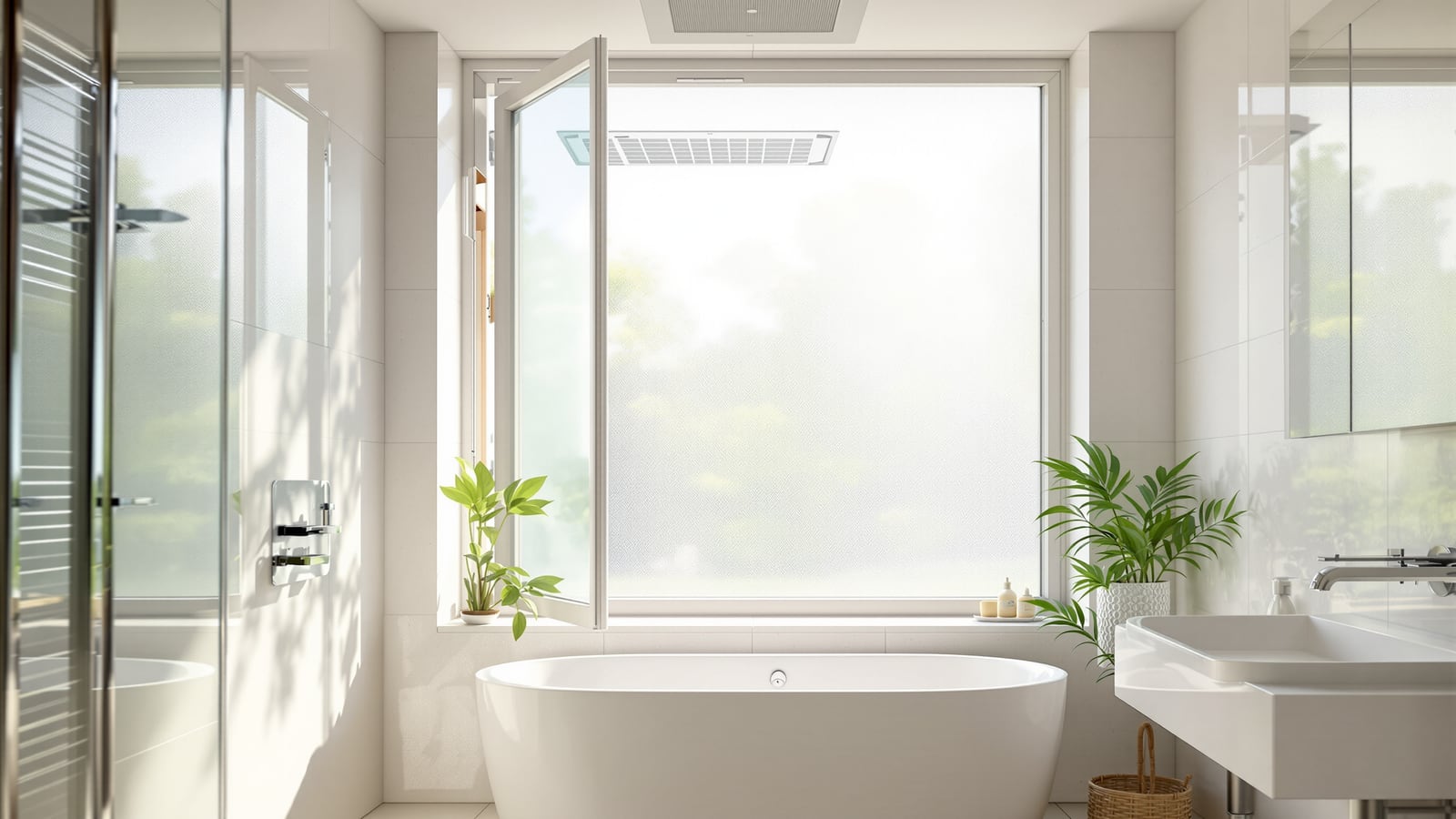
Bathroom Ventilation India: The Complete Guide to Moisture, Mould, NBC 2016 Air Changes & Windowless Solutions
Why bathroom ventilation matters more than any fitting in an Indian home — how moisture, mould and odour build up, natural versus mechanical options, what NBC 2016 actually requires, how to size a fan by air changes and CFM, and how to ventilate a windowless bathroom that stays dry through the monsoon.
Of every decision you make in a bathroom, ventilation is the one people spend the least money on and regret the most. You can specify imported sanitaryware, anti-skid tiles and a rain shower, and still open the door six months later to a grey bloom of mould in the corner, paint peeling off the ceiling, a musty smell that never quite leaves, and silicone joints going black. None of that is a materials failure. It is humid air that had nowhere to go. An Indian bathroom, used two or three times a day and hit by months of monsoon humidity, generates a remarkable amount of water vapour — a single hot shower can put well over half a litre of water into the air — and unless that air is swept out and replaced, it condenses on every cool surface and feeds mould.
This is the ventilation pillar in the Studio Matrx bathroom hub: the one-stop overview of why ventilation matters, what the code demands, and how to get it right whether your bathroom has a window or not. Read it alongside the complete bathroom design guide for India, which ties ventilation together with layout, waterproofing and finishes. For the deeper dives, this guide links out to dedicated pieces on exhaust fans, natural airflow, condensation and ceilings.
Ventilation is the cheapest health-and-durability upgrade in the whole bathroom. Every rupee spent moving humid air out earns itself back in paint, ceiling, joinery and lungs — and no finish, however waterproof, survives a room that never dries.
Why ventilation matters: moisture, mould, odour, health
Four separate problems all trace back to the same cause — air that stays wet and still.
- Moisture and condensation. Warm shower air holds far more water vapour than cool air. When it meets the coolest surfaces — the ceiling, an outside wall, the mirror, a cold-water cistern — it gives up that vapour as liquid water. Repeated wetting swells timber, blisters paint, corrodes hinges and fixings, and keeps the room damp for hours.
- Mould and mildew. Fungal spores are always in the air; they only need a damp, still, slightly organic surface to colonise. Grout, silicone, painted ceilings and MDF vanity carcasses are all fair game. Mould is not a cleaning problem you can scrub away permanently — it is a ventilation problem wearing a stain.
- Odour. A bathroom's smells — from the WC, from a floor trap, from damp itself — linger when air is static. Moving air carries them out; a well-placed extract at the source clears them before they spread into the home.
- Health and indoor air quality. Damp bathrooms raise the whole home's humidity and airborne mould-spore count, which matters for anyone with asthma, allergies or a compromised immune system. Good extract also removes the fine aerosols and any cleaning-chemical fumes that concentrate in a small, sealed room.
All four are solved the same way: pull the humid, smelly air out, and let fresh, drier air in to replace it. That flow — out and in — is what "ventilation" means, and doing only half of it (an extract fan with no air path in, or a window with no cross-draught) barely works.
Natural versus mechanical ventilation
There are two ways to move that air, and most good Indian bathrooms use a blend of both.
Natural ventilation uses openings — a window, a high-level ventilator, a louvre, a gap under the door — and relies on wind and the fact that warm air rises to drive the exchange. It costs nothing to run, needs no power (which matters during load-shedding), and in a well-oriented bathroom with cross-openings it can be genuinely enough for much of the year. Its weakness is that it is unreliable: on a still, humid monsoon day there is no wind to drive it, in winter you keep the window shut, and an internal apartment bathroom has no external wall to open at all. Detail is in the natural bathroom ventilation guide.
Mechanical ventilation uses a powered exhaust fan to guarantee a set airflow regardless of weather, ducted to the outside. It works on the stillest, wettest day, can be automated with timers and humidity sensors, and is the only reliable option for a windowless bathroom. Its costs are the fan, the wiring, a duct route to outside, a little electricity and the noise. The full selection and installation detail lives in the bathroom exhaust fan guide.
What NBC 2016 actually requires
The National Building Code of India (NBC) 2016 does not leave bathroom ventilation to taste — it sets a floor. In broad terms, every bathroom and water-closet must be ventilated by one of two routes:
- Natural ventilation — an openable window, ventilator or opening to the outside (or to an open shaft) with an area of at least about one-twentieth (roughly 4–5%) of the floor area of the room, and not less than the minimum the code specifies. This is why traditional Indian bathrooms carry that high ventilator above the door line.
- Mechanical ventilation — where such an opening is absent or inadequate (the reality for most internal apartment bathrooms), a powered exhaust system providing a minimum rate of air changes. The code and allied CPHEEO/CPWD guidance point to bathrooms needing broadly in the region of 6 to 10 air changes per hour, with wet or steam-heavy areas at the higher end.
Two practical takeaways. First, a small window alone does not automatically satisfy the intent — in a humid climate you often need mechanical extract as well, because a shut window ventilates nothing. Second, a windowless bathroom is legal and normal provided it has compliant mechanical ventilation ducted to the outside; it is not a loophole, it is the code's expected solution. Always confirm the current clauses and any local municipal or society by-laws for your project.
Sizing it: air changes and CFM
The honest way to size ventilation is by air changes per hour (ACH) — how many times the fan replaces the entire volume of air in the room every hour. The arithmetic is simple and worth doing:
- Room volume = length × breadth × height, in metres → cubic metres (m³).
- Required airflow = volume × target ACH. Use 6–8 ACH for a normal bathroom and 10–15 ACH for a shower or steam-heavy room.
- Match to a fan. Fans are sold rated in m³/h or CFM (cubic feet per minute). Convert with 1 m³/h ≈ 0.59 CFM (or 1 CFM ≈ 1.7 m³/h), and pick a fan at or above your number, allowing a margin for duct resistance.
| Room / use | Suggested ACH | Typical fan size |
|---|---|---|
| Small WC / powder room | 6–8 | 60–90 m³/h (35–55 CFM) |
| Standard family bathroom | 8–10 | 90–140 m³/h (55–85 CFM) |
| Shower or wet room | 10–12 | 140–200 m³/h (85–120 CFM) |
| Steam / spa bathroom | 12–15 | 200+ m³/h, humidity-controlled |
Sizing right is only half of it — running it long enough is the rest. The fan must run through the shower and for 15–20 minutes after, which a timer switch or humidity-sensing (humidistat) switch does automatically. And extract needs an inlet: a 10–15 mm undercut below the door, or a louvre, lets replacement air in so the fan can actually pull.
Ventilating a windowless bathroom
Most Indian apartment bathrooms are internal — no external wall, no window. This is not a design failure; it is normal, and it is entirely solvable with a properly sized, well-installed mechanical system.
- Duct it to the outside, not the void. The single most common mistake is a fan that dumps humid air into the false-ceiling void or a dead pipe shaft. That just relocates the mould where you cannot see it. The duct must reach a genuine outlet — an external wall, terrace, or a designed ventilation shaft.
- Use an inline or higher-static fan for long runs. A cheap axial fan struggles to push air more than a metre or two of duct. For an internal bathroom with a long run to the shaft, a centrifugal or inline duct fan holds its airflow against the resistance.
- Automate it. With no window to open, the fan is the only defence, so make it foolproof — a humidistat switches it on when humidity climbs and off when the room is dry, with a run-on timer to guarantee the post-shower clear-out.
- Consider a heat recovery ventilator (HRV) for tight, high-end homes. In a very well-sealed or air-conditioned home, a small single-room HRV / heat recovery ventilator extracts stale humid air while pre-conditioning the incoming fresh air through a heat-exchange core, so you ventilate continuously without throwing away cooled air. It is a premium, still-uncommon choice in India but a genuinely good one for airtight apartments chasing indoor air quality.
Condensation is the visible symptom to design against; the full playbook — warm surfaces, drainage, run-on fans — is in the bathroom condensation prevention guide. And because the ceiling is the surface steam hits first, pair your ventilation with a moisture-resistant ceiling so material and airflow protect each other.
| Do | Don't |
|---|---|
| Duct extract air fully outside | Dump moist air into the ceiling void or shaft |
| Size to 6–10 ACH (more for a shower) | Guess from a fan's box photo |
| Fit a timer or humidistat switch | Turn the fan off the moment you step out |
| Leave a 10–15 mm door undercut for inlet air | Seal the door so the fan has nothing to pull |
| Combine a ventilator with a fan where you can | Rely on a shut window in monsoon humidity |
| Use an inline fan for long internal duct runs | Fit a weak axial fan on a 5 m duct |
Get ventilation right and every other bathroom decision lasts longer — paint, ceiling, joinery, grout and your own air all stay healthier. Start from the complete bathroom design guide for India for how ventilation sits within the whole room, then use the exhaust fan and natural ventilation guides to specify the hardware.
References
- National Building Code of India (NBC) 2016, Part 8 (Building Services, Section 1 Lighting and Ventilation) and Part 9 (Plumbing Services) — natural ventilation opening areas and mechanical ventilation / air-change requirements for bathrooms and water-closets.
- IS 3103 — Code of practice for industrial ventilation, referenced for air-change-rate principles (BIS).
- Central Public Health and Environmental Engineering Organisation (CPHEEO) manuals — ventilation and humidity control guidance for sanitary and wet spaces.
- CPWD specifications and general guidance — mechanical exhaust provisions for internal toilets and bathrooms.
- IGBC / GRIHA residential rating criteria — indoor environmental quality, ventilation and fresh-air provisions for wet areas.
- Bureau of Indian Standards (BIS) — related standards for luminaire IP ratings and electrical safety (IS 732) where fans and lights share the wet zone.
Export this guide
Related Guides — Deep-dive reading
Bathroom Condensation and Mould India: Stop Damp, Black Mould & Musty Smell for Good
Why warm, wet shower air keeps fogging your tiles, ceiling and walls with black mould — and the full Indian playbook to stop it: exhaust run-on, anti-fungal paint, wet-dry separation, wiping down, a dehumidifier, and safely cleaning the mould you already have.
BathroomsMoisture-Resistant Bathroom Ceiling India: PVC, Metal & Gypsum by Zone, Anti-Fungal Paint & Ventilation
How to design a bathroom ceiling that survives steam and condensation in an Indian home — matching waterproof PVC or metal over the wet zone, moisture-resistant gypsum in the dry zone, sizing the exhaust fan that actually protects it, and the anti-fungal paint, slope and drip detail that stops mould.
BathroomsBathroom Exhaust Fan India: CFM Sizing, Wall vs Ceiling vs Inline, Ducting, Sones & Cost
How to specify a bathroom exhaust fan that actually clears steam in an Indian home — sizing by CFM from room volume and air changes, choosing wall, ceiling or inline, ducting it to outside air (never into a false-ceiling void), and picking backdraft-damper, humidity-sensor and timer models at the right noise and IP rating.
BathroomsRelated Tools — Try Free
Cross-Ventilation Analyzer
Estimate airflow and air changes per hour (ACH) from room size, window areas, layout, and local wind — with NBC 2016 Part 8 compliance check.
Ventilation CalculatorMonsoon-Readiness Checklist
Pre-rain home audit across 9 categories — terrace, drains, waterproofing, electrical, HVAC, pest, vehicles, documents.
Seasonal AuditBathroom Exhaust Fan Calculator
Size a bathroom exhaust fan from room volume and air changes per hour — output in CFM and CMH with a recommended fan rating and diameter.
Bathroom Calculator