
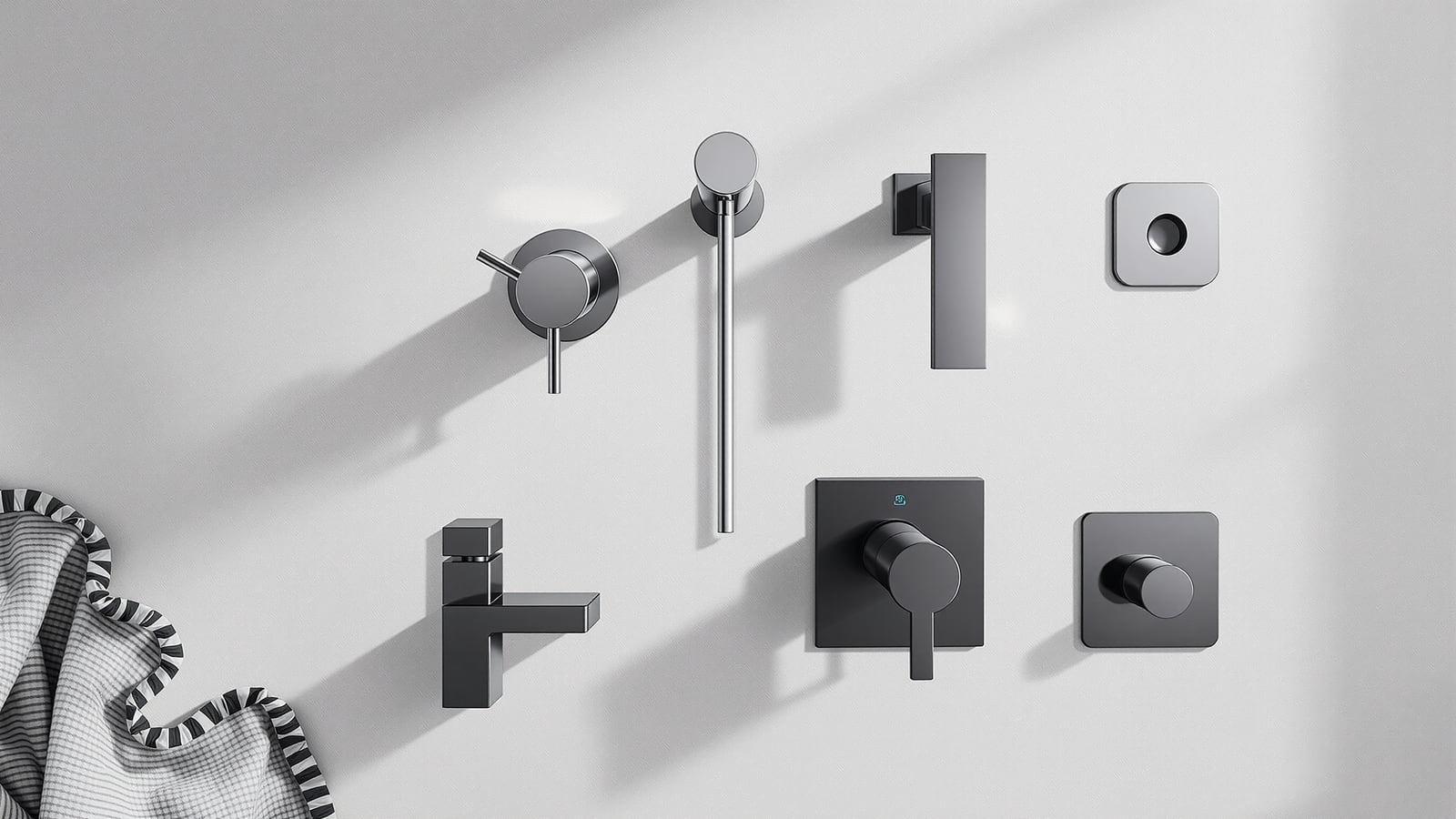
Bathroom Faucets India: The Complete Guide to Taps, Cartridges, Finishes & Flow (2026)
Every faucet type explained for Indian bathrooms — pillar taps, basin mixers, single-lever vs two-handle, wall vs deck vs concealed, sensor and thermostatic — plus the ceramic-disc cartridge that survives hard water, CP-fitting quality to IS standards, finishes, aerators and honest rupee ranges.
The faucet is the one thing in your bathroom you touch every single day, several times a day, with wet hands. It is also the part most people choose last, by looks alone, from a wall of near-identical chrome in a showroom. That is backwards. A tap that drips within a year, stains white with hard-water scale, or spits a harsh unaerated jet all over the counter is a daily irritation you paid extra to install. Get the mechanism, the finish and the flow right and a good faucet quietly does its job for a decade.
This is the overview pillar for tapware. It walks through every faucet type you will meet in an Indian showroom, explains the ceramic-disc cartridge that decides whether your tap survives our hard water, and gives honest rupee ranges and the IS standards that separate real CP (chrome-plated) fittings from the cheap castings. Read it alongside the bathroom design guide for India, and dive deeper through the linked sibling guides as each type comes up.
Buy the cartridge, not the shape. The prettiest faucet with a poor cartridge fails first; a plain tap with a genuine ceramic-disc cartridge outlives the bathroom.
The faucet family — what each type is for
"Faucet", "tap", "mixer" and "CP fitting" all get used loosely in India. Here is the plain-language map.
- Pillar tap — a single tap delivering one temperature (usually cold), mounted on the basin deck. The cheapest, simplest fitting; two of them on a two-tap-hole basin give you separate hot and cold. See the dedicated pillar taps guide.
- Basin mixer — one spout that blends hot and cold. The default for a modern basin; covered in depth in the basin mixer taps guide.
- Single-lever vs two-handle. A single-lever mixer uses one handle for both flow and temperature over a ceramic cartridge; a two-handle (or two-tap) setup has separate hot and cold controls. Single-lever is faster, more hygienic (one wet-hand touch) and now standard.
- Wall-mounted faucet — spout and controls come out of the wall, leaving the counter clear and easy to wipe. Ideal over counter-top basins; details in the wall-mounted faucet guide.
- Deck-mounted faucet — mounted on the basin or counter itself, plumbing hidden below. The most common and forgiving to install.
- Concealed faucet — the body is buried in the wall, only the lever and spout show. The cleanest look, but the working part is inaccessible, so cartridge quality is non-negotiable; see the concealed faucet guide.
- Sensor faucet — infrared, touch-free, water only when hands are present. Excellent hygiene and water saving; needs power or batteries. See the sensor faucets guide.
- Thermostatic mixer — holds a set temperature regardless of pressure swings, and cuts flow if cold supply fails. A safety and comfort upgrade for showers; covered in the thermostatic mixer guide.
The cartridge — the part that actually matters
Inside almost every modern mixer is a cartridge: a small replaceable valve that controls flow and, in a single-lever, temperature. The technology inside it decides how long your faucet lasts.
- Rubber-washer / compression valves are the old two-handle design. Cheap, but the washer wears and the tap starts to drip. Fine for a pillar bib tap, poor for a daily basin.
- Ceramic-disc cartridges use two polished ceramic discs that slide over each other. There is nothing to wear out the way rubber does, so a quality ceramic cartridge gives a crisp quarter-turn shut-off with no drip for years.
Why this matters so much in India: hard water. Dissolved calcium and magnesium leave scale that chews through rubber washers and jams cheap valves. A good ceramic disc resists scaling far better — but only if the ceramic is genuine and well-finished. This is exactly why a concealed faucet, whose cartridge is buried in the wall, must use a top-grade cartridge: replacing it means opening the wall. Look for cartridges rated for high open-close cycles (200,000+ is common on good brands) and, in very hard water, add a point-of-use or whole-house softener to protect every tap.
Finishes — looks, durability and hard-water reality
| Finish | Look | Hard-water / durability | Indicative price premium |
|---|---|---|---|
| Chrome (CP) | Bright mirror | Proven, easy to wipe; water spots show | Baseline |
| Matte black | Modern, matte | Hides spots; scratches show as shiny marks | +30 to 60% |
| Brushed / satin nickel | Soft warm grey | Very forgiving on spots and fingerprints | +40 to 80% |
| Brushed / antique brass | Warm gold, vintage | Living finish; can tarnish if lacquer wears | +50 to 100% |
| PVD-coated (any colour) | As chosen | Hardest, most scratch- and tarnish-resistant | +40 to 90% |
The single most useful word here is PVD (physical vapour deposition) — a vacuum-bonded coating that is far tougher and more corrosion-resistant than ordinary electroplating. In hard water and humid, monsoon-heavy conditions a PVD finish keeps its colour and shine years longer, whatever the shade. If you want black or gold that lasts, insist on PVD rather than a painted or thinly plated finish.
Flow rate and aerators — comfort and water saving
The aerator is the mesh tip on the spout that mixes air into the stream. It stops splashing, makes a soft full-feeling flow, and — crucially — caps water use.
- A conventional basin tap can run 8–12 litres per minute (LPM) at typical pressure.
- A good aerated tap delivers a comfortable stream at 4–6 LPM.
- Low-flow / eco aerators reach 2–4 LPM with no real loss of usefulness for hand-washing.
Switching a family's basin taps to 4–6 LPM aerators can cut basin water use by roughly 40–50% with no comfort penalty — the cheapest water saving in the whole bathroom. This is the core of the water-saving faucet guide. One India-specific caution: many homes run on low gravity/overhead-tank pressure. A heavily restricted aerator can feel weak on such supply, so match the aerator to your pressure, or choose a pressure-compensating aerator that holds flow steady.
CP-fitting quality — how to tell a real faucet from a casting
The bulk of the price difference between a ₹900 tap and a ₹4,000 one is the metal and the plating you cannot see.
- Body metal. Good faucets use forged or cast brass with high copper content, giving weight and corrosion resistance. Cheap taps use zinc alloy (ZAMAK) that corrodes and cracks. A genuine brass mixer feels noticeably heavy for its size — heft is a quick field test.
- Plating. Quality CP fittings are nickel-plated then chrome-plated to a controlled thickness so the shine survives daily wiping and hard-water attack. Thin plating flakes within a year or two.
- Standards. Look for conformance to Indian standards: IS 8931 for single-control (single-lever) sanitary fittings, IS 1701 for pillar taps and bib taps, and the plating quality benchmarks these reference. An ISI mark and a real warranty (many good brands offer long warranties on the cartridge and finish) are the practical signals of compliance.
Matching the faucet to the basin
The faucet and basin must be chosen together — the wrong spout height or reach makes a beautiful basin unusable.
| Basin type | Best faucet | Why |
|---|---|---|
| Counter-top (above-counter bowl) | Tall deck mixer or wall-mounted mixer | Spout must clear the high rim without splashing |
| Under-counter | Standard-height deck basin mixer | Normal reach lands in the bowl centre |
| Semi-recessed | Standard deck mixer | Bowl sits mid-height; ordinary spout works |
| Wall-hung with narrow shelf | Wall-mounted mixer | Keeps the slim counter clear and wipeable |
| Two-tap-hole vintage basin | Two pillar taps or 3-hole mixer | Matches the existing tap holes |
Two numbers decide fit: spout height (must exceed the basin rim by enough to get hands under) and spout reach/projection (the stream should land near the drain, not the front lip or the back wall). Confirm both against the basin before buying, especially for tall counter-top bowls.
Cost comparison — what you actually pay
| Faucet type | Budget (₹) | Mid-range (₹) | Premium (₹) |
|---|---|---|---|
| Pillar tap | 500–900 | 1,200–2,200 | 3,000+ |
| Deck basin mixer (single-lever) | 1,500–2,800 | 3,500–7,000 | 12,000+ |
| Wall-mounted mixer (with concealed body) | 2,500–4,500 | 6,000–12,000 | 20,000+ |
| Concealed diverter / mixer | 3,000–6,000 | 8,000–16,000 | 30,000+ |
| Sensor faucet | 4,000–8,000 | 10,000–20,000 | 35,000+ |
| Thermostatic mixer | 8,000–15,000 | 18,000–35,000 | 60,000+ |
Prices are indicative 2026 retail before discount and exclude installation. The sensible rule: spend on the cartridge and finish (they decide lifespan) rather than on decorative shape, and never buy the cheapest fitting for a concealed application where a future failure means breaking tile.
References
- Bureau of Indian Standards — IS 8931: Copper alloy single-control sanitary fittings (single-lever mixers).
- Bureau of Indian Standards — IS 1701: Copper alloy pillar taps, bib taps and stop valves for water supply.
- National Building Code of India (NBC) 2016, Part 9: Plumbing services and water supply.
- IS 1172: Basic requirements for water supply, drainage and sanitation.
- CPHEEO Manual on Water Supply and Treatment, Ministry of Housing and Urban Affairs — water-efficiency and fixture guidance.
- IGBC / GRIHA green-building rating criteria for water-efficient fixtures and low-flow fittings.
Export this guide
Related Guides — Deep-dive reading
Basin Mixer Tap India: Single-Lever Buying Guide, Spout Height, Cartridge & Cost (2026)
How a single-lever basin mixer blends hot and cold on one control — what supplies it needs, the spout height that matches your basin, the ceramic cartridge that decides its life, pop-up waste, tall vessel mixers, finishes, flow rate, and rupee tiers versus separate pillar taps.
BathroomsHow to Choose a Bathroom Faucet in India: A Buyer's Guide to Cartridges, Brass & Fakes (2026)
A buyer's decision guide to CP fittings — the ceramic-disc cartridge that decides life in hard water, the brass-vs-zinc weight test, finish durability, warranty, honest good/better/best rupee tiers, and how to spot the huge fake-faucet problem in the Indian market.
BathroomsPillar Taps India: The Single-Supply Basin Tap, Quarter-Turn vs Washer, Cost & Where They Still Win (2026)
What a pillar tap (pillar cock) actually is, why it stays the default on Indian basins, quarter-turn ceramic-disc versus conventional washer types, sizes, finishes, rupee costs, and an honest comparison with a basin mixer.
BathroomsRelated Tools — Try Free
Before vs After — Cost Reality Check
Compare what you expected to pay vs what you actually paid, category by category.
Reality CheckShower Water Flow Calculator
Shower water use per shower, day and month by head type, plus a pressure-adequacy check for your tank height or pump and low-flow savings.
Bathroom CalculatorGreen Building Water Score Calculator
Score a building's water efficiency 0–100 from treated-water reuse, rainwater harvesting, low-flow fixtures and metering, with an IGBC/GRIHA-style rating and your biggest improvement lever.
Sustainability