
Smart Bathroom Mirror India: Touch Display, Voice, Defogger, Cost & Is It Worth It
A practical India-first guide to smart bathroom mirrors — the embedded touch display showing time, weather and news, the Bluetooth speaker, voice assistant, mood-lighting scenes and defogger — plus the power and optional data point behind the glass, the IP and electrical safety it demands, how hard water and monsoon humidity decide whether it lasts, and whether it is really worth the money over a good LED mirror.
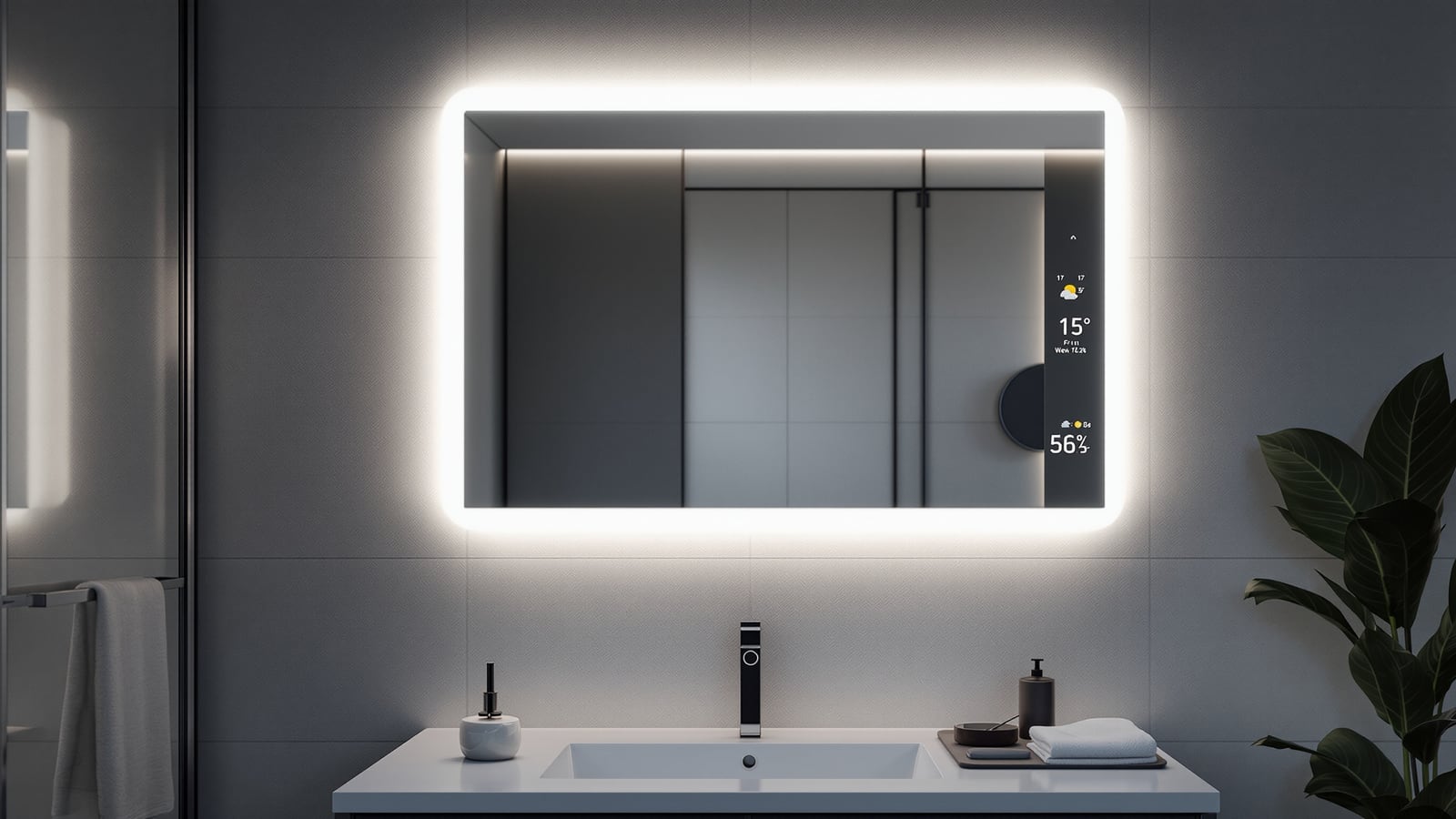
A smart bathroom mirror looks, at rest, like any good backlit mirror — until it wakes. A slice of glass turns into a display: the time and date, today's weather, your calendar, a news ticker or a music track, all shown through the mirror surface while you brush your teeth. Touch it, or speak to it, and it plays the radio, dims the lights to a warm scene, or reads out your morning. The defogger keeps a clear patch even after the hottest shower. For a slice of Indian homes — premium apartments, villas, boutique hotels and the design-led master bathroom — this has moved from gadget to a genuinely wanted piece of the connected home.
The catch is the same one every powered fixture in an Indian bathroom faces. A smart mirror is an electrical appliance and, often, a networked device, hung on a wet wall in the hardest-water, most humid corner of the house. Buy one without planning a concealed power point, optional data and proper IP protection behind the glass — and without defending it against scale and monsoon damp — and you either cannot install it cleanly or you shorten its life to a couple of years. This component guide explains exactly what a smart mirror does, what you must rough in behind it, how to keep it alive in Indian conditions, what it costs, and the honest question: is it worth it over a plain good LED mirror?
This sits inside the Studio Matrx bathroom hub. For the wider connected-home picture read the smart bathroom guide for India; to choose the mirror itself — size, position, lighting and safety — start from the bathroom mirror guide for India; and if the smart features do not earn their keep, the LED bathroom mirror guide is the honest, far cheaper companion to this page.
A smart mirror is a mirror, a light and a computer at once. Decide which features you will actually use every day, then rough in a concealed IP-protected power point (and data, if the display needs it) behind the glass before tiling — chasing services in afterwards is the expensive part, not the mirror.
What a smart bathroom mirror actually does
Strip away the showroom demo and a smart mirror bundles a set of features, some genuinely useful daily and some pure novelty. Know which is which before you pay for them.
- Embedded touch display. A screen sits behind a two-way (half-silvered) mirror so it is invisible when off and shows through the glass when lit — time, date, weather, calendar, news headlines, even a small video feed. You control it by touching the mirror surface. This is the headline feature and the one that most divides opinion: some use it every morning, others switch it off within a week.
- Bluetooth speaker. A moisture-tolerant speaker plays music, podcasts or radio from your phone. On many Indian buyers' lists this is the single most-used smart feature — showering to music, no phone at risk near water.
- Voice assistant. Some mirrors embed or pair with Alexa or Google Assistant, so you ask for the time, weather, a timer or a song hands-free with wet hands. Useful, but check it works on Indian accents and your home network before relying on it.
- Mood-lighting scenes. Beyond plain white light, the mirror offers tunable colour temperature (warm 2700K to cool 6500K) and preset scenes — bright cool light for shaving or make-up, a warm dim scene for a relaxing soak. This overlaps heavily with what a good LED mirror already does.
- Defogger (demister). A heating pad bonded behind the glass keeps a section clear of condensation after a hot shower — a real, everyday win in humid Indian bathrooms and one you feel every single day, unlike the news ticker.
- Motion / proximity sensing. The mirror wakes as you approach and sleeps when you leave, saving power and giving a hands-free feel.
- Magnification and make-up zones. A dedicated brightly lit, sometimes magnified panel for detailed grooming.
The honest split: the defogger, the speaker and good tunable lighting are the features people keep using; the weather-and-news display and voice assistant are the ones that either delight you or gather dust. Buy for the first group, treat the second as a bonus.
The point behind the glass — what you must rough in
This is what almost every Indian buyer discovers too late. A plain mirror needs a hook; a smart mirror needs services brought to the wall behind it, and they are far cheaper to place before tiling than to chase in afterwards.
| Service | Requirement | Notes for India |
|---|---|---|
| Power point | Concealed 5A/6A socket or fused spur, IP44+, RCCB-protected | Behind the mirror body, above splash height; dedicated point, not a shared extension |
| Earthing + RCCB | 30 mA earth-leakage protection per IS 732 | Non-negotiable — mains power on a wet wall |
| Data (optional) | Wi-Fi coverage, or a LAN drop for display models | News/weather/voice need a reliable network at the mirror |
| Backing / fixing | Solid backing or anchors for the mirror's weight | Display mirrors are heavy; do not hang on hollow board alone |
| Clearance | ~25-40 mm cavity behind for wiring and connectors | Coordinate with tile layout and any niche |
- A concealed, IP-rated feed is the single most-missed item. NBC 2016 and IS 732 treat the zone around the basin as wet; the connection should be sealed, splash-protected (IP44 or better), set above likely splash height and fed on a dedicated circuit with 30 mA RCCB / earth-leakage protection. A powered mirror on an unprotected point over a wet basin is a shock risk — do not compromise here. Use a licensed electrician, not a handyman.
- Plan data for display and voice models. The touch display, news, weather and voice assistant all need a reliable network at the mirror. Bathrooms sit at the edge of home Wi-Fi; confirm a strong signal, or run a LAN point, before you commit to a display mirror. A speaker-only Bluetooth mirror needs no data — it pairs to your phone.
- Carry the mirror's weight. A display mirror is heavier than plain glass. Fix into solid backing or proper cavity anchors, coordinated with your bathroom wall tiles and any recessed niche, so it does not sag or pull out.
Bring these to the wall while you plan the wet and dry zones of the bathroom, and the smart mirror becomes a clean fix rather than a demolition job.
Hard water and humidity — the two things that kill smart mirrors in India
A smart mirror that lasts a decade in a dry, soft-water city can fail in two years in an Indian bathroom. Both threats are Indian and both are manageable if you plan for them.
- Hard water spots and etches the glass. Most Indian municipal and borewell water is hard, and every splash that dries on the mirror leaves calcium. On the touch zone it becomes grime that dulls the sensor; on the glass edge it can, over years, etch. Defence: wipe the mirror dry after use, keep splashes off with sensible basin placement, run softened water where you can, and buy a mirror with a properly sealed edge so water cannot wick under the silvering.
- Humidity attacks the electronics and the silvering. India's monsoon and daily hot showers push damp into every gap. Behind a smart mirror sit a display, a speaker, a demister element and wiring — all of which corrode if moisture reaches them — and cheap glass can go black at the edge as the silver backing lifts. Defence: insist on an IP-rated, sealed unit designed for bathroom use; run a good exhaust fan and ventilation so the room dries between uses; and keep the demister on, which both clears the glass and gently warms the assembly.
- Warranty and service. Buy a brand with a real Indian service network and spare parts. A grey-market imported smart mirror with no local support is a gamble when the display, speaker or demister eventually needs attention — and on a wet-wall appliance, it will.
What it costs in India
Prices span a huge range because "smart mirror" covers everything from a plain LED mirror with a demister to a full display-and-voice unit. Brands such as Jaquar, Hindware, Cera, Kohler and several online specialists offer options at different tiers — treat these as examples, not endorsements.
| Option | Typical ₹ range | What you get |
|---|---|---|
| Good LED mirror (backlight only) | ₹4,000-12,000 | Even light, tunable colour on better units — the baseline |
| LED mirror + demister + touch dimmer | ₹8,000-20,000 | The everyday-useful features, no screen |
| LED mirror + Bluetooth speaker + demister | ₹15,000-35,000 | Music and clear glass; most people's sweet spot |
| Smart mirror with touch display | ₹30,000-80,000 | Time, weather, news, calendar through the glass |
| Full smart mirror + voice assistant | ₹60,000-1,50,000+ | Display, voice, app control, scenes |
| Add-on: concealed IP point + RCCB rough-in | ₹2,500-6,000 | Do this at build stage, not after |
For most Indian homes the sweet spot is an LED mirror with a demister, tunable light and a Bluetooth speaker — the features people actually use daily — backed by a properly protected power point. That delivers nearly all the lived comfort of a ₹1-lakh display mirror at a fraction of the cost.
Is a smart mirror worth it, versus a good LED mirror?
Here is the honest word. The features you use every single day — clear glass after a shower, flattering tunable light, and music while you get ready — are all available on a good LED bathroom mirror with a demister and a speaker for a fraction of a full smart mirror's price. The extra spend on a smart mirror buys the display and the voice assistant: the time, weather, news and hands-free commands shown through the glass. For some households that morning dashboard is a real delight; for many it is a novelty switched off within weeks, and a phone or a bathroom speaker already does the job.
So specify a full smart mirror where the display and voice genuinely fit how you live — a design-led master bathroom, a premium hotel suite, a gadget-loving household with rock-solid bathroom Wi-Fi. Everywhere else, put the money into a first-class LED mirror with a demister and a Bluetooth speaker, and spend the rest on the parts of the bathroom you touch more — the tap, the shower, the floor. Read the bathroom mirror guide and the LED mirror guide alongside this page, and plan whichever you choose as part of a coherent smart bathroom rather than a bolt-on gadget.
References
- NBC 2016 (National Building Code of India), Part 8 — building services, electrical installations for wet areas of dwellings.
- IS 732 — Code of practice for electrical wiring installations; earthing and 30 mA RCCB / earth-leakage protection in bathroom wet zones.
- IS 3548 / IS 60598 (bathroom luminaires) — safety and ingress-protection requirements for light fittings in bathrooms.
- IS 1172 — Basic requirements for water supply, drainage and sanitation, relevant to basin and splash zones.
- BIS product certification — check for IS-marked electrical safety and a stated IP rating on any imported smart mirror.
- IGBC / GRIHA — green-rating guidance where low-energy LED lighting and controls contribute to building credits.
Export this guide
Related Guides — Deep-dive reading
LED Bathroom Mirror India: Backlit vs Front-Lit, Colour Temperature, Cost & The Point Behind the Glass
A practical India-first guide to LED and backlit bathroom mirrors — integrated shadow-free face lighting, 2700K-6500K colour temperature and tunable white, halo backlight versus sandblasted front strips, plus the concealed electrical point, IP rating, demister and driver access you must plan behind the mirror before you tile.
BathroomsVoice Controlled Bathroom India: Waterproof Smart Speaker, Hands-Free Lights, Shower & Geyser, Privacy & Cost
A practical India-first guide to voice control in the bathroom — a splash-rated smart speaker or voice-enabled mirror that turns lights, music, exhaust fan, geyser and even the shower on and off hands-free — plus the microphone and privacy questions, the humidity and IP durability the device must survive, whether your Wi-Fi even reaches the wet corner of the house, which tasks genuinely benefit, the real accessibility win for elderly and disabled users, and what it all costs.
BathroomsBathroom Planning for New Homes in India: Get It Right Before You Build
The bathroom decisions you cannot undo once the slab is cast — location and stacking, sunken vs non-sunken slabs, waterproofing, and the plumbing, electrical and ventilation you must coordinate with the civil work, stage by stage.
BathroomsRelated Tools — Try Free
Electrical Safety & Load Audit
Home electrical audit — 10 categories, 65+ checkpoints across earthing, RCCB, MCB, wiring, switchboards, appliance circuits, DG/inverter backup.
Safety AuditApartment vs Villa Interior Planning Guide
Compare ceiling height, structural flexibility, lighting, storage, and services between apartments and villas.
Planning GuideFalse Ceiling Cost Estimator
Live ₹/sqft across 8 ceiling types — POP, gypsum, designer, metal, PVC, wooden — with cove and spot lighting for 20 Indian cities.
Cost Calculator