
From Space to Place: Turning Empty Rooms into a Home
How to transform a bare builder flat into a warm, lived-in home — through scale, zones, layering, retreat corners and flow
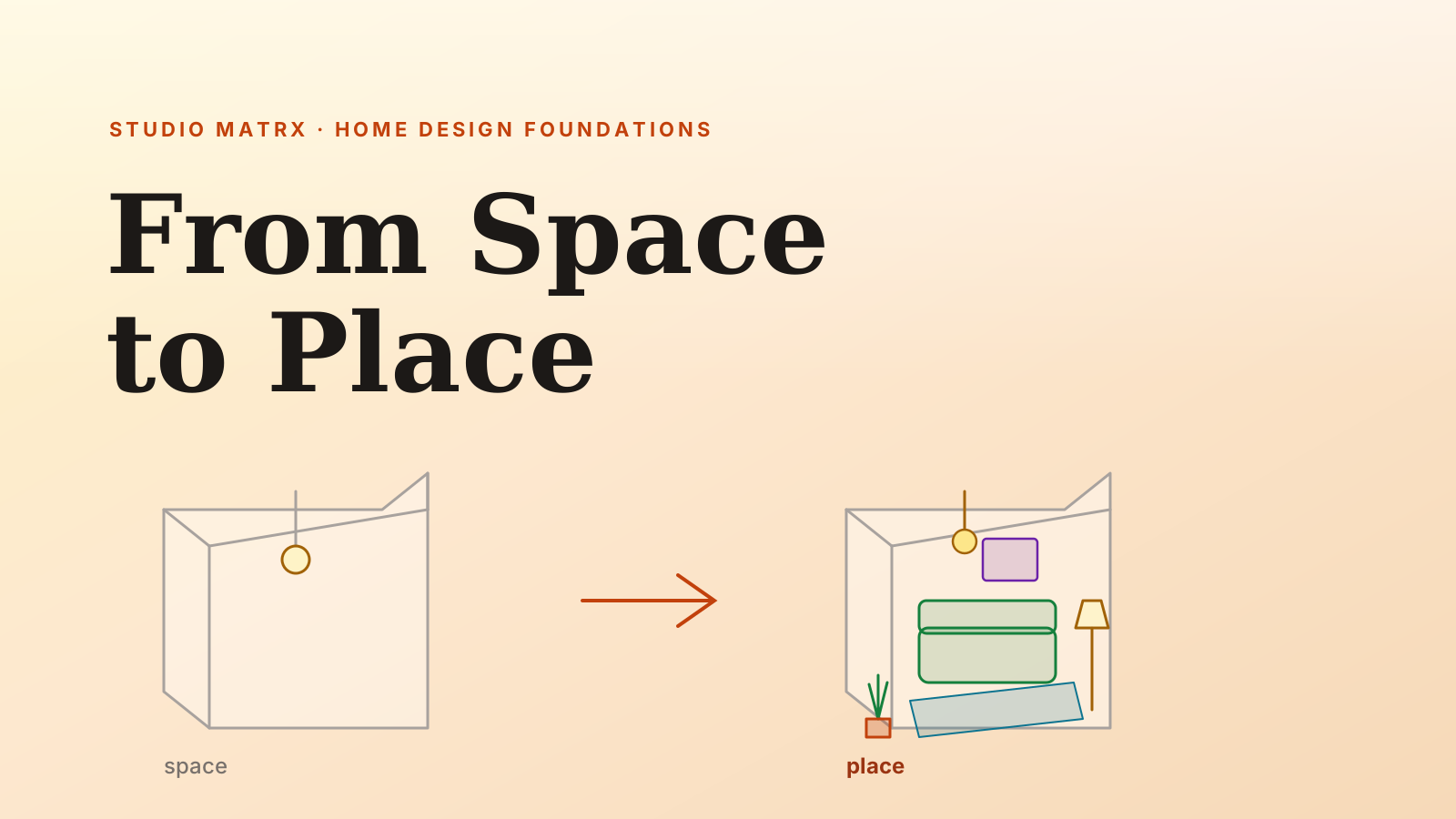
When the builder hands you the keys, what you actually receive is a set of empty boxes. Plastered walls, a vitrified floor, a few electrical points, a balcony railing. The lift opens, you step in, your footsteps echo, and for a moment the flat feels less like the future home you imagined and more like a parking lot stood on its end. This is normal. What you have been given is space. What you have not yet been given — what no builder can give you — is place.
A space is just enclosed air. A place is space you have grown to care about: the corner where your mother always sits with her morning tea, the landing where the children drop their bags, the balcony that smells of wet earth in the first monsoon shower. The difference between the two is not money, and it is not square footage. Some of the warmest homes in India are two-room flats; some of the coldest are 4,000-square-foot bungalows where every room feels like a hotel lobby. The difference is a handful of design decisions, most of which you can still make after possession, and many of which cost very little.
This guide is about those decisions. It is the craft of turning the empty boxes you were handed into rooms that hold people, hold memory, and feel — the moment you walk in — like they were waiting for you.
Space and place: what actually separates them
Walk into a model flat in any new project and notice how it has been "staged" — a sofa angled just so, a rug, a lamp casting warm light, two cushions, a coffee-table book, a plant in the corner. The developer is not selling you furniture. The developer is selling you the feeling of place, manufactured for the showing. The cruel trick is that your own flat, identical in plan, will feel nothing like it on handover day, because place is not built into the walls. It is layered on afterwards.
So it helps to be precise about what you are trying to achieve. Below is the practical difference, room by feeling.
| Quality | A mere SPACE | A true PLACE |
|---|---|---|
| First impression | Echoey, you talk softly | Sound is absorbed, you relax |
| Scale | Feels too big or too tall, you drift to the edges | Feels held, you settle in the middle |
| Light | Flat tubelight, evenly bright everywhere | Pools of light, some corners dim and cosy |
| Materials | Hard, uniform, factory-finished | A mix, some handmade, some that age well |
| Cues of life | Nothing suggests a person | Books, plants, a shawl, a photo, a swing |
| Your instinct | You pass through it | You want to stay |
Notice that none of the "place" qualities require demolition. A pool of warm light, a handwoven dhurrie, a brass diya, a stack of well-read books — these are additive. The single most freeing idea in home-making is this: you do not have to get the walls right to get the home right. You have far more power than the builder left you to believe.
A builder pours the space; only the people who live there can pour the place.
How space gets defined: the invisible architecture
Before you can make a place, you should understand how human beings read space at all. We rarely experience "boundless" space in a flat — the closest is standing on an open terrace under the sky, where without edges the space feels grand but also exposed, which is exactly why people instinctively move to the parapet rather than stand in the dead centre. Most of the space we live in is defined space: air shaped by something solid.
The tools that define space are older than architecture itself. A single peepal tree in a village defines a place beneath it — the chabutra, the panchayat seat, the spot where the bus is caught — without a single wall. Indoors, the definers are walls, columns, ceilings, level changes, screens and even planting. They draw lines in the air.
| Definer | What it does | Common Indian use |
|---|---|---|
| Full wall | Total separation, privacy, acoustic cut | Bedroom, bathroom, pooja room |
| Half wall / ledge | Suggests separation, keeps sightline | Living-to-dining divider with a planter on top |
| Column or dropped beam | Marks a threshold without blocking | Open kitchen edge, hall-to-passage |
| Jaali / screen | Filters light and view, hints at "beyond" | Foyer screen, balcony partition, pooja backdrop |
| Ceiling change | Defines a zone overhead | False-ceiling tray over the seating, coffered pooja ceiling |
| Level change | Sets a zone apart by a step | Sunken living, raised study or pooja platform |
| Flooring band | Draws a boundary on the ground | A strip of a different tile or wood marking the dining area |
| Rug | The cheapest, most movable definer | Anchors a seating group in an open hall |
The lesson for the very common Indian open plan — kitchen, dining and living flowing into one long rectangle — is that you do not need to wall things off to make them feel like distinct rooms. You need to define them. We will return to this; it is one of the most useful skills you can carry.
The zone of influence: why big rooms can feel cold
Stand near a wall and you feel its presence; the wall extends an invisible zone of comfort outward, a few feet of "near-ness" that feels protected. This is why, at a wedding reception in a vast banquet hall, the chairs along the walls fill first and the lonely chairs marooned in the centre fill last. It is why we sit under the tree and not beside it, why a child reads tucked into the corner of a sofa rather than perched in the middle of an empty room, why the diwan pushed against the wall is the most-used seat in the house.
Every vertical element — a wall, a pillar, a tall plant, a bookshelf, a swing hung from the ceiling — radiates this zone of influence. Good rooms are built from overlapping zones so that wherever you stand, something is "holding" you. Bad rooms are too big for their furniture, so the zones float as little islands in a sea of empty floor, and the room feels cold no matter how expensive the marble.
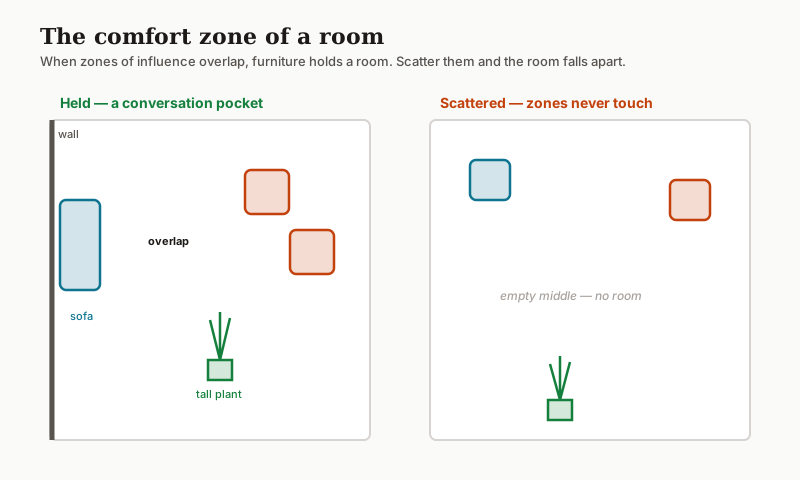
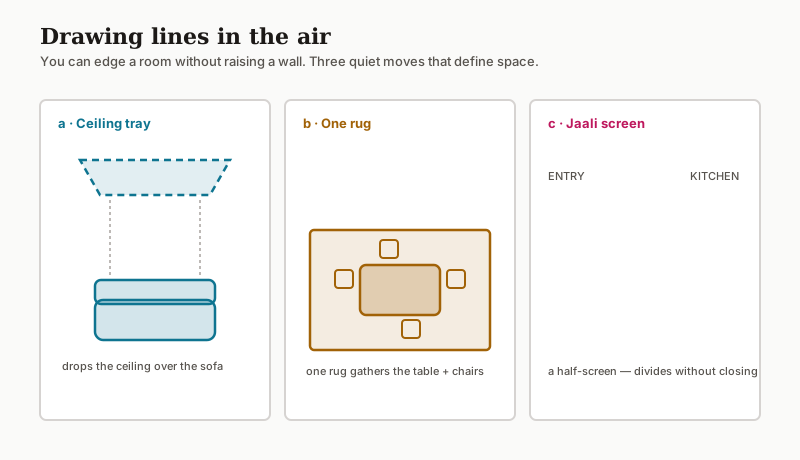
This is the hidden danger of the double-height drawing room and the over-large hall that builders advertise as "grand." Grandeur and comfort pull in opposite directions. A 14-foot-high living room photographs beautifully and feels like an airport on a quiet evening. If you have inherited such a space, you tame it: a false-ceiling tray brings the overhead height down over the seating to a human 9 to 10 feet, a large rug pulls the floor inward, and the sofas are turned to face each other rather than pushed flat to distant walls.
For conversation specifically, distance matters. People talking comfortably want to be close enough to speak without raising their voices but not so close it feels formal.
| Setting | Comfortable face-to-face distance | Practical Indian guidance |
|---|---|---|
| Intimate chat (family evening) | About 1.0 to 1.5 m | Two-seater and a chair at right angles, a small side table between |
| Normal living-room conversation | About 1.5 to 2.4 m | Two sofas facing across a 1.2 m coffee table; this is the everyday default |
| Formal drawing-room seating | About 2.4 to 3.0 m | Acceptable for a guest parlour; do not use it for the room you actually live in |
| Too far (feels cold) | Over 3.0 m face to face | The classic mistake of sofas hugging opposite walls of a big hall |
If your sofas are more than about ten feet apart and facing each other, nobody will use the room for talking — they will retreat to a bedroom. Pull them in. The hall will feel smaller and live larger.
Peopling a space: the cues that say "humans live here"
There is a moment, walking through a house, when you sense whether anyone really lives there or whether it is a furniture showroom. The signals are subtle but you read them instantly. A space feels "peopled" when it carries evidence of the human body and the human hand.
Some cues are about scale: a window low enough that you could imagine someone standing at it and looking out, a door of human proportion, a chair clearly shaped to a human back. Some are about touch: handmade Athangudi tiles with their slight irregularities, a brass urli, terracotta pots, a kota-stone floor that warms in the sun, a wooden jhoola whose chains have been polished smooth by years of hands. Some are simply the residue of living: a newspaper folded on the takht, slippers by the door, a half-read book, a child's drawing on the fridge, tulsi in the balcony, a string of marigold over a doorway.
The all-glass-and-gloss apartment fails this test precisely because every surface is machine-perfect and nothing carries a human trace. You do not have to abandon modern finishes — you have to interrupt them with the handmade and the lived-in.
| Room | Peopling cue (Indian, low-cost first) | What it signals |
|---|---|---|
| Entry / foyer | A console with a brass diya, a small mirror, a key bowl | Someone arrives and leaves here |
| Living | A jhoola or a takht, a dhurrie, books on the coffee table | This room holds family, not just guests |
| Dining | Handmade ceramic, a cloth runner, a fruit bowl that is actually used | Food and gathering happen here |
| Kitchen | A masala dabba on the counter, a hanging utensil rack | A real cook works here, not a catalogue |
| Bedroom | A bedside reading lamp, a shawl over the chair, a photo | A particular person sleeps and dreams here |
| Balcony / sit-out | Two chairs, a few terracotta planters, a watering can | An evening is spent here |
| Pooja corner | A worn wooden chowki, a small bell, fresh flowers | The household's quiet centre |
The cheapest of these — flowers, books, plants, a textile, a lamp — do more for the soul of a room than the most expensive imported sofa. A ₹600 cotton dhurrie and a ₹1,200 brass lamp will "people" a corner that a ₹90,000 modular unit left cold.
Perfection signals a showroom; the handmade and the slightly worn signal a home.
The journey from public to private: sequence and threshold
A home is not a pile of rooms; it is a journey, and the journey has an order. We move, instinctively, from the most public part of a house to the most private. The front door and entry are public — anyone may reach them. The drawing or living room receives guests. The family room is more intimate, for the household and close people. The bedrooms are private, and within them a few corners are the most private of all. A home feels right when this gradient is honoured and wrong when it is violated.
You have felt the violation. A front door that opens straight into a bedroom is unsettling — the most private room exposed at the most public threshold. A kitchen visible the moment you step in, with its working mess, breaks the gradient too — the cook feels watched and the guest feels they have walked in on something. A toilet door facing the dining table is the small daily indignity of many builder flats. None of these are about Vastu superstition; they are about the felt logic of public-to-private that human beings carry everywhere.
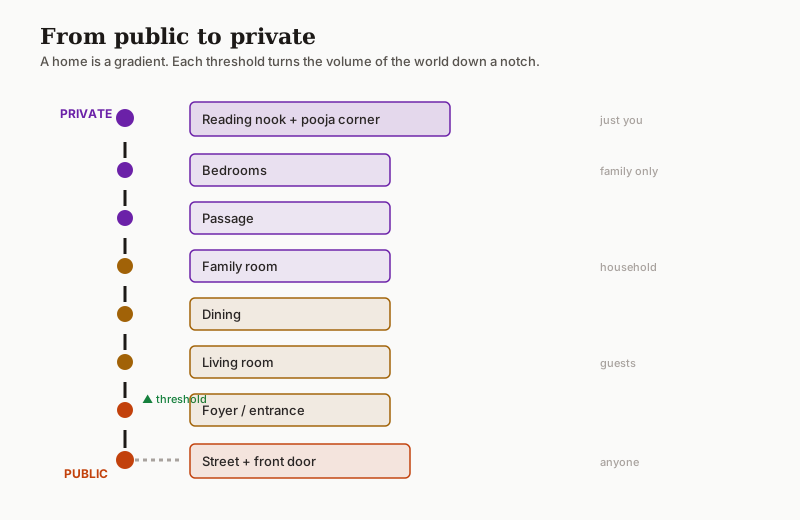
The fix, when you cannot move walls, is the transition space — a small pause that softens the jump from one level of privacy to the next. A foyer or a shoe-and-key console between the door and the living room. A jaali screen that breaks the direct sightline into the kitchen or the bedroom passage. A change of flooring or a low planter to mark where "guest territory" ends and "family territory" begins. Even a curtain on a rod can rescue a bedroom that opens too publicly.
| Zone | Privacy level | Who belongs here | Threshold before it |
|---|---|---|---|
| Street / lift lobby | Public | Anyone | — |
| Front door | Public edge | Visitors, deliveries | The door itself, a name plate |
| Foyer / entry | Semi-public | Greeted guests | Console, mirror, shoe rack |
| Drawing / living | Social | Invited guests | A step, a screen, or a rug |
| Dining | Social-family | Guests at meals, family | Flooring change or half-wall |
| Family room / TV | Intimate | Household and close kin | A passage or level change |
| Bedrooms | Private | Individuals, couples | A passage and a door |
| Reading nook / pooja corner | Most private | One person at a time | The corner itself |
In a small flat you cannot give every zone its own room — but you can still give each its own moment. A 2BHK can sequence the journey with nothing more than a console, a rug and a curtain. The gradient is about feeling, not floor area.
Zones of retreat: every person needs a corner
For all our love of joint family and the gathered evening, every human being needs somewhere to withdraw — a place to be alone without leaving the house. In the old haveli this was understood: the thinnai or sit-out for the elder, the inner courtyard for the women, the terrace at night. In a compact flat it must be designed deliberately, because the open plan that is so good for togetherness leaves nowhere to hide.
A zone of retreat need not be a whole room. It can be a window seat with a cushion and good light, a reading nook carved from the end of a passage, a chair and lamp turned to a corner, a balcony with one chair and a few plants, a meditation or pooja corner with a low seat. What makes it a retreat is that it is yours for an hour, it is slightly apart, and it has its own pool of light and its own zone of influence holding you.
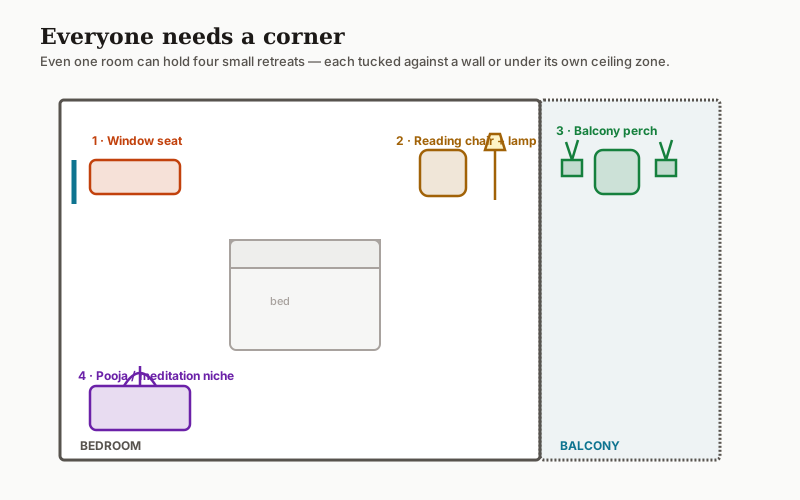
Spaces also want to be sized to the number of people they hold. A corner for one is small and tightly held; a room for eight is generous and open. Trouble comes when the sizing is wrong — a tiny study meant for one crammed for four, or a vast hall used by two. Graduated sizing is part of why a good home feels effortless.
| Group size | Right kind of space | Indian example | Approx. footprint |
|---|---|---|---|
| 1 (retreat) | A nook, deeply held | Window seat, pooja corner, reading chair | 1.0 to 2.5 sqm |
| 2 (intimacy) | A small defined pocket | Balcony sit-out, two-chair coffee corner | 3 to 5 sqm |
| 4 (family) | A held but open room | Family TV room, breakfast nook | 9 to 14 sqm |
| 8 (gathering) | A generous social room | Living-dining for festivals and guests | 18 to 28 sqm |
The practical move in a small home is to make one space serve two sizes — the dining table that seats four daily and eight at Diwali, the living room that holds the couple on a Tuesday and the whole extended family on a Sunday — and to carve at least one genuine retreat for each resident, even if it is only a chair turned to a window.
| Home size | Realistic retreats to plan for | Notes |
|---|---|---|
| 1BHK | One: a window seat or a balcony chair | Share it by time of day |
| 2BHK | Two: a balcony perch plus a bedroom reading corner | Pooja corner doubles as a quiet seat |
| 3BHK | Three to four: study, balcony, window seat, pooja | One per adult is the goal |
| Independent house / villa | A terrace, a courtyard seat, a study, a balcony | The courtyard becomes the household's shared retreat |
Flow: a home that moves like a stream
There is a quality in some homes that everyone notices but few can name — the house flows. You move through it without bumping, without backtracking, without that awkward shuffle past furniture. Think of it as a stream: the circulation paths are the flowing water, the rooms are the calm pools where the water collects and rests. The water should reach every pool without flooding the rooms, and the pools should feel still, set slightly aside from the current.
A house flows badly when the path runs straight through the middle of where you want to sit, when you must cross the living room to reach the kitchen with the grocery bags, when two doors clash, or when the only route to the bedrooms cuts across the dining table. It flows well when paths hug the edges, when rooms are pockets off the main current rather than corridors with furniture in them, and when each room has a clear "still" centre the path does not invade.
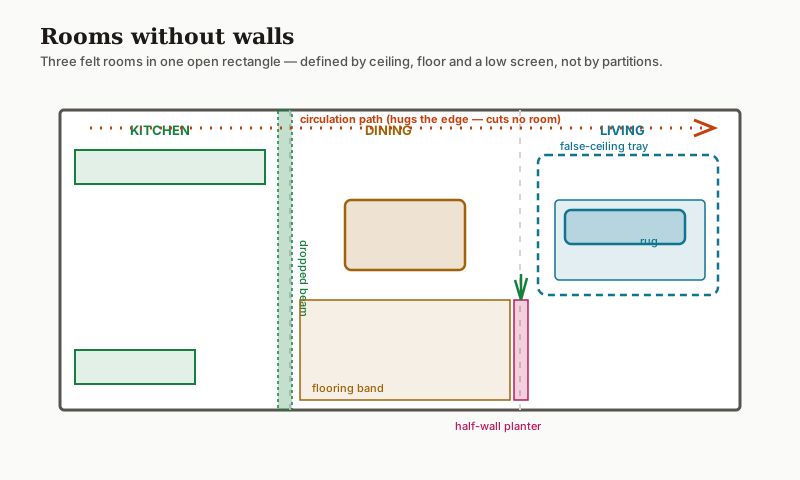
This is where defining-without-walls returns. In the typical Indian open kitchen-dining-living, the danger is that it reads as one big undifferentiated hall — a single space, never three places. You divide it by drawing lines in the air: a false-ceiling tray over the seating to give the living its own ceiling; a dropped beam or a single column to mark the kitchen threshold; a flooring band or a rug to anchor the dining; a half-wall with a planter to screen the kitchen counter from the entry. None of these block movement. All of them turn one space into three places, each with its own zone of influence, while the stream still flows along the edge.
The four tools that turn space into place
If you remember nothing else, remember the four levers. Each one is affordable, each one is reversible, and together they do most of the work.
Light. Flat, uniform tubelight is the enemy of place; it abolishes the shadows and pools that make a room feel layered. Replace the single ceiling tube with several smaller sources — a floor lamp by the reading chair, a warm pendant over the dining, cove lighting in the false-ceiling tray, a table lamp in the corner. Warm light (around 2700 to 3000 K) for living and bedrooms; keep cooler, brighter light for the kitchen and study. The same room, relit, becomes a different home.
Focal points. Every room wants something for the eye to settle on — a feature wall in a textured finish, a single large artwork, the jhoola, a pooja unit, a console with a mirror and lamp. Without a focus, the eye wanders and the room feels restless. With one, the room composes itself around it.
Changes in level, height and material. A single step into a sunken seating, a raised pooja platform, a coffered or trayed ceiling over one zone, a band of wood in a tiled floor — each small change tells you "a different place begins here," doing the work of a wall without the wall.
The human and handmade layer. The peopling cues from earlier — textiles, plants, books, brass, terracotta, handcraft, the slightly imperfect. This is the layer that turns a correctly arranged room into a loved one.
| Lever | Cheapest first move | Approx. cost | Effect |
|---|---|---|---|
| Light | Swap one tube for a warm floor lamp | ₹1,500 to ₹4,000 | Instant warmth, pools of light |
| Focal point | One large artwork or a styled console | ₹2,000 to ₹15,000 | The room gains a centre |
| Level / material | A rug, then a flooring band, then a tray ceiling | ₹3,000 to ₹40,000 | Zones defined without walls |
| Handmade layer | Dhurrie, plants, brass, books | ₹2,000 to ₹10,000 | The room becomes "peopled" |
You can transform the feel of an entire flat for well under a lakh using only these four levers — long before you touch the big-ticket modular work. Place is cheaper than people think; it is mostly attention.
Walls cost money; place mostly costs attention — and attention is the one thing the builder could never charge you for.
References
- Bureau of Indian Standards, National Building Code of India 2016 (NBC 2016) — Part 4 (Fire and Life Safety, occupancy and circulation), Part 8 (Building Services, Lighting and Ventilation). New Delhi: BIS.
- Bureau of Indian Standards, IS 3646: Code of Practice for Interior Illumination — recommended lux levels and lighting practice for residential and task spaces.
- Bureau of Indian Standards, IS 4963: Recommendations for Buildings and Facilities for the Physically Handicapped — human-scale clearances and circulation widths useful for residential planning.
- Ministry of Housing and Urban Affairs / Town and Country Planning Organisation, Urban and Regional Development Plans Formulation and Implementation (URDPFI) Guidelines — residential space and density norms.
- Hirsch, William J. Jr. Designing Your Perfect House: Lessons from an Architect. Dalsimer Press. (A general inspiration for this series' approach to turning an empty space into a lived-in place.)
- V. Ganapati Sthapati, Building Architecture of Sthapatya Veda — traditional Indian principles of proportion, threshold and the courtyard, useful as a cultural lens.
- Christopher Alexander, Sara Ishikawa and Murray Silverstein, A Pattern Language: Towns, Buildings, Construction — patterns on zones of retreat, light on two sides, and intimacy gradients.
This guide is part of the Studio Matrx "Home Design Foundations" series. Read the companion pillars: How a Home Feels Right, Planning Your Home Before You Spend a Rupee, Programming Your Home, Interior Design Budgets in India, and Designing a Naturally Energy-Efficient Home. Plan your layout with the Bubble Diagram Planner and discover how you really want to live with the Home Lifestyle Quiz. When you are ready to see your space become a place, design it with Studio Matrx DesignAI.
Export this guide
Related Guides — Deep-dive reading
How to Design a Home That Feels Right — Beyond Just Looks
The invisible design decisions — order, scale, light, craft and memory — that make a home feel like home, not a showroom
Design EducationWhy Scale Matters: Keeping Rooms Comfortable for Humans
How sizing furniture, art and lighting to the human body — not the showroom — keeps small Indian flats from feeling crushed and large halls from feeling empty.
Design PrinciplesSequential Progressions: Why the Order of Spaces Matters
A home is experienced as a journey in time, not a plan seen all at once — and arranging that journey, with compression, release and thresholds from public street to private inner room, is what makes a house feel right.
Design PrinciplesRelated Tools — Try Free
Cross-Ventilation Analyzer
Estimate airflow and air changes per hour (ACH) from room size, window areas, layout, and local wind — with NBC 2016 Part 8 compliance check.
Ventilation CalculatorVastu Window Planner
Vastu guidance for window placement and size by wall direction and room — rating and remedies.
VastuApartment Furniture Size Chart
Standard furniture dimensions for Indian apartments — sofas, beds, tables, dining, storage.
Reference Chart