
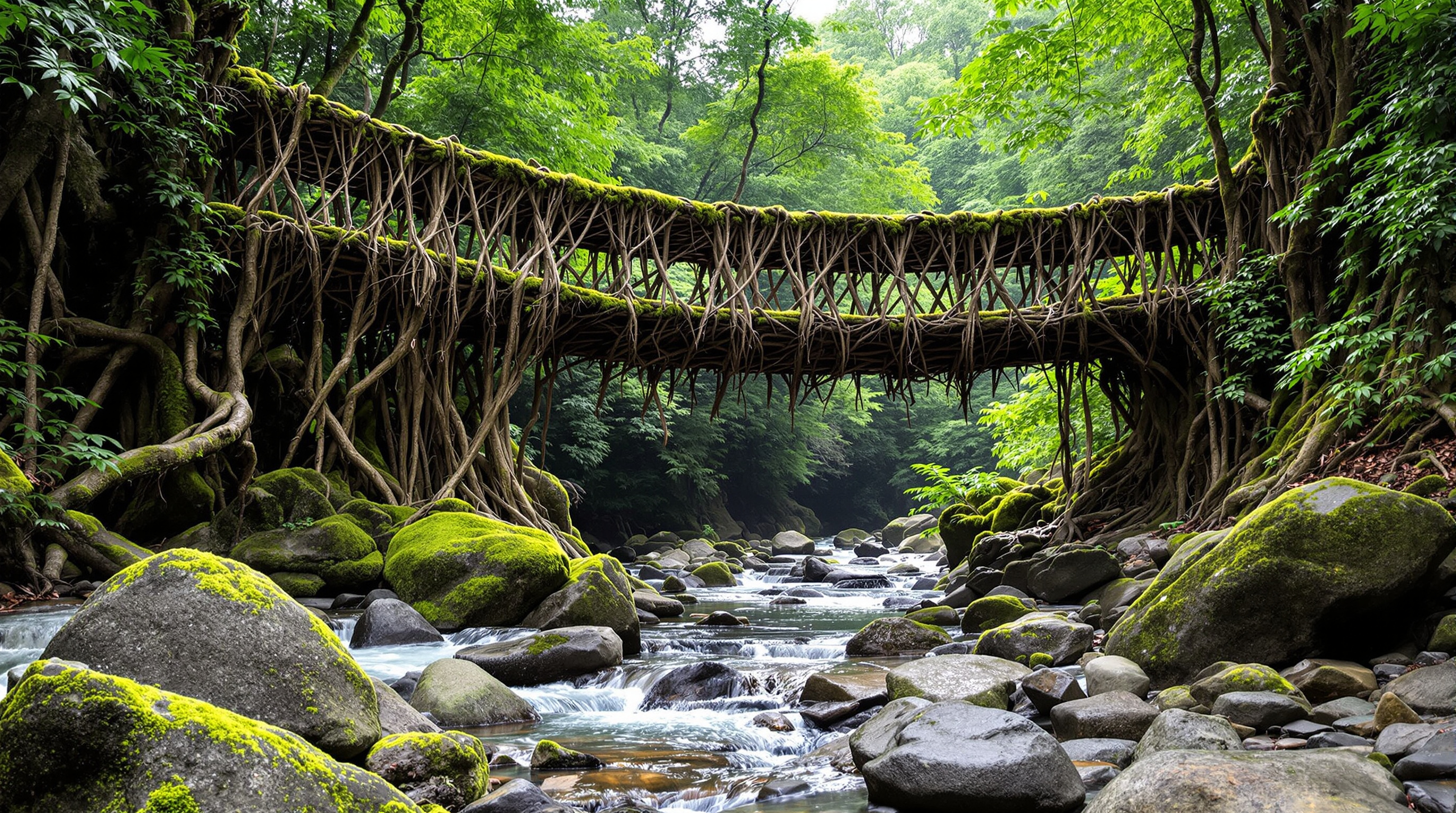
Living Root Bridges: How Meghalaya Grew the Architecture of the Future
For centuries the Khasi and Jaintia communities of north-east India have not built their river crossings but grown them — training the aerial roots of Ficus elastica across gorges until the living tree becomes a load-bearing bridge that gets stronger every year. This deep study reads their botany, their structural logic, and why an ancient vernacular now sits at the frontier of where architecture is going.
Almost every building in this canon began as a drawing. A living root bridge in Meghalaya began as a seed. Somewhere in the wet hills above the Bangladesh plain, a Khasi or Jaintia family planted a cutting of the Indian rubber tree on a riverbank, and then a grandparent, a parent and a child spent the better part of a century patiently guiding its roots across the water until the tree itself had become a bridge — one that is still alive, still growing, and still carrying people across the gorge today. No steel, no concrete, no mortar, no bill of quantities. Just a plant, a river, and time treated as a building material.
That is why this ancient, anonymous, entirely vernacular structure earns a place in a book about the future of architecture. Marc Kushner's question — what does this building tell us about where architecture is going? — has an unusually sharp answer here. The living root bridge is the working prototype for something the discipline has only recently learned to want: architecture that is grown rather than manufactured, that repairs itself rather than decays, and that removes carbon from the air instead of pouring it in. The Khasi and Jaintia peoples solved a problem in living architecture centuries before European research labs gave it a name.
A living root bridge is not a finished object but a process that never stops. It is the rare structure that is weakest on the day it opens and strongest generations later — the exact inversion of everything we build in steel and concrete.
The question it poses: can you build with time?
The conventional building is an act of subtraction against entropy. The moment a bridge of steel or reinforced concrete is finished, it begins to lose — corroding, cracking, fatiguing — and every year of its life is a managed decline toward demolition. The living root bridge, or jingkieng jri in Khasi, proposes the opposite contract. It is deliberately unfinished. Its builders accept that they will not cross their own bridge in its mature form; they are growing it for descendants they will never meet. In exchange, the structure does something no manufactured bridge can: it heals its own wounds, thickens where it is loaded, and grows more capable with age.
This is the provocation that places a centuries-old craft in the "not-yet-built" chapter of a book about architecture's frontier. Everything else in this chapter is speculative — floating cities, orbital towers, printed communities. The living root bridge is the one entry that is fully built, fully proven, and hundreds of years old, yet it points at the same horizon: a future in which buildings are living systems. It is not a relic. It is a working answer to a question the rest of architecture is only now learning to ask.
How a bridge is grown, not built
The species doing the work is Ficus elastica, the Indian rubber tree — a facultative hemiepiphyte and a member of the strangler-fig group. Its defining trait is a prolific production of aerial roots: secondary roots that descend from the trunk and branches, flexible and searching while young, woody and immensely strong once anchored in soil. Khasi and Jaintia builders discovered, long before anyone wrote it down, that these roots could be captured and directed.
The technique is elegantly simple in principle and monumentally patient in practice. A young rubber tree is established on one bank of a stream. As its aerial roots emerge, they are guided horizontally toward the far bank — traditionally along a hollowed-out betel-nut trunk, a bamboo scaffold, or a frame of interwoven older roots that acts as a temporary formwork. Roots that reach the opposite bank are pressed into the soil, where they take hold and begin to draw water and nutrients, anchoring the far end. The process is repeated, root after root, generation after generation, thickening and multiplying the crossing until it can carry a person, then several people, then loaded porters.
The critical detail is that the scaffold is temporary and the tree is permanent. The bamboo rots, the betel trunk decays, and by the time they are gone the roots they guided have become the structure. The formwork does not stay behind as waste — a quiet lesson for an industry that generates a third of the world's solid waste from construction and demolition.
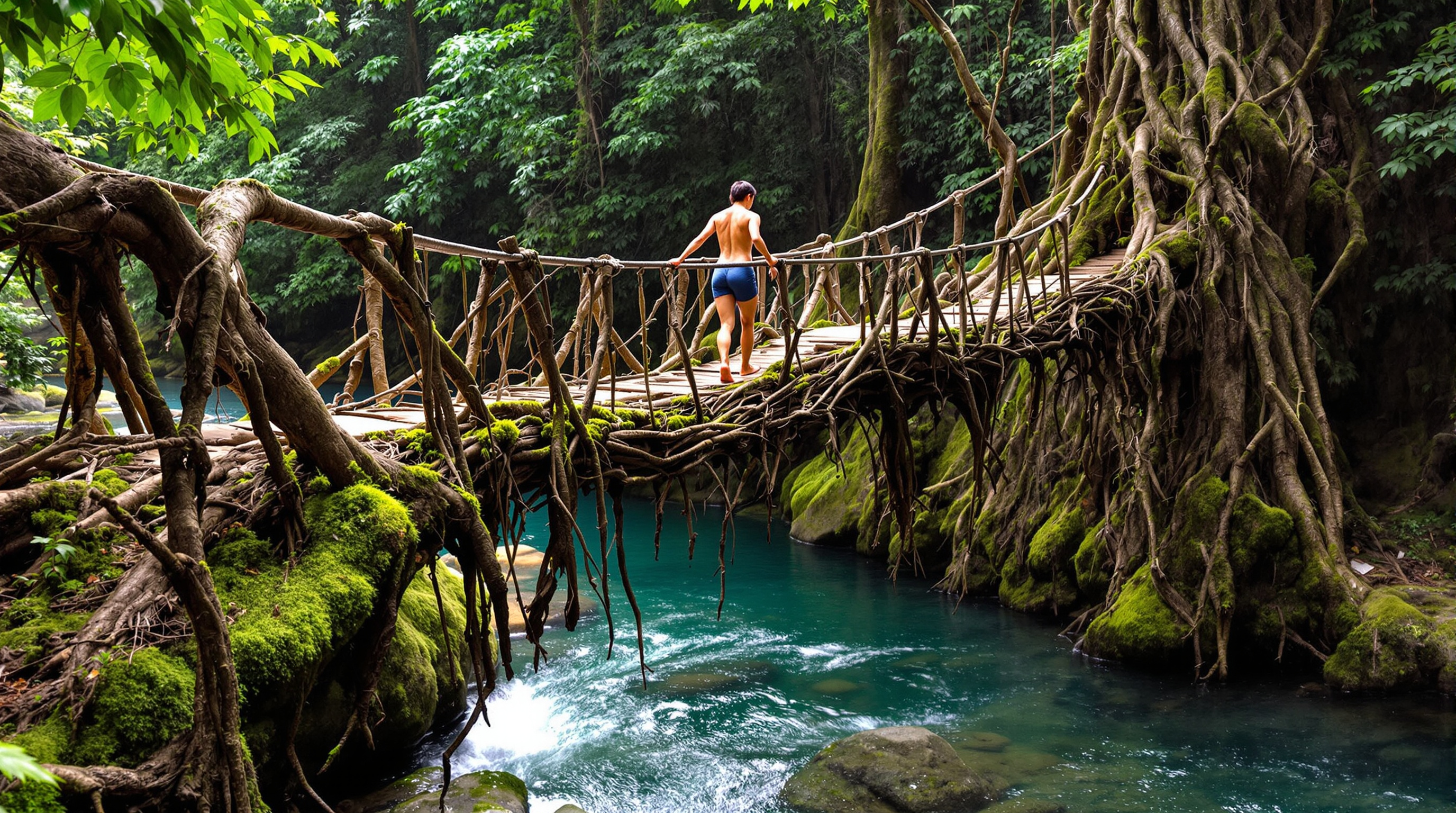
The botany of a self-building structure
What makes the bridge a structure rather than merely a tangle of roots is a pair of biological processes that a 2019 study in Scientific Reports — the first peer-reviewed scientific paper on this living architecture, led by Ferdinand Ludwig with botanist Thomas Speck and colleagues — documented in detail across a survey of more than seventy bridges in the Khasi and Jaintia Hills.
The first process is inosculation: the natural grafting of separate roots into one continuous body. Where two rubber-tree roots are pressed together and held, their bark abrades, their vascular tissues meet, and over time they fuse so completely that the boundary between them disappears. The researchers describe this happening in stages — first a loose nodal contact, then a pressing-together as the roots contract under their own tension, and finally a homogeneous fusion in which the original separate roots can no longer be told apart. A living root bridge is therefore not many roots lying side by side; it is a single grafted network, a true structural continuum.
The second process is adaptive secondary growth: the tree's ability to add wood exactly where mechanical stress demands it. Roots that carry load respond by thickening, and the 2019 survey found that horizontal load-bearing roots develop specialised elliptical or inverted-T cross-sections — shapes an engineer would recognise as optimised beams — while unloaded vertical roots stay round. The structure literally reads its own force diagram and grows into it. This is why the bridge strengthens with use: every crossing is a small structural instruction that the living material obeys.
Because the roots can be trained into so many configurations, the bridges display a startling range of engineering behaviours. The same survey noted individual structures that read like suspension bridges, cable-stayed bridges, arches, trusses and simply-supported beams — a whole catalogue of structural types, all executed in one material by intuition and inheritance rather than calculation.
| Living-root feature | Engineering analogue | How it behaves in the bridge |
|---|---|---|
| Aerial root in tension across a span | Suspension cable / tie | Carries the deck load back to the anchored banks |
| Root arching between banks | Compression arch | Transfers load to abutments in the riverbank soil |
| Inosculated root network | Welded / grafted joint | Fuses many roots into one continuous load path |
| Adaptive secondary growth | Load-optimised beam section | Thickens and reshapes where stress is highest |
| Roots anchored in far-bank soil | Foundation / abutment | Living anchorage that deepens over time |
The span figures are modest by civil-engineering standards and all the more remarkable for being alive. The 2019 inventory recorded bridges ranging from about 2 to 52.7 metres, with roughly four-fifths under 20 metres, at altitudes between 57 and 1,211 metres above sea level. These are not follies. They are the everyday infrastructure of villages that would otherwise be cut off by water for months of the year.
Why Meghalaya, and why it matters for India
The living root bridge is not a curiosity that could have appeared anywhere; it is a precise answer to a specific place. Meghalaya sits on the front line of the South Asian monsoon, and its southern hill stations — Sohra (Cherrapunji) and Mawsynram — trade the title of the wettest inhabited places on Earth. When that much rain falls onto steep terrain, the streams become violent, flash-flooding torrents that tear conventional timber and steel bridges away and rot untreated wood within a season or two.
A dead bridge fails against a monsoon; a living one adapts to it. Roots that are ripped or damaged regrow. A structure anchored by living roots that go on driving themselves deeper into the bank actually becomes better founded with each passing year. In a landscape that punishes everything static, the Khasi and Jaintia peoples engineered something dynamic. This is Indian vernacular architecture at its most sophisticated — an indigenous technology, refined over centuries and transmitted through custom and kinship rather than drawings, that outperforms imported alternatives on their own terms of durability and resilience.
That significance is now being formally recognised. In 2022 the site Jingkieng Jri: Living Root Bridge Cultural Landscapes of Meghalaya was added to UNESCO's World Heritage tentative list, with an estimated hundred or so bridges spread across dozens of villages in the East Khasi Hills and West Jaintia Hills. For a tradition long treated as folklore, inclusion alongside the world's monumental heritage is an argument that the future of architecture may be found in its overlooked margins as much as in its capitals.
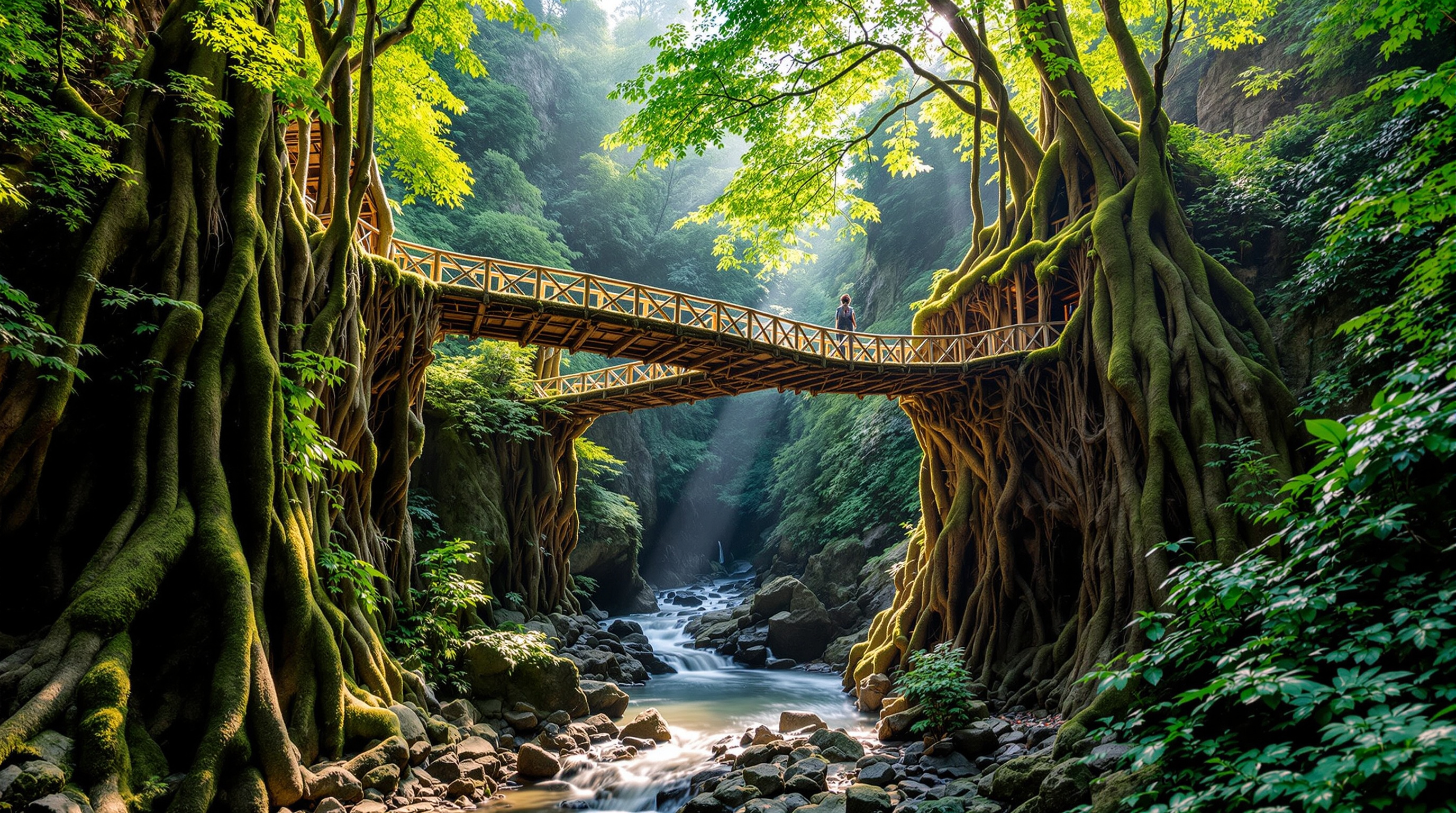
From vernacular craft to Baubotanik
The reason a 2019 research team travelled to these valleys at all is that the living root bridge has become a lodestar for a small but serious movement in contemporary architecture. Ferdinand Ludwig, now a professor at the Technical University of Munich, is the founder of Baubotanik — literally "building-botany" — a discipline that treats living trees as structural members, weaving and grafting them into load-bearing towers, walkways and facades that continue to grow after construction. Ludwig has called the Meghalaya bridges a unique "concept generator" for botanical architecture, and it is easy to see why: they are the only large body of evidence on Earth for how grown structures behave over centuries, not seasons.
The appeal is not merely poetic. A grown structure is carbon-negative by definition — it sequesters carbon into its own fabric as it builds itself — and it collapses the wall between construction and ecology. It provides habitat, cools its microclimate, holds soil and manages water, all while performing as infrastructure. As architecture confronts the fact that cement and steel are among the planet's largest industrial carbon sources, a building method whose primary emission is oxygen begins to look less like an anthropological footnote and more like a research programme. A 2020 study in Sustainability went so far as to characterise the bridges explicitly as regenerative structures — infrastructure that improves its own ecosystem over time rather than degrading it — a benchmark most "green" buildings can only aspire to.
The third position: myth, tourism and the concrete threat
Honesty requires resisting the romance. Several things routinely claimed about these bridges do not survive scrutiny, and the tradition itself is under real pressure.
Begin with age. It is common to read that particular bridges are five or six hundred years old, but the 2019 researchers could offer confident age estimates for only about fifteen of the structures they studied, and even those rest on oral history rather than physical dating. The truthful statement is that the oldest bridges are probably several centuries old — genuinely ancient, but not verifiable to a specific year. Dates should be reported as tradition holds them, not as measured fact.
The deeper threat is modernity arriving as help. Steel wire-and-plank footbridges and reinforced-concrete spans are cheaper to install and, crucially, usable within weeks rather than decades — an almost irresistible offer to a village that needs a crossing now. Where they are built, the incentive to invest a lifetime of patient root-training evaporates, and the knowledge chain, which depends on one generation apprenticing the next, quietly breaks. Tourism cuts both ways: the income it brings has given some villages a fresh reason to protect their bridges, but the sheer footfall on celebrated structures like the double-decker at Nongriat imposes loads and wear the roots were never grown to carry, and the surrounding forest — the very ecosystem the rubber trees depend on — is thinned by the pressure of visitors and development.
Studio Matrx's editorial position is to hold these truths together. The living root bridge is a genuine masterpiece of indigenous engineering and a credible prototype for a lower-carbon architectural future — and it is a fragile, slow, place-bound craft that cannot simply be scaled up, exported, or rushed. Its lesson for the future of architecture is not that we should all grow our buildings tomorrow. It is subtler and more demanding: that the most advanced ideas in the discipline — living materials, self-repair, carbon capture, structures designed for descendants — already exist, fully realised, in the hands of communities the mainstream long dismissed as pre-modern.
Why it belongs in the canon
Strip away the theory and the caveats and one fact remains. In a book searching for where architecture goes next, the most convincing living example of a grown, self-strengthening, carbon-negative structure is not a laboratory prototype or a competition render. It is a bridge in a rain-drenched Indian valley, planted by people whose names were never recorded, tended across generations, and still carrying children to school today. The future of architecture, it turns out, has been quietly working in Meghalaya for four hundred years.
References
- Ludwig, F., Middleton, W., Gallenmüller, F., Rogers, P. & Speck, T. (2019). "Living bridges using aerial roots of Ficus elastica – an interdisciplinary perspective." Scientific Reports, 9, 12226. DOI: 10.1038/s41598-019-48652-w. nature.com (peer-reviewed; the first scientific paper on living root bridges and the core source for the inventory, span data and growth biology)
- Middleton, W., Habibi, A., Shankar, S. & Ludwig, F. (2020). "Characterizing Regenerative Aspects of Living Root Bridges." Sustainability, 12(8), 3267. MDPI. DOI: 10.3390/su12083267. mdpi.com (peer-reviewed; frames the bridges as regenerative infrastructure)
- UNESCO World Heritage Centre (2022). "Jingkieng jri: Living Root Bridge Cultural Landscapes of Meghalaya" — World Heritage tentative list, ref. 6606, inscribed on the tentative list 28 March 2022. whc.unesco.org (primary; official heritage documentation)
- Ludwig, F. — Green Technologies in Landscape Architecture, Technical University of Munich. "Living bridges / Baubotanik" research programme. arc.ed.tum.de (primary; the research group and the Baubotanik concept)
- The Living Root Bridge Project — geolocated database of tribal botanical architecture in Meghalaya. livingrootbridges.com (primary; field inventory that fed the peer-reviewed studies)
- Middleton, W., Shu, Q. & Ludwig, F. (2023). "A circuit-analogy-based girth growth model for living root bridges." Journal of the Royal Society Interface, 20(203). DOI: 10.1098/rsif.2023.0168. royalsocietypublishing.org (peer-reviewed; models how the roots thicken under load)
- "Rooted in tradition, nature-based architecture bridges generations." Mongabay India (2024). india.mongabay.com (press; on transmission of the craft and current threats)
Part of The Future of Architecture in 300 Buildings — Studio Matrx's canon of the buildings asking where architecture goes next. Chapter 16: Concepts & Provocations.
Export this guide
Related Guides — Deep-dive reading
Sharma Springs: How IBUKU Made Bamboo Grow Six Storeys Tall
Elora Hardy and IBUKU's bamboo villa above the Ayung River valley in Bali is the tallest bamboo house in Indonesia — a lotus-shaped structure grown from a single grass, designed through physical models rather than drawings, and a serious argument that the fastest-growing plant on earth belongs in the future of building.
The Future of ArchitectureHampi Art Labs: How sP+a Built a Second Ground Beside a Ruined Capital
Near the boulder-strewn ruins of Vijayanagara, Sameep Padora's arts centre for the JSW Foundation dissolves itself into the terrain — a sinuous concrete shell rendered in local red earth, organised around a 'space of flows' and roofed with an accessible landscape that becomes a second ground. A study of its concept, its construction, its place in the Nature Building chapter, and the questions its steel-money patronage cannot quite render over.
The Future of ArchitectureIn-Vitro and Grown-Material Habitats: The Building That Is Cultivated, Not Constructed
From mushroom-brick towers to bacteria-cemented blocks and speculative dwellings grown from living cells, a cluster of experiments asks a genuinely new question: what if we stopped mining and manufacturing our buildings and started farming them instead? A deep study of grown architecture — its biology, its structural limits, and the honest gap between the manifesto and the load path.
The Future of ArchitectureRelated Tools — Try Free
Concept Generator
Get 3 AI-generated design concepts for any room with style, materials, and cost estimate.
DesignAIAI BOQ Generator
AI generates detailed Bill of Quantities with city-specific rates and labour breakdown.
ArchitectAIBefore & After Studio
Generate AI before-and-after renders to preview how your redesign could look.
DesignAI