
Universal Design and Residential Elevators (India): The Seven Principles in a Home Lift
The seven principles of universal design, applied feature by feature to a residential lift — why a well-specified home lift is one of the most universal elements in the house.
There is a quiet test that every part of a house should be able to pass: can everyone in the family use it, the same way, without help, without a special version, and without thinking too hard about it? Most of a home fails that test in small ways — a stair, a heavy door, a switch mounted too high for a child or too low for someone in a wheelchair. A well-specified home lift is one of the rare elements that can pass it outright.
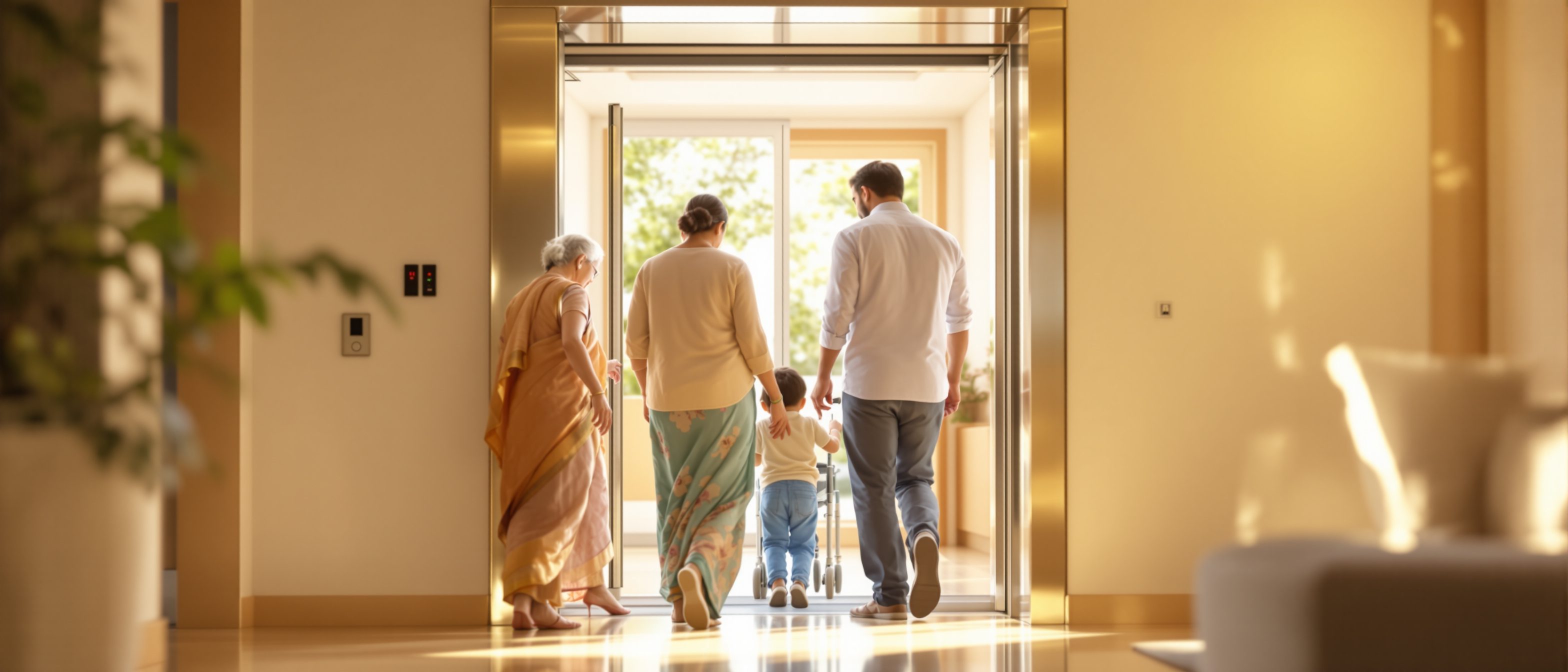
That is what "universal design" means. It is not a synonym for "disabled access" or a ramp bolted on as an afterthought. It is a design philosophy — seven clear principles, first set out at North Carolina State University — that asks for things to work for the widest possible range of people from the very start. A child too small for the stairs. A grandparent whose knees have given up. A wheelchair user. A pregnant family member. Anyone carrying shopping bags, a suitcase, or a sleeping toddler. The same lift serves all of them, with no fuss and no labels.
This guide walks through the seven principles of universal design one by one and shows the concrete lift feature that delivers each. Think of it as a specification checklist with a reason attached to every line.
A quick map of this cluster: for the exact CPWD and RPwD numbers (door widths, car sizes, handrail heights) see our accessibility standards for residential lifts. For the broad architect-level view of universal design across the whole house, see universal design and adaptable homes. For room-by-room execution, see accessible home design in India. This guide is the lift-and-the-seven-principles lens.
What "universal design" actually is
Universal design (UD) and accessibility are related but not the same. Accessibility, in the legal sense — the RPwD Act 2016 — sets a floor: minimum dimensions a public building must meet so a person with a disability is not excluded. Universal design sets an aspiration: design that is good for everyone, so well thought-out that no special accommodation is needed and nobody feels singled out.
A ramp beside a flight of stairs is "accessible." A single step-free path that everyone — the toddler, the courier, the wheelchair user — takes together is universal. The difference is dignity and inclusion, not just compliance.
A home lift, specified properly, sits firmly on the universal side. It is the same machine for the eight-year-old reaching the lower button and the eighty-year-old who can no longer climb. Nobody gets a "special" route. That is the whole idea.
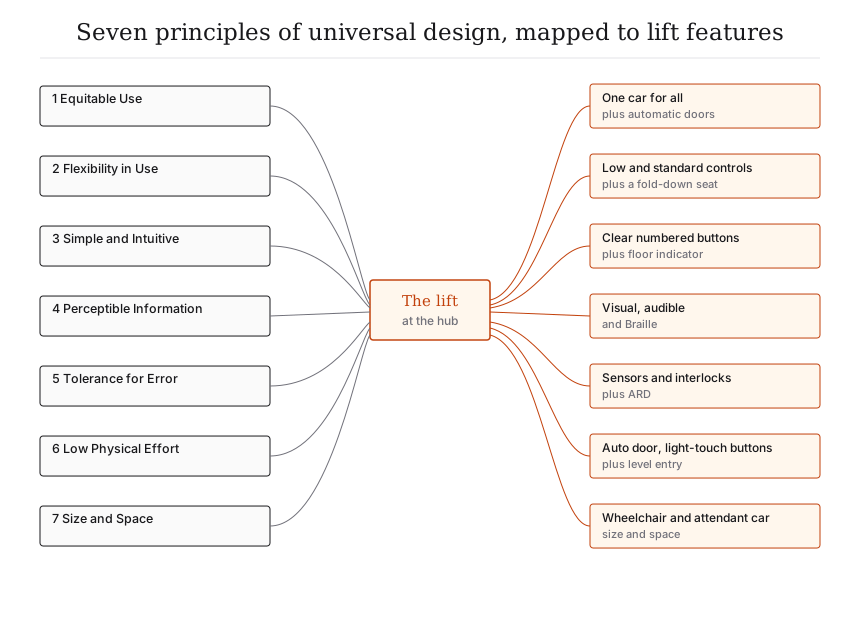
The seven principles, applied to a home lift
1. Equitable Use
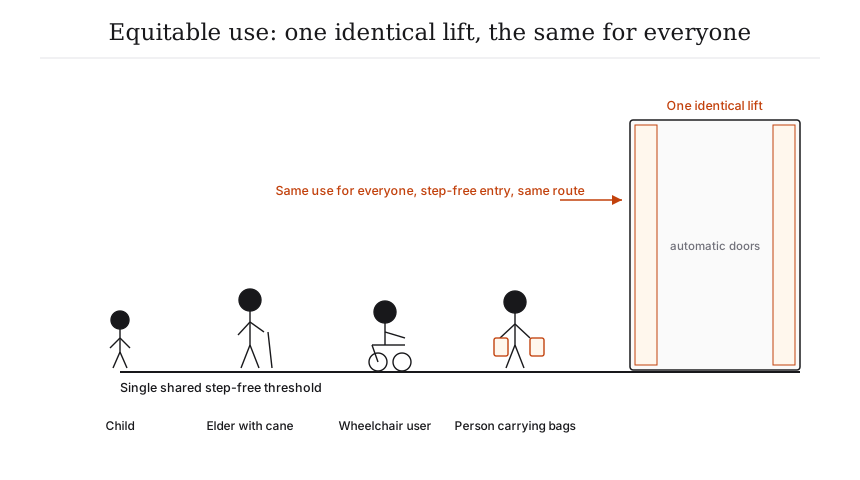
The principle, in one line: the design is useful and appealing to people with diverse abilities — the same means of use for all, identical when possible, equivalent when not.
The lift feature that delivers it: a single car that everyone uses the same way. The child, the elder, the wheelchair user and the person carrying bags all step (or roll) into the same lift, press a button, and arrive. No separate "accessible" entrance, no staff-only key, no asking for help. Automatic telescopic doors matter here: a heavy manual swing door quietly excludes a wheelchair user and a small child, so it is not equitable — automatic sliding doors are. The lift becomes the most equal piece of vertical circulation in the house.
2. Flexibility in Use
The principle, in one line: the design accommodates a wide range of individual preferences and abilities.
The lift feature that delivers it: controls and arrangements that suit more than one kind of user. Provide two control heights — a standard panel and a lower set of buttons reachable from a wheelchair or by a child (CPWD guidance puts the accessible reach band low and within an arm's natural sweep). Offer a fold-down seat for anyone who would rather sit. Allow the car to be entered and operated standing, seated, or from a wheelchair. Flexibility means the lift does not assume one "average" body.
3. Simple and Intuitive Use
The principle, in one line: use of the design is easy to understand, regardless of the user's experience, knowledge, language skills or concentration level.
The lift feature that delivers it: obvious controls and clear floor indicators that need no learning. Buttons numbered simply, a clear "door open" and alarm symbol, and a floor indicator you can read at a glance. A grandparent who has never used a touchscreen, a child, and a guest who does not read English should all manage it instantly. Avoid clever multi-function panels; an intuitive lift is a boring lift, and that is a compliment.
4. Perceptible Information
The principle, in one line: the design communicates necessary information effectively, regardless of ambient conditions or the user's sensory abilities.
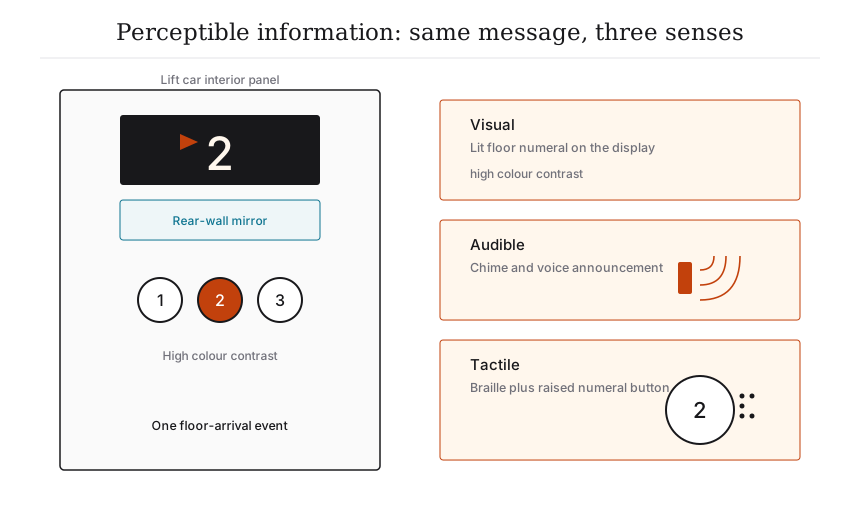
The lift feature that delivers it: the same information delivered in more than one sense at once. A floor arrival is shown by a visual indicator (a lit numeral), announced by an audible chime or voice, and the buttons carry Braille and raised tactile markings — so the lift speaks to someone who cannot see the display, someone who cannot hear the chime, and someone reading by touch. Add good colour contrast between buttons and panel, and a mirror on the rear wall (which also helps a wheelchair user reverse out). Redundant information is the point: never rely on one sense alone.
5. Tolerance for Error
The principle, in one line: the design minimises hazards and the adverse consequences of accidental or unintended actions.
The lift feature that delivers it: the safety systems that make a mistake harmless. Door sensors / a light curtain stop the doors closing on a child's arm or a walking stick. Door interlocks prevent the car moving with a door open. An overspeed governor and safety gear arrest the car if anything fails. An overload sensor refuses to move if the car is too heavy, and — crucially in India — an Automatic Rescue Device (ARD) brings the car gently to the nearest floor and opens the doors during a power cut, so nobody is ever trapped in the dark. Good universal design assumes people will make mistakes and the building will lose power, and makes both safe.
6. Low Physical Effort
The principle, in one line: the design can be used efficiently and comfortably with a minimum of fatigue.
The lift feature that delivers it: everything that removes effort. No heavy manual door to haul (automatic doors again). Light-touch buttons that respond to the gentlest press, useful for arthritic hands or a child's finger. A level, step-free entry with no lip to trip on or bump a wheel over. And — for anyone who cannot stand for the ride — a fold-down seat. Compare this with the alternative the lift replaces: a flight of stairs, the highest-effort element in any multi-storey home.
7. Size and Space for Approach and Use
The principle, in one line: appropriate size and space is provided for approach, reach, manipulation and use, regardless of body size, posture or mobility.
The lift feature that delivers it: a car and lobby big enough for a wheelchair and an attendant, with room to turn. CPWD's barrier-free guidelines point to a clear door width of at least 900 mm, a car of roughly 1100 × 1400 mm so a wheelchair user plus a helper fit comfortably, and a lift lobby around 1800 × 1800 mm so a wheelchair can approach and turn. A handrail at 800–1000 mm runs near the panel for support. Get these numbers from the accessibility standards guide — and crucially, reserve the shaft for them at the planning stage, because you cannot widen a lift well after the slab is poured.
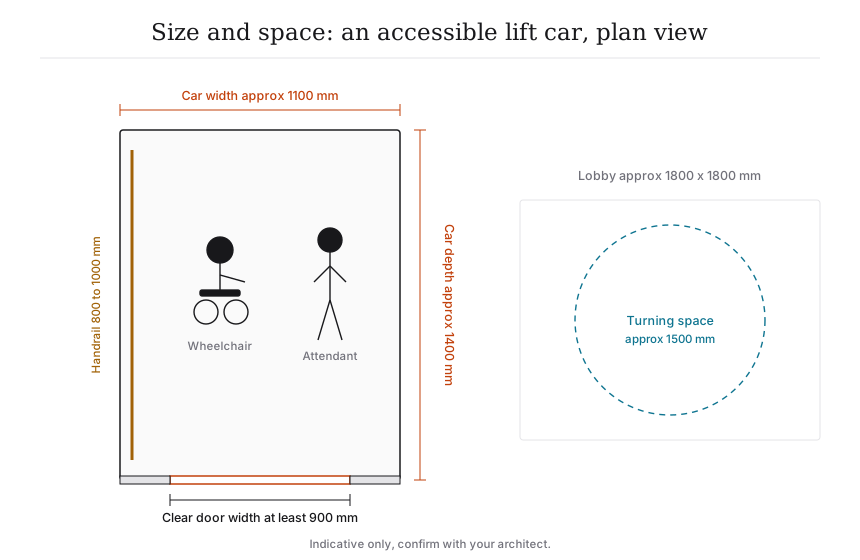
The seven principles, in one table
| # | Universal-design principle | What it means (one line) | The lift feature that delivers it |
|---|---|---|---|
| 1 | Equitable Use | Same use for everyone; no special version | One car for all; automatic doors; no separate "accessible" route |
| 2 | Flexibility in Use | Suits different bodies and preferences | Low + standard control panels; fold-down seat; standing or seated use |
| 3 | Simple and Intuitive Use | Obvious, needs no learning | Clear numbered buttons; legible floor indicator; no clever menus |
| 4 | Perceptible Information | Reaches every sense at once | Visual numeral + audible chime/voice + Braille/tactile buttons; contrast; rear mirror |
| 5 | Tolerance for Error | Mistakes and failures stay safe | Door light curtain; interlocks; overspeed governor + safety gear; overload sensor; ARD on power cut |
| 6 | Low Physical Effort | Comfortable, no fatigue | Automatic (no heavy) door; light-touch buttons; level entry; a seat |
| 7 | Size and Space for Approach | Fits any body, posture, mobility | Door ≥ 900 mm; car ≈ 1100 × 1400 mm; lobby ≈ 1800 × 1800 mm; handrail 800–1000 mm |
These figures are indicative and drawn from the CPWD Harmonised Guidelines and RPwD best practice — confirm the exact numbers and your state's lift rules with your architect and a licensed lift contractor. The numbers themselves are spelled out in accessibility standards for residential lifts.
Why the lift is the most universal element in the house
Look back over the table and notice something: almost no other single component in a home delivers all seven principles at once. A door delivers maybe two. A staircase delivers none — it actively fails Low Physical Effort and Size and Space. But a properly specified lift, with automatic doors, dual-height light-touch controls, audible-visual-Braille information, full safety interlocks plus an ARD, a seat, level entry, and a wheelchair-and-attendant-sized car, ticks every box.
And it does so without anyone feeling catered to as a special case. The child who cannot manage the stairs, the elder whose knees have gone, the family member in a wheelchair, the parent with a pram, and you with two heavy grocery bags all use the identical machine, the identical way. That is universal design working exactly as intended — and it is why a home lift is so often the single best accessibility investment a multi-level Indian home can make.
This connects directly to ageing in place — staying in the home you love as you grow older instead of moving out (see home lifts and ageing in place). Universal design serves everyone of all ages from the start; ageing-in-place design anticipates later life specifically. A lift serves both at once, which is rare and valuable.
A note on vastu and universal design
Many Indian families also weigh vastu when siting a lift. Vastu is a respected cultural preference, and it can usually be reconciled with a well-specified, accessible lift — favoured north / north-east positioning, calm light cabin colours, a clean and well-lit car all sit happily alongside universal design. But where a vastu placement would force a manual door, a too-small car, or a position that breaks the step-free path, engineering, safety and accessibility win — a lift that someone cannot use safely serves no one. See vastu for home lifts and the focused lift placement and vastu guide for how to hold both.
Specify it once, get it right
Universal design is mostly a planning decision, not a luxury upgrade. The expensive mistakes — a shaft too narrow for an accessible car, manual doors, no ARD, controls at one height only — are the ones you cannot fix after construction. Reserve the right-sized shaft early even if you fit the lift later (the lift-ready, future-proof home), and walk the spec sheet against the seven-principle table above before you sign.
To go further:
- For the exact dimensions and legal standards behind every number here — Accessibility standards for residential lifts in India.
- For universal design across the whole house — Universal design and adaptable homes.
- For room-by-room accessible execution — Accessible home design in India.
- For the lift as the spine of a fully accessible home — Accessible homes with elevators.
- To choose a lift type and understand the market — the residential elevator buyer's guide and home lift cost in India 2026.
References
- Rights of Persons with Disabilities (RPwD) Act 2016 — Sections 40, 44 and 45 on accessibility standards and built-environment obligations. Full text (Odisha SSEPD): https://ssepd.odisha.gov.in/sites/default/files/2024-01/RPWD%20ACT.pdf
- CPWD / MoHUA — Harmonised Guidelines and Space Standards for a Barrier-Free Built Environment (2016; Harmonised Guidelines 2021) — accessible-lift door width, car size, handrail height, lobby dimensions, Braille/tactile and audible-visual indicators. https://www.cpwd.gov.in/Publication/Harmonisedguidelinesdreleasedon23rdMarch2016.pdf
- Department of Empowerment of Persons with Disabilities (DEPwD) — accessibility FAQs: https://depwd.gov.in/en/faqs-4/
- IS 14665 (BIS) — Electric Traction Lifts — safety rules, door interlocks, dimensions (Parts 1–5): https://law.resource.org/pub/in/bis/S05/is.14665.1.2000.pdf
- National Building Code of India 2016, Part 8 Section 5 — Installation of Lifts (BIS): https://www.bis.gov.in/standards/technical-department/national-building-code/
- The Seven Principles of Universal Design — Center for Universal Design, North Carolina State University (foundational framework applied throughout this guide).
The seven principles of universal design are a design framework; the dimensional figures are indicative and drawn from CPWD/RPwD best practice. Confirm specifics with your architect, a licensed lift contractor, and your state's lift authority.
Export this guide
Related Guides — Deep-dive reading
Designing Adaptable & Universal-Design Homes
Accessibility, Aging-in-Place, and the Multi-Stage Family — Code, Anthropometrics, and Plan-Stage Discipline for Indian Residential Architects
Room PlanningUniversal Design Doors for Indian Homes: Inclusive Doors That Work for Everyone (2026)
How to design and specify doors that serve children, the elderly, pregnant women, the injured and wheelchair users by default - generous width, lever handles, near-flush thresholds, low-force closing, contrast and good lighting - without your home ever looking medical.
Home Doors & EntrancesSenior Citizen Safety Features in Home Elevators (India)
The cabin and control features that make a home lift genuinely safe and easy for an older person — automatic doors, level entry, handrail, fold-down seat, reachable contrasting controls, ARD and an alarm pendant.
Home Lifts & AccessibilityRelated Tools — Try Free
Accessibility Compliance Calculator
Check a planned lift against the CPWD and RPwD accessible-lift benchmarks for a score.
Lift CheckerLift Safety Audit Checklist
Interactive checklist that scores your home lift on safety devices, compliance and upkeep.
ChecklistElevator Capacity Calculator
Pick the right home-lift capacity — 2 to 8 person — with car size and wheelchair fit.
Lift Calculator