
Vastu for Home Lifts (India): Direction, Colour, Materials and Remedies
The complete vastu picture for a home lift — favoured and avoided directions, the honest north-east nuance, cabin colour and material, the door, light and cleanliness, the stair relationship, and remedies when an existing lift cannot be moved — always reconciled with structure, safety and accessibility.
A home lift is one of the most modern things you can add to an Indian house, yet many families still want it to sit comfortably within an older, much-loved framework: vastu shastra. That is a perfectly reasonable wish. Vastu is a cultural and spiritual tradition that gives a home a sense of order, calm and rightness, and for a great many homeowners it matters that a new machine respects it.
This guide is the broad, complete vastu picture for home lifts — not just which direction the lift should face, but the full set of considerations: favoured and avoided zones, the honest nuance around the north-east, cabin colours and materials, the door, light and cleanliness, how the lift relates to the staircase, and what to do when an existing lift is already in a "wrong" zone and cannot be moved.
A note before we begin. We treat vastu as a respected preference, not a building code. Different consultants and different regional schools genuinely disagree, so we give ranges and tendencies, not absolutes. And there is one rule we will repeat because it is the most important sentence in this guide: where vastu conflicts with structure, safety, accessibility or the practical core of how a stair-lift home works, engineering and safety win. A lift that is unsafe, unreachable or structurally compromised is not made auspicious by its direction.
If you want only the placement-and-direction deep-dive, read our focused guide Lift Placement as per Vastu (India). If you want the recommendation tuned to your home's facing, see Best Lift Location by Vastu and House Facing. This guide is the wider one that ties direction together with colour, materials and remedies.
How to read vastu sensibly
Vastu divides a home into directions, each carrying an element and a quality — north with water and growth, east with the rising sun, south-west with earth and stability, the north-east (Ishanya) with lightness and divine energy, the exact centre (Brahmasthan) as the still heart of the home. A lift is heavy, moving, mechanical and somewhat noisy, so vastu asks a simple question: where does a heavy, active thing belong, and where would it disturb a zone that should stay light or still?
Hold three things in mind throughout:
- Consultants differ. Treat any single rule as a tendency, not a law.
- Your structure is fixed first. The lift shaft must land on a column grid, a sound foundation and a sensible circulation path. Vastu is fitted within those givens.
- A vastu-friendly lift is, happily, often a well-designed lift — light, clean, well-lit, calm. Most of the advice here improves the home whether or not you follow vastu.
Favoured and avoided directions
Across the commonly cited readings, a fairly consistent picture emerges for where the lift well wants to sit.
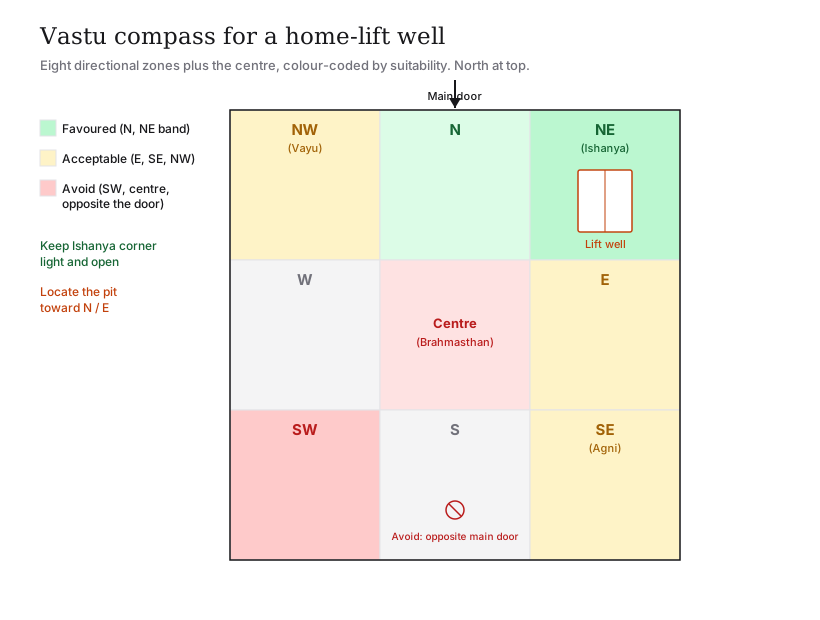
The favoured band is the north and north-east side of the plan. North carries the water element and a sense of growth and flow, and the broad north-east band is considered positive for movement and energy. South-east (Agni, fire) and north-west (Vayu, air) are widely accepted as workable alternatives in several schools — useful, because a real plan rarely lets you put everything in one quadrant. The pit is often advised toward the north or east.
The zones to avoid are more agreed-upon than the favoured ones. The south-west should stay heavy, grounding and stable — it is the zone of earth and of the family's anchor — so a tall moving void cut through it is generally discouraged. The exact centre (Brahmasthan) should stay open and uncluttered, never pierced by a shaft. And the lift is usually advised not to sit directly opposite the main entrance door, so that energy entering the home is not pulled straight into a mechanical void.
| Direction / zone | Vastu view | Practical do / don't |
|---|---|---|
| North | Favoured (water, growth) | Good first choice if the column grid allows |
| North-east band | Favoured for the lift well — with a nuance (see below) | Fine for the broad band; keep the exact Ishanya corner clear |
| East | Acceptable; pit often advised here | Workable; pairs well with morning-light circulation |
| South-east (Agni) | Acceptable in several schools | A practical alternative when north is taken |
| North-west (Vayu) | Acceptable in several schools | Good for a lift adjacent to guest or utility zones |
| South-west | Avoid (should stay heavy and grounding) | Generally discouraged — but see the elderly nuance below |
| Exact centre (Brahmasthan) | Avoid (keep open and still) | Never run a shaft through the home's centre |
| Directly opposite the main door | Avoid | Offset the lift so it is not the first thing the entrance faces |
The north-east nuance — told honestly
Here is where you must not be sold a tidy half-truth. The broad north-east band is favoured, yet many vastu writers also insist that the exact north-east corner (Ishanya) should stay light, open and uncluttered — it is treated as the most sacred, most subtle part of the home. Heavy machinery, by that reading, does not belong in the precise Ishanya corner even though the wider band is welcoming.
So the honest position is: the north-east region is a good place for a lift, but keep it toward the north or the broader band and keep the exact Ishanya corner light. If a consultant tells you the north-east is wholly forbidden, or wholly ideal, they are flattening a genuine disagreement. Ranges, not absolutes.
The elderly bridge to the south-west
One useful exception is worth knowing. Some readings hold that where a lift will be used mainly by elders, a south-west location can actually suit — the south-west's grounding, stabilising quality is felt to support those who most need stability. This is a small but lovely bridge between vastu and our wider wellness thinking: if the lift exists chiefly so a parent or grandparent can move between floors with dignity, the "avoid south-west" rule softens. See our ageing-in-place guide for that side of the story.
The lift and the staircase
Vastu traditionally places the staircase in the south-west (again, the heavy, grounding zone), and in most homes the lift is built adjacent to the stair so that the two vertical circulation elements share a core. That pairing is sensible structurally too — one shaft wall, one landing zone, one fire-rated core. The mild tension is obvious: the stair wants the south-west, the lift prefers the north or north-east. In practice you reconcile by keeping the stair in or near the south-west and offsetting the lift toward the north/north-east edge of the same circulation core, or by accepting an acceptable alternate (south-east, north-west) so the two can sit together. Our staircase vastu guide covers the stair side in full.
Beyond direction: colour, material, door, light
Vastu for a lift is not only about the compass. Once the well is placed, the cabin itself carries the same logic — it should feel calm, clean and positive.
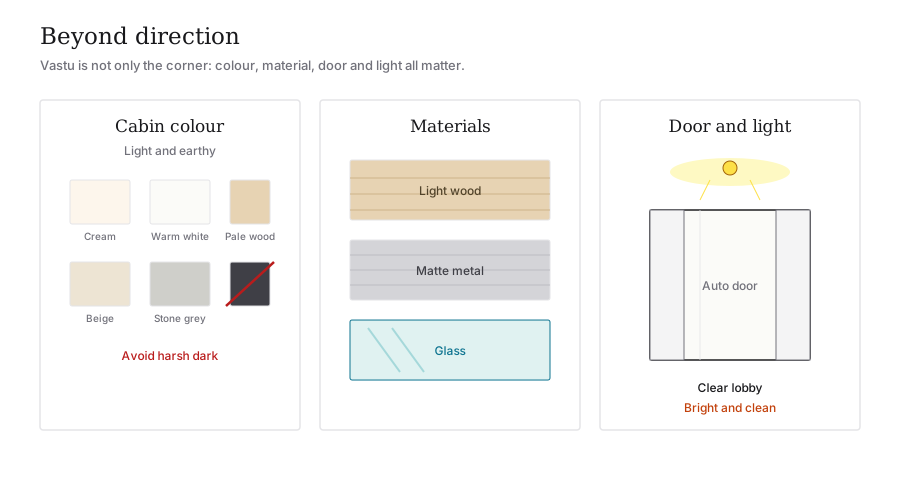
Cabin colours. Favour light, calm, earthy tones — soft whites, warm creams, pale wood, gentle beige and stone greys. These read as open and welcoming, the opposite of a cramped dark box. Avoid harsh, heavy dark finishes (deep black, aggressive reds across the whole cabin) that make a small moving space feel oppressive. This is also simply good interior design: a light cabin feels larger and safer, which matters most to elderly users.
Materials. Prefer clean, well-finished materials — light wood, brushed or matte metal, glass for a panoramic cabin, good-quality laminate. The vastu instinct here is for materials that feel honest and orderly. Glass-cabin pneumatic lifts (a popular retrofit choice in India) sit easily with this, since they read as open and light rather than enclosed.
The door. Keep the cabin and landing doors well-oriented and unobstructed — the entry should open to a clear, well-lit lobby, not into a dark or cluttered corner, and ideally not directly facing the main entrance of the home (as above). A smooth automatic door is both more auspicious in feel and far more accessible than a heavy manual swing door.
Light and cleanliness. This is the single most repeated "beyond direction" instruction in vastu writing, and the easiest to honour: keep the lift well-lit, clean, quiet and well-maintained. A bright, spotless, smoothly running cabin is held to carry positive energy; a flickering, dirty, juddering one carries the opposite. Conveniently, "well-lit, clean and well-maintained" is exactly what a good Annual Maintenance Contract and decent lighting deliver anyway.
| Beyond-direction element | Vastu preference | Why it also just works |
|---|---|---|
| Cabin colour | Light, calm, earthy; avoid harsh dark | Light cabins feel bigger and safer for elders |
| Materials | Clean, well-finished — light wood, matte metal, glass | Durable, easy to keep spotless |
| Door | Well-oriented, clear lobby; not facing the main door | Smooth auto doors are more accessible |
| Lighting | Bright, even, never flickering | Safety and reassurance, especially at night |
| Cleanliness and quiet | Spotless, smooth, well-maintained | A good AMC delivers this regardless |
When the lift is already in a "wrong" zone — remedies
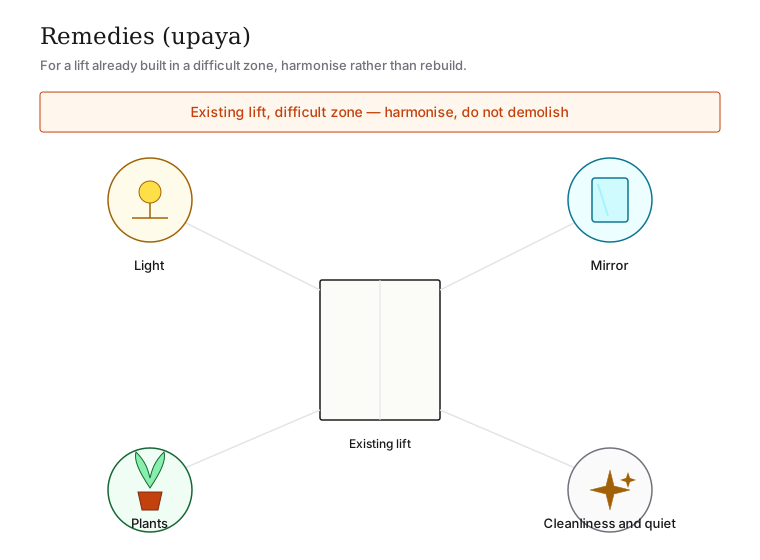
Most homeowners reading this already have a lift, or a fixed shaft location they cannot change. Relocating a lift shaft is rarely feasible — it is structural, expensive and disruptive. The vastu tradition is gentle about this: it offers remedies (upaya) to harmonise a placement rather than demanding you tear it out.
The widely cited remedies are reassuringly simple and, again, good practice anyway:
- Light. Keep the lift and its lobby bright and warmly lit. Light is the primary remedy in almost every reading.
- Mirrors. A well-placed mirror in or near the cabin or lobby is held to deflect and ease energy in a less-favoured zone — and a rear-wall mirror also helps a wheelchair user reverse out, so it doubles as an accessibility feature.
- Plants. Healthy plants near the lift lobby (not inside the cabin) soften and freshen the space.
- Cleanliness and quiet. A spotless, smoothly running, well-serviced lift is the strongest remedy of all — neglect is what vastu treats as truly inauspicious.
- Calm finishes. Re-skin a dark, heavy cabin in lighter tones if it sits in a difficult zone.
The remedy you should not reach for is demolition. If your lift is safely placed on the structural grid and reachable by everyone who needs it, light, mirrors, plants and good upkeep are the proportionate response — not a rebuild.
The reconciliation rule
We end where the framing began, because this is the part most worth keeping. Vastu is a preference your family holds, and a good architect will honour it as far as the building genuinely allows. But a lift also has to obey physics, safety standards and the people who use it.
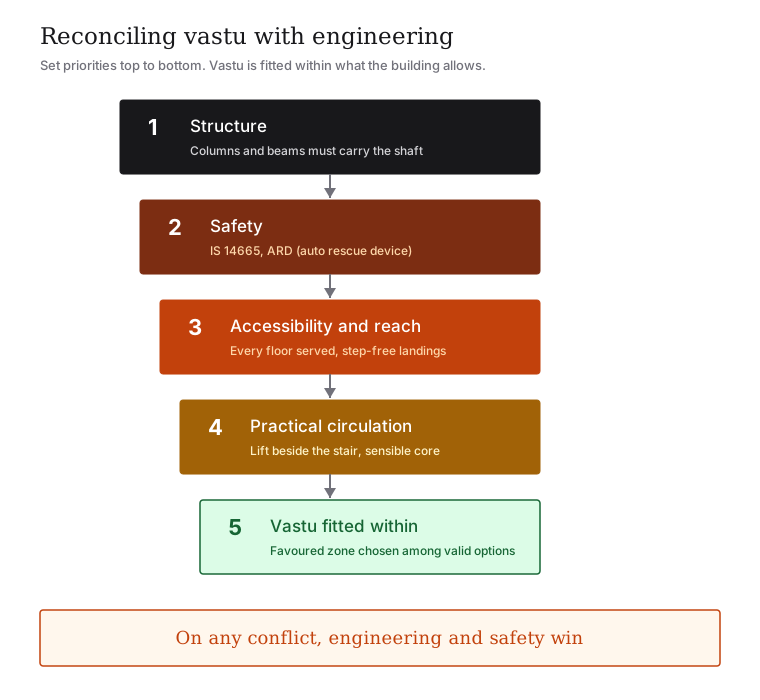
When the two pull apart, the order of priority is not negotiable:
1. Structure first. The shaft lands on columns and foundations that can carry it. You do not move a load path for a direction.
2. Safety next. The lift must meet IS 14665 and carry an Automatic Rescue Device for India's power cuts, plus door sensors, alarm and overspeed protection. None of that is traded for a compass reading.
3. Accessibility and reach. The lift must be usable by the elder or wheelchair user it was built for — a clear ≥900 mm door, an accessible car and lobby (see accessibility standards). A perfectly oriented lift no one can reach has failed.
4. The practical circulation core. The lift should connect the floors people actually use, near the stair, on a sensible path.
5. Then vastu, fitted within all of the above — favoured direction where possible, acceptable alternates where not, and remedies where neither is available.
Read this way, vastu and good engineering are rarely enemies. A lift in the favoured north or north-east band, finished in light earthy tones, with a clear well-lit lobby, an accessible auto door, an ARD and a clean AMC, satisfies almost every school of vastu and every safety standard at once. The hard cases are few — and in those few, you keep the family safe and harmonise the rest with light, mirrors, plants and care.
Where to go next
- Lift Placement as per Vastu (India) — the focused placement and direction deep-dive.
- Best Lift Location by Vastu and House Facing — the recommendation tuned to north / east / south / west-facing homes.
- Staircase Vastu — the south-west stair and how the lift sits beside it.
- Vastu House Plan (India) — the whole-home vastu framework the lift fits into.
- Home Lifts for Ageing in Place and the Residential Elevator Buyer's Guide for the practical and cost side.
References
These figures and standards are indicative — confirm with your architect, a licensed lift contractor and, for vastu, your own consultant, since municipal bye-laws and vastu schools both vary.
- RPwD Act 2016 (Rights of Persons with Disabilities), accessibility provisions — https://ssepd.odisha.gov.in/sites/default/files/2024-01/RPWD%20ACT.pdf
- CPWD / MoHUA Harmonised Guidelines and Space Standards for a Barrier-Free Built Environment (2016) — accessible-lift door width, car size, handrail, mirror — https://www.cpwd.gov.in/Publication/Harmonisedguidelinesdreleasedon23rdMarch2016.pdf
- IS 14665 — Electric Traction Lifts (BIS), Part 1 outline dimensions and Part 3 safety rules — https://law.resource.org/pub/in/bis/S05/is.14665.1.2000.pdf
- National Building Code of India 2016, Part 8 Section 5 (BIS) — installation of lifts — https://www.bis.gov.in/standards/technical-department/national-building-code/
- Elite Elevators — Vastu for home elevators — https://www.eliteelevators.com/blog/vastu-home-elevator/
- NoBroker — lift vastu placement — https://www.nobroker.in/blog/lift-vastu/
- SubhaVaastu — lift / elevator vastu tips — https://www.subhavaastu.com/vastu-tips-lift.html
Export this guide
Related Guides — Deep-dive reading
Best Lift Location as per Vastu (India): Direction by Direction for Every House Facing
Where the home lift belongs in a north, east, south or west facing plan — favoured zones, the stair core, the main door and the pit direction, reconciled with structure and safety.
Home Lifts & AccessibilityDesigning Adaptable & Universal-Design Homes
Accessibility, Aging-in-Place, and the Multi-Stage Family — Code, Anthropometrics, and Plan-Stage Discipline for Indian Residential Architects
Room PlanningMain Door Direction in Vastu: Best Facing & Padas (India Guide)
Which direction your main door should face according to Vastu Shastra — the favoured north, east and north-east, the auspicious padas within each direction, what each facing is said to bring, and the practical light-and-access logic that sits alongside the tradition.
Home Doors & EntrancesRelated Tools — Try Free
Accessibility Compliance Calculator
Check a planned lift against the CPWD and RPwD accessible-lift benchmarks for a score.
Lift CheckerLift Annual Maintenance Cost Calculator
AMC cost for a home lift — comprehensive vs non-comprehensive, with a 5-year projection.
Lift CalculatorSenior-Friendly Home Assessment
Assess whether a multi-level home needs a lift for ageing in place, with a readiness score.
Assessment