

Home Lifts for Aging in Place (India): Staying in the Home You Love
Why the staircase is the single biggest barrier to growing old at home, how a home lift removes it, and the independence, dignity and multi-generational living it gives back.
There is a particular kind of grief that arrives quietly, one stair at a time. The bedroom that used to be a few easy steps away starts to feel like a climb. The terrace where you grew tulsi and dried papads becomes a place you visit less and less. The home you built — the one with your children's height-marks on the door frame and the smell of decades of Sunday cooking in its walls — slowly begins to shrink around you, floor by floor, until you are living in just one part of it.
This guide is about refusing that. Ageing in place means staying safely and independently in the home you love as you grow older, rather than moving to an assisted-living facility or being uprooted to a relative's house. In a multi-level Indian home, the single biggest obstacle to ageing in place is almost never the kitchen, the bathroom or the lighting. It is the staircase. And a well-planned home lift is the one intervention that removes that obstacle completely — often it is the deciding factor in whether someone can stay home at all.
This is the warm, human case for a lift: not the standards, not the vastu, not the price list, but the life it gives back. We link to the technical guides throughout so you can go deeper wherever you need to.
What "ageing in place" really means
The phrase sounds clinical, but the idea is deeply personal. Ageing in place is the choice to grow old here — in your own rooms, on your own terms, surrounded by your own things and your own neighbours — instead of moving somewhere designed for old age.
For most Indian families this is not a fringe preference; it is the default wish. Multi-generational living is the norm, elders expect to remain at the heart of the household, and a parent moving into a child's home is a celebration, not a last resort. The problem is that the homes themselves — the proud G+1, G+2 and G+3 houses built in the boom decades — were designed for young legs. The master bedroom is upstairs. The pooja room is on the first floor. The good light and the cross-breeze are on the terrace. Everything that makes the house home is on the wrong side of a staircase.
Ageing in place asks a simple question: what would it take for you to stay, comfortably and with dignity, for the next twenty years? For a single-storey home, the answer is usually a safe bathroom and good lighting. For a home with stairs, the honest answer almost always includes a lift.
Why the staircase is the single biggest barrier
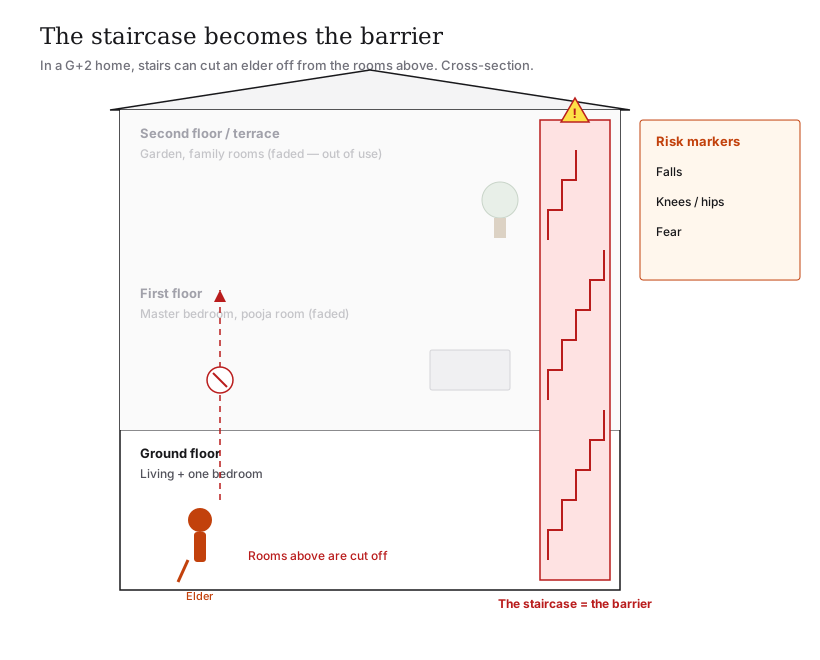
Look honestly at a flight of stairs through the eyes of a seventy-year-old, and you see what it really is: a daily test of strength, balance and nerve, taken several times a day, with hard edges and a long drop if you fail.
- Falls are the headline risk. Among older adults, stairs are one of the most common places for a serious fall, and a hip fracture at seventy can change everything that follows. The fear of falling is itself disabling — people stop using the stairs long before their bodies force them to.
- Knees, hips and hearts say no. Arthritis, a knee replacement, recovery from surgery, breathlessness, a weak heart — any of these can turn a staircase from inconvenient to impossible, sometimes overnight.
- It shrinks the home. When the stairs become too much, the elder retreats to the ground floor. The upper floors — bedrooms, the prayer room, the terrace garden, the grandchildren's rooms — quietly fall out of their life. The house gets smaller while the loneliness gets larger.
- It steals independence. Needing someone to help you up your own stairs, every single time, is a small daily erosion of dignity. It makes a capable adult feel like a patient in their own house.
A ramp does not solve a full storey of vertical travel — the run required is impractically long. A stairlift on the staircase helps in some homes but leaves the wheelchair behind at the top and bottom and is awkward on Indian dog-leg stairs. The clean, complete answer to "the stairs are the barrier" is to make the stairs optional.
How a home lift gives the whole house back
A home lift does one quietly revolutionary thing: it makes every floor reachable again, by anyone, in seconds, without effort or fear. The master bedroom comes back. The pooja room comes back. The terrace comes back. The grandchildren's floor comes back. The home stops shrinking.
A lift is not a medical device bolted onto a house. It is the thing that lets a house keep being a home — for the grandfather with a new knee, the grandmother who simply tires on the stairs, the daughter recovering from a C-section, and the toddler who should never be carried up a flight at all.
Modern home lifts are designed to disappear into a house rather than dominate it. A compact two- to four-person car, automatic sliding doors, soft lighting, a fold-down seat, and controls anyone can use turn vertical travel into a non-event. Crucially for India, a good lift includes an Automatic Rescue Device (ARD) — a battery that gently brings the car to the nearest floor and opens the doors during a power cut — so an outage is never a trap. (For the full safety specification, see our senior-citizen safety features guide.)
There are several lift technologies suited to homes — hydraulic, traction (machine-room-less), screw-driven, and the no-pit pneumatic vacuum lift that retrofits most easily into an existing house. Which one fits your home, your floors and your budget is covered in the residential elevator buyer's guide.
The benefits, in plain terms
| Benefit | What it means day to day |
|---|---|
| Independence | Reach every floor alone, on your own schedule, without waiting for help or feeling like a burden. |
| Dignity | No being carried, no apologising for slowing everyone down, no retreating to one floor. |
| Safety | Removes the highest-risk daily activity in the home — climbing stairs — and the fear that comes with it. |
| The whole home, restored | Bedrooms, pooja room, terrace garden and family floors all back in everyday use. |
| Multi-generational living | Parents can move in and live upstairs, not be confined to a back room; children and elders share the full house. |
| Caregiving made easier | A spouse or carer no longer risks injury helping someone up the stairs; groceries, laundry and luggage travel by lift too. |
| Recovery and the unexpected | Surgery, pregnancy, a broken ankle — the lift carries the household through life's temporary as well as permanent changes. |
| Staying near what matters | Keep your neighbours, your temple, your doctor, your routines — the social fabric that genuinely protects health in old age. |
| Asset value and appeal | A future-ready, accessible home appeals to a wider set of buyers and tenants and tends to hold its value well. |
Ageing in place vs universal design — a useful distinction
You will hear two phrases used almost interchangeably, but they are not quite the same.
- Ageing-in-place design specifically anticipates the needs of later life — it asks how this particular household will live here as its members grow older, and adapts the home accordingly.
- Universal design is broader: it designs a home to work for everyone — children, elders, wheelchair users, a person carrying a sleeping baby or a heavy suitcase — from the very start, without anyone being singled out.
They overlap enormously, and a well-chosen lift serves both: it is one of the most genuinely universal elements you can put in a house, useful to every member of the family at every age. If you want the design philosophy in depth, see our companion guides on universal design and residential elevators and accessible homes built around an elevator. The practical point for now is simple: designing for ageing in place is not designing a "home for the old". It is designing a home that is generous to everyone, with the elder's needs as the clarifying lens.
The lift works best with three companions
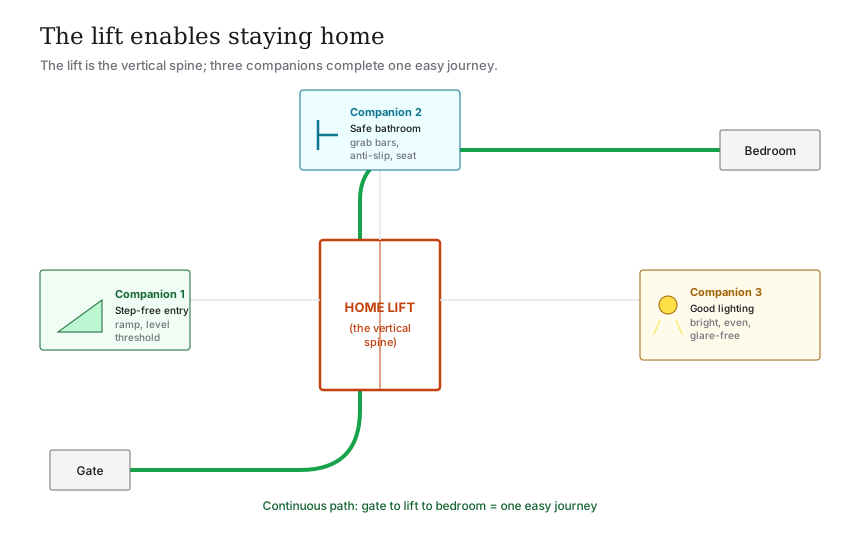
A lift removes the biggest barrier, but it works best as the centrepiece of a small, sensible set of changes. Think of the lift as the vertical spine and these three as the limbs.
1. Step-free entry. A lift that connects every floor is undermined by two steps at the front gate or a high threshold at the door. A gentle ramp or a graded path, level thresholds, and a step-free route from the gate to the lift turn the whole journey — from the car to the bedroom — into one continuous, easy path.
2. A safe bathroom. The bathroom is the second most dangerous room for an older person after the staircase. A grab bar by the WC and shower, an anti-slip floor, a curb-free or low-curb shower, a hand-held spray, and a seat make it secure. Our accessible home design guide walks through the bathroom and every other room.
3. Good, even lighting. Older eyes need far more light and hate sudden contrast. Bright, even, glare-free lighting along corridors, on the stairs and at the lift entrance — with switches that are easy to find at night — prevents a huge share of trips and stumbles.
Get the lift plus these three right, and you have not just removed a barrier — you have built a home that quietly looks after the people in it.
Is ageing in place right for you? A readiness checklist
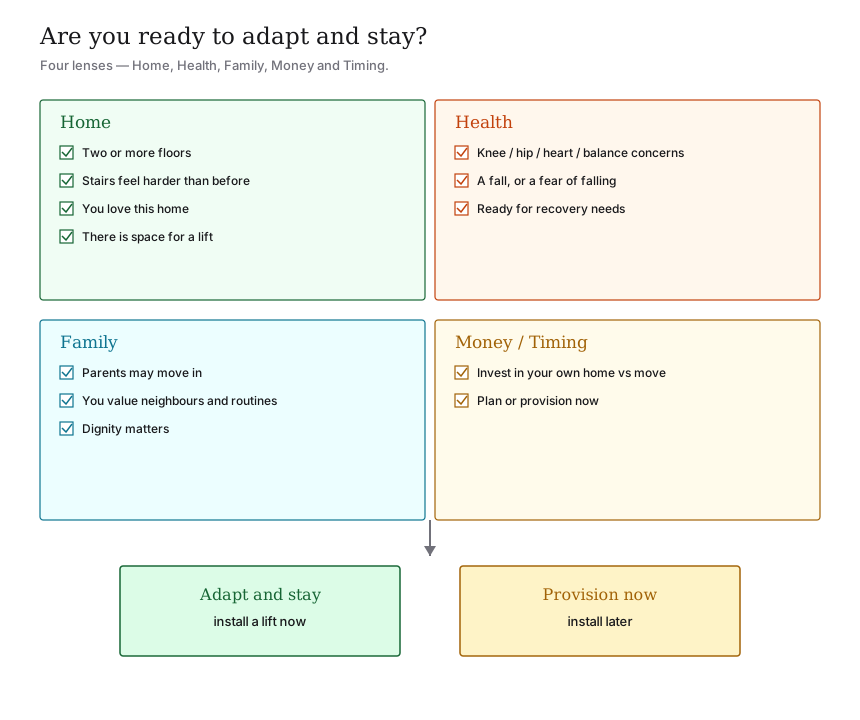
Run honestly through these. The more you tick, the stronger the case for adapting your home now rather than moving later.
The home
- [ ] Our home has two or more floors, with essential rooms (bedroom, pooja room) above the ground floor.
- [ ] The staircase already feels harder than it used to, or we worry about it.
- [ ] We genuinely love this home and want to stay in it for the long term.
- [ ] There is, or can be, a place to put a lift — even a compact one. (A lift-ready / future-proof assessment confirms this.)
Health and ability
- [ ] Someone in the household has, or may soon have, knee, hip, heart or balance issues.
- [ ] There has been a fall, a near-fall, or a real fear of falling on the stairs.
- [ ] We want to be ready for temporary needs too — surgery recovery, pregnancy, an injury.
Family and life
- [ ] We want elderly parents to be able to move in and use the whole home, not just one floor.
- [ ] We value staying near our neighbours, temple, doctor and daily routines.
- [ ] Independence and dignity for our elders matter more to us than avoiding a renovation.
Money and timing
- [ ] We would rather invest in our own home than spend on moving, brokerage and the upheaval of a new place.
- [ ] We can plan this now, or at least provision for it now and install later.
If most of these ring true, ageing in place is very likely the right path — and a lift is very likely at the heart of it.
Provision now, install later — the smartest, kindest move
You do not have to install a lift today to make ageing in place possible. The single most valuable thing you can do — especially if you are building or renovating — is to provision for one: leave a stacked, aligned space (a column of cupboards, a redundant store, or a planned shaft) that a lift can drop into later with minimal disruption.
This costs very little now and saves an enormous amount later, when retrofitting a lift into a finished home means breaking floors and reworking civil structure. It also means the lift can arrive exactly when it is needed — after a diagnosis, before a parent moves in, ahead of a surgery — without months of dust and demolition at the worst possible time. Our lift-ready, future-proof home guide explains exactly what to leave in place.
For a complete walk-through of designing the move and the home around an older resident, the senior-friendly lift planning guide is your next stop.
A note on vastu and the elder's lift
Many families want the lift to sit comfortably with vastu, and that is entirely reasonable — it is a respected cultural preference. Some readings even favour a more grounded location for a lift used mainly by elders, associating stability with that part of the plan. Treat such guidance as a preference to honour within the structural and accessibility plan, not above it: where vastu and the safe, reachable, well-engineered placement of the lift conflict, the engineering and the elder's safety must win. Our lift placement and vastu guide shows how to reconcile the two sensibly.
The cost question — and the cost of not doing it
A home lift is a significant investment, and we will not pretend otherwise. Indicative all-in figures vary widely by lift type, number of floors, civil work and brand, and prices change year to year — so we keep the real numbers in one carefully maintained place: the home lift cost guide for India 2026. Please use that, and confirm with a licensed local lift contractor, rather than trusting any single figure quoted in passing.
But frame the cost honestly against the alternative. The alternative to a lift is rarely "do nothing". It is one of these:
- Moving home. Buying or renting a single-storey or lift-equipped flat means brokerage, registration and stamp duty, the cost of the new place, and the deep, often underestimated upheaval of leaving the home, the street and the community you have lived in for decades. For many older people, the disruption of a move is itself a health setback.
- Confining the elder to one floor. This is free in rupees and expensive in everything else — independence, dignity, the use of half the house, and slowly, social connection and morale.
- Full-time help to manage the stairs. Paid help to assist with stairs, day after day, year after year, adds up — and still does not give back independence.
Seen this way, a lift is not an extravagance. It is frequently the cheaper, and almost always the kinder, path to the same goal: staying in the home you love.
Bringing it together
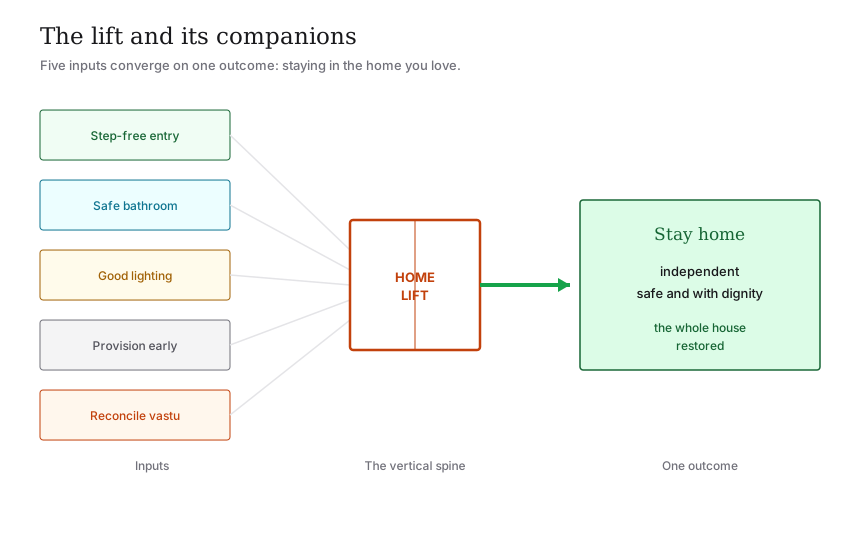
Ageing in place is, at heart, a refusal to let stairs decide where you grow old. For a multi-level Indian home, the staircase is the one barrier that matters most, and a well-chosen home lift is the one intervention that removes it completely — restoring the whole house, the independence, the dignity, and the room for parents and grandchildren to share it all.
Pair the lift with step-free entry, a safe bathroom and good lighting; provision for it early even if you install it later; reconcile it gently with vastu; and weigh its cost against the far larger cost of moving or shrinking your life. Do that, and the home with the height-marks on the door frame stays exactly what it should be — home, for as long as you want it.
Next steps: Senior-friendly lift planning · Senior-citizen safety features · Accessible home design · Lift-ready, future-proof home · Residential elevator buyer's guide
References
- Rights of Persons with Disabilities (RPwD) Act, 2016 — the legal framework for accessibility standards in India (binds public buildings; the right best-practice benchmark for homes). Full text: https://ssepd.odisha.gov.in/sites/default/files/2024-01/RPWD%20ACT.pdf
- Department of Empowerment of Persons with Disabilities (DEPwD) — accessibility FAQs: https://depwd.gov.in/en/faqs-4/
- CPWD / MoHUA Harmonised Guidelines and Space Standards for a Barrier-Free Built Environment (2016) — accessible-lift and barrier-free home essentials: https://www.cpwd.gov.in/Publication/Harmonisedguidelinesdreleasedon23rdMarch2016.pdf
- IS 14665 (BIS) — Electric Traction Lifts, including safety rules and installation practice that govern a home lift's specification. Part 1 (outline dimensions): https://law.resource.org/pub/in/bis/S05/is.14665.1.2000.pdf · Part 2 (installation, operation, maintenance): https://law.resource.org/pub/in/bis/S05/is.14665.2.1-2.2000.pdf
- National Building Code of India 2016 (BIS), Part 8 Section 5 — Installation of Lifts: https://www.bis.gov.in/standards/technical-department/national-building-code/
- Chambers Architects — how universal design facilitates ageing in place: https://chambersarchitects.com/blog/principles-universal-design-facilitate-aging-place/
- NewHomeSource — ageing in place and the accessible home: https://www.newhomesource.com/learn/aging-in-place/
Accessibility dimensions, regulatory triggers and costs cited here are indicative and vary by state, vendor and year. Always confirm with your architect, a licensed lift contractor and your local municipal bye-laws.
Export this guide
Related Guides — Deep-dive reading
Designing Adaptable & Universal-Design Homes
Accessibility, Aging-in-Place, and the Multi-Stage Family — Code, Anthropometrics, and Plan-Stage Discipline for Indian Residential Architects
Room PlanningLift Planning for Senior-Friendly Homes (India): Ageing in Place, with the Lift at the Centre
When stairs become a barrier with age, the home lift is the heart of an ageing-in-place plan. How to choose it over a stairlift, specify it for an older user, place it for daily use, and plan for a parent moving in.
Home Lifts & AccessibilityUniversal Design Doors for Indian Homes: Inclusive Doors That Work for Everyone (2026)
How to design and specify doors that serve children, the elderly, pregnant women, the injured and wheelchair users by default - generous width, lever handles, near-flush thresholds, low-force closing, contrast and good lighting - without your home ever looking medical.
Home Doors & EntrancesRelated Tools — Try Free
Senior-Friendly Home Assessment
Assess whether a multi-level home needs a lift for ageing in place, with a readiness score.
AssessmentAccessibility Compliance Calculator
Check a planned lift against the CPWD and RPwD accessible-lift benchmarks for a score.
Lift CheckerChild & Elder Home-Safety Audit
Room-by-room safety audit for households with children or seniors — 10 categories, 70+ checkpoints tagged by audience.
Safety Audit