
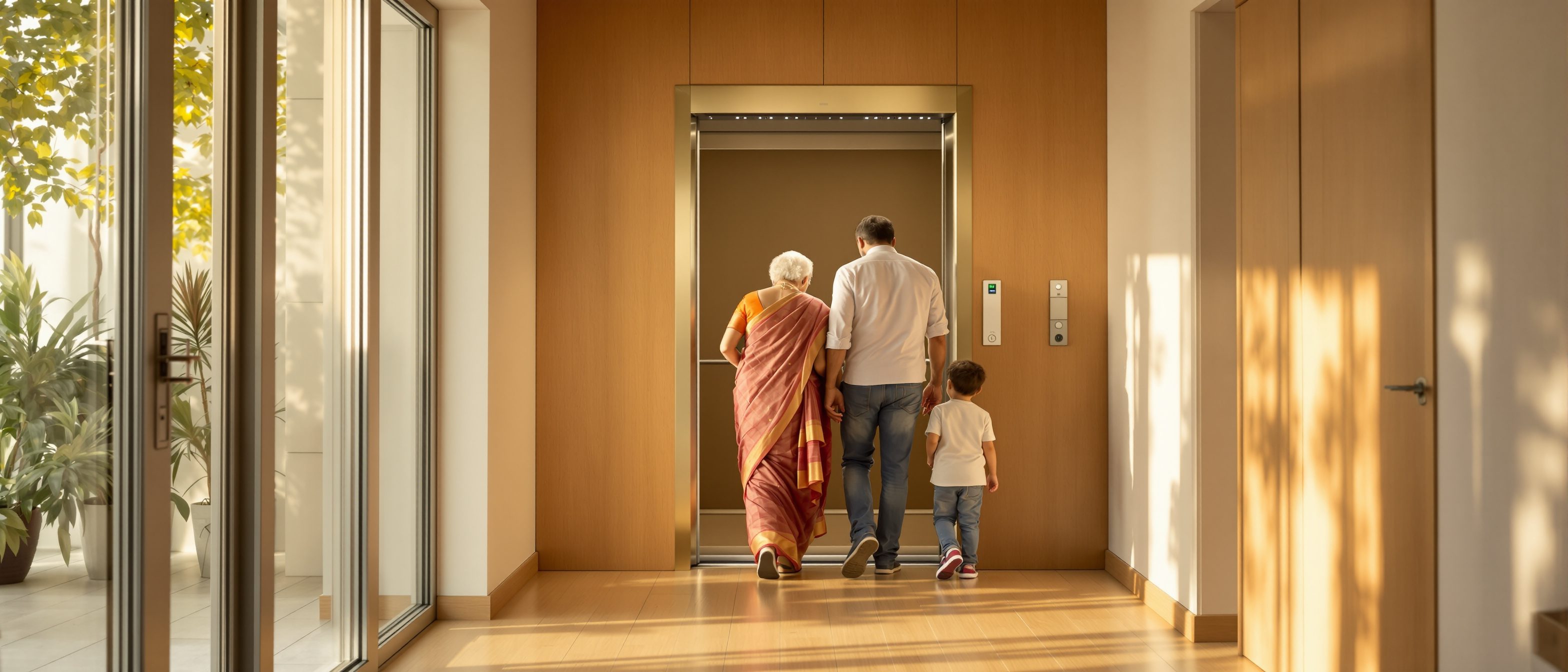
Accessible Homes with Elevators (India): Designing the Whole Home Around the Lift
The lift as the vertical spine of an accessible home — a continuous step-free path from the gate to every floor, with the accessible circulation, doors, turning space and lift specs that flow from it.
An accessible home is not a list of grab bars bolted on after the fact. It is one continuous, step-free journey — from the front gate, through the door, across the main floor, into the lift, and out onto every floor above. The piece that makes that journey possible in a multi-level Indian house is the lift. Take the lift away and the upper floors quietly stop belonging to the person who cannot climb. Put the lift in the right place, and every floor becomes usable again.
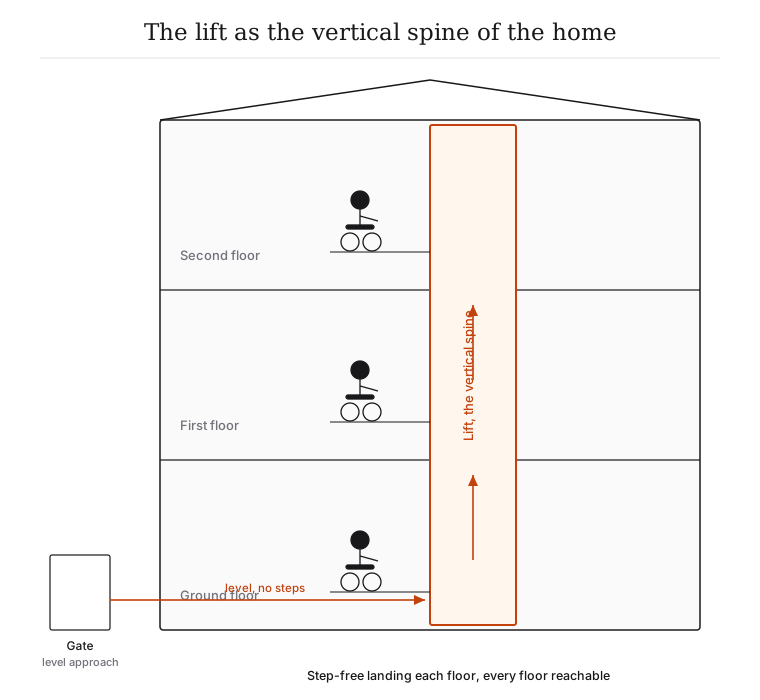
That is the idea at the heart of this guide: the lift is the vertical spine of an accessible home. You do not design the rooms first and squeeze a lift in afterwards. You decide where the spine goes, and then you let the accessible circulation — the ramp, the wide doors, the turning space, the bathroom on the main level — flow out from it.
This guide is the whole-home composition view: how the lift ties an accessible home together. For the room-by-room execution (kitchen heights, bathroom layouts, switch positions), see Accessible Home Design (India). For the exact regulatory numbers (door widths, car sizes, handrail heights), see Accessibility Standards for Residential Lifts (India). For the philosophy that underpins all of it, see Universal Design for Residential Elevators.
Why the lift comes first
In a single-storey home, accessibility is mostly about widths and thresholds. In a two-, three- or four-storey Indian home — the typical independent house or villa — the stairs are the single biggest barrier. A staircase cannot be made accessible. You can light it well and add handrails on both sides, but a person using a wheelchair, a parent recovering from a knee replacement, or a grandparent who can no longer trust their balance simply cannot use the upper floors without help.
The lift removes that barrier outright. And because it is the one fixed vertical element that connects every level, its position dictates everything else:
- The entrance and ramp should lead, by a level path, towards the lift.
- The corridors and doors on each floor should be wide enough to roll from the lift to the rooms.
- The turning space in front of the lift on every floor must be large enough for a wheelchair to enter, turn and exit.
- An accessible bathroom on the main level means the person can manage a full day without needing the lift for every small thing — but the lift still connects the bedroom, the terrace, the prayer room above.
Design the spine first, and the rest of the accessible home composes itself around it.
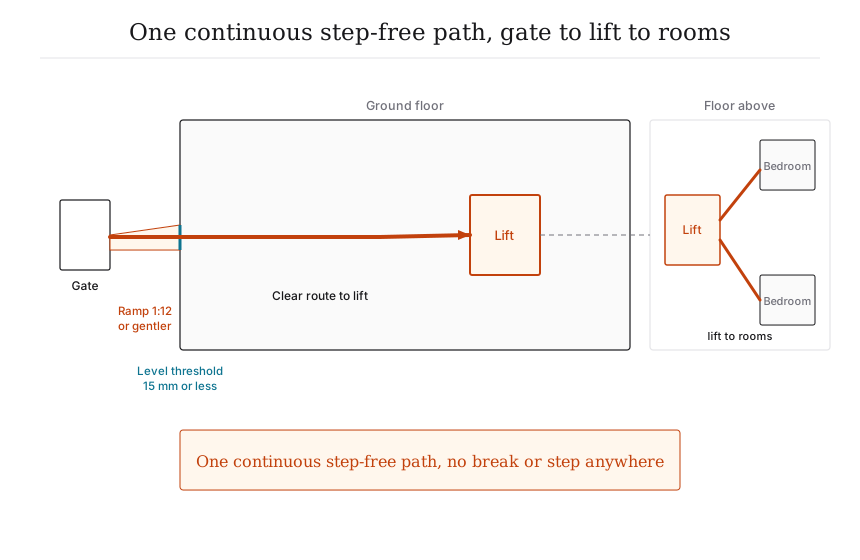
The continuous step-free path: gate to lift to every floor
Accessibility breaks at thresholds. A single 50 mm step, an awkward gate latch, a 20 mm raised door sill — any one of these can defeat the whole chain. The test of an accessible home is simple: can a person in a wheelchair travel from the street to any room on any floor without being stopped once?
Walk that path in your mind, gate to top floor:
1. Gate to door. A level or gently ramped approach — ramp slope no steeper than 1:12, ideally 1:15 to 1:20 for comfort — with a firm, non-slip surface and no loose gravel. A small landing at the door so a wheelchair can pause flat while the door is opened.
2. The threshold. Level entry, or a sill no higher than about 12–15 mm with a bevelled edge. This is the detail most often got wrong in Indian homes, where a raised marble threshold is traditional. It can be kept low and ramped on the inside.
3. Main floor circulation. A clear, obstacle-free route from the entrance to the lift — wide enough, turning space where the route changes direction.
4. The lift. Placed at a logical, reachable point that the main route naturally passes, connecting to every floor.
5. Each upper floor. Step out of the lift onto a level landing, with turning space, and corridors wide enough to reach the bedrooms, bathroom and terrace.
If any link in that chain has a step, the chain is broken. The lift is only as useful as the path that leads to it and the path that leads away from it on each floor.
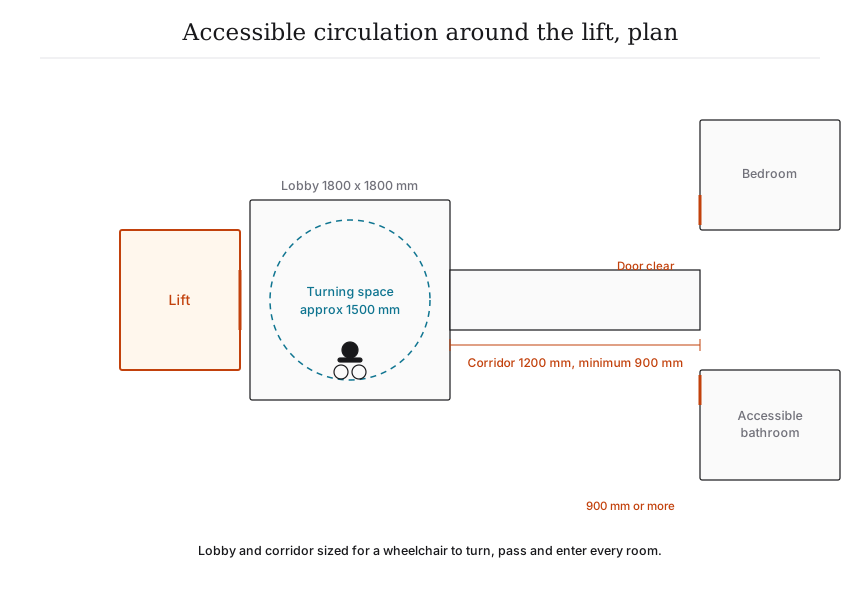
Designing the circulation around the lift
Once the lift's position is fixed, the accessible circulation is a matter of widths and turning spaces. These are the numbers worth holding in your head as you plan — all indicative, to be confirmed with your architect against the CPWD Harmonised Guidelines and local bye-laws.
| Element | Comfortable target | Why it matters |
|---|---|---|
| Corridor / passage width | minimum 900 mm, ideally 1200 mm | 900 mm lets a wheelchair pass; 1200 mm lets a wheelchair and a walking person pass, and feels generous |
| Doorway clear width | minimum 900 mm | The clear opening, not the frame size — a 900 mm door leaf often gives only ~830 mm clear |
| Turning space (wheelchair) | about 1500 mm diameter | A full 360-degree turn in front of the lift, in the bathroom, at the top of each floor |
| Lift door clear width | minimum 900 mm | Matches the CPWD accessible-lift standard |
| Lift car (accessible home) | about 1100 x 1400 mm minimum | Wheelchair plus an attendant; deep enough to enter forwards and exit |
| Lift lobby (inside, each floor) | about 1800 x 1800 mm | Space to wait, turn and approach the car squarely |
| Approach in front of lift | about 1500 mm clear | The wheelchair must square up to the doors |
The lift lobby on each floor doubles as the turning space — which is exactly why placing the lift well saves you from carving out turning circles all over the house. One generous landing at the lift serves the wheelchair's needs and the lift's approach at the same time.
Specifying the lift itself
The composition fails if the lift in the middle of it is not itself accessible. A narrow shaft with a manual swing door is useless to a wheelchair user, no matter how well the corridors are sized. Specify the lift to accessible standards from the start — these are the essentials, drawn from the CPWD Harmonised Guidelines and the home-lift fact base.
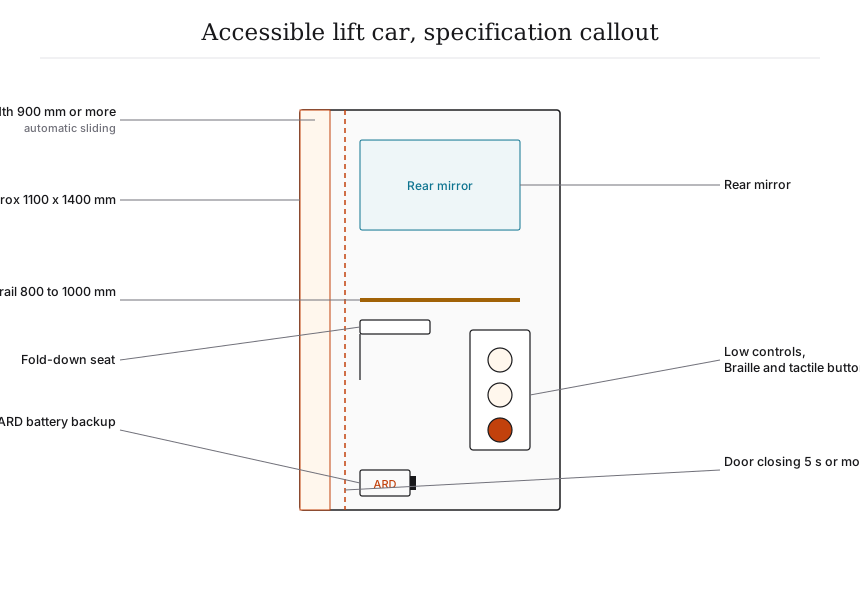
- Door: clear width at least 900 mm, automatic sliding or telescopic — never a manual swing door, which a wheelchair user cannot manage and which blocks the opening.
- Car size: about 1100 x 1400 mm minimum — room for a wheelchair plus an attendant, deep enough to enter forwards.
- Handrail: at least 600 mm long, fixed at 800–1000 mm above the floor, beside the control panel, to steady a standing user.
- A fold-down seat: so someone who tires standing — many elders — can sit for the ride. A genuinely universal touch.
- Low controls: a control panel reachable from a seated position, with large, well-contrasted, Braille / tactile buttons and audible plus visual floor indicators.
- A rear mirror: so a wheelchair user can reverse out of the car safely when there is no room to turn inside.
- Automatic Rescue Device (ARD): battery backup that brings the car to the nearest floor and opens the doors on a power cut. Non-negotiable in India given our power situation — never buy a home lift without one.
- Door closing time: at least about 5 seconds, so a slower user can enter and exit without being caught.
Most of these are the same numbers covered in depth in the accessibility standards guide; here they matter because the lift is the hinge of the whole home. Get the spine right and the rest holds together.
Where the lift should sit in the plan
A logical, reachable point — that phrase does a lot of work. In practice it means:
- On or beside the natural circulation route, so the path from the entrance reaches it without detours. The lift should be the place you naturally arrive at, not a corner you have to go looking for.
- Adjacent to the staircase in most homes. This keeps the vertical circulation together, lets the lift and stair share a lobby, and is also the traditional arrangement many vastu readings prefer (the stair is conventionally to the south-west, with the lift kept beside it). If you are reconciling accessibility with vastu, see the lift-vastu guides — but remember the framing rule of this whole cluster: where a directional preference conflicts with the accessible step-free path, safety and accessibility win.
- Reachable from the bedroom, bathroom and main living level, because those are the rooms an ageing or wheelchair-using resident moves between most.
- Sized and located so the lobby on each floor can hold the 1500 mm turning space without stealing it from a bedroom.
If the home has a bedroom suite that will serve as the main-level accessible bedroom, the lift should be a short, level roll from it — so the resident can move between sleeping on one floor and living, prayer or terrace on another without help.
The accessible main level
Even with a lift, design so the main floor can support a full, dignified day on its own — the lift connects, but does not become a daily bottleneck. On the main level, provide:
- A step-free entrance and level circulation, as above.
- An accessible bathroom — about 1500 mm turning space, a roll-in or low-threshold shower, grab bars, a comfortable WC height. (Layouts in the accessible home design guide.)
- Ideally a bedroom or convertible room on this level, so that even if the lift were ever out of service, the resident is not stranded above or below their bathroom.
This is the resilience layer. The lift makes every floor usable; the accessible main level means no single failure traps anyone.
A whole-home accessibility checklist, centred on the lift
Use this as you plan with your architect. Every row connects back to the spine.
| Zone | What to check | Lift-centred target |
|---|---|---|
| Gate and approach | Level or gently ramped path to the door | Ramp ≤ 1:12 (ideally 1:15–1:20), non-slip, leads towards the lift |
| Entrance | Threshold height and door width | Sill ≤ 12–15 mm bevelled; door clear ≥ 900 mm |
| Main floor route | Clear path from entrance to lift | No steps, ≥ 900 mm (ideally 1200 mm) wide, turning space at changes of direction |
| Lift position | Logical, reachable, beside the stair | On the natural route; connects every floor; lobby holds 1500 mm turning space |
| Lift door | Clear width and type | ≥ 900 mm, automatic sliding — never manual swing |
| Lift car | Internal size | ~1100 x 1400 mm (wheelchair plus attendant) |
| Lift fit-out | Aids for standing and seated users | Handrail at 800–1000 mm, fold-down seat, low + tactile controls, rear mirror |
| Lift safety | Power-cut and emergency | ARD battery backup, door sensors, alarm and intercom |
| Each upper floor | Exit and circulation | Level landing, 1500 mm turning space, ≥ 900 mm doors and ≥ 900 mm (ideally 1200 mm) corridors |
| Accessible bathroom | On the main level | 1500 mm turning space, roll-in shower, grab bars |
| Main-level bedroom | Resilience if lift is unavailable | A bedroom or convertible room on the accessible floor |
| Future-proofing | Provision even if installed later | Stack a lift-ready shaft now — see the lift-ready guide |
Bringing it together
An accessible home with an elevator is not a house with a lift in it. It is a house organised by its lift — where the front gate, the ramp, the level thresholds, the wide corridors, the turning spaces and the bathroom all line up because they were all planned around the one element that lets a person reach every floor on their own terms.
Plan the spine first. Let the accessible path flow from it. Specify the lift to accessible standards. And the home you are left with serves a toddler, a grandparent, a wheelchair user and a person carrying shopping equally well — which is the whole point of universal design.
Costs vary widely by lift type, travel and fit-out; we do not quote them here. See Home Lift Cost in India (2026) for current benchmarks, and the Residential Elevator Buyer's Guide to choose a type.
Related reading
- Accessible Home Design (India) — the room-by-room execution.
- Accessibility Standards for Residential Lifts (India) — the exact numbers.
- Universal Design for Residential Elevators — the seven principles.
- Universal Design and Adaptable Homes — designing for everyone from the start.
- Home Lifts and Ageing in Place (India) — staying in the home you love.
- Lift-Ready, Future-Proof Home (India) — provisioning the shaft now.
- Best Lift Location by Vastu (India) and Vastu for Home Lifts (India) — reconciling direction with the accessible path.
References
- Rights of Persons with Disabilities Act, 2016 (RPwD Act 2016) — accessibility duty and standards (Sec 40, 44, 45). Full text (Odisha SSEPD): https://ssepd.odisha.gov.in/sites/default/files/2024-01/RPWD%20ACT.pdf
- Department of Empowerment of Persons with Disabilities (DEPwD) — accessibility FAQs: https://depwd.gov.in/en/faqs-4/
- CPWD / MoHUA Harmonised Guidelines and Space Standards for a Barrier-Free Built Environment (2016) — accessible lift, door, corridor, turning-space and ramp standards: https://www.cpwd.gov.in/Publication/Harmonisedguidelinesdreleasedon23rdMarch2016.pdf
- IS 14665 — Electric Traction Lifts (BIS), Part 1 (outline dimensions): https://law.resource.org/pub/in/bis/S05/is.14665.1.2000.pdf and Part 2 (installation, operation and maintenance): https://law.resource.org/pub/in/bis/S05/is.14665.2.1-2.2000.pdf
- National Building Code of India 2016, Part 8 Section 5 (installation of lifts) — BIS: https://www.bis.gov.in/standards/technical-department/national-building-code/
Accessibility figures here are indicative and follow best-practice benchmarks. Confirm exact dimensions, ramp slopes and lift specifications with your architect and a licensed lift contractor against the current CPWD Harmonised Guidelines and your local municipal bye-laws.
Export this guide
Related Guides — Deep-dive reading
Designing Adaptable & Universal-Design Homes
Accessibility, Aging-in-Place, and the Multi-Stage Family — Code, Anthropometrics, and Plan-Stage Discipline for Indian Residential Architects
Room PlanningUniversal Design Doors for Indian Homes: Inclusive Doors That Work for Everyone (2026)
How to design and specify doors that serve children, the elderly, pregnant women, the injured and wheelchair users by default - generous width, lever handles, near-flush thresholds, low-force closing, contrast and good lighting - without your home ever looking medical.
Home Doors & EntrancesAccessible Bathroom Standards India: CPWD Harmonised Guidelines & NBC 2016 (2026)
The regulatory reference for barrier-free bathrooms in India — the CPWD Harmonised Guidelines and Standards for Universal Accessibility, NBC 2016 Part 3, the RPwD Act 2016 mandate, and the working dimensions for turning circles, grab bars, WC height, roll-in showers and door widths.
BathroomsRelated Tools — Try Free
Accessibility Compliance Calculator
Check a planned lift against the CPWD and RPwD accessible-lift benchmarks for a score.
Lift CheckerLift Safety Audit Checklist
Interactive checklist that scores your home lift on safety devices, compliance and upkeep.
ChecklistElevator Capacity Calculator
Pick the right home-lift capacity — 2 to 8 person — with car size and wheelchair fit.
Lift Calculator