
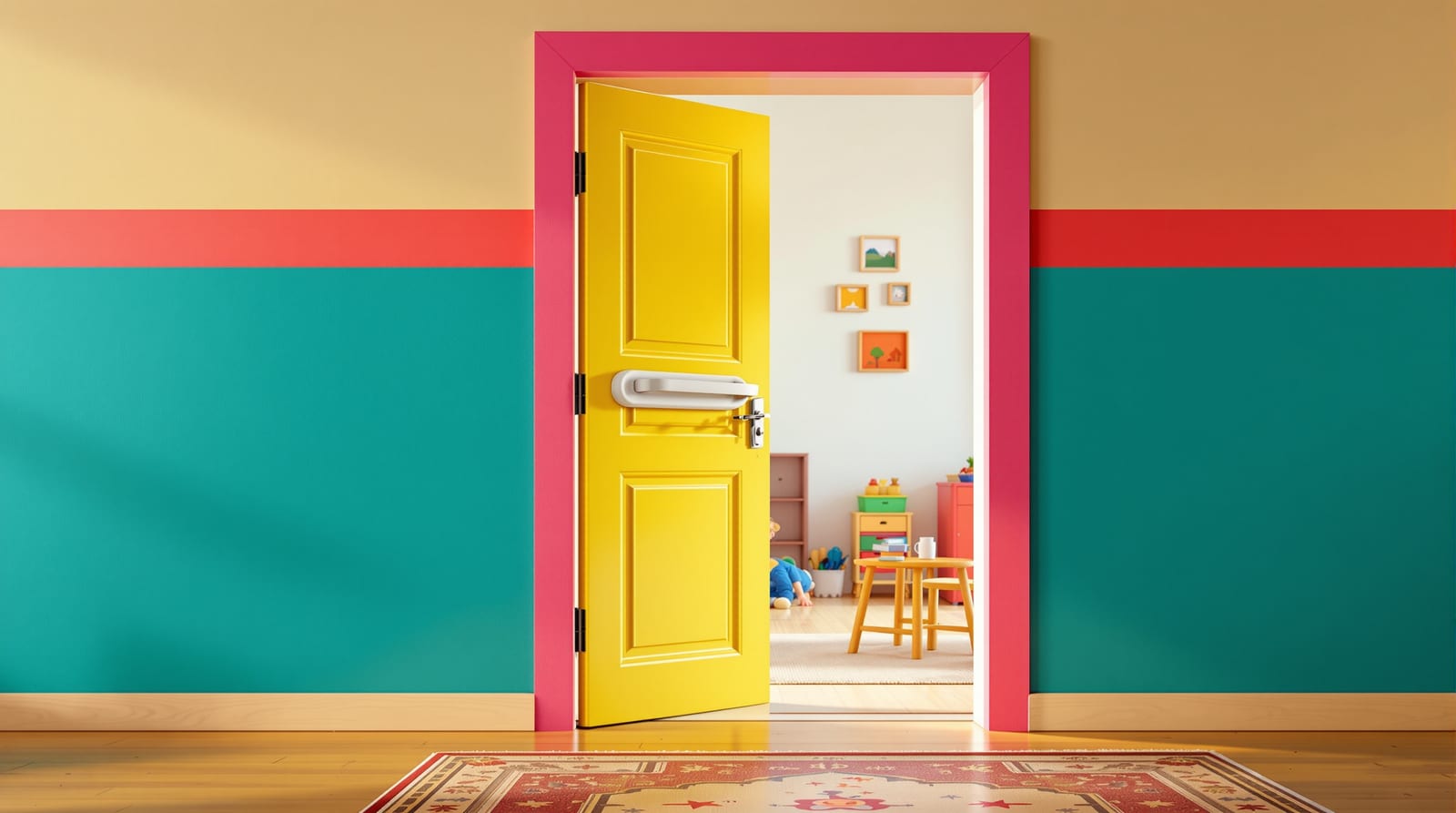
Kids Room Door in India: Safe, Non-Toxic and Cheerful Door Picks (2026)
How to choose a children's bedroom door for an Indian home - finger-pinch-guard hinges and soft-close first, then non-toxic low-VOC finishes, easy lever handles, fun colours and abuse-proof durability - with picks ranked and indicative rupee costs.
Ask any parent in India what scares them about a door and the answer is the same: pinched fingers. The children's-room door is the one door in the house where safety is not a nice-to-have feature stacked on top of looks - it is the brief. A toddler's hand is small enough to slip into the hinge gap, a five-year-old swings a door like a toy, and a slammed door at nap time wakes the whole flat. So before you fall in love with a sky-blue panel and dinosaur decals, sort the four things that actually protect your child: stop the fingers, stop the slam, lose the sharp edges, and keep the finish non-toxic. Get those right and you can be as playful as you like.
This guide is the application layer for a child's bedroom. It does not re-explain how a flush door is built or how a hinge works - for that, follow the links to our type, material and hardware guides. Here we rank the doors and the hardware specifically for a kids' room in an Indian home, in rupees, with safety, durability, non-toxicity and cheerfulness as the deciding drivers.
The five demands of a child's bedroom door
A kids' door has to answer a very specific list before anything else:
1. No finger traps (the number-one issue). Children are injured at the hinge side far more often than at the latch side. The fix is a pinch-guard or anti-finger-trap hinge plus a soft-close mechanism so the door cannot crush a hand.
2. No slamming. A door that bangs shut frightens, wakes and - on the closing edge - hurts. A soft-close closer or a hydraulic damper turns a slam into a gentle glide.
3. No sharp edges or pinch points. Eased (rounded) edges on the leaf, no protruding bolt heads, no jagged grill, handle ends that curve back to the door.
4. Easy for small hands. A lever handle a child can push down beats a round knob they cannot grip. Mount it low enough to use but think about where you want a toddler to NOT go.
5. Non-toxic finish and abuse-proof durability. Kids chew, scratch, kick, draw on and lean their full weight on doors. The finish must be low-VOC and the surface must shrug off years of this.
Privacy comes last and with a condition: a child may want a latch, but a parent must always be able to override it. Choose a privacy latch with an emergency release (a coin-slot or pin on the outside) so no child is ever locked in.
Safety hardware comes before the door itself
The single most cost-effective safety upgrade is not the door - it is the hinge and the closer. You can fit these to almost any leaf.
Anti-finger-trap / pinch-guard hinge. A standard butt hinge leaves a wedge-shaped gap on the hinge side that closes like scissors. A finger-guard hinge either wraps that gap with a flexible shield or uses a barrel geometry that leaves no gap to trap into. This is mandatory hardware in schools and an obvious win at home. The diagram below shows the difference.
Soft-close / anti-slam. A small overhead soft-close closer or a concealed hydraulic damper slows the last few inches so the door eases shut instead of banging. It also stops a draught from slamming the door on a child following behind. For a fuller comparison of closer types, see our door closers in India guide.
Door-edge guard and corner cushions. Cheap foam or silicone edge guards on the latch edge and a top-corner finger stopper that holds the door slightly open are pocket-money insurance.
Lever handle, child-friendly. Levers with returned (curved-back) ends cannot snag clothing. Choose nylon or coated levers in a bright colour - easier to spot and warmer to touch than cold metal.
Privacy latch with emergency release. A simple snib that the child can use for "do not disturb", with an exterior coin-slot the parent can turn from outside. Never fit a keyed lock a child can use to lock themselves in. For how latches and locks differ, see our door hardware guide.
Picking the leaf: ranked for a kids' room
Now the door itself. The job is a finish that is non-toxic and abuse-proof, a weight that small arms can move, and a surface you can make cheerful. Heavy solid-timber leaves slam harder and cost more, so they rank lower here despite being lovely.
1. Laminate-finished flush door (best all-rounder)
A hollow- or solid-core flush door faced with a tough high-pressure laminate is the default winner. The laminate is scratch-, stain- and crayon-resistant, wipes clean, comes in bright solids and printed motifs (space, jungle, pastel), and the leaf is light enough for a child to swing without a heavy slam. Insist on a low-VOC adhesive and a finish that is food-safe to the touch. Fit a pinch-guard hinge and soft-close and this is hard to beat.
2. Membrane / PVC-laminated flush door (wipe-clean, seamless)
A flush door wrapped in a seamless membrane (moulded PVC skin) has no edges to chip, is fully wipe-clean of fingerprints and stickers, and comes in cheerful colours and soft-touch finishes. Slightly less abrasion-resistant than HPL but the most hygienic and the easiest to keep looking new. Good for younger children.
3. Painted panel / moulded door (classic and customisable)
A moulded panel door finished in a low-VOC, water-based enamel gives the "proper bedroom door" look and takes any colour you like - and repaints when fashion (or your child) changes. The catch: insist on a low-VOC, lead-free paint and let it cure fully before the child sleeps in the room. Heavier than a flush leaf, so soft-close matters more.
4. WPC or FRP door (humid climates, bathrooms-within-room)
For coastal Kerala, Mumbai or a child's en-suite, a WPC door or FRP leaf is waterproof, termite-proof and won't warp - and takes bright colours. Surface is less premium than laminate but it is genuinely low-maintenance.
5. Solid teak / engineered-wood (lovely but lower for kids)
Beautiful and durable, but heavy (harder slams), expensive, and the natural finish shows every crayon mark. If you want warm timber, choose engineered wood with a low-VOC finish over solid teak, and lean hard on soft-close.
Comparison: kids' room doors ranked by what matters
| Door choice | Child safety | Durability vs abuse | Non-toxic / cheerful | Indicative ₹ (3x7 ft, leaf + finish) |
|---|---|---|---|---|
| Laminate flush door | Best (light, soft-close, pinch-guard) | Excellent - scratch & crayon proof | HPL in bright solids/prints; ask low-VOC | 3,000 - 9,000 |
| Membrane / PVC-laminated flush | Best (light, seamless) | Good - wipes clean, no chip edges | Seamless colours, soft-touch | 4,000 - 10,000 |
| Painted moulded panel | Good (heavier; needs soft-close) | Good - repaintable | Any colour; insist low-VOC enamel | 4,000 - 14,000 |
| WPC / FRP | Good (light, waterproof) | Very good - humid-proof | Bright colours, low maintenance | 4,000 - 14,000 |
| Solid teak / engineered wood | Fair (heavy - harder slam) | Excellent | Natural; shows marks; low-VOC finish | 6,000 - 60,000+ |
Costs are indicative for 2026 and vary by size, finish and city; add about 18% GST. Hardware is extra: budget roughly 600 - 1,800 for a pinch-guard hinge set, 800 - 2,500 for a soft-close closer/damper, and 400 - 1,500 for a child-friendly lever and privacy latch with emergency release.
Width, swing and clearance
A child's bedroom is a habitable room, so under NBC 2016 the door opening should be at least 900 mm wide - which also keeps it usable if you ever need wheelchair or stroller access (RPwD 2021 favours a clear width of 900 mm, lever handles and a threshold no higher than 12 mm). Keep the swing into the room, not the corridor, so the door cannot knock a sibling walking past, and make sure the open door does not foul a bed, a wardrobe or a play mat. If floor space is tight, a soft-close sliding or pocket door removes the swing-arc hazard entirely - but check the running gear has no finger-catch points. For how to plan the swing, see our bedroom door design guide.
Making it cheerful - safely
The fun part is also where parents trip over hidden hazards:
- Colour: bright low-VOC laminates or water-based paints. Let a child pick from two or three you have pre-approved.
- Decals and stickers: removable vinyl decals (name, height chart, planets) are reversible and damage-free. Avoid permanent paint murals if you might resell.
- Height chart: a printed-laminate door can carry a measuring scale down one edge - useful and loved.
- Glow / chalkboard panels: chalkboard-laminate panels let kids draw on the door legitimately; choose dust-free chalk.
- Mind the small parts: no glued-on plastic knobs, googly eyes or magnets a toddler can prise off and swallow.
Do and don't
Do: fit anti-finger-trap hinges and a soft-close on day one; choose a light leaf; specify low-VOC finishes; use a returned lever handle; fit a privacy latch with an exterior emergency release; ease all edges.
Don't: fit a keyed lock the child can operate; choose a heavy solid door that slams hard; use solvent-based high-VOC paint just before the child moves in; leave a swing arc that hits furniture or a passing sibling; add small detachable decorations a toddler can swallow.
For the wider menu of interior doors and where each one suits a room, see our doors-by-space decision guide.
Frequently asked questions
What is the single most important safety feature for a kids' room door?
Stopping pinched fingers. The hinge side traps small hands far more often than the latch side, so fit an anti-finger-trap (pinch-guard) hinge plus a soft-close mechanism so the door cannot bang or crush. Everything else - colour, latch, handle - comes after.
Should a child's bedroom door have a lock?
Only a privacy latch with an emergency override, never a keyed lock the child can use to lock themselves in. Choose a latch with an exterior coin-slot or pin so a parent can open it from outside in seconds during an emergency.
Which door material is safest and most durable for kids in India?
A laminate-finished flush door is the best all-rounder: light enough to avoid hard slams, scratch- and crayon-resistant, cheerful, and affordable at roughly 3,000 - 9,000 rupees. Pair it with a pinch-guard hinge and soft-close. For humid coastal homes, a WPC or FRP leaf is waterproof and termite-proof.
Are painted doors safe for a child's room?
Yes, if you use a low-VOC, lead-free, water-based enamel and let it cure fully before the child sleeps in the room. Avoid solvent-based high-VOC paints. Membrane and laminate finishes avoid wet-paint fumes entirely and are easier to keep clean.
How wide should a kids' room door be?
At least 900 mm of opening, in line with NBC 2016 for a habitable room. That width also keeps the door usable for a stroller or, if ever needed, a wheelchair, and pairs well with a lever handle and a low (under 12 mm) threshold per RPwD 2021. See our bedroom door design guide for swing and clearance planning, and the doors-by-space guide for the full room-by-room picture.
Export this guide
Related Guides — Deep-dive reading
Universal Design Doors for Indian Homes: Inclusive Doors That Work for Everyone (2026)
How to design and specify doors that serve children, the elderly, pregnant women, the injured and wheelchair users by default - generous width, lever handles, near-flush thresholds, low-force closing, contrast and good lighting - without your home ever looking medical.
Home Doors & EntrancesGuest Room Door in India: Privacy, Quiet and Smart Picks Without Overspending (2026)
How to choose a guest bedroom door for an Indian home - privacy and acoustics so visitors feel comfortable, but budget-sensible for a room used only now and then: solid-core flush for quiet, panel or laminate for looks, the right privacy lock, simple soundproofing, and a finish that matches the rest of your doors - with picks ranked and indicative rupee costs.
Home Doors & EntrancesBedroom Door Design in India: Materials, Sizes, Finishes, Privacy and Cost (2026)
How to choose and design a bedroom door for Indian homes — privacy, light-noise control, finishes that match the room, the right 900x2100 internal door, locks and ₹ budget.
Home Doors & EntrancesRelated Tools — Try Free
Door Material Comparison Tool
Compare 2–4 door materials on cost, durability, maintenance, security and moisture resistance.
Comparison ToolCross-Ventilation Analyzer
Estimate airflow and air changes per hour (ACH) from room size, window areas, layout, and local wind — with NBC 2016 Part 8 compliance check.
Ventilation CalculatorAccessible Door Checker
Check a door against wheelchair-accessibility guidance — clear width, threshold, handle and closer force per RPwD 2021.
Compliance Tool