
Understanding Site Potential
The opportunity lens — the real buildable yield, a plot's latent assets (a view, a tree, north light, a level change), and best-use thinking, so two identical plots reveal very different potential
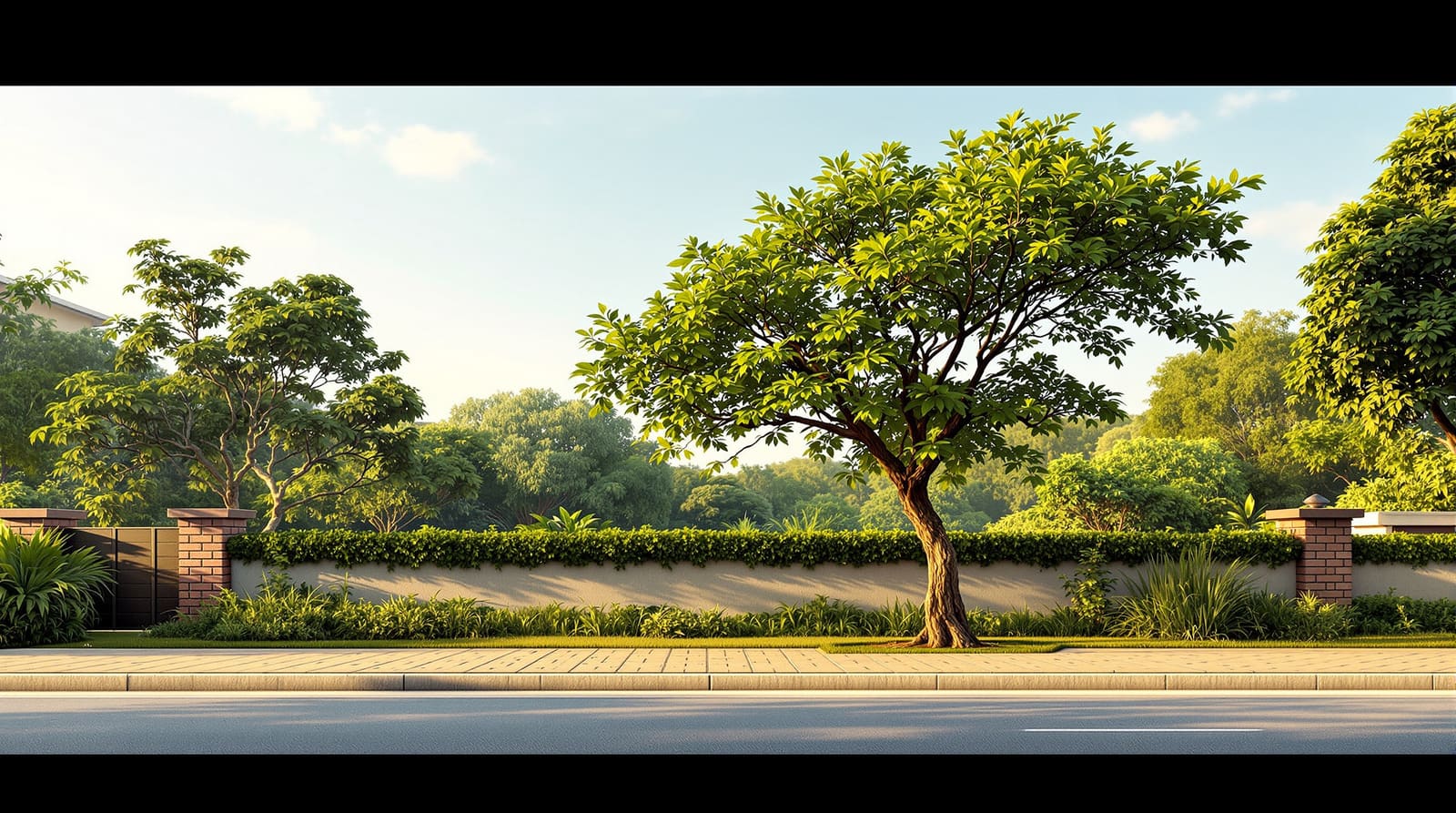
Two friends bought plots on the same new layout outside Mysuru in the same month — same dimensions, 40 by 60, the same asking price almost to the rupee, the same red-soil ground and the same tar road running past the gate. A year on, one of them is living in a house that catches the first cool light of morning across a double-height stair, looks out over a neighbour's old mango tree it never had to plant, and quietly earns a little rent from a one-bedroom unit at the back. The other built a perfectly sound box that turns its blank service wall to the only view on the street and bakes every afternoon under the west sun.
Nothing about the land decided that difference. Both plots "passed" — clear title, sanctioned layout, road access, no obvious defect. What separated them was that one buyer looked at the same patch of earth and asked a different question. Not "what is wrong with this plot?" but "what could this plot become?" The value of a site is not what it is today — it is the best version of itself you can responsibly unlock, and learning to see that latent upside is a skill you can practise before you sign anything.
The opportunity lens — the other half of reading a site
Reading a plot well takes two passes, and most buyers only ever make one. The first pass is the limits pass: the setbacks you must leave, the height you cannot exceed, the soft monsoon corner where water collects, the encroaching transformer, the title you must clear. That defensive reading deserves its own discipline, and it has one — understanding site constraints is the companion to this guide and you should read the two together, because every real decision lives where opportunity and constraint meet.
This guide is the second pass: the opportunity pass. Where the constraints reading protects you from a bad buy, the opportunity reading shows you which of several "fine" plots is quietly worth far more than its neighbours — and how to build to capture that worth. The two are not in tension. A constraint named honestly often hides an asset: a level change that complicates the foundation is also a free split-level section; a setback you resent on the north is also the strip of cool light and garden that makes the whole house breathe.
One caution before we start spotting upside: this is not the buy-or-walk-away decision itself. That belongs to a structured evaluation — how to evaluate a residential plot walks through title, khata, encumbrance, RERA status and the rest of the go/no-go checklist. Read potential to choose between plots worth buying and to brief your design; lean on the pillar, site analysis, to read the land itself.
The buildable envelope is your real yield, not the plot size
The first number every buyer quotes is the plot size. It is almost never the number that matters. What you actually get to build — and therefore the house you can live in and the value you can create — is the buildable envelope, and it is usually a good deal smaller than the land you paid for.
Three regulations shape that envelope, and all three vary by city, by zone and by road width under the local Development Control Regulations, so treat every figure here as a relationship to verify, never a fixed value:
- FSI / FAR (Floor Space Index, or Floor Area Ratio) caps the total floor area you may build as a multiple of the plot area. An FSI of, say, 1.75 on a 2,400 sq ft plot permits roughly 4,200 sq ft of countable floor across all storeys. This is your headline yield, and the single biggest lever on what a plot can become. The arithmetic — what counts, what is exempt, how balconies and stairs and parking are treated — repays careful study; FSI / FAR computation sets it out properly.
- Ground coverage caps the footprint — how much of the plot the building may sit on at ground level, often expressed as a percentage. It decides how many floors you need to reach your permitted FSI, and how much open ground stays for light, garden, parking and rainwater.
- Setbacks and height push the building in from each boundary and cap how tall it climbs. Setbacks widen with road width and building height under most bye-laws.
Put crudely: gross plot area is what you bought; the buildable envelope is what FSI, ground coverage, setbacks and height will actually let you raise; and the liveable area is what is left once stairs, walls, ducts and circulation take their share. The gap between the three surprises people. Two plots of identical size can yield very different liveable homes because one sits on a wider sanctioned road (more FSI, gentler setbacks) or in a more generous zone than the other.
So the first act of opportunity-spotting is dull and decisive: compute the real yield for each plot you are weighing, in floor area and storeys, not in plot dimensions. The plot that looks bigger on paper is sometimes the smaller house.
Reading latent assets — what the plot already gives you for free
Once you know how much you can build, the more interesting question is what is already here that you would otherwise have to buy, plant or fake. These are a plot's latent assets, and they are the reason two identical envelopes produce homes worth thousands of rupees per square foot apart.
A latent asset is anything the site offers at no cost that a good design can convert into delight or money. A clean view to a lake, a ridgeline or even a neighbour's old garden — borrowed scenery you will never pay to maintain. A mature tree that gives twenty years of shade and a grown canopy from day one. A north or north-east edge that pours soft, glare-free light into the rooms you live in. A quiet boundary away from the road for the bedrooms. A gentle level change that hands you a split-level section or a tucked-under car park for free. A corner that allows two street accesses — a front door for the family and a discreet second entry for an office or a let unit.
The catch is that latent assets are perishable and easy to squander. The view gets walled out by a thoughtless plan. The tree gets felled because it sat where the standard layout wanted the car. The north light gets wasted on a store room while the bedroom faces the harsh west sun. Spotting the asset is half the work; the other half is committing, early, to a plan that keeps it. The craft of capturing a view without losing privacy is a study in itself — designing for views and privacy is worth a read once you know what you are protecting.

Here is a way to walk a plot and turn each asset into a design move:
| Latent asset on the plot | How to unlock it in the design |
|---|---|
| A clean long view (lake, ridge, mature trees next door) | Place living spaces & the main glazing to frame it; lift it to an upper floor if a ground wall would block it |
| A mature tree already on or beside the plot | Plan the footprint & parking around it; treat its canopy as built shade & a grown garden from day one |
| A north or north-east edge | Put the rooms you use by day there for soft, even daylight; avoid burying it behind a store or stair |
| A quiet boundary away from the road | Zone bedrooms & study against it; keep the noisy service & parking on the road edge |
| A natural level change or slope | Use it for a split-level section, a tucked-under garage or a stepped garden instead of flattening it |
| A corner plot with two road faces | Split a family entrance & a separate access for a home office or rental unit; see corner-plot strategies |
| The prevailing breeze direction | Align openable windows & a cross-ventilation path along it to cut cooling cost year-round |
For the orientation lines in that table, site orientation explained and the sun-path and wind companions go deeper than there is room for here; for the level-change line, a sloping plot is an opportunity, not a defect, and sloping site design shows why.
Best-and-highest use — for a home, not a developer
"Highest and best use" sounds like a phrase for commercial developers, but a calmer version belongs to every homeowner. It simply means: of all the things this plot could legally and sensibly become, which serves your life best over the next twenty years — and does the land have the legs for more than you need today?
For a residential plot the live options usually are: how many floors to build now versus later; whether to carve out an income unit — a self-contained one-bedroom on the ground or top floor that earns rent or houses parents; whether to fit a proper home office with its own access for the work-from-home reality; and whether to leave structure and services ready for a future floor or wing as the family grows. A plot whose envelope and access support these without contortion is worth more to you than one that does not, even at the same price.

The art is to match the plot to your brief rather than to a generic ideal. A retired couple values a single graceful floor, a garden and a guest room far more than a third storey they will never climb. A young family with ageing parents and a side hustle wants exactly the corner plot with two accesses and an unused FSI margin. The same land scores differently against different lives — which is why a plot's "potential" is meaningless until you hold it against the home you actually intend to build. Designing the structure and services so tomorrow's floor or let-unit costs a fraction of starting over is its own discipline; future-proof home design for Indian families is the guide to read before you pour the foundation, and it pairs naturally with thinking about future resale value.
A plot that "passes" versus a plot with real upside
This is the heart of it. Plenty of plots pass — clear title and khata, no encumbrance, sanctioned layout, RERA-registered project, a metalled approach road, soil that a geotechnical test confirms will carry an ordinary house. Passing means the plot will not hurt you. It says nothing about whether the plot will reward you.
Upside is a different reading. Two plots can both pass and sit a world apart once you overlay the opportunity lens: orientation that hands you free morning light and a shaded west wall versus one that fights the afternoon sun all summer; a wider sanctioned road that lifts FSI and eases setbacks versus a narrow lane that caps both; a view, a tree or a quiet edge versus a flat default with nothing to frame; an envelope with room to grow versus one already maxed on day one. None of these shows up in a title search. All of them show up in the house you eventually live in and the price it eventually commands.

The practical move is to run both readings on every shortlisted plot and keep them separate on the page. First the constraints and the pass/fail — does it clear title, access, soil, water table and the bye-laws? Then, only on the survivors, the upside — yield, orientation, assets and fit to your brief. A plot that passes but shows thin upside is a fair buy at a fair price and nothing more. A plot that passes and reads rich in latent assets is the one to stretch for, because you are paying once for land that will keep giving back.
What to actually do, on the ground in India
Walk the plot at least twice, and once in the morning so you can see where the soft northern light falls and where the west sun will land in summer. Take a compass — orientation is the cheapest, most permanent advantage a plot can hold, and you cannot change it after you buy.
Get the real numbers from the local planning authority or municipal office before you fall in love: the zone, the FSI and ground coverage for that road width, the setbacks and the height cap. Confirm the sanctioned road width on record, not just what the tarmac looks like — it drives your whole envelope. Note the contours and any level change, the likely water table and how the monsoon will drain across the land; a quick geotechnical test (the standard soil-bearing references apply) tells you what foundation the plot's true potential will cost to realise. Mark every latent asset on a sketch — the view, the tree, the quiet edge, the breeze line — and a first envelope that respects setbacks. Then, and only then, ask the developer's question gently: given my brief, what is the best version of this house this land will allow? If two plots tie on paper, the answer to that question is the tie-breaker.
If you want to pressure-test the upside of a shortlisted plot quickly — sketch a buildable envelope, try an orientation, see how an income unit or a future floor sits — DesignAI lets you explore those what-ifs in minutes so you walk into the purchase already seeing what the land could become.
References
- Bureau of Indian Standards, National Building Code of India 2016 (Part 3, Development Control Rules & General Building Requirements).
- The relevant State Town & Country Planning Act and the local Development Control Regulations / building bye-laws (FSI/FAR, ground coverage, setbacks and height vary by city and zone).
- IS 1904 (foundation design — general requirements) and IS 6403 (bearing capacity of shallow foundations) for the geotechnical reading of a plot.
- Real Estate (Regulation and Development) Act, 2016 (RERA), and the relevant State RERA rules for layout and project verification.
- Kevin Lynch & Gary Hack, Site Planning (MIT Press) — reading and developing the latent value of a site.
- Joseph De Chiara, Julius Panero & Martin Zelnik, Time-Saver Standards for Site Planning — yield, access and envelope fundamentals.
Read this alongside its companion, understanding site constraints, and the pillar, site analysis for homeowners — and use DesignAI to see what your plot could become.
Export this guide
Related Guides — Deep-dive reading
Site Analysis for Homeowners: How to Read a Plot Before You Build
The master guide to reading your land — its legal envelope, sun, wind, slope, soil, access, neighbours, views, services and microclimate — before you buy a plot or draw a plan.
Site PlanningOrientation, Light & Views: Designing With Your Space, Not Against It
How reading your plot's sun, breeze and views — and placing each room on the right face — gives an Indian home that is cooler, brighter and quietly right, instead of one that fights its site forever.
Design PrinciplesUnderstanding Sun Path Analysis for Your Home
How the sun actually moves over an Indian site through the day and the year — and why that single fact quietly decides where your kitchen, bedroom and living room should sit.
Site PlanningRelated Tools — Try Free
Cross-Ventilation Analyzer
Estimate airflow and air changes per hour (ACH) from room size, window areas, layout, and local wind — with NBC 2016 Part 8 compliance check.
Ventilation CalculatorWindow Orientation Planner
Pick the best window type, glass and shading by wall direction — north, east, south and west.
Window ToolWindow Quantity Calculator
Estimate how many windows your home needs for NBC daylight and ventilation norms.
Window Tool