
Understanding Site Constraints
The limits that decide what you can build — regulatory (zoning, FSI, setbacks, NOCs), physical (soil, water table, slope), legal (title, easements, access) and contextual — and how they shrink a plot to its buildable envelope
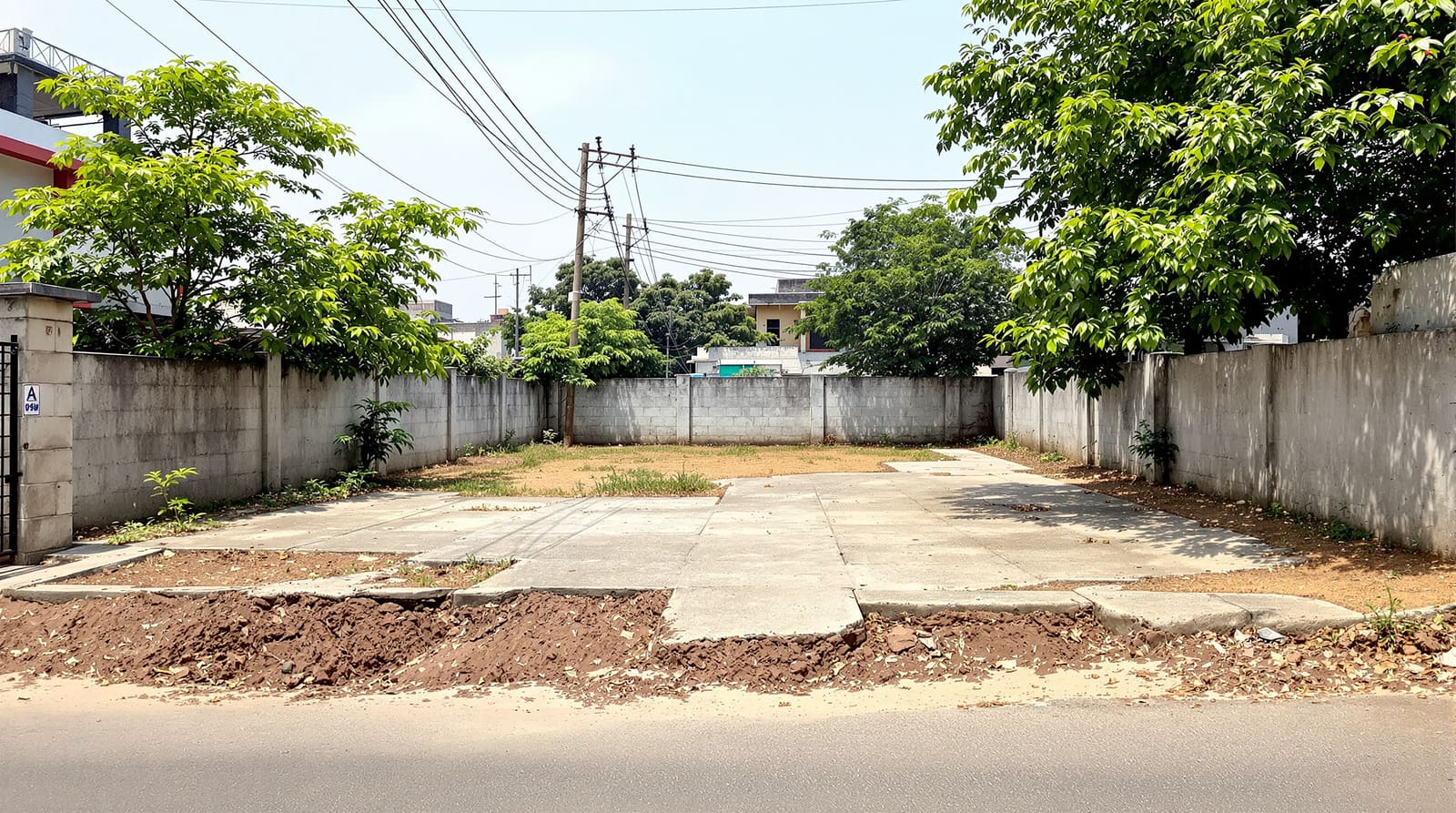
A family in Pune found the plot they had been dreaming of for three years — 2,400 sq ft, a quiet lane, a peepal tree at the rear, friendly neighbours who waved them in for tea. They paid the token, celebrated, and only then sat down with an architect to sketch the home they had pictured a thousand times. Within an hour the sketch had shrunk twice. The Development Control Regulations demanded setbacks on all four sides; the lane out front was marked for future widening, and a strip of their land already belonged, on paper, to that road. A municipal drain crossed the rear corner under an easement they had never been told about. The peepal tree, it turned out, could not legally be felled without permission that rarely comes. By the time the limits were drawn in, the buildable footprint was barely half what they had paid for.
Nothing was wrong with the plot. What was wrong was the order in which they learned about it. Every one of those limits existed before they signed; they simply had not gone looking. A plot is never just its boundary line and its price per square foot — it is that area minus everything the law, the ground, the title and the neighbourhood quietly take away. A site does not tell you what you can build; its constraints tell you what you cannot, and the wise buyer learns those limits before the money moves, not after.
Why the constraints lens comes first
There are two ways to look at a plot. One is hopeful — what could this become, where will the morning light fall, how might the garden read against the house. That optimistic reading matters, and it has its own guide: understanding site potential is the paired companion to this one. The other reading is the cautious one, and it must come first: what are the hard edges that no design talent, no budget and no clever architect can push past?
This guide is deliberately the catalogue of limits. The pillar, site analysis for homeowners, teaches you how to read a plot in the round — sun, wind, slope, character. Here we narrow the lens to a single, unglamorous question: what decides what you can and cannot build? Constraints are cheaper to discover early than late. A title defect found before you pay is a reason to walk away; the same defect found after is a lawsuit. A weak soil discovered during due diligence is a line in your budget; discovered after foundations are poured, it is a crisis. The whole argument of this guide is that constraints are information, and information bought early is the cheapest information there is.
Constraints fall into four families. Knowing the families is half the discipline, because it stops you checking ten things and forgetting twenty.
Family one: the regulatory limits
These are the limits the planning authority imposes, and they are usually the ones that shrink a plot most dramatically. They sit in the local Development Control Regulations and building bye-laws, and they vary by city, zone and plot size — so every figure below must be confirmed locally, never assumed.
Begin with zoning and land use. The master plan or development plan assigns your plot a use — residential, commercial, mixed, agricultural, green belt, no-development. A residential home on agricultural land is unbuildable until the land is converted (the NA, or non-agricultural, order), and conversion is neither quick nor guaranteed. Then comes FSI / FAR — the floor space ratio that caps how much built-up area you may raise on the plot. The arithmetic of FSI, premium FSI and TDR deserves its own treatment, so we defer it to FSI/FAR computation; for now, understand only that FSI is the single number that converts plot area into the floors you are allowed.
Ground coverage limits how much of the plot the building may touch at the ground, independent of FSI. Setbacks — the mandatory gaps from each boundary — then carve the footprint inward; they grow with building height and plot size, and the specifics differ enough between states that we send you to setbacks across India for the detail. Height limits cap how tall you may go, sometimes by a fixed metre figure, sometimes as a ratio to the abutting road width. And lurking beneath all of these is the road-widening reservation — the line on the development plan that hands a strip of your frontage to a future road. That strip is not yours to build on, and it is exactly what the Pune family missed.
Layered on top are the NOCs — no-objection certificates required before sanction. A tall building needs fire clearance. A plot near an airport falls under the height / funnel-zone restriction, which can cap your building far below the local norm. Larger projects trigger environmental clearance; a plot in an old quarter may face heritage controls; and any plot near the sea sits inside the Coastal Regulation Zone (CRZ), where construction within the notified distance from the high-tide line is sharply curtailed or forbidden. Finally, if you are buying into a plotted development or an under-construction project, check its RERA registration — the regulator's record tells you whether the layout is sanctioned and the title clean.
Family two: the physical limits
The ground itself sets limits the law cannot waive. The most important is soil bearing capacity — how much load the earth can carry before it settles. You cannot read this from the surface; it comes from a geotechnical investigation (boreholes, plate-load or SPT tests, interpreted against IS 1904 and IS 6403). Black cotton soil, common across the Deccan, swells and shrinks with moisture and demands special foundations; filled-up or reclaimed land hides soft pockets. A soil test costs a modest amount before you buy and saves a fortune in foundation surprises after.
Then the water table and flooding. A high water table complicates basements and foundations and, in the monsoon, can flood them. Ask whether the area waterlogs in heavy rain — neighbours will tell you honestly what no document will. Contours and slope decide cut-and-fill, retaining walls and drainage; a falling site can be a gift or a cost depending on how steep, which is why slope earns its own discussion in why topography matters. Existing trees may be protected — mature trees often cannot be felled without permission, and that peepal at the rear may quietly dictate your layout. Rock close to the surface raises excavation cost; natural drainage lines crossing the plot must be respected, not blocked, or the water will find you in July.
Family three: the legal limits
These are the limits hiding in paper, and they are the ones that turn a dream into litigation. The foundation is clear title: a chain of ownership with no breaks, backed by the khata (or its regional equivalent) in the right name and an encumbrance certificate showing no undisclosed loans or charges over the years. Verify both through a property lawyer — this is not a corner to cut.
Beyond title sit the quieter encumbrances. Easements and rights of way give someone else a legal right across your land — a neighbour's access path, a utility's drain, a shared passage. Access width matters more than buyers expect: the legal width of the approach road governs your permissible height and sometimes whether you can build at all, and a plot reached only by a private or disputed lane is a plot in trouble. Shared walls with a neighbour carry shared rights and obligations. And litigation — any pending dispute, partition suit or court stay — must be ruled out before payment, because an injunction can freeze a property for years. The buy decision that weighs all of this sensibly is laid out in how to evaluate a residential plot.
Family four: the contextual limits
The last family is about the world around the plot — limits that no document records but that shape life inside the house. Neighbours and their buildings cast shadow and create overlooking, the loss of privacy when a window stares straight into yours; designing around it is its own craft, treated in designing for views and privacy. Noise from a main road, a market or a railway line is permanent. Electrical lines and transformers impose statutory clearances — you cannot build under or too close to high-tension lines, and a transformer at the gate is both a hazard and an eyesore. Finally, the prosaic but decisive services availability: is there a municipal water connection, a sewer to tap into, reliable power? A plot far from the sewer network means a septic system and its land; a plot with no piped water means a borewell and its uncertainty.
How the four families define the buildable envelope
Put the families together and you get the single most useful idea in plot-buying: the buildable envelope. Start with the gross plot area. Subtract the road-widening reservation. Subtract the setbacks on every side. Subtract any easement strip and any tree you must protect. What remains — in plan, and then extruded up to the height limit and capped by FSI — is the envelope you may actually build within. It is almost always smaller than the plot you paid for, and on a constrained urban site it can be dramatically smaller.

This is why the constraints lens must precede the design. An architect who knows the envelope designs within reality; one who designs first and discovers the envelope later draws twice. The envelope is not a limitation on creativity — it is the canvas, and knowing its true edges is what lets a good design fill it completely.
A constraint checklist: what to check and who tells you
| Constraint type | What to check | Who tells you |
|---|---|---|
| Zoning & land use | Permitted use; NA conversion if agricultural | Planning authority / development plan |
| FSI / FAR & ground coverage | Permissible built-up area & footprint | Local DCR / building bye-laws |
| Setbacks & height | Mandatory margins & max height vs road width | Local DCR; sanctioning architect |
| Road-widening reservation | Strip lost to future road on the DP | Development plan / planning authority |
| NOCs (fire, airport, CRZ, heritage, environment) | Which clearances apply to this plot | Respective authorities; architect |
| Soil bearing & water table | Geotechnical test (IS 1904 / IS 6403); flooding history | Geotechnical engineer; neighbours |
| Contours, rock & drainage | Slope, excavation difficulty, natural water paths | Surveyor; site visit |
| Title, khata & encumbrance | Clean ownership chain; no charges or loans | Property lawyer; sub-registrar |
| Easements & access width | Rights of way; legal approach-road width | Lawyer; revenue records |
| Litigation | Pending suits, stays, partition disputes | Lawyer; court search |
| Services & HT lines | Water, sewer, power; statutory line clearances | Utility departments; site visit |

What to actually do, in order
Do the cheap, fast checks first and the expensive ones only once the plot survives them. Pull the development plan and confirm zoning and any reservation — this is a desk task and often free. Walk the plot at different times: a market morning, a monsoon evening. Talk to neighbours, who will tell you about flooding, disputes and water supply more honestly than any seller. Then engage a property lawyer for title, khata and encumbrance before you part with serious money. Only after the title is clean is it worth commissioning the soil test and the topographic survey, and engaging an architect to translate the bye-laws into your true buildable envelope. The principle holds throughout: every constraint is cheaper to find one step earlier than where you would otherwise find it. Many of the costliest plot-buying errors — catalogued in plot selection mistakes to avoid — are simply constraints discovered one step too late.
References
- Bureau of Indian Standards, National Building Code of India (NBC) 2016.
- The local Development Control Regulations / Unified Building Bye-laws for the relevant municipal authority (varies by city and state).
- IS 1904: Code of Practice for Design and Construction of Foundations in Soils; IS 6403: Code of Practice for Determination of Bearing Capacity of Shallow Foundations.
- The relevant state Town & Country Planning Act and the Real Estate (Regulation and Development) Act, 2016 (RERA).
- Coastal Regulation Zone Notification, Ministry of Environment, Forest and Climate Change (for coastal plots).
- Kevin Lynch & Gary Hack, Site Planning, MIT Press.
Read this alongside its optimistic twin, understanding site potential, and the plot-reading pillar, site analysis for homeowners — then let DesignAI help you test what your true buildable envelope can become.
Export this guide
Related Guides — Deep-dive reading
Site Analysis for Homeowners: How to Read a Plot Before You Build
The master guide to reading your land — its legal envelope, sun, wind, slope, soil, access, neighbours, views, services and microclimate — before you buy a plot or draw a plan.
Site PlanningPlot Due Diligence in India: The Complete Pre-Purchase Check (2026)
Before you pay a rupee for a plot, run the full pre-purchase check with your lawyer and a licensed surveyor - legal title, revenue records, planning approvals, physical survey and financial dues. This guide walks through each pillar, gives you a checklist and tells you when to walk away.
Buying LandHow to Evaluate a Residential Plot in India
A practical, layered framework for assessing a plot before you buy — from clear title and the buildable-area maths to access, soil, orientation and a weighted scorecard.
Site PlanningRelated Tools — Try Free
Cross-Ventilation Analyzer
Estimate airflow and air changes per hour (ACH) from room size, window areas, layout, and local wind — with NBC 2016 Part 8 compliance check.
Ventilation CalculatorStamp Duty Calculator — All Indian States
Stamp duty + registration charges for all 28 states and 8 UTs — gender concessions, urban/rural variants, metro cess built in.
Stamp DutyBefore vs After — Cost Reality Check
Compare what you expected to pay vs what you actually paid, category by category.
Reality Check