
Site Orientation Explained: Which Way Should Your Home Face?
Plot facing is about the road. Building orientation is about the sun. This guide untangles the two — and shows you how to reconcile climate logic, Vastu and the realities of your site when they pull in different directions.
A family in a Bengaluru gated layout has shortlisted two plots. The agent leads with one number: "This one is east-facing, sir — very auspicious, very good resale." The other, slightly cheaper, is "west-facing — people avoid." They are about to pay a lakh or two more for a label, and nobody in the room has yet asked the question that actually decides how the house will feel: where will the afternoon sun hit, and which rooms get the soft morning light?
Meanwhile in Jaipur, an owner has a genuinely east-facing plot and is delighted — until the architect points out that to satisfy both the entry-from-the-east instinct and a habitable layout, the main bedrooms will end up on the brutal western edge, baking every afternoon from March to June. The label was right; the orientation that followed from it was wrong.
These are two different things, and confusing them is the single most expensive orientation mistake homeowners make. "Plot facing" describes which side meets the road. "Building orientation" describes how you place rooms, walls and windows relative to the sun. You inherit the first; you design the second.
A plot has a facing; a house has an orientation — and a good design uses the freedom inside the plot to give every important room the right relationship with the sun, almost regardless of which way the gate points.
1. Plot facing vs building orientation — two different decisions
"Facing" in Indian real estate is a convention: a plot is named by the direction you look when you stand at the main road and face into the site. A north-facing plot has the road to its north; you enter walking southward. That is genuinely useful information — it tells you where the gate, the approach and the street-side rooms must go, and it constrains your setbacks. But it says surprisingly little about comfort on its own.
Building orientation is what you do inside the plot. On a typical 30 ft × 40 ft or larger site you have real freedom: you choose which walls carry the big windows, where the double-height void goes, which way the verandah opens, how deep the chhajja (sun-shade) projects. Two identical west-facing plots can produce one house that overheats every evening and one that stays cool — the difference is orientation, not facing.
| Term | What it describes | Who controls it | What it actually affects |
|---|---|---|---|
| Plot facing | Which side meets the road | The plot you buy (fixed) | Gate position, approach, street rooms, parking, setback shape |
| Building orientation | How rooms & windows sit relative to the sun | You and your architect (designed) | Heat gain, daylight quality, ventilation, comfort, energy bills |
| Room placement | Which function goes on which face | You and your architect (designed) | Whether bedrooms bake or stay cool; where the kitchen heat goes |
The practical takeaway: do not let a facing label make or break a plot purchase. A skilled layout can rescue almost any facing. Use our plot evaluation tool to score a site on the things that are genuinely hard to change — road width, levels, setbacks, neighbours — rather than on a compass label that good design can absorb.
2. What the sun actually does over an Indian site
Before choosing an orientation you have to know the opponent. Across mainland India (roughly 8°N to 35°N), the sun rises in the east, climbs to a high point in the southern sky around noon, and sets in the west. In summer it rises slightly north of east and sets slightly north of west, riding very high; in winter it tracks lower and stays in the south. This produces a few stubborn facts:
- The north face is the calm one. It receives soft, indirect light almost all day and only catches direct sun for a short spell on summer mornings and evenings. North light is glare-free and cool — the reason artists and studios crave it.
- The south face is strong but disciplined. South sun is high overhead, so a modest horizontal chhajja can shade a south window completely in summer while still letting low winter sun in. It is the most controllable face.
- East gives gentle warmth. Morning sun is low and not very hot; pleasant in bedrooms and breakfast spaces, easy to live with.
- West is the villain. Afternoon and evening sun is low, fierce and comes in almost horizontally — the hardest to shade, hitting walls when they are already hot. West-facing glazing is the leading cause of evening overheating in Indian homes.
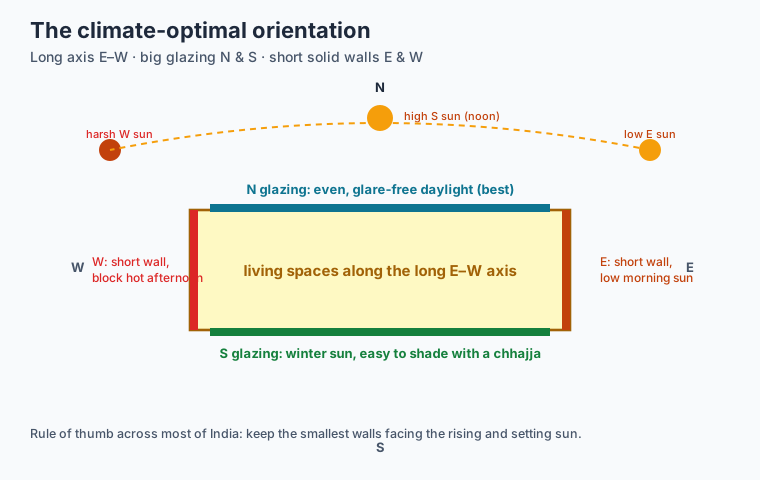
Figure 1: The climate-optimal orientation for most of India — long axis east–west, generous glazing to the north and south, and the smallest, most solid walls turned toward the rising and setting sun.
"In the tropics the building should be oriented with its long axis running east–west, presenting the least surface to the low morning and evening sun and the most to the controllable high sun." — the orientation principle set out in the National Building Code of India (NBC 2016, Part 11 on Approach to Sustainability) and echoed in the Energy Conservation Building Code (ECBC).
If you want to see exactly where the sun will be on your own plot, on your own dates, run it through the sun path analyzer — it turns these general rules into the specific arcs for your latitude. The deeper mechanics live in our companion guide, understanding sun path analysis.
3. The climate-optimal orientation, in one rule
If you remember nothing else: elongate the house east–west, open it to the north and south, and turn your back on the west.
Laid out that way, your two longest walls — the ones that carry living rooms, the best bedrooms and the kitchen — face north and south, where light is either soft (N) or easily shaded (S). The two short walls face east and west, so the small, fierce-angle exposures are minimised. Put utility spaces with small windows — staircase, store, toilets, a service court — on the west to act as a thermal buffer, soaking up the afternoon heat before it reaches the rooms you live in.
This is not a Western import; it is exactly how Indian vernacular courtyard houses, the haveli and the Kerala nalukettu have worked for centuries — thick western walls, shaded southern verandahs, openings to the cooler quarters.
| Orientation move | Why it works | Practical version |
|---|---|---|
| Long axis E–W | Minimises hard east/west exposure, maximises shadeable south | Make the plan a rectangle wider than it is deep, running E–W |
| Main glazing N & S | North = glare-free; South = winter sun, easy summer shade | Living, study, key bedrooms on N/S walls |
| Buffer the west | West sun is fierce and low | Stairs, stores, toilets, tall trees or a service court to the W |
| Chhajja over south glass | Blocks high summer sun, admits low winter sun | 450–600 mm projection on south windows |
| Cross-ventilation N↔S | Catch prevailing breeze, flush heat | Aligned openings on opposite long walls |
For cooling, orientation and airflow are two halves of one decision — the breeze you let in matters as much as the sun you keep out. Pair this with the cross-ventilation analyzer and our guide on understanding wind analysis so your openings line up with both the sun and the wind.
4. The eight facings, honestly compared
Real plots come in eight facings, and most owners want to know what theirs means. Here is the climate reality of each — and, kept separate, the typical Vastu view you will encounter, so you can see where the two traditions agree and where they part ways.
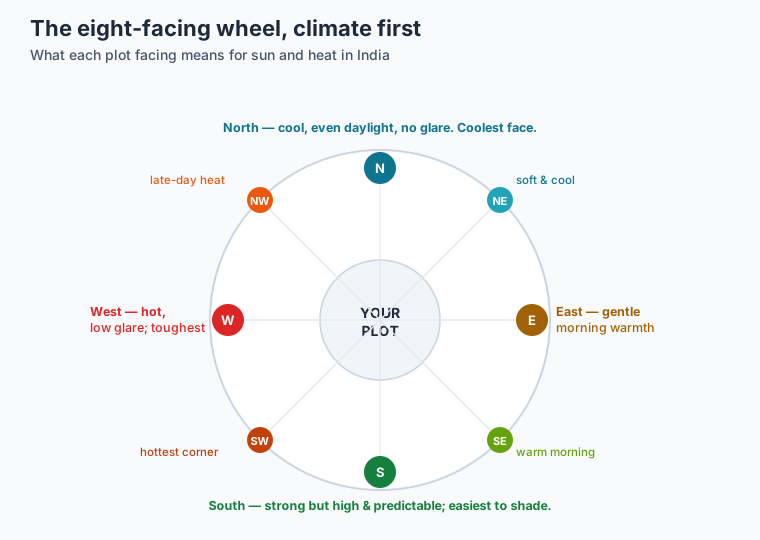
Figure 2: The eight-facing wheel read through a climate lens — cool and even to the north, gentle to the east, controllable to the south, and demanding to the west.
| Facing | Climate pros | Climate cons | Typical Vastu view |
|---|---|---|---|
| North (N) | Coolest face; soft even daylight; minimal heat gain | Less direct winter warmth; can feel dim in deep rooms | Highly favoured; prosperity; good for entrances |
| East (E) | Gentle morning sun; pleasant, low heat | Morning glare possible; needs shading by midday | Highly favoured; "auspicious" entry; sunrise virtue |
| South (S) | Strong but high sun, easily shaded; good winter gain | Needs proper chhajja or it overheats | Often treated with caution; depends on sub-direction |
| West (W) | Useful winter evening warmth in cold regions | Harsh, low afternoon sun; hardest to control; overheating | Generally seen as less desirable |
| North-East (NE) | Soft, cool light from two good faces | Limited direct winter sun | Most auspicious in Vastu; kept open, light, for water/prayer |
| South-East (SE) | Warm morning sun; reasonable | Afternoon heat creeps in | Linked to the "fire" zone; favoured for kitchens |
| South-West (SW) | — | Hottest corner — both afternoon sun and accumulated heat | Treated as the "heavy" zone; master bedroom, kept solid |
| North-West (NW) | Cool mornings | Late-day western heat | Linked to "air"; often guest rooms, stores |
Notice the interesting overlap: the climate-favourite north and the Vastu-favourite north-east point the same way, and both traditions like keeping the south-west solid and heavy — climate because it blocks the worst heat, Vastu for its own reasons. The sharpest divergence is the east-facing fixation: real estate and Vastu both prize it, but from a pure-comfort standpoint east is merely pleasant, not superior, and an east entry can push living spaces onto a bad western edge if you are not careful.
5. Where solar logic and Vastu agree — and where they don't
Vastu Shastra is a tradition many Indian families value deeply, and it is woven into resale expectations, family approval and personal peace of mind. It is not our place to endorse or dismiss it. What we can do is lay the two systems side by side so you can make an informed call.
Reassuringly, a lot of Vastu's orientation guidance lines up with climate science, because both grew out of the same hot Indian sun. Vastu keeping the north-east open and light matches the cool, glare-free north light. Vastu putting the kitchen toward the south-east sits comfortably with morning sun and afternoon shading. Vastu treating the south-west as heavy and built-up is exactly what a thermal engineer would prescribe to block the hottest corner. Where they harmonise, you lose nothing by honouring both.
The friction points are real but few:
- The east-entry insistence. Vastu often prefers an east or north entry; if your plot faces south or west, forcing an east approach can distort an otherwise good plan. Usually solvable — you can have an east-facing gate and still put the living spaces on the cool side.
- Water and openings in the north-east. Generally aligns with climate; rarely a conflict.
- Bedroom in the south-west. Vastu favours the master bedroom here, but this is the hottest quadrant — so insist on a deep chhajja, smaller west-facing windows and good insulation if you place it there.
| When solar logic and Vastu point different ways | How to weigh it | Suggested resolution |
|---|---|---|
| Vastu wants east entry; comfort wants south/north rooms | Entry direction is symbolic; room comfort is daily, physical | Keep the gate/entry as Vastu likes; place habitable rooms by climate |
| Vastu wants bedroom in hot SW | You live in that room every night | Allow it, but shade hard: deep chhajja, small W windows, insulation |
| Vastu warns against a south-facing plot | South is the most controllable face | Buy it; a good chhajja neutralises the concern entirely |
| A Vastu "defect" needs costly structural change | Cost vs benefit; remedy may be cosmetic | Use a low-cost symbolic remedy; don't rebuild for it |
| Vastu and climate agree (NE open, SW heavy) | No conflict | Do both — free win |
The pragmatic principle we recommend: let climate govern the things you cannot change later (which way the big windows face, where the heat lands), and let Vastu govern the things that are flexible or symbolic (entry direction, the location of the prayer space, a preferred sub-direction for a room). When a Vastu requirement is cheap and harmless, honour it; when it would force you to bake in an afternoon-sun bedroom or wall off the cool north, weigh it carefully against years of real discomfort.
If Vastu matters to your family, get a concrete reading rather than guesswork: the Vastu compass fixes your true directions, and the Vastu compliance tool scores a layout. For the tradition itself, our guides on the Vastu house plan and Vastu for modern homes treat it in depth. Remember to check the difference between magnetic and true north before you trust any compass reading.
6. A practical method when the three forces conflict
Solar logic, Vastu and the brute facts of your site — the road, the entry, the views, the setbacks, the neighbours — will not always agree. Here is the order we resolve them in.
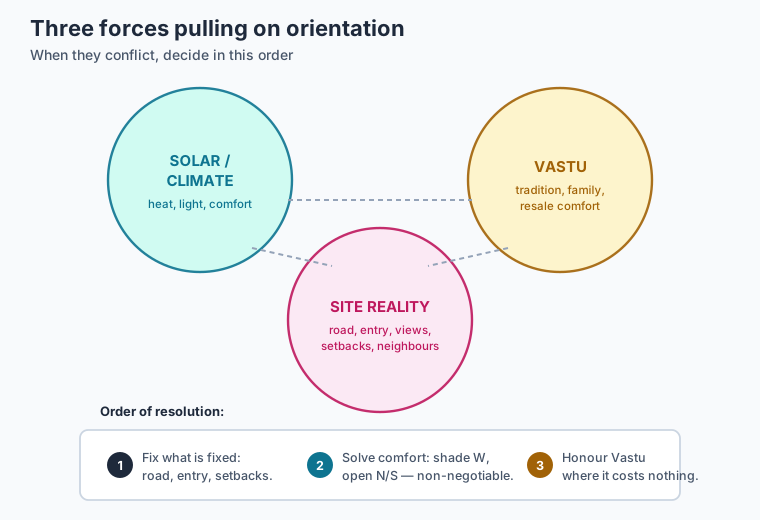
Figure 3: Three forces pull on every orientation decision. Resolve them in order — fix what is fixed, then solve comfort, then honour tradition where it's free.
1. Lock the fixed things first. The road, the legal entry, the setbacks and the buildable envelope are not negotiable. Map them before anything else — our setback visualizer and FAR/FSI calculator show you the box you actually have to work within.
2. Solve comfort next — it's non-negotiable for life. Within that box, decide which walls face the sun. Shade or buffer the west, open generously to the north, control the south with chhajjas, keep the east for morning rooms. This is the layer you will feel every single day for decades, so it earns priority.
3. Then honour Vastu wherever it costs nothing. A huge share of Vastu can be satisfied with no comfort penalty — entry direction, prayer-space placement, keeping the north-east light. Spend your flexibility here, after comfort is safe.
4. Reconcile views and privacy last. If the good view faces the hot west, you shade it cleverly (a deep verandah, a screen, a punched window) rather than throwing open a wall of glass. Our guide on designing for views and privacy covers the trade-offs.
Think of it as a hierarchy of permanence: you can repaint, re-curtain and re-furnish, but you cannot easily move which way a wall of glass faces the afternoon sun. So the things that are hardest to undo deserve the first and strongest claim on the orientation.
This whole orientation decision is one layer of a larger reading of your plot. For the full picture — sun, wind, slope, drainage, soil, access and neighbours together — start from the pillar guide, site analysis for homeowners, and the design-principles companion, orientation, light and views.
7. A homeowner's orientation checklist
Before you sign off on a plan, walk through this:
- [ ] Do you know your plot's facing and, separately, how the building is oriented to the sun? They are not the same.
- [ ] Does the long axis of the house run roughly east–west?
- [ ] Are your most-used rooms (living, key bedrooms, study) on the north or south, not the west?
- [ ] Is the west edge buffered — stores, stairs, toilets, a service court or planting?
- [ ] Do south-facing windows have a chhajja of about 450–600 mm?
- [ ] Are openings aligned north–south to catch cross-breeze?
- [ ] Have you run the actual sun arcs for your latitude, not just trusted a rule of thumb?
- [ ] If Vastu matters to your family, have you separated the free requirements (honour them) from the costly comfort trade-offs (weigh them)?
- [ ] Have you avoided overpaying for a facing label that good design can absorb?
Get these right and your home will be cooler, brighter and cheaper to run — whichever way the gate happens to point.
Sources & further reading
1. Bureau of Indian Standards — National Building Code of India 2016 (NBC 2016), Part 11: Approach to Sustainability — orientation and passive-design guidance.
2. Bureau of Energy Efficiency — Energy Conservation Building Code (ECBC) 2017 and Eco-Niwas Samhita (ENS) 2018 — building-envelope orientation and shading provisions for residential buildings.
3. IS 3792 / SP 41 (S&T): Handbook on Functional Requirements of Buildings — daylight, ventilation and orientation recommendations.
4. Christopher Alexander, Sara Ishikawa & Murray Silverstein, A Pattern Language — patterns on south-facing outdoors, indoor sunlight and site orientation.
5. Francis D. K. Ching, Architecture: Form, Space & Order — solar orientation and the relationship of form to the path of the sun.
6. Baker, Fanchiotti & Steemers (eds.), Daylighting in Architecture: A European Reference Book — north vs south daylight quality; principles applicable to tropical orientation.
7. Vastu Shastra (traditional texts & modern compilations) — presented for cultural context; orientation guidance varies by school.
If this helped, read the cluster pillar site analysis for homeowners next, then understanding sun path analysis and understanding wind analysis to turn the sun and breeze on your own plot into specific design moves.
Export this guide
Related Guides — Deep-dive reading
Understanding Sun Path Analysis for Your Home
How the sun actually moves over an Indian site through the day and the year — and why that single fact quietly decides where your kitchen, bedroom and living room should sit.
Site PlanningOrientation, Light & Views: Designing With Your Space, Not Against It
How reading your plot's sun, breeze and views — and placing each room on the right face — gives an Indian home that is cooler, brighter and quietly right, instead of one that fights its site forever.
Design PrinciplesNorth-Facing Window Design (India): The Best Light With the Least Heat
Why the north wall gives soft, even, glare-free daylight with almost no heat, and how to design large, high-VLT windows that make the most of it.
Windows & GlazingRelated Tools — Try Free
Cross-Ventilation Analyzer
Estimate airflow and air changes per hour (ACH) from room size, window areas, layout, and local wind — with NBC 2016 Part 8 compliance check.
Ventilation CalculatorBrise-Soleil Visualizer
Interactive horizontal-louvre cut-off angle calculator — sun altitude, louvre depth, and spacing inputs with a live shadow preview. Computes θ = arctan(spacing/depth) for façade shading, ECBC envelope compliance, hospital daylight design, and tropical sun-control detailing.
Sun Shading ToolWindow Orientation Planner
Pick the best window type, glass and shading by wall direction — north, east, south and west.
Window Tool