
Utility Networks in Townships
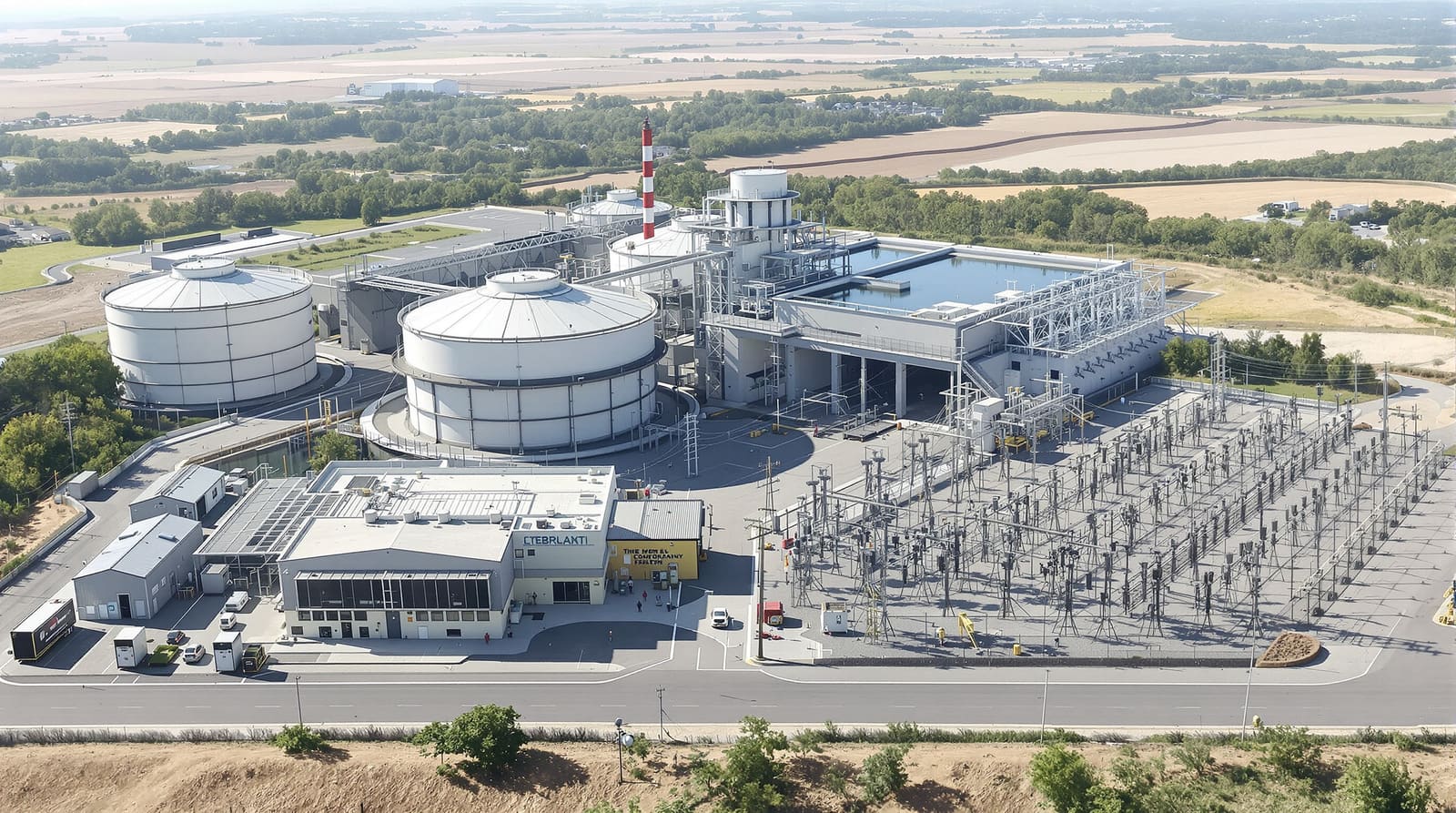
The trunk utility backbone of a township — the water source and WTP, the sewerage network and STP with reuse, the power substation and HT ring, and the coordinated utility corridor
At five in the morning, before the milk vans and the school buses, a different shift is already at work in a large township on the edge of Pune. A plant operator opens a valve at the water treatment plant where raw water — drawn from a bulk municipal main and topped up from the township's own intake — has settled, flocculated and filtered overnight. Treated water climbs into a master balancing reservoir, then feeds, by gravity and pumping, the overhead tanks that crown each cluster of buildings. A few hundred metres away, the sewage treatment plant hums; last night's flows have been screened, aerated and clarified, and the treated effluent is now being pumped back out along a separate purple-tagged main to fill the irrigation tanks for the parks and the dual-plumbed flush lines. In the receiving substation, an engineer logs the night's load on the HT ring main while a SCADA screen blinks quietly with reservoir levels, pump status and transformer temperatures across the whole estate.
None of the ten thousand residents waking up will think about any of this. They will turn a tap, flush a toilet, switch on a geyser, and expect it to simply work — the way it does in any city served by a municipal corporation. That is precisely the point, and the burden: a township of this size is not merely connected to public utilities, it very often has to become a small utility authority in its own right — producing, treating, storing and distributing its own water, power and sewerage at a scale that municipal towns took decades to build. A township's utility backbone is the trunk tier — the source, the treatment plants, the master reservoirs, the substation and the big distribution mains — that turns one bulk connection into reliable, redundant service across many neighbourhoods, and it must be master-planned as a single coordinated system from day one.
The township as a mini-utility authority
The defining shift from neighbourhood to township scale is one of self-sufficiency. A single residential layout taps an existing municipal main at its edge and runs distribution pipes under its streets — the work covered in utility planning in layouts. A township usually cannot assume that the public network has the headroom to serve thousands of new homes, so it takes a bulk supply (or develops its own source) and then performs, internally, the functions a municipal corporation performs for a city: treatment, bulk storage, trunk distribution, sewage collection and treatment, and power receipt and distribution.
This guide is the trunk tier. It deals with the source, the water treatment plant (WTP), the sewage treatment plant (STP), the receiving substation, the HT ring main and the master distribution mains that run along the township's spine roads. Where those trunk mains reach the gate of each neighbourhood and dive under the local streets to individual plots and buildings, the work hands off to the neighbourhood-scale utility planning in layouts — read that guide for the local distribution tier; treat this one as the network that feeds it. Two adjacent systems are deliberately excluded here: surface drainage and rainwater belong to township stormwater planning, and the road corridors that carry all of these belong to the township road hierarchy. All of it sits inside the larger process described in designing a residential township.
Water: from source to neighbourhood
The water system is the most demanding to build because it has the longest internal chain. It begins with a source decision. The cleanest option is a bulk treated-water connection from the municipal or water-board trunk main, metered at a single point — but bulk allocations are often capped well below township demand, and supply can be intermittent. So most large townships build a hybrid: a bulk supply where available, supplemented by their own raw-water intake (a river or canal draw, a reservoir tie-up, or a battery of borewells). Groundwater is the fallback of last resort and an unreliable one — over-abstraction has emptied aquifers across peri-urban India, which is why the more thoughtful estates lean hard on recharge and reuse, ideas explored in water-sensitive urban design.
Raw water then passes through the township WTP — aeration, coagulation and flocculation, sedimentation, rapid sand or membrane filtration, and disinfection — designed and operated to the CPHEEO water-supply manual and IS 10500 potable standards. Treated water rises into a master balancing reservoir (a large ground-level or clear-water reservoir) that absorbs the gap between steady plant output and peaky demand, and from there into the overhead service reservoirs that give each cluster its working pressure. The trunk distribution network — large-diameter ductile-iron or HDPE ring mains along the main roads — carries water to district metered areas at each neighbourhood, after which it becomes the local under-street distribution. Designing it as a looped ring, rather than dead-end branches, is what lets a single burst be isolated without dropping supply to half the township.
Sewerage and the reuse loop
Sewage runs the chain in reverse and downhill. A gravity trunk sewer network collects flows from each neighbourhood's local sewers and carries them, falling along the natural slope, toward the low point of the site. Where the land flattens or rises, pumping stations (lift stations) raise the flow back up so gravity can take over again — a township on undulating Deccan terrain may need three or four. The flows converge at the township STP, sized to treat roughly 80 per cent of the metered water supply (the conventional return-flow assumption in the CPHEEO sewerage manual), using a process train — typically extended aeration, sequencing batch reactor (SBR) or membrane bioreactor (MBR) — chosen for the effluent quality the reuse plan demands.
That reuse plan is the difference between a green township and a thirsty one. Treated effluent, polished to the prescribed reuse standard, is pumped back through a separate dual-water main — kept physically and visibly distinct from potable lines to prevent cross-connection — to irrigate the parks and avenues and to feed the dual-plumbed flushing cisterns in homes. In a water-stressed Indian township, this recycled loop can offset a quarter to a third of fresh-water demand, which is why IGBC Green Townships and LEED-ND both reward it heavily. The landscape and water case for it sits within blue-green infrastructure.
Power, gas, telecom and the dual network
Electricity arrives at township scale as high-tension (HT) power — typically 33 kV or 11 kV — into a receiving substation built by the developer and energised under a bulk agreement with the state DISCOM. From the substation, an HT ring main loops around the township feeding ring-main units and distribution transformers sited near each load centre, which step the supply down to 415/240 V for homes. The ring topology matters here too: a fault on one segment is switched out and the load re-fed from the other direction, so neighbourhoods do not go dark. Backbone cabling is increasingly laid underground in ducted trenches rather than on overhead poles — costlier upfront, but safer, storm-resilient and far better looking, and now expected in any premium or smart township.
Alongside power run the lighter networks: a piped natural gas (PNG) distribution grid where a city-gas franchisee operates in the region, and the telecom and fibre backbone — OFC ducts to every neighbourhood for broadband, the township management network, CCTV, smart metering and the SCADA telemetry. These low-voltage and communication assets are what later carry the smart-utility layer discussed in future-ready residential layouts.
The master utility plan and the shared corridor
The single most important drawing in this whole exercise is not any one network but the one that overlays them all: the master utility plan. Without it, the water engineer, the sewerage contractor, the DISCOM and the gas franchisee each trench the main road on their own schedule, clash underground, and dig the same carriageway open four times. The master plan assigns every trunk service a reserved lane within a shared utility corridor that runs along the road reserves defined in the township road hierarchy — typically with the heavy gravity sewer deepest and on one side, water mains opposite, and the dry services (power, gas, telecom) banked at shallow set depths with mandated vertical and horizontal clearances, all set out in NBC 2016. Building the corridor with spare ducts and a planned crossing every so often is what makes future augmentation possible without re-excavation.
Sizing for a whole population
Trunk infrastructure is sized to ultimate township population, not phase-one occupancy, because you cannot easily widen a buried main later. The numbers below are planning starting points from the CPHEEO and URDPFI frameworks — they must be qualified by local climate, the actual housing mix and the design population, never lifted as gospel.
| Trunk utility | Township-scale facility | Indicative provisioning & what it serves |
|---|---|---|
| Water supply | WTP & master balancing reservoir | Roughly 135–150 litres per capita per day for piped, sewered housing; bulk & own-source feed; serves all potable demand |
| Bulk storage | Overhead service reservoirs | Sized for peak-hour & firefighting reserve; gives each neighbourhood working pressure |
| Sewerage | Gravity trunk sewers & pumping stations | Designed at about 80 per cent of water supply as return flow; collects from all neighbourhoods |
| Sewage treatment | Township STP | Treats the full dry-weather flow; effluent polished to the reuse standard |
| Recycled water | Dual / treated-water main | Offsets 25–35 per cent of fresh demand via landscape irrigation & flushing |
| Power | Receiving substation & HT ring | Bulk HT tie-in with the DISCOM; load qualified by housing mix & appliance assumptions |
| Distribution | Transformers & LT network | Steps HT down to 415/240 V at each load centre |
| Telecom / gas | OFC ducts & PNG grid | Fibre backbone, SCADA & smart metering; piped gas where a franchisee exists |
Two design disciplines run through the whole table. Redundancy — looped rings, standby pumps, dual feeders, a second source — is what separates a township that rides out a failure from one that floods the WhatsApp group. And staged augmentation matches capital to occupancy: you build the trunk corridor and the first treatment module for phase one, then bolt on additional WTP and STP modules and transformers as each phase fills, a discipline tied directly to the township's phasing and to residential density planning.
Making it real in India
The hard truth of Indian townships is that building these networks is the easy half — running them for thirty years is the hard half. Magarpatta and Aranya Indore are studied as much for their operations as their plans. A township STP that is over-built and under-loaded in phase one runs inefficiently; one that is starved of trained operators and power simply bypasses to the nearest nullah, quietly defeating the whole reuse promise. The classic company townships such as Jamshedpur worked because a single owner funded and ran the utilities as a permanent obligation; the modern gated township leans instead on the township management company or RWA, whose maintenance budget and technical competence become the real determinant of service quality long after the developer has sold the last flat and moved on.
So the genuinely Indian questions are governance and money, not pipes. Who owns the WTP and STP after handover, and is the service charge realistic enough to fund operators, power, chemicals and eventual re-investment? Is the bulk-water allocation legally secured, or a verbal assurance that evaporates in a drought year? Has the DISCOM agreement been signed, or is the substation waiting on a sanction? RERA now forces some of this into the open by requiring disclosed common-area infrastructure, and the better integrated-township policies and IGBC Green Township ratings push for metering, reuse and SCADA from the start. The estates that age well are the ones that treated the utility backbone — and its operating institution — as a thirty-year commitment, not a sales brochure.
References
- URDPFI Guidelines 2014, Ministry of Urban Development, Government of India — infrastructure provisioning and per-population standards.
- CPHEEO, Manual on Water Supply and Treatment, Ministry of Housing and Urban Affairs.
- CPHEEO, Manual on Sewerage and Sewage Treatment Systems, Ministry of Housing and Urban Affairs.
- National Building Code of India (NBC) 2016, Bureau of Indian Standards — services, utilities and clearances.
- IGBC Green Townships Rating System, Indian Green Building Council.
- IS 10500: Drinking Water Specification, Bureau of Indian Standards.
- The relevant State Integrated Township Policy and DISCOM bulk-supply regulations.
This is the trunk tier of a larger system: read designing a residential township for the whole process and township stormwater planning for the separate surface-water network — and see how DesignAI helps you visualise the infrastructure layers behind every home.
Export this guide
Related Guides — Deep-dive reading
Utility Planning in Layouts
The invisible infrastructure — water, sewerage and STP, stormwater, power, lighting, telecom and gas; how they share the road section, the water cycle, and why sequencing matters
Residential Layout DesignSTP for High-Rise Buildings: Solving the Vertical Challenges
Why an STP in a tower is a different animal from one in a low-rise block — sharp peak flows, a basement site starved of air and light, treated water that has to be pumped forty floors up, and odour and fire clearances that decide whether the plant gets signed off at all.
Sewage Treatment PlantsSTP for Housing Layouts & Plotted Developments: The Developer's Guide
Whether to mandate individual plot STPs or build one common plant, how to run the sewer network and lift stations, and how to phase treatment capacity as plots sell and homes come up over years — explained for developers and layout planners in India.
Sewage Treatment PlantsRelated Tools — Try Free
Rainwater Tank Sizer
How big should your rainwater tank be? Computes annual harvest, recommended tank capacity in litres, water-bill savings, and payback — for 10 Indian cities.
RWH CalculatorInterior Budget Allocation Map
How ₹5L / ₹10L / ₹20L budgets should be distributed across rooms with visual charts and tier breakdown.
Reference GuideCross-Ventilation Analyzer
Estimate airflow and air changes per hour (ACH) from room size, window areas, layout, and local wind — with NBC 2016 Part 8 compliance check.
Ventilation Calculator