
Blue-Green Infrastructure Explained — Cities That Work With Water
Blue water and green vegetation as connected infrastructure — the typologies, the services they deliver, grey vs blue-green, sponge cities and India's relevance
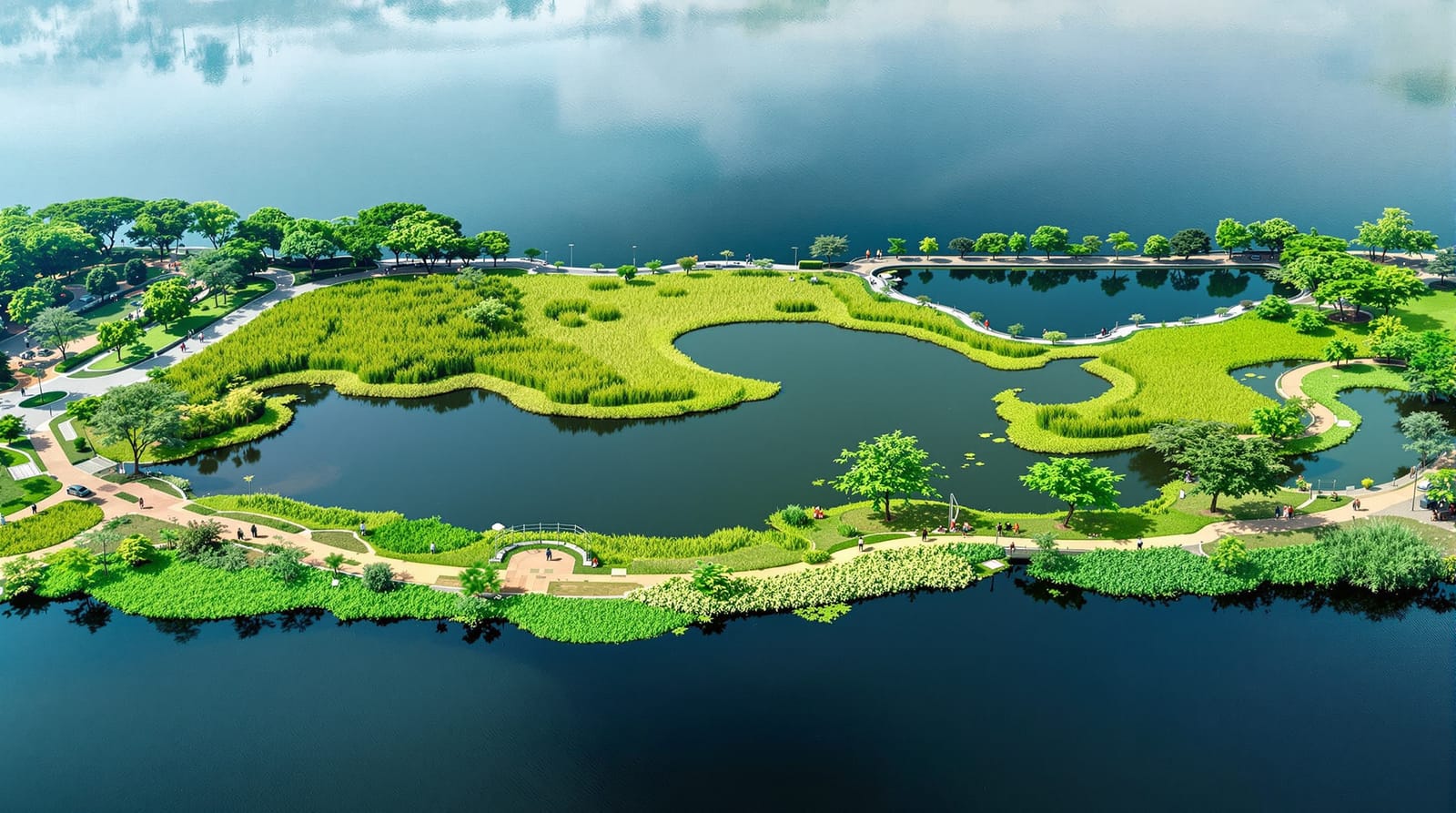
Blue-green infrastructure is the deliberate, connected network of water bodies and vegetation — lakes, wetlands, channels, parks, tree corridors — engineered to deliver the same services as pipes and concrete, except it works with water rather than fighting it. Where grey infrastructure rushes stormwater away through drains, blue-green infrastructure (BGI) slows it, soaks it, stores it and lets it cool, clean and recharge the city along the way. For Indian cities lurching between June floods and April taps running dry, it is less a green nicety than a survival strategy.
This is an explainer of BGI as a physical asset typology — the things you build and connect on the ground. It is the sibling of, but not the same as, Water Sensitive Urban Design: WSUD is the design philosophy and process — the way of thinking and planning. BGI is the network of physical assets that philosophy produces. Think of WSUD as the doctrine and BGI as the army it fields.
What blue-green infrastructure actually is
BGI has two halves that only work together.
The blue is water in all its urban forms: lakes and traditional tanks, constructed and natural wetlands, rivers and restored streams, swales and channels, retention and detention ponds, floodplains. The green is living vegetation working as infrastructure: urban forests, street-tree corridors, parks, green roofs and walls, riparian buffers, planted swales.
The single most important word is network. A pond here and a park there are pleasant patches, but they are not infrastructure. BGI delivers services only when these assets are connected — when a rooftop drains to a bioswale that feeds a rain garden that overflows to a wetland that buffers a restored lake, which in turn recharges the aquifer and cools the neighbourhood. Connectivity lets water, species and air move through the city. A fragmented pond is a puddle; a connected one is a flood-control device, a heat sink, a habitat corridor and a recharge well at once.
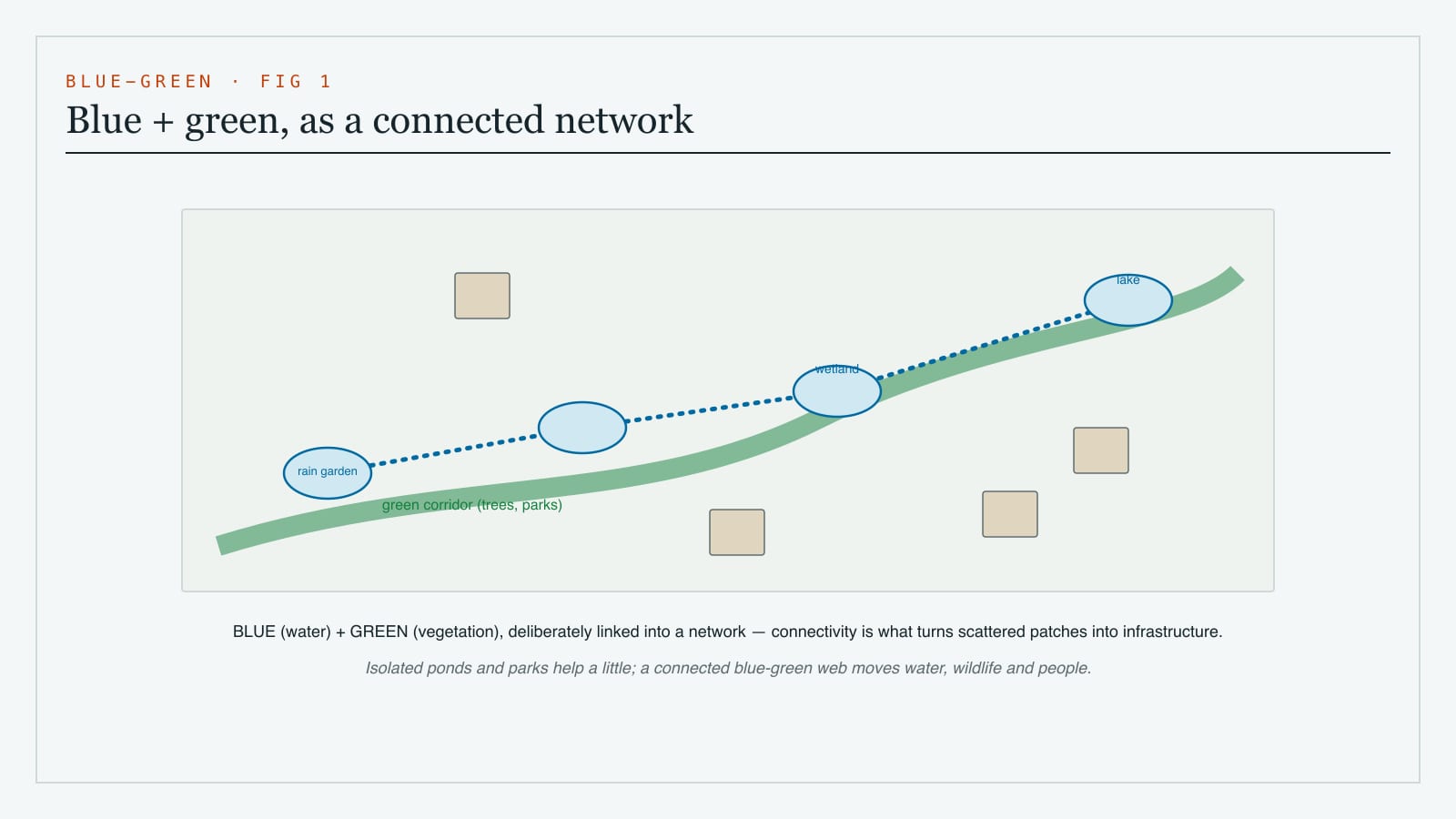
This is why BGI is usually planned at neighbourhood, ward or city scale, not plot by plot — though plot-scale moves like rainwater harvesting and rain gardens are the capillaries that feed the larger system.
Grey versus blue-green: the paradigm shift
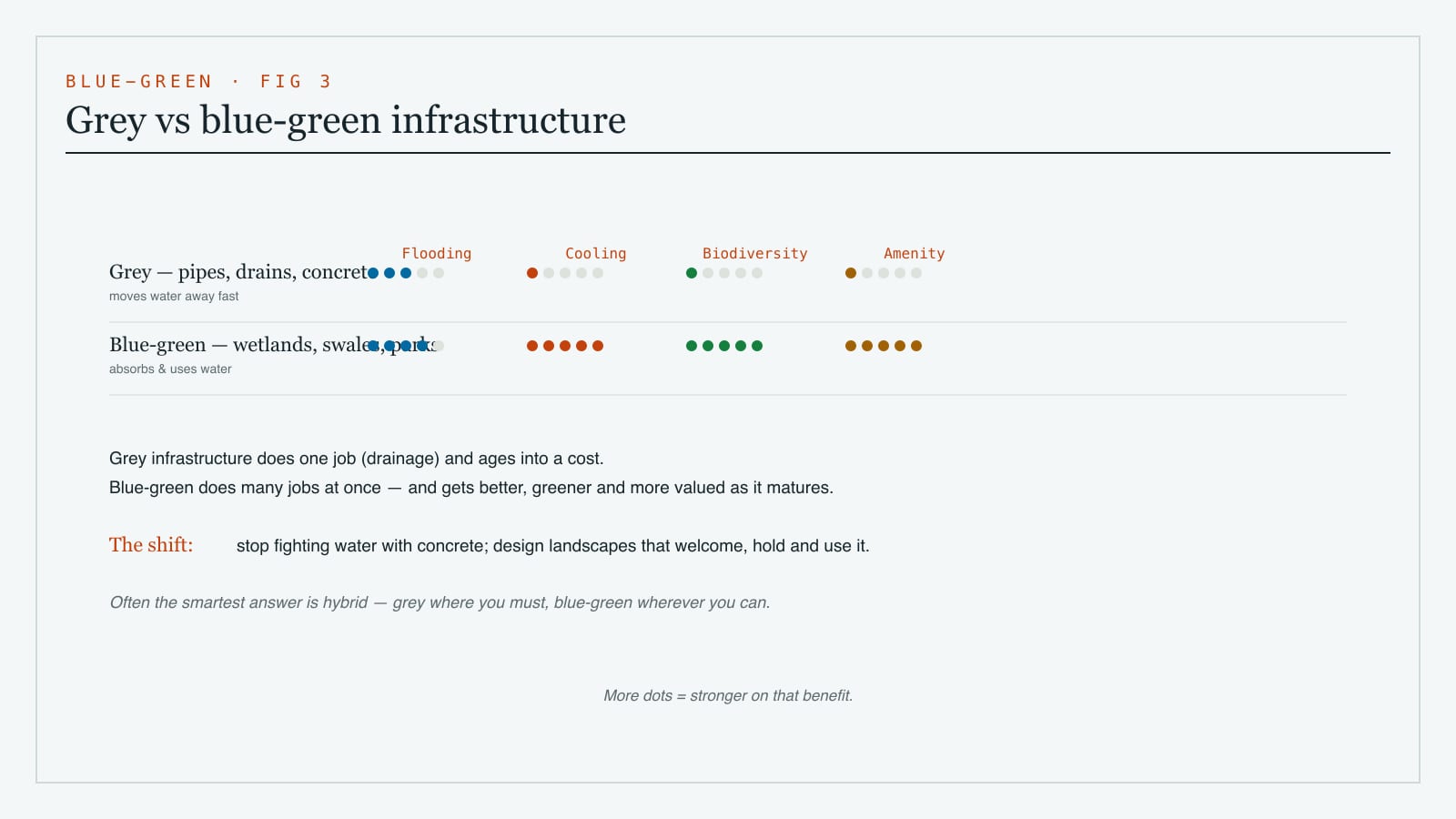
Twentieth-century Indian city engineering was almost entirely grey: kerbed roads, sealed surfaces, underground storm drains and concrete nalas built to a single objective — get the water out, fast. It is a logic of resistance and removal. It works until it doesn't: drains size for a storm of the past, the city paves over its sponges, and the same channel that evacuates water in a 50 mm shower becomes a firehose pointed at downstream colonies in a 200 mm cloudburst.
Blue-green infrastructure inverts the logic to absorption and reuse. Instead of moving water away as a waste, it treats every drop as an asset to be slowed, infiltrated, stored and cooled by. The two are not enemies — mature cities use hybrid systems, with grey drains as the backbone and blue-green assets cutting the peak load the pipes must carry. But the centre of gravity shifts decisively.
| Dimension | Grey infrastructure | Blue-green infrastructure |
|---|---|---|
| Core logic | Resist and remove water fast | Absorb, slow, store and reuse |
| Flooding | Capacity fixed; fails hard when exceeded | Distributed storage; degrades gracefully |
| Urban heat | Concrete radiates heat; worsens UHI | Water + shade actively cool the air |
| Groundwater | Sealed surfaces stop recharge | Infiltration recharges aquifers |
| Biodiversity | Sterile; barriers to movement | Habitat and corridors for species |
| Water quality | Discharges pollutants downstream | Wetlands/soils filter and treat |
| Amenity | None; often fenced and ugly | Parks, lakes, walkability, value |
| Lifecycle cost | High capital; rigid; ages to liability | Lower capital; appreciates if maintained |
| Failure mode | Catastrophic, concentrated | Gradual, distributed |
The honest caveats: blue-green assets need land, they need ongoing maintenance, and they perform within a design storm — they reduce flood risk, they do not abolish it. A well-run hybrid system, not green purism, is the realistic Indian target.
The typologies — the kit of parts
BGI is assembled from a recognisable palette of asset types. Each does several jobs at once, but each has a signature service.
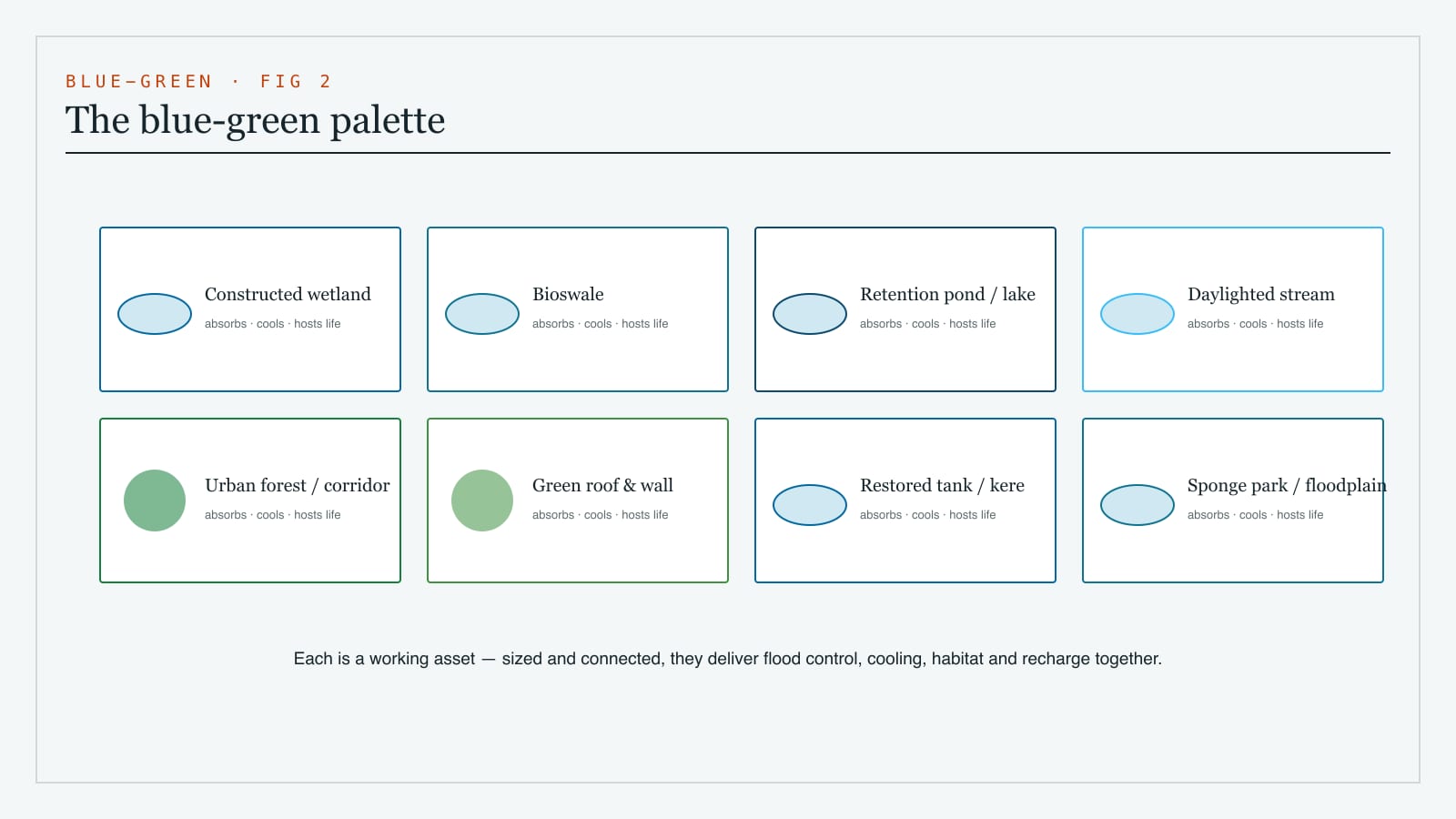
- Constructed wetlands — engineered shallow basins planted with reeds and rushes (Typha, Phragmites, Canna, water canna, Colocasia) that filter stormwater and treated sewage. India's flagship case is the East Kolkata Wetlands, which naturally treat much of the city's wastewater while supporting fisheries — a Ramsar site doing the work of a sewage-treatment plant.
- Bioswales and vegetated channels — gently sloped, planted ditches that convey and clean runoff instead of a concrete drain. Ideal along roads, parking edges and campus spines.
- Retention and detention ponds — retention ponds hold a permanent pool; detention ponds stay dry between storms and only fill to buffer the peak. The classic flood-attenuation workhorse.
- Daylighted and restored streams — uncovering culverted streams and rehabilitating choked nalas back into living, vegetated watercourses. Restoring riparian edges turns an open sewer back into a corridor.
- Urban forests and green corridors — Miyawaki and conventional plantings, avenue-tree networks and greenways that shade streets, scrub air and link habitats. (See Wildlife-Friendly Home Landscapes for the species and corridor logic at garden scale.)
- Green roofs and living walls — vegetated building skins that hold rooftop rain, insulate and cool. The retrofit-friendly typology for dense cities with no spare ground.
- Lakes, tanks and baolis — India's inheritance: temple tanks, eris, kere, baolis and stepwells that were once a continuous water-harvesting grid.
- Floodplains and sponge parks — multifunctional parks deliberately designed to flood. Dry, they are cricket grounds and lawns; in the monsoon, they become temporary lakes that spare the city.
| Typology | Primary service | Also delivers | Indian fit |
|---|---|---|---|
| Constructed wetland | Water treatment | Habitat, recharge | Sewage-stressed peri-urban edges |
| Bioswale | Convey + clean runoff | Recharge, greening | Roadsides, campuses, parking |
| Detention/retention pond | Flood attenuation | Amenity, recharge | New townships, SEZs |
| Daylighted stream | Drainage + ecology | Cooling, amenity | Choked urban nalas |
| Urban forest / corridor | Cooling + air + biodiversity | Carbon, health | Heat-island wards |
| Green roof / wall | Rooftop retention | Insulation, cooling | Dense, land-poor cores |
| Lake / tank revival | Storage + recharge | Amenity, culture | Bengaluru, Chennai, Telangana |
| Sponge park / floodplain | Peak flood storage | Recreation, biodiversity | Riverfront, low-lying land |
The multiple benefits — one asset, many services
The economic case for BGI rests on stacked ecosystem services: a single restored lake repays its cost across many ledgers a grey drain never touches.
- Flood resilience — distributed storage shaves the peak that overwhelms pipes; sponge parks and ponds buy the city time.
- Urban heat island cooling — open water and tree canopy can lower local air temperature by 2–5 °C, a real difference in a 44 °C Indian summer and a direct cut to cooling-energy bills.
- Air quality — tree canopies trap particulates, meaningful in cities where PM2.5 routinely breaches safe limits.
- Biodiversity — connected blue-green corridors restore habitat for birds, pollinators, amphibians and fish.
- Carbon — vegetation and wetland soils sequester carbon; wetlands are disproportionately effective stores.
- Groundwater recharge — infiltration refills aquifers, the single most decisive service for water-scarce Indian cities. This is the heart of Sustainable Water Management in the Landscape.
- Amenity and value — lakes, greenways and walkable parks lift wellbeing and property values; an attractive waterbody is the cheapest real-estate uplift a developer can buy.
- Health — accessible green-blue space measurably lowers stress and supports physical activity.
The Sponge City idea — and India's deeper roots
The most influential modern articulation of BGI is the Sponge City, championed by landscape architect Kongjian Yu and his firm Turenscape, and adopted as national policy in China from 2014. A sponge city is engineered to absorb, store, filter and reuse rainwater where it falls rather than channel it away — flagship projects like Yu's Yanweizhou Park in Jinhua flood by design and drain themselves. The doctrine: make peace with floods, give the river room, let the city breathe water.
India needs no import for this idea — it has been forgetting it. For centuries, the subcontinent ran on a sophisticated grid of tanks (eris in Tamil Nadu, kere in Karnataka, cheruvu in Telangana), temple tanks, baolis and stepwells — a chained, gravity-fed harvesting network that was blue-green infrastructure before the term existed. The modern flood lessons are tragically clear:
- Chennai, 2015 — catastrophic floods worsened by built-over wetlands, encroached eris and concretised drainage. The water had nowhere to go because its sponges had been paved.
- Bengaluru — once a city of interconnected lakes (kere) joined by channels; encroachment and sewage broke the chain, giving the city both floods and froth-spewing, fire-prone lakes (Bellandur, Varthur). Restoration of lakes such as Jakkur and Kaikondrahalli shows the network can be stitched back.
Policy is catching up. The Smart Cities Mission, AMRUT (Atal Mission for Rejuvenation and Urban Transformation) and AMRUT 2.0 now fund urban water-body rejuvenation, and the Amrit Sarovar mission targets the revival of thousands of ponds and tanks. The opportunity is less invention than re-connection — daylighting buried channels and re-linking surviving tanks into a working network.
Retrofit versus new build
New developments are where BGI is cheapest and cleanest: integrate ponds, swales and sponge parks into the master plan, set the drainage hierarchy from rooftop to wetland before a single road is kerbed, and protect natural low points as storage rather than selling them as plots. Greenfield townships, IT parks and SEZs have no excuse.
Retrofit is the harder, more important Indian reality — the floods happen in cities already built. Retrofit BGI means daylighting culverted streams, converting concrete nalas back to vegetated channels, restoring encroached lakes, greening roofs in dense cores where ground is gone, and threading bioswales into road-widening and parking projects. It is slower and contested, but it is where the lives are.
The real barriers — said plainly
BGI fails in India for institutional reasons more than technical ones.
- Land — assets need space in cities where every metre is contested and floodplains are the first land sold. Protecting low ground for storage fights the strongest commercial pressure there is.
- Maintenance — a neglected wetland becomes a foul, silted, mosquito-breeding liability. BGI must be designed with dense edge planting, fish (native Gambusia alternatives, larvivorous Aplocheilus), flushing flows and a funded maintenance contract — not as a one-time inauguration project. Dengue and malaria are honest risks of stagnant water done badly.
- Siloed agencies — water supply, sewerage, storm drainage, parks, lakes and roads sit in separate departments with separate budgets, so the connected network that BGI requires has no single owner. This fragmentation, more than any cost curve, is why Indian BGI stalls.
- Maintenance funding and skills — landscape-led hydrology is a young profession here; RWAs, municipalities and developers often lack the in-house capacity to operate living assets.
Done well — planned as a connected network, owned by an accountable agency, designed for monsoon and summer extremes, and maintained as seriously as a pumping station — blue-green infrastructure is the most cost-effective resilience an Indian city can buy. It is the working machinery behind the philosophy of Water Sensitive Urban Design, built one wetland, swale, rain garden and restored tank at a time.
References & further reading
- Central Ground Water Board (CGWB), Manual on Artificial Recharge of Ground Water — infiltration and recharge norms.
- Central Public Health and Environmental Engineering Organisation (CPHEEO), Manual on Storm Water Drainage Systems — Indian urban drainage standards.
- Ministry of Housing and Urban Affairs — Smart Cities Mission and AMRUT / AMRUT 2.0 programme documents on urban water-body rejuvenation.
- Kongjian Yu / Turenscape — published Sponge City projects and writings on landscape as living infrastructure.
- S. Vishwanath (Rainwater Club / Biome Environmental Solutions) — writing on Bengaluru's lakes, tanks and urban water.
- Ramsar Convention site information on the East Kolkata Wetlands — natural wastewater treatment case study.
Export this guide
Related Guides — Deep-dive reading
The Sponge City: How Kongjian Yu Taught China's Cities to Drink the Rain
Landscape architect Kongjian Yu and his firm Turenscape reframed the flood-prone city as a living sponge — a national programme, launched in 2013–14 across dozens of Chinese cities, that swaps concrete pipes for wetlands, rain gardens and terraces. A study of its ecological logic, its flagship parks, and the hard question of what a sponge can and cannot hold.
The Future of ArchitectureHow Buildings Can Give Back: Biodiversity and Environmental Health
How an Indian home and its plot can actively improve the ecology and environment around it, not just reduce harm
SustainabilityWhy Landscape Architecture Matters More Than the Building
How the green around, above and beyond your home out-cools, out-drains and out-appreciates the structure itself — at every scale from balcony to city.
LandscapeRelated Tools — Try Free
Rainwater Tank Sizer
How big should your rainwater tank be? Computes annual harvest, recommended tank capacity in litres, water-bill savings, and payback — for 10 Indian cities.
RWH CalculatorLandscape Cost Calculator
Estimate a garden's cost — hardscape, softscape, lawn, irrigation, lighting and annual upkeep — by area, tier and city.
Budget CalculatorBefore vs After — Cost Reality Check
Compare what you expected to pay vs what you actually paid, category by category.
Reality Check