
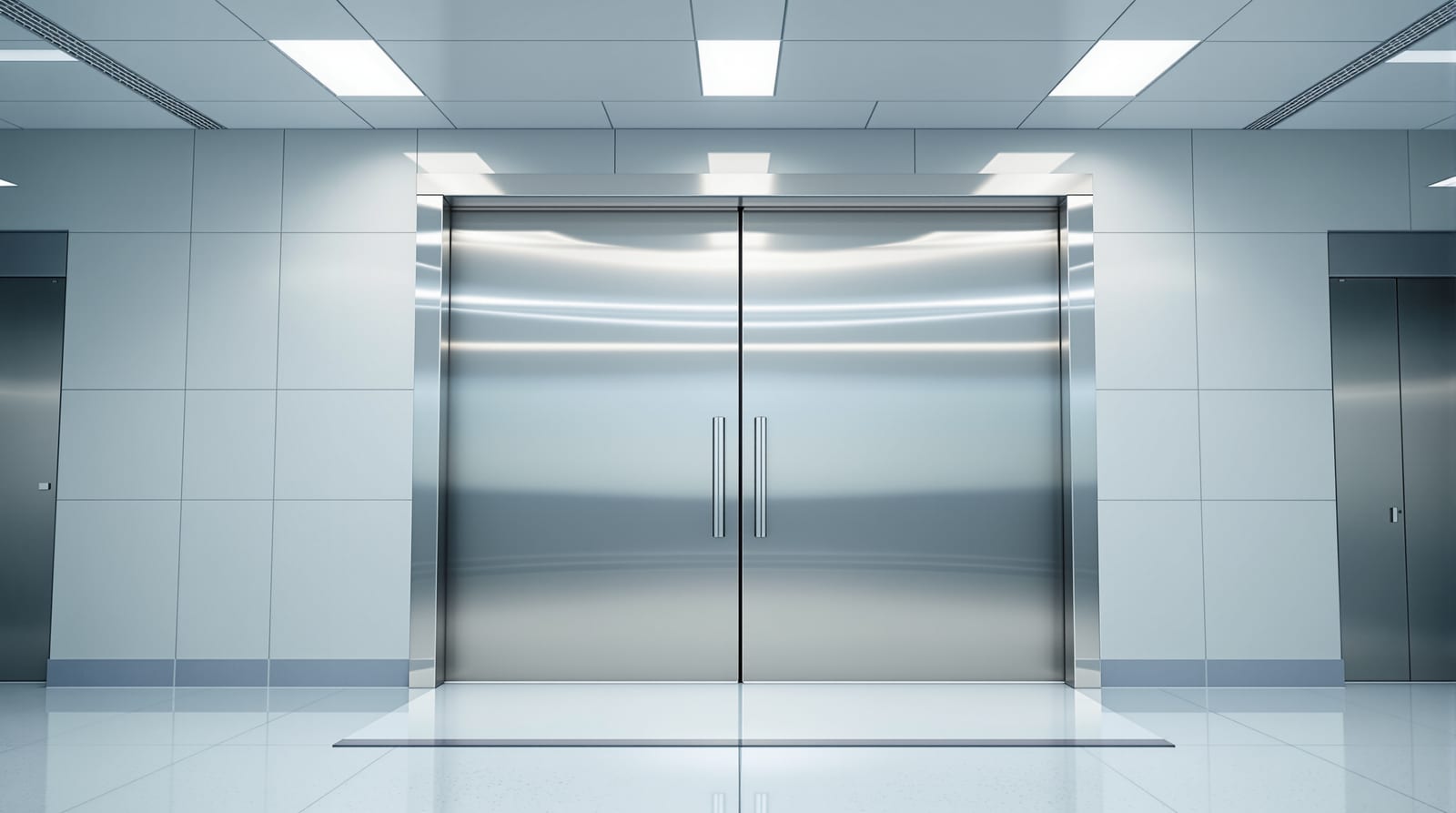
Hermetic Doors: Airtight OT Sliding Door Guide India 2026
Airtight automatic sliding doors that hold a pressure differential for OTs, IVF, ICU and isolation rooms — gaskets, drop seals and NABH context.
In a modern operation theatre the air is the patient's first line of defence — filtered, conditioned and held at a positive pressure so that nothing drifts inward when the door opens. Hermetic doors are the engineered full stop on that envelope: airtight automatic sliding leaves that, with a continuous perimeter gasket and an automatic bottom drop seal, can hold a measurable pressure differential between an OT and the corridor outside it. They are not architectural sliding doors with a nicer finish — they are pressure-control components, and in an NABH-accredited theatre or an IVF clean laboratory they are specified, sealed and tested as such. This guide covers how hermetic doors work, the standards that govern them in India, the spec language a facility manager should read, and realistic ₹ cost bands — always with the caveat that a hermetic door is project-engineered and the final spec comes from a vendor against your room pressure scheme.
What makes a door "hermetic"
The word means airtight. A hermetic door achieves that through three coordinated elements that an ordinary auto-slider lacks:
- A full-perimeter gasket — a compressible silicone or EPDM seal around the head and both jambs of the opening, so the closed leaf meets a continuous soft contact line rather than an air gap.
- An automatic bottom drop seal — a spring-loaded threshold seal hidden in the leaf that drops onto the floor as the door closes (and retracts as it opens), sealing the one edge a top-hung sliding leaf cannot otherwise close. This is the single component that separates a hermetic door from a hygienic auto-slider.
- A flush, gap-minimising leaf and frame — usually a flush hygienic stainless-steel (SS 304/316) face with no recesses, on an overlapping (telescopic-capable) sliding track that compresses the gaskets at the end of travel.
Together these let the closed door sustain a pressure differential — typically the +10 to +15 Pa positive pressure an OT is held at relative to the corridor, or the negative pressure an isolation room runs at. A door that merely slides shut over a brush seal cannot do this; air short-circuits under the leaf and the room loses its cascade.
Sliding, not swinging — and why
Hermetic doors are almost always automatic sliding (single-leaf or bi-parting telescopic). A swing door sweeps a large air volume and turbulence into a clean space every cycle and is awkward for gowned, gloved or trolley-bound traffic. A sliding leaf moves parallel to the wall, disturbs far less air, and clears a wide trolley opening. Touchless activation — wave sensor, foot sensor or elbow switch — keeps the staff's hands off the surface, which matters as much for asepsis as the seal itself.
Where hermetic doors are required
| Room type | Pressure regime | Why a hermetic door | Typical code/context |
|---|---|---|---|
| Operation theatre (OT) | Positive (+10 to +15 Pa) | Holds clean air in; protects sterile field | NABH, ISO 14644 (modular OT), HVAC scheme |
| IVF / ART laboratory | Positive, tightly controlled | VOC- and particle-free embryology air | ICMR/ART Act facility norms, ISO class |
| ICU / critical care | Often positive | Protects immunocompromised patients | NABH, hospital infection-control policy |
| Airborne-isolation room | Negative | Contains infectious aerosols (TB, etc.) | NABH, NCDC isolation guidance |
| Sterile pharmacy / CSSD sterile side | Positive, interlocked | Protects sterilised loads | Schedule M / WHO-GMP cascade |
Note the split: most clinical hermetic doors hold positive pressure to keep contamination out, while airborne-isolation doors hold negative pressure to keep contamination in. The hardware is similar but the pressure scheme — and which side the gasket is loaded from — is set by the room. For the application detail of theatre doors specifically, see operation theatre door; for the wider clinical context see hospital doors and isolation room doors.
Anatomy of a hermetic sliding door
The leaf itself is a flush hygienic panel — SS 304 for general OT, SS 316 where washdown chemicals are aggressive — with a flush-glazed vision panel (no protruding beads to trap dirt) and rounded or recessed pulls. Behind the head cover sits the automatic operator (a low-energy motor and controller) and the telescopic track. The gasket runs the head and both jambs; the drop seal closes the floor line. Crucially, the door operator drives the leaf into an overlap at end of travel so the gaskets actually compress — a hermetic door is only hermetic when shut and seated, not merely closed.
Touchless activation and hygiene
Activation should be hands-free: a microwave/PIR wave sensor, a hardwired foot or knee switch, or a contactless elbow plate. Many OT installations add a hold-open timer for trolley passage and a manual breakout for power failure. Surfaces are antimicrobial-coated or bare SS; there are no fabric or porous parts to harbour organisms. This is the same hygiene logic as a cleanroom door, pushed to the airtight extreme.
Interlocking and airlocks
Hermetic doors rarely work alone. An OT or IVF suite is usually entered through an interlocked airlock: two hermetic doors with an electronic interlock so both cannot open at once, preserving the pressure cascade as people and trolleys pass. The interlock is wired through the building management system and typically includes an override for emergencies. When you specify hermetic doors for a sterile suite, specify the interlock logic and the override at the same time — retrofitting it is painful. For the broader pharma equivalent, the same interlocked-airlock thinking applies to pharma cleanroom doors.
Standards and approvals in India
There is no single "hermetic door IS code"; the door is governed by the room it serves:
- NABH accreditation standards set the infection-control and OT-environment expectations a hospital must meet; hermetic doors are how the door opening complies with the OT's pressure and asepsis requirements.
- ISO 14644 (cleanroom classification) and the modular-OT specifications that reference it define the cleanliness class the door must help maintain.
- HVAC design — the room's supply, return and pressure-cascade scheme — dictates the differential the door must hold; the door spec follows the HVAC consultant's pressure map, not the other way round.
- For IVF/ART facilities, the ART (Regulation) Act facility norms and ICMR guidance frame the laboratory environment.
- Negative-pressure isolation follows NABH and NCDC isolation guidance.
Because compliance is room-led, treat the hermetic door as one line item in an integrated modular-OT or cleanroom package and make the vendor demonstrate the door holds the specified differential. A door that passes a leakage check in isolation but defeats the room's cascade has failed.
Cost bands in India (2026)
Hermetic doors are custom, low-volume products; prices vary with size, SS grade, glass, operator brand and whether interlocking is included. Treat the figures below as rule-of-thumb supply bands, and confirm against a written vendor quote.
| Configuration | Typical opening | Indicative band (supply) | Notes |
|---|---|---|---|
| Manual hermetic sliding, SS 304 | Single leaf ~1.0–1.2 m | ₹60,000–1,20,000 | Entry level; gasket + drop seal, hand-operated |
| Automatic hermetic sliding, SS 304 | Single leaf | ₹1,20,000–2,50,000 | Touchless operator + drop seal |
| Automatic telescopic / bi-parting, SS 316 | Wide trolley opening | ₹2,50,000–4,50,000+ | OT/IVF grade, wide clear opening |
| Interlocked airlock pair (2 doors + interlock) | Two openings | ₹4,00,000–8,00,000+ | Includes interlock logic + BMS wiring |
Add 18% GST. Quotes are typically supply-only unless stated; installation, the flush wall interface, sensors, BMS integration and commissioning are extra and material. Lead times of 6–12 weeks are normal because each leaf is built to opening. For project-level budgeting across door types, see specialty door cost, and model your own figure with the specialty door cost estimator or the door cost calculator.
How hermetic compares to its near neighbours
| Door | Seals the floor? | Holds pressure differential? | Typical use |
|---|---|---|---|
| Standard automatic slider | No | No | General hospital corridors |
| Hygienic cleanroom door | Partial (gaskets) | Marginal | GMP rooms without strict cascade |
| Hermetic door | Yes (drop seal) | Yes | OT, IVF, ICU, isolation |
| FRP/flush swing OT door | Sometimes (drop seal) | Limited (swing turbulence) | Lower-class theatres |
The deciding question is simple: does the room run on a pressure cascade you must not break? If yes, a hygienic-looking auto-slider is not enough — you need the drop seal and the end-of-travel gasket compression that define a hermetic door. If the room has no cascade, a flush hygienic door from the hospital doors family may be the right, cheaper answer.
Within the specialty family, hermetic doors sit alongside other pressure- and hygiene-critical types — see the specialty doors overview and the master complete door guide for where they fit in the full picture.
Frequently asked questions
What is the difference between a hermetic door and a hygienic auto-slider?
Both have flush, easy-clean SS faces, but a hermetic door adds a full-perimeter gasket and an automatic bottom drop seal, and the operator drives the leaf into an overlap so the gaskets compress at the end of travel. That combination lets it hold a pressure differential; a plain hygienic slider leaks air under the leaf and cannot maintain a cascade.
Are hermetic doors mandatory for an operation theatre in India?
No single code names "hermetic doors" as mandatory, but NABH-accredited and modular OTs are designed around a positive-pressure cascade and ISO 14644 cleanliness, and a hermetic door is the practical way the door opening meets those requirements. The room's HVAC and accreditation scheme effectively drive the need; confirm with your hospital's infection-control and HVAC consultants.
Can a hermetic door run on negative pressure for an isolation room?
Yes. The same hardware — gaskets plus drop seal — is used on airborne-isolation rooms that run at negative pressure to contain infectious aerosols, per NABH and NCDC isolation guidance. The door spec must state the direction and magnitude of the differential, because that sets how the gaskets are loaded.
How much does a hermetic OT door cost in India?
As a rule of thumb, manual hermetic sliders start around ₹60,000–1,20,000 (supply), automatic SS 304 around ₹1,20,000–2,50,000, and SS 316 telescopic OT/IVF doors ₹2,50,000–4,50,000 or more, plus 18% GST. Interlocked airlock pairs run higher. These are supply bands — installation, sensors, BMS wiring and commissioning are extra. Get a written vendor quote against your opening.
Do hermetic doors need to be interlocked?
For OT, IVF and sterile suites they almost always enter through an interlocked airlock so both doors of the pair cannot open simultaneously, preserving the pressure cascade during passage. Specify the interlock logic, the BMS integration and the emergency override at the design stage — retrofitting an interlock to installed hermetic doors is difficult and costly.
What maintenance do hermetic doors need?
The wear items are the perimeter gaskets and the drop seal, which lose compression over time and must be inspected and replaced on schedule, plus the operator, sensors and interlock checked periodically. Because a degraded seal silently defeats the room's pressure cascade, hermetic doors should be on a planned AMC and periodically leak-checked against the specified differential, not just "opened and closed to confirm they work."
Export this guide
Related Guides — Deep-dive reading
Pharma Cleanroom Doors: GMP Flush Door Guide India 2026
Specifier's guide to flush GI/SS304 cleanroom doors, double vision panels, full gaskets, interlocked airlocks and Schedule M / ISO 14644 compliance.
Home Doors & EntrancesHospital Doors in India: The Right Door for Every Zone (2026)
A clinical, zone-by-zone guide to specifying doors for an Indian hospital - patient wards, the operation theatre, ICU, corridors, isolation, toilets, labs and fire exits - ranked for hygiene, stretcher clearance, hands-free use and NABH compliance, with indicative per-door costs.
Home Doors & EntrancesIsolation Room Doors: Negative & Positive Pressure India 2026
Sealed self-closing doors and anteroom pairs for negative-pressure AIIR and positive-pressure protective isolation rooms in Indian hospitals.
Home Doors & EntrancesRelated Tools — Try Free
Acoustic Privacy (STC) Visualizer
Indian healthcare acoustic visualizer — compare wall assemblies and noise sources, see received SPL after STC attenuation, and check FGI 2018 / IS 1950 / NABH speech-privacy compliance with live dual-canvas waveform.
Acoustic ToolDoor Cost Calculator
Estimate the all-in cost of a door — leaf, frame, hardware, fitting and GST — by type, material and size.
Door CalculatorHealing View Impact Calculator
Evidence-Based Design dashboard quantifying the recovery impact of nature view + daylight factor on analgesic use, length of stay, and HCAHPS patient-experience uplift. Calibrated against Ulrich 1984 (Science), Park & Mattson 2008, and the CHD EBD evidence base.
EBD Calculator