
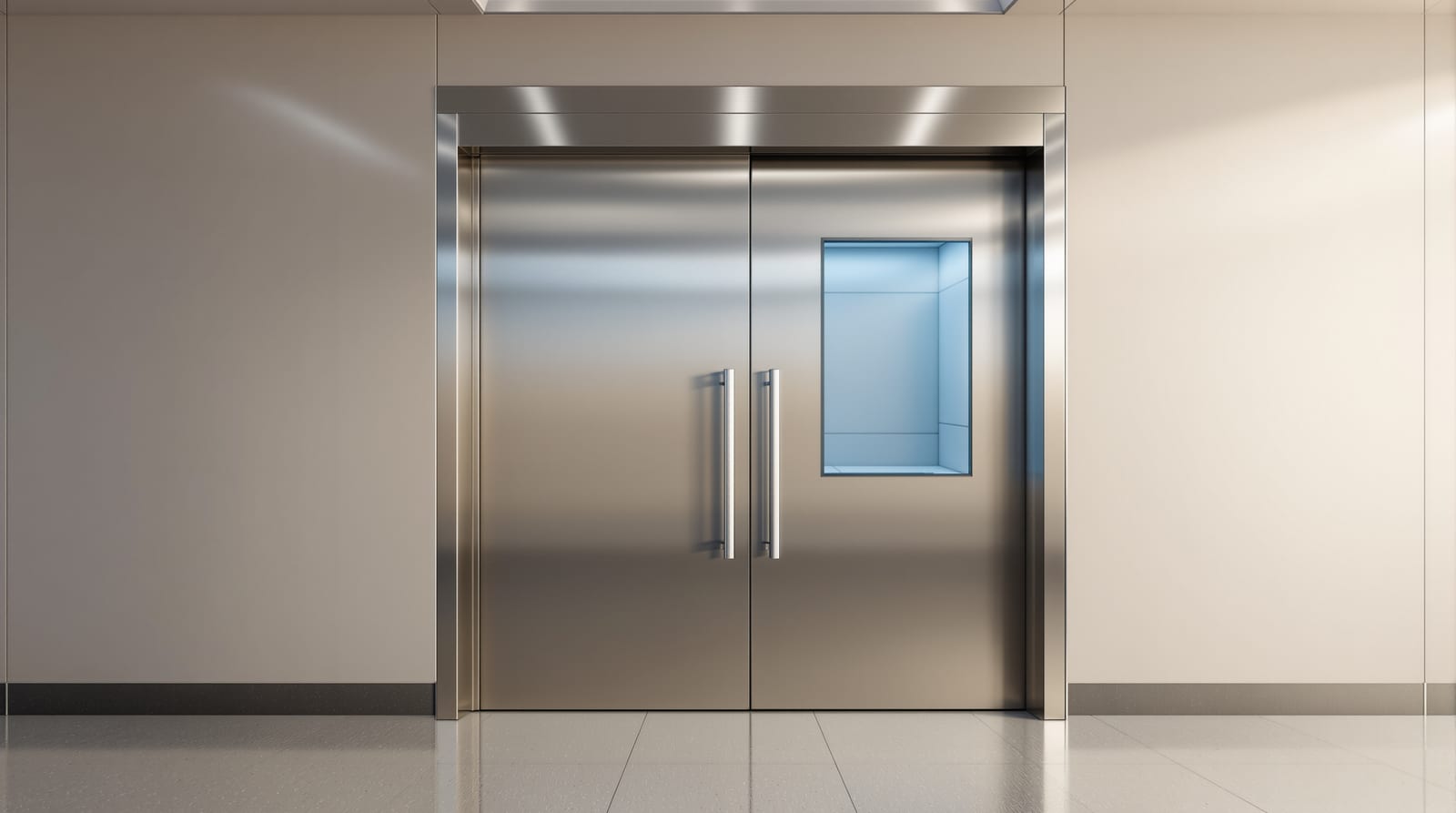
Operation Theatre Door in India: Hermetic, Hands-Free and Lead-Lined (2026)
How to specify the door for an operation theatre in India - a hermetically-sealed automatic sliding door that holds OT positive pressure, opens hands-free for sterility, can be lead-lined for imaging, and sits flush for cleanability - with indicative rupee costs and NABH/IS references.
The operation theatre door is the most specialised door in any Indian building. It is not joinery and it is barely even a "door" in the everyday sense - it is a moving wall that seals an air-conditioned, positively-pressured sterile box, opens without a single touch, and in a hybrid theatre can stop X-rays as well. Every demand piles onto one leaf at once: airtight pressure sealing so asepsis holds, touch-free operation so nobody contaminates a scrubbed hand, a face you can wash down a hundred times a day, width for a C-arm or a loaded OT table, and - in imaging theatres - lead inside the panel. This guide tells you exactly how to specify an operation theatre door in India, the seal, the drive, the surface and the shielding, with indicative rupee costs and the NABH and IS references to write into your schedule.
What an operation theatre door actually has to do
Treat the OT door as six overlapping requirements, ranked by what protects the patient most directly. Looks genuinely do come last here - this is pure performance.
1. Seal the pressure and the airflow. A modular OT runs at positive pressure relative to the corridor (typically a few pascals up) with HEPA-filtered laminar flow over the table. The door is part of the room envelope: when shut it must be near airtight via a compression gasket so the pressure cascade and clean airflow are not lost every time someone enters. A leaky door lets corridor air, dust and microbes wash in.
2. Open hands-free for sterility. A scrubbed surgeon or nurse cannot touch a handle. The door must open on an elbow switch, a foot sensor, a hand-wave/no-touch sensor or a remote, so nobody breaks scrub to move it. This is the single biggest reason an OT uses an automatic door rather than a swing door.
3. Wipe down and stay decontaminable. The face has to take repeated cleaning and disinfection. Specify a flush, gap-free, antibacterial finish - stainless steel (SS 304) or a hygienic high-pressure laminate (HPL) / compact panel - with rounded edges, no exposed fasteners and a flush threshold so there is nowhere for bio-burden to collect.
4. Pass equipment and the patient. OT tables, anaesthesia carts, C-arms and microscopes are wide. The clear opening is usually 1200-1500 mm or more, which is why OT doors are wide single-leaf sliders or telescopic 1.5/2-leaf sliders.
5. Shield radiation where imaging happens. A hybrid OT or a theatre with fixed/mobile imaging needs the door lead-lined to the same lead-equivalence as the surrounding walls so the door is not a radiation leak in the shielded boundary.
6. Fail safe and stay code-compliant. On power failure the door must be openable by hand for egress, and the OT complex still needs a compliant fire and escape strategy for the suite around it.
Why a hermetic automatic slider, not a swing door
For almost every OT in India the right answer is a hermetically-sealed automatic sliding door rather than a hinged swing door. A swing door sweeps a large arc through a tight sterile zone, disturbs the laminar airflow as it moves, is hard to seal airtight, and cannot be opened without a push. A sealed slider glides flush along the wall, compresses onto its gasket when shut for a near-airtight pressure seal, opens hands-free on a sensor, and takes a wide clear opening for equipment. It is the same family of door used for cleanrooms - see the deeper mechanics in cleanroom doors in India and the drive itself in automatic sliding doors in India. The OT version simply adds the strictest sealing, the hands-free triggers, the medical-grade surface and, optionally, lead.
The recommended specification
Here is what to write into the OT door schedule for a standard modular theatre.
Door type and drive. A surface- or in-wall hermetic sliding leaf on a sealed, low-maintenance electromechanical operator with a quiet brushless motor. The leaf drops and compresses onto a continuous perimeter gasket at the end of travel to make the closed door near-airtight. The operator logic should hold the door shut to maintain pressure and reopen only on a deliberate trigger. The underlying drive is the same family covered in automatic sliding doors in India.
Seal. A continuous inflatable or compression gasket around the full perimeter plus a sealed bottom (drop seal or flush brush-plus-gasket) so there is no floor gap. This near-airtight closure is what preserves the OT pressure cascade and laminar flow. Test the closed leakage as part of OT validation.
Hands-free triggers. At least two of: an elbow / press-plate switch on each side, a foot sensor, a no-touch hand-wave sensor, and a remote/automation input so the door can be opened from the control panel. No conventional lever handle on the clean side.
Surface and form. SS 304 or hygienic HPL/compact face, flush and gap-free, with rounded edges, concealed fixings, no protruding hardware and a flush (level) threshold for cleanability and for rolling equipment. Match the finish to the modular OT panelling so the whole wall wipes down as one surface.
Vision window. A flush, double-glazed sealed vision panel set into the leaf so staff can see in/out without opening the door - useful for coordination and to avoid unnecessary cycles that dump pressure. The glazing must be flush and sealed, not a recessed pane that traps dirt.
Width / leaf count. A single wide slider for a clear opening around 1200-1400 mm; a telescopic (2-leaf) slider where you need 1500 mm+ in a constrained wall. This stretcher/equipment width aligns with the wider hospital logic in hospital room door in India.
Lead lining (imaging / hybrid OT only). For a hybrid theatre or any OT with fixed or significant mobile imaging, specify the leaf (and the vision glass) lead-lined to the lead-equivalence (e.g. 1.5-2 mm Pb, per the RSO's shielding calculation) so the door matches the shielded wall. The operator must be sized for the extra leaf mass.
Power-fail / manual override. On power loss the leaf must be hand-openable for egress and emergency access, with a clear break-out or manual-slide function and a battery backup option for controlled closing.
Inline plan: a hermetic, hands-free OT door
Cost: what an operation theatre door runs in India
Indicative, per door, 2026, including the operator, gasket seal, hands-free triggers and a flush vision panel where noted; add about 18% GST. Lead lining, validation and the surrounding modular OT panelling are separate line items. Costs vary widely by size, brand, lead-equivalence and city.
| Door / scope | Type | Indicative cost (₹ per door) | Why this price |
|---|---|---|---|
| Hermetic auto-slider, single leaf, SS 304 | Standard modular OT | 2,50,000 - 5,00,000 | Sealed operator + full gasket + hands-free + vision panel |
| Hermetic auto-slider, telescopic 2-leaf | Wide / constrained-wall OT | 4,00,000 - 8,00,000 | Twin leaves, telescopic gear, wider clear opening |
| Lead-lined hermetic auto-slider | Hybrid / imaging OT | 6,00,000 - 14,00,000+ | Pb-lined leaf + Pb vision glass, heavier operator, shielding cert |
| Manual hermetic slider (non-auto) | Budget / pre-op, recovery edge | 80,000 - 1,80,000 | Sealed leaf + gasket, no operator - acceptable only off the sterile core |
| OT door validation / leakage test (per door) | n/a | Project line item | Part of OT commissioning / NABH validation |
A standard SS hermetic OT door is far costlier than any ordinary hospital door - the seal, the operator and the medical-grade leaf are what you are paying for. For the wider ward-side comparison see hospital doors in India.
How it compares to other hospital doors
| Requirement | General ward / corridor door | Operation theatre door |
|---|---|---|
| Type | Often swing or manual slider | Hermetic automatic sliding |
| Pressure / air seal | Not required | Near-airtight compression gasket (holds OT pressure) |
| Operation | Push/pull, lever | Hands-free - elbow / foot / no-touch / remote |
| Surface | Antibacterial laminate / SS | Flush SS 304 or HPL, gap-free, rounded, flush threshold |
| Width (clear) | 1000-1200 mm (stretcher) | 1200-1500 mm+ for OT table / C-arm |
| Radiation shielding | None | Lead-lined for hybrid / imaging OT |
| Vision panel | Common | Flush sealed window to cut needless cycles |
| Power-fail | n/a | Manual override / break-out for egress |
For the general patient-room version of these demands, see hospital room door in India; for the building-wide which-door-where logic, doors by space in India.
Standards and references to quote in your schedule
- NABH accreditation standards - the OT is the most scrutinised space in a NABH audit; the door is part of the infection-control, asepsis and OT-validation evidence (pressure cascade, air changes, cleanability). Build the door spec to support OT validation from day one.
- ISO 14644 (cleanroom air cleanliness, applied to OT classification) - the door must help maintain the OT's air-class and pressure cascade; treat the closed leaf as part of the room's enclosure integrity. The cleanroom door logic is in cleanroom doors in India.
- AERB / radiation shielding (for imaging OTs) - the radiological safety officer's shielding plan sets the lead-equivalence; the door and its vision glass must match the wall so the shielded boundary is unbroken.
- NBC 2016 + RPwD 2021 - the OT suite still needs a compliant fire and egress strategy and accessible clear widths (>=900 mm) on the staff/patient routes around the sterile core; the OT door's flush threshold (<=12 mm) suits both hygiene and accessibility.
- HVAC / OT engineering practice (positive pressure, HEPA laminar flow) - design the door seal to the room's pressure and air-change targets; a leaky door fails the whole validation.
For the fire strategy of the surrounding suite, see fire-rated doors in India.
Do and don't
Do specify the gasket seal and the hands-free triggers in the same line as the door - a sealed leaf you have to push is not an OT door. Do match the leaf finish to the modular OT panels so the wall wipes as one surface. Do size the clear opening for the largest equipment the theatre will ever take (C-arm, hybrid imaging, microscope). Do confirm the manual power-fail override before you sign off. Do get the RSO's lead-equivalence in writing before ordering a hybrid-OT door.
Don't re-purpose a swing door or an ordinary auto-slider as an OT door - it will not hold pressure, will disturb the laminar flow and is hard to clean. Don't leave a floor gap; the threshold is the commonest leak path for the pressure cascade. Don't add a recessed vision pane that traps bio-burden - use a flush sealed window. Don't forget the door in the OT validation scope; its leakage is part of the room's enclosure integrity. Don't order a lead-lined leaf on a standard operator - the extra mass needs a sized drive.
For the bigger hospital picture this door sits inside, see hospital doors in India. To shortlist the right door for any clinical space fast, use the hospital-door-selector tool at /utilities/hospital-door-selector.
Frequently asked questions
Why does an operation theatre door have to be hermetically sealed?
A modular OT is held at positive pressure with HEPA-filtered laminar airflow so that air - and the microbes in it - flows out of the sterile field, never in. The door is part of that sealed envelope. If it is not near-airtight when shut, the pressure cascade and clean airflow break down every time it is closed, corridor air leaks in, and the asepsis the whole theatre is built around is compromised. A continuous compression gasket on a sliding leaf is what keeps the room sealed.
Why is the OT door hands-free?
Surgeons and scrub nurses cannot touch a handle without breaking sterility. A hands-free door - opened by an elbow switch, a foot sensor, a no-touch hand-wave sensor or a remote from the control panel - lets a scrubbed person move through without contaminating their hands or the door. This is the core reason an OT uses an automatic sliding door rather than a push/pull swing door. See automatic sliding doors in India.
When does an OT door need to be lead-lined?
When the theatre does imaging - a hybrid OT with a fixed angiography/CT system, or any OT using significant mobile imaging like a C-arm. The radiological safety officer calculates the required lead-equivalence (commonly around 1.5-2 mm Pb) for the walls, and the door plus its vision glass must match so the shielded boundary has no gap. A standard OT with no imaging does not need lead.
What clear width should an operation theatre door be?
Wide enough for the OT table, anaesthesia cart, C-arm and microscope to pass with the patient - typically a clear opening of 1200-1500 mm or more. Where the wall is too narrow for a single leaf that wide, use a telescopic 2-leaf slider to get the opening without needing a long wall pocket. This is wider than a general ward door; the stretcher-width logic is covered in hospital room door in India.
What happens to the OT door in a power cut?
It must be openable by hand. A compliant OT door has a manual override - a break-out or manual-slide function - so staff and the patient can get out and emergency teams can get in if power and backup fail. A battery backup can also let the operator close the door under control. Confirm the power-fail behaviour during commissioning as part of the OT validation, and check the suite's wider escape route against fire-rated doors in India.
Export this guide
Related Guides — Deep-dive reading
Hospital Doors in India: The Right Door for Every Zone (2026)
A clinical, zone-by-zone guide to specifying doors for an Indian hospital - patient wards, the operation theatre, ICU, corridors, isolation, toilets, labs and fire exits - ranked for hygiene, stretcher clearance, hands-free use and NABH compliance, with indicative per-door costs.
Home Doors & EntrancesHospital Room Door in India: Patient-Ward & Stretcher Door Specification (2026)
How to specify the patient-room / ward door in an Indian hospital - a wide 1.5-leaf flush door with at least 1200 mm clear width for beds and stretchers, antibacterial wipe-clean face, a vision panel with integral blind, hands-free or lever hardware, kick and bumper plates, and fire compliance - with indicative per-door-set costs.
Home Doors & EntrancesAutomatic Swing Door Operators: Retrofit Guide India 2026
How to retrofit a normal hinged door to open by itself — full-energy vs low-energy operators, activation, safety and cost for Indian buildings.
Home Doors & EntrancesRelated Tools — Try Free
Window Cleaning Cost Calculator
Estimate professional window cleaning cost per visit and per year by access and frequency.
Window CalculatorAccessible Door Checker
Check a door against wheelchair-accessibility guidance — clear width, threshold, handle and closer force per RPwD 2021.
Compliance ToolAccess-Control Battery-Backup Calculator
Size the standby battery so an access system keeps running through a power cut, with an egress life-safety note.
Battery Backup