
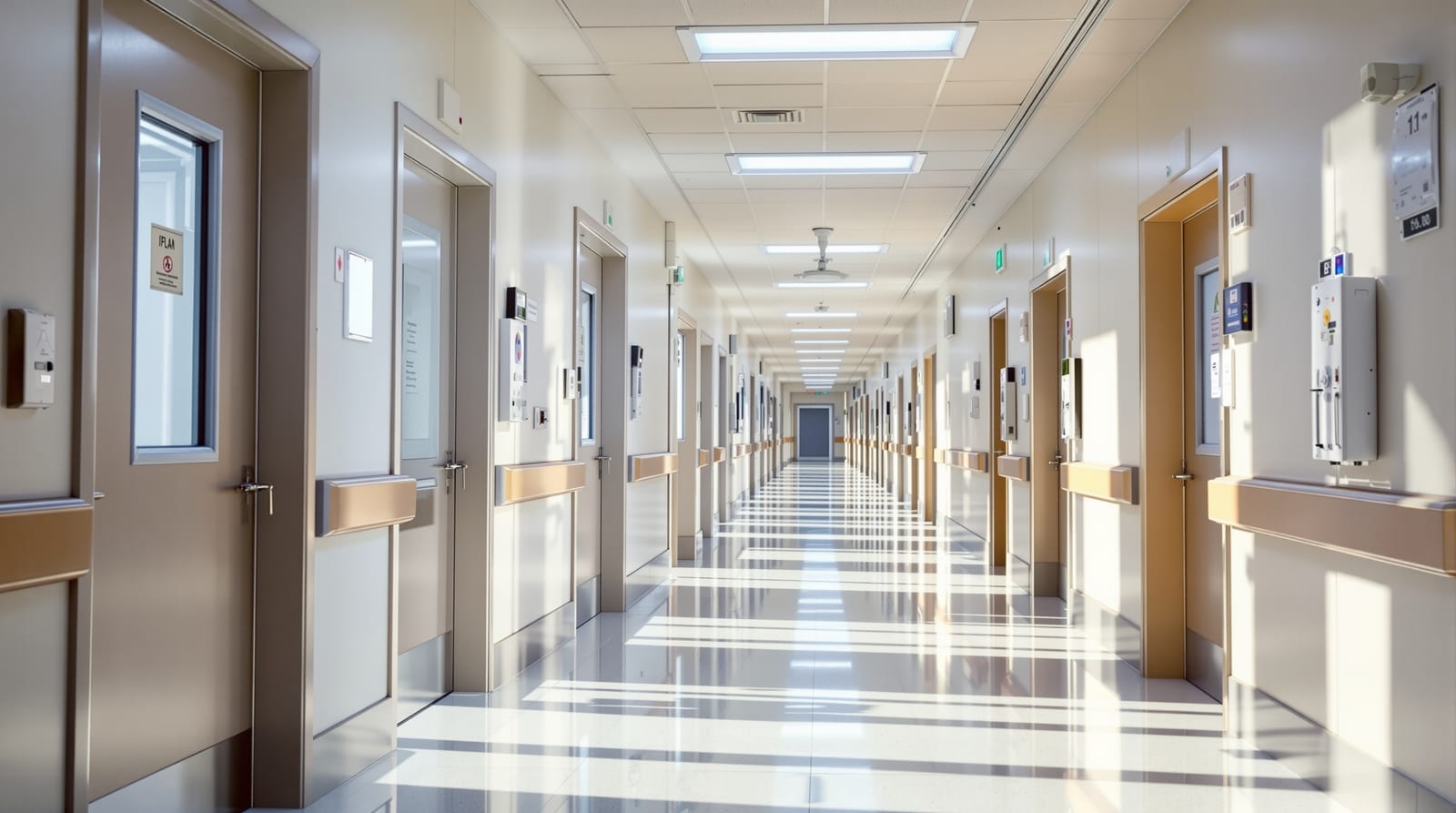
Hospital Doors in India: The Right Door for Every Zone (2026)
A clinical, zone-by-zone guide to specifying doors for an Indian hospital - patient wards, the operation theatre, ICU, corridors, isolation, toilets, labs and fire exits - ranked for hygiene, stretcher clearance, hands-free use and NABH compliance, with indicative per-door costs.
A hospital is the single most demanding door environment any architect will ever specify for. No other building asks one threshold to be hygienic enough to slow an infection, wide enough for a stretcher and crash trolley at a run, sealable enough to hold a positive-pressure operating field, tough enough to survive a decade of trolley strikes, and compliant with fire and NABH accreditation - all at once, and all without a single door scoring high on every count. The fatal mistake is treating a hospital like an office with more corridors: ordering one flush door specification for the whole building. The ward door, the operation-theatre door and the isolation-room door are not three finishes of the same product; they are different machines hinged - or, increasingly, slid - into different walls. This guide walks the hospital zone by zone and tells you which door belongs at each threshold, the clinical driver that decides it, the Indian codes and NABH conventions that govern it, and what each costs in 2026. For the wider logic of matching a door to its space, read the master overview on choosing a door by space; this is its most exacting application.
The six forces that shape every hospital door
Before the zones, the drivers. Every hospital door is decided by where it sits on these six demands, and the weighting changes completely from a ward to an operating theatre:
- Hygiene and infection control. The defining force. Surfaces must be non-porous, seamless and wipeable with hospital-grade disinfectant - antibacterial laminate, stainless steel or HPL - with no carved panels or fabric to harbour pathogens. Hands-free or foot-pull operation removes the handle as a contamination touchpoint in clinical zones.
- Clearance and width. Stretchers, crash carts, wheelchairs, bariatric beds and imaging trolleys all pass through these doors at speed. Patient-room and corridor doors need a clear width of at least 1200 mm, very often a leaf-and-a-half (uneven double) so the second leaf opens only when a bed must pass.
- Hands-free and assisted operation. Surgeons and nurses carry sterile trays and push beds; they cannot grip a knob. Automatic sliding, elbow-pads, foot-pulls, sensor or push-plate operation matter most in the OT, ICU and clean zones.
- Sealing and air control. Operating theatres run positive pressure to keep contaminated air out; isolation rooms run negative pressure to keep contaminated air in. Both need a door that seals on all four edges - hermetic sliding for the OT, gasket-sealed swing for isolation.
- Durability against impact. A casualty trolley driven into a door at 2 a.m. is a daily event. Bumper guards, kick plates, push plates, stainless edge protection and impact-resistant cores keep doors serviceable for years.
- Fire, egress and code. A hospital is a high-occupancy, low-mobility building - patients cannot self-evacuate quickly. Fire-rated assemblies on compartment lines and stairwells (IS 3614), NBC 2016 egress widths and NABH safety norms are non-negotiable, and radiology rooms add lead-lined shielding to the list.
No single door answers all six. The skill is reading each zone and specifying for its dominant force.
Hospital zones and the door each one needs
Read the hospital as a gradient of cleanliness and urgency. The general zone (wards, corridors, toilets, offices) is busy, public-ish and built for traffic and hygiene. The critical zone (ICU, recovery, labour) is access-controlled, hands-free and quietly sealed. The sterile core (operation theatres, CSSD) is the cleanroom - hermetic, sealed on every edge, hands-free without exception. Doors get wider, smoother, more sealed and more automated as you move inward. The table below maps the door to each zone.
| Zone | Recommended door | Primary clinical driver | Indicative ₹ (per door, 2026) |
|---|---|---|---|
| Patient ward / room | Wide flush leaf-and-a-half (1200+ mm), antibacterial HPL/laminate, vision panel, lever or hands-free | Hygiene + stretcher clearance | 14,000 - 35,000 |
| Operation theatre | Hermetic automatic sliding, sealed four edges, hands-free, lead-lined if imaging | Sterile field + air seal + hands-free | 1,80,000 - 6,00,000+ |
| ICU / HDU / recovery | Automatic sliding glazed, sensor or push-plate, antibacterial frame | Hands-free + monitoring visibility | 90,000 - 3,00,000 |
| Corridor / cross-junction | Double-swing impact, bumper guards, vision panels, 1200+ mm | Trolley flow + impact durability | 18,000 - 55,000 |
| Isolation / negative-pressure | Sealed gasket swing or auto-slide, four-edge seal, self-closing | Air containment + infection control | 45,000 - 1,50,000 |
| Radiology / X-ray / cath lab | Lead-lined sliding or swing (1.5-3 mm Pb), interlock, warning light | Radiation shielding + hands-free | 1,20,000 - 4,50,000 |
| Patient toilet / bathroom | Antibacterial PVC/WPC, outward-swing or sliding, 900 mm clear | Emergency access + wet-area hygiene | 4,000 - 14,000 |
| Lab / pharmacy / CSSD | Access-controlled flush or glazed, self-closing, vision panel | Access control + hygiene | 16,000 - 60,000 |
| Fire compartment / stairwell | IS 3614 fire-rated steel/timber, panic bar, self-closer | Egress + compartmentation | 18,000 - 55,000 |
Patient ward and room doors - hygiene meets the stretcher
This is the workhorse, and the one most often under-specified. A ward or patient-room door must let a hospital bed, a crash trolley and two nurses through in an emergency, then sit quietly being wiped down with disinfectant ten times a day. The answer is a wide flush door faced in antibacterial high-pressure laminate or HPL - seamless, non-porous, no carved panels to trap pathogens - sized at a 1200 mm clear opening or more. In practice that means a leaf-and-a-half: a primary leaf of about 900 mm for daily use and a narrow second leaf, normally bolted shut, that opens only when a bed must pass. A vision panel (wired or laminated safety glass) lets staff see in without opening the door and breaking the room's air balance. Hardware is a lever handle at minimum - never a knob, which a gloved or full hand cannot turn - and ideally a hands-free elbow plate or door closer tuned soft so it never slams on a patient's bed. For the dedicated specification, see the hospital patient-room door guide.
Operation theatre doors - the hardest door in the building
The OT door is in a class of its own. The theatre runs positive pressure so that air always flows outward, keeping airborne contamination away from the open surgical field; the door must seal on all four edges to hold that pressure, yet open hands-free in under three seconds when a surgeon's gloved hands are sterile. The standard answer is a hermetic automatic sliding door: a single or telescopic stainless-steel or HPL leaf with a perimeter inflatable or compression gasket, foot, elbow or sensor activation, and a tight return that re-seals every time. Where the theatre adjoins imaging - a hybrid OT or cath lab - the leaf is lead-lined (commonly 1.5-3 mm of lead) for radiation shielding, with an interlock and an over-door warning light. These are the most expensive doors in the hospital, running from roughly 1,80,000 to well over 6,00,000 per opening once automation, lead-lining and sealing are added. This guide only frames the choice; the full hermetic and lead-lined specification lives in the operation-theatre door guide. The drive mechanism is shared with the automatic sliding doors guide.
ICU, corridors and isolation - flow, seal and containment
The ICU and HDU sit between ward and theatre in demand. The preferred door is an automatic sliding glazed leaf - hands-free for staff carrying lines and monitors, with a glazed panel (often switchable privacy glass) so nurses can watch a critical patient without entering. Antibacterial frames and self-closing returns keep the unit clean and quiet.
Corridors are about traffic, not sterility. At nurse-station junctions and ward entries, double-swing impact doors take the daily beating of beds and trolleys driven through them from either side. Specify impact-resistant cores, full-height bumper guards or HPL impact rails, stainless kick plates and large vision panels so two trolleys do not collide head-on. Width again is 1200 mm or more so a bed and a person pass together.
Isolation rooms invert the OT logic: they run negative pressure so contaminated air is contained, never released into the corridor. The door must seal on all four edges with a gasket and threshold drop-seal, self-close reliably, and ideally pair with an anteroom airlock for the highest-risk infectious cases. A sealed swing or sealed auto-slide both work; the test is whether the room can hold its negative pressure with the door shut.
Toilets, labs and fire exits - the supporting cast
Patient toilets and bathrooms are wet, hygiene-critical and an emergency-access risk: a patient who collapses inside must be reachable. Specify an antibacterial PVC or WPC door - rot-proof in the wet zone, wipeable, cheap to replace - hung to swing outward or, better, to slide, so a fallen patient never blocks the leaf. Keep a 900 mm clear opening for wheelchair access and fit a lever handle; for the accessibility rules see the wheelchair-accessible doors guide.
Labs, pharmacy and CSSD need access control and hygiene rather than width. Self-closing flush or glazed doors with vision panels and electronic access logs suit them. For smaller OPD-scale and diagnostic settings, the clinic door guide covers the lighter version of the same logic.
Fire and escape doors are where hospital design is least forgiving, because patients cannot self-evacuate. Compartment lines and stairwells take IS 3614 fire-rated assemblies - steel or treated timber with intumescent seals - fitted with self-closers and, on exits, panic push bars that open in the direction of escape under a crowd. The fire strategy must never let the infection-control or security regime trap people inside. See the dedicated fire-rated doors guide for ratings and detailing.
Standards, codes and NABH
Hospital doors answer to a stack of Indian and accreditation norms. NBC 2016 sets egress widths by occupancy and mobility, requires escape doors to open in the direction of travel, and treats institutional buildings as a higher-care category. IS 3614 governs fire-rated door assemblies (30/60/90/120-minute ratings) for compartment and stairwell doors; IS 4351 covers steel frames and IS 1003 timber leaves where used. RPwD 2021 accessibility applies at patient-facing and public doors - clear width of at least 900 mm, lever handles, and thresholds no higher than 12 mm so a wheelchair or trolley does not jolt. Over all of this, NABH accreditation expects demonstrable infection-control surfaces, hands-free operation in clinical zones, vision panels for observation, and validated negative/positive pressure where required. Radiology rooms additionally follow AERB radiation-shielding requirements, which drive the lead-lining of imaging-room doors. Treat these as a combined checklist, not a menu - a door can pass the fire code and still fail NABH on hygiene.
Do and don't
- Do standardise on a clear opening of 1200 mm or more for all patient, corridor and critical-zone doors - the leaf-and-a-half pattern gives you everyday economy and emergency width.
- Do specify antibacterial, seamless surfaces - HPL, laminate or stainless - everywhere a patient or surgeon is treated; reject carved panels and any porous finish in clinical zones.
- Do go hands-free (auto-slide, foot-pull, elbow plate) in the OT, ICU and isolation zones where touching a handle breaks asepsis.
- Don't reuse one flush-door spec for the whole hospital - the OT and the office store cannot share a door.
- Don't forget impact protection on corridor and door junctions; bumper guards and kick plates pay for themselves within two years.
- Don't let security or infection-control locking compromise fire egress - escape must always win.
Frequently asked questions
How wide should a hospital patient-room door be in India?
Aim for a clear opening of at least 1200 mm so a hospital bed, crash trolley and an attendant pass together. The common solution is a leaf-and-a-half door: a roughly 900 mm primary leaf for daily use plus a narrower second leaf, normally bolted, that opens for beds. Public and toilet doors should still meet the 900 mm RPwD 2021 accessibility minimum.
Why do operation theatres use hermetic sliding doors instead of swing doors?
A theatre runs positive air pressure to keep contamination away from the surgical field, and the door must seal on all four edges to hold that pressure - a swing door cannot seal as tightly and sweeps a large arc through a tight sterile space. A hermetic automatic slide seals on a gasket, opens hands-free for sterile-gloved surgeons, and re-seals automatically. See the operation-theatre door guide for the full specification.
What makes a hospital door antibacterial?
It is the surface and the construction, not a coating alone. A non-porous, seamless face - antibacterial high-pressure laminate, HPL or stainless steel - with no carved panels, joints or fabric leaves nowhere for pathogens to lodge, and survives repeated wiping with hospital-grade disinfectant. Hands-free operation removes the handle as a touchpoint, which matters as much as the surface in clinical zones.
Which hospital doors need to be lead-lined?
Doors to rooms with ionising radiation - X-ray, CT, cath labs, hybrid operating theatres and some nuclear-medicine rooms - are lead-lined, typically with 1.5-3 mm of lead, plus an interlock and a warning light, following AERB shielding requirements. The exact lead thickness is calculated by a radiation-protection physicist from the equipment and occupancy, not chosen off a catalogue.
How much does a full hospital door package cost in India?
It varies enormously by zone. Ward and corridor doors run roughly 14,000 to 55,000 each; ICU auto-slides 90,000 to 3,00,000; isolation doors 45,000 to 1,50,000; and operation-theatre hermetic, lead-lined doors from about 1,80,000 to over 6,00,000 each, before 18% GST. Size, automation, sealing and lead-lining drive the spread. Use the hospital door selector to map zones to doors and budgets, and read the companion overview on healthcare architecture for the building-wide picture.
Export this guide
Related Guides — Deep-dive reading
Hospital Room Door in India: Patient-Ward & Stretcher Door Specification (2026)
How to specify the patient-room / ward door in an Indian hospital - a wide 1.5-leaf flush door with at least 1200 mm clear width for beds and stretchers, antibacterial wipe-clean face, a vision panel with integral blind, hands-free or lever hardware, kick and bumper plates, and fire compliance - with indicative per-door-set costs.
Home Doors & EntrancesWheelchair Accessible Doors for Indian Homes: Clear Width, Thresholds & Hardware (2026)
The exact specs that make a door usable from a wheelchair - clear opening width, near-flush threshold, lever hardware, approach clearance and low-force or auto operation, mapped to the RPwD Harmonised Guidelines 2021.
Home Doors & EntrancesLibrary Door in India: Quiet, Access-Controlled and Anti-Theft Reading-Room Entrances (2026)
Doors for public, college and corporate libraries in India - acoustic silence, RFID security gates, controlled single entry and a calm scholarly look, with zone-by-zone choices and costs.
Home Doors & EntrancesRelated Tools — Try Free
Accessible Door Checker
Check a door against wheelchair-accessibility guidance — clear width, threshold, handle and closer force per RPwD 2021.
Compliance ToolAcoustic Privacy (STC) Visualizer
Indian healthcare acoustic visualizer — compare wall assemblies and noise sources, see received SPL after STC attenuation, and check FGI 2018 / IS 1950 / NABH speech-privacy compliance with live dual-canvas waveform.
Acoustic ToolHealing View Impact Calculator
Evidence-Based Design dashboard quantifying the recovery impact of nature view + daylight factor on analgesic use, length of stay, and HCAHPS patient-experience uplift. Calibrated against Ulrich 1984 (Science), Park & Mattson 2008, and the CHD EBD evidence base.
EBD Calculator