
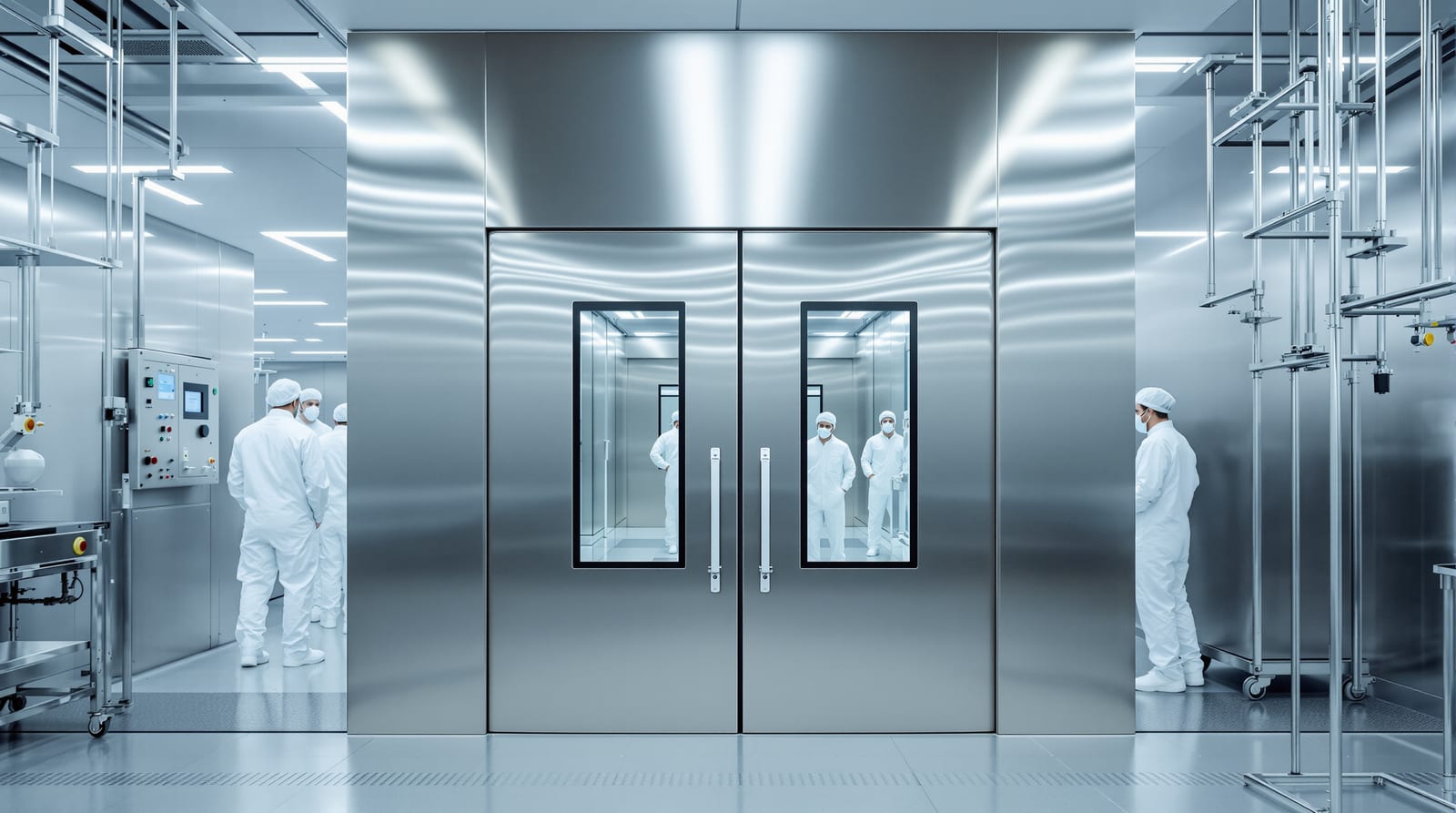
Pharma Cleanroom Doors: GMP Flush Door Guide India 2026
Specifier's guide to flush GI/SS304 cleanroom doors, double vision panels, full gaskets, interlocked airlocks and Schedule M / ISO 14644 compliance.
In a regulated pharmaceutical facility the door is not a fitting — it is part of the contamination-control envelope. Pharma cleanroom doors are engineered to be flush, fully cleanable, well-sealed against pressure differentials, and capable of being interlocked into airlocks so that two doors never open at once. Get the door wrong and you compromise the area's particle class, your pressure cascade, and ultimately your audit. This guide is the product-level deep dive for specifiers: how cleanroom doors are built, how they are sealed and interlocked, what the Indian regulatory frame (Schedule M, WHO-GMP, ISO 14644) expects, and what they realistically cost. It complements our application-level cleanroom door guide, which covers where these doors sit within a facility layout.
What makes a door a pharma cleanroom door
The defining feature of pharma cleanroom doors is cleanability. Every detail is chosen to eliminate ledges, crevices and porous surfaces where particles, microbes or cleaning residue could lodge. A compliant door has:
- A flush leaf — no raised panels, no rebates, no protruding hardware on the clean face.
- A flush-glazed vision panel, double-glazed and set so the glass is co-planar with the leaf (no putty lip, no dust shelf).
- Full-perimeter silicone gaskets plus, on higher-grade doors, an automatic drop seal at the threshold to hold a pressure differential.
- A coved or flush frame that meets the wall and floor without sharp internal corners, so it can be wiped and fogged.
- Smooth, corner-radiused leaf edges and concealed or semi-concealed hardware.
The leaf core is typically a honeycomb, PU foam or rockwool-filled sandwich faced with the chosen skin. The skin choice — GI versus stainless — is the single biggest cost and durability lever, covered next.
Leaf material: powder-coated GI vs SS304/316
Most Indian pharma cleanroom doors use one of three skin systems. The choice follows the room grade, the chemicals it sees, and the budget.
| Leaf skin | Typical use | Cleanability | Corrosion / chemical | Relative cost |
|---|---|---|---|---|
| Powder-coated GI (galvanised steel) | Grade C/D, corridors, gowning, general OSD areas | Good — smooth epoxy/polyester powder coat | Moderate; coating can chip and rust if scratched | Lowest |
| SS304 (flush) | Grade B/C, sterile-adjacent, wet/wash-down zones | Excellent | Very good for most CIP/cleaning agents | Mid |
| SS316 / 316L | Aseptic Grade A/B, halide or aggressive-chemical exposure | Excellent | Best; resists chlorides and harsh sanitisers | Highest |
As a rule of thumb: GI powder-coat is acceptable for lower-classified support areas where cost matters and the door will not be repeatedly washed down; SS304 is the workhorse for most aseptic-adjacent areas; SS316/316L is reserved for the most critical aseptic zones or where chloride/sanitiser attack is a real risk. Skin gauge is usually 0.8–1.2 mm over a rigid core; the frame is matched to the leaf material.
Sealing, frames and the pressure cascade
Pharma facilities run a designed pressure cascade — cleaner rooms held at higher pressure so air flows from clean to less-clean. The door must support, not defeat, this. Full silicone gaskets on the jambs and head, plus an automatic drop seal at the sill, let the door close against a differential (commonly 10–15 Pa between adjacent classified spaces). Where a true airtight seal is needed — sterile suites, some aseptic transfer points — a hermetic automatic sliding door is specified instead; see our hermetic doors guide and the operating-theatre parallel in our operation theatre door guide.
Frames must be coved or flush so they leave no horizontal dust ledge and meet the wall finish (modular GI/PUF panel or epoxy-coated masonry) cleanly. On modular cleanroom walls the door frame is integrated into the partition system; on conventional walls a coved architrave or flush-set frame is used. Always confirm the frame–wall junction detail with the panel vendor — a beautifully sealed leaf in a poorly junctioned frame still fails a fogging validation.
Vision panels and single vs double leaf
Vision panels are mandatory at most cleanroom thresholds for safety and traffic. The cleanroom standard is a flush-glazed double vision panel: two panes of toughened glass set flush to each face with a sealed cavity, so neither face has a ledge and the cavity stays dust-free. Sizes are typically 200–400 mm wide and 300–800 mm tall, positioned for both standing and seated sightlines.
Choose single leaf (900–1000 mm clear) for personnel and gowning routes, and double leaf (often 1.5+1.5 m, one active + one dormant) for material movement, trolleys and equipment. Double-leaf doors need a robust astragal/meeting-stile gasket detail to maintain the seal — specify this explicitly.
Interlocked airlocks and pass-boxes
The contamination-control logic of a cleanroom lives in its airlocks. A personnel airlock (PAL) or material airlock (MAL) is a small buffer room with a door at each end, electrically interlocked so both can never be open simultaneously — this preserves the pressure cascade and prevents direct cross-flow. The same logic applies to pass-boxes: a small interlocked hatch (static or dynamic, with HEPA filtration) used to transfer materials without opening a door.
Interlock controllers should provide visual (and often audible) status, a timed release or magnetic-lock override for emergency egress, and a manual override that is logged. Critically, interlocks must never trap a person — egress-side release and fire-alarm release are non-negotiable and must reconcile with NBC 2016 life-safety requirements. Specify interlock logic, emergency override and any BMS integration in the door schedule, not as a site afterthought.
Automatic vs manual operation
Manual swing doors with a hydraulic self-closer suit personnel routes in Grade C/D and most gowning rooms — they are cheaper, simpler and easy to maintain. Automatic sliding doors (sensor or hands-free foot/elbow switch) are preferred where hand contact must be avoided, where trolleys move heavy loads, or where a hermetic seal and pressure hold are required (aseptic core, sterile transfer). Automatic doors should fail-safe to a defined position on power loss and integrate with the interlock and fire-alarm logic.
For touch-free actuation across hospital and pharma settings, see our hospital doors and automatic sliding doors guides; FRP-skinned variants for chemical wet areas are covered in FRP doors.
Standards, validation and Indian regulation
Cleanroom doors are specified against the room's classification, not in isolation. The key references in India:
| Reference | What it governs |
|---|---|
| ISO 14644-1 | Airborne particle classification (ISO Class 1–9), maps to EU/WHO Grades A–D |
| Schedule M (Drugs & Cosmetics Rules) | India's GMP for premises and plant; mandates clean, smooth, crevice-free surfaces and airlocks |
| WHO-GMP / EU-GMP Annex 1 | Aseptic manufacturing expectations adopted by Indian exporters |
| NBC 2016 | Life-safety, egress and fire interface for the building |
What regulators check at audit is rarely the door's brochure — it is whether surfaces are cleanable, whether airlocks hold their cascade, whether interlocks work, and whether the installed assembly matches the validated design. Build your URS (User Requirement Specification) around the room grade, then let a vendor engineer the door to it. The complete cluster context is in our complete door guide and the specialty doors phase pillar; for hygiene-class siblings see food-grade doors and isolation room doors.
Cost bands in India (2026)
Pharma cleanroom doors are project-engineered, so prices vary with material, size, vision panel, interlock and automation. Treat these as indicative supply-only bands; add installation, interlock controllers, automation and GST at 18%.
| Configuration | Indicative supply-only ₹ |
|---|---|
| Powder-coated GI single flush door, single vision panel | ₹14,500 – 22,000 |
| SS304 single flush door, double vision panel | ₹24,000 – 38,000 |
| SS304/316 double-leaf material door | ₹38,000 – 60,000 |
| Automatic hermetic sliding (aseptic) | ₹90,000 – 2,00,000+ |
| Interlock controller (per airlock, 2 doors) | ₹18,000 – 45,000 |
| Static / dynamic pass-box | ₹35,000 – 1,50,000+ |
Installed cost typically runs 20–40% above supply-only depending on frame integration with the modular wall system and site conditions. Indian and global players in this space include Cronax, GMP Technical, Envirotech, Avians and Dormakaba/ASSA ABLOY for automation — frame your enquiry generically and get a written spec against your room grades.
For budgeting, our specialty door cost estimator and specialty door selector help you sanity-check a quote before tendering.
Frequently asked questions
Do all pharma cleanroom doors have to be stainless steel?
No. Powder-coated GI is acceptable for lower-classified support areas (Grade C/D corridors, gowning) where the surface stays cleanable and is not heavily washed down. SS304 is standard for aseptic-adjacent zones, and SS316/316L is reserved for the most critical aseptic areas or aggressive chemical/chloride exposure. Match the skin to the room grade in your URS.
Why do cleanroom doors need interlocks?
Interlocks ensure both doors of an airlock or pass-box never open at once, preserving the pressure cascade that keeps cleaner rooms at higher pressure and prevents direct cross-contamination. Interlocks must always allow emergency egress and release on fire alarm, reconciled with NBC 2016 life-safety rules.
What pressure differential should the door hold?
Adjacent classified spaces are commonly designed around a 10–15 Pa differential, with the overall cascade often stepping up to +45 Pa or more in the cleanest zones. Full silicone perimeter gaskets plus an automatic drop seal handle this for swing doors; hermetic automatic sliders are used where a tighter, validated seal is required.
Are cleanroom doors fire-rated?
Not inherently — cleanroom and fire ratings are separate functions. Where a cleanroom door also sits on a fire-compartment line, you need a tested, certified fire-rated assembly per IS 3614 and NBC 2016; you cannot assume a hygienic flush door is fire-rated. See our fire-rated doors guide and engage a fire consultant.
How do I confirm the final specification and price?
Cleanroom doors are project-engineered. Write a URS around each room's ISO 14644 class and Schedule M/WHO-GMP requirements, then have the vendor engineer the door, frame junction, interlock and automation to it and issue a written spec. Validate the installed assembly against the design — the audit checks the as-built room, not the brochure.
Export this guide
Related Guides — Deep-dive reading
Fire Rated Doors in India: IS 3614 Ratings, Cost & Where They're Required (2026)
What a fire-check door is, how the 30/60/90/120-minute ratings work to IS 3614, where the NBC makes them mandatory, and why the whole assembly must be certified.
Home Doors & EntrancesHygienic food-grade doors: washdown specs, India 2026
Spec SS304/316 and FRP washdown doors for food, dairy, beverage and meat plants — sealed, crevice-free and FSSAI/HACCP-ready.
Home Doors & EntrancesDouble Doors in India (2026): Two-Leaf Entrances, Proportions, Hardware & Cost
When a double-leaf door makes sense for Indian main entrances, pooja rooms and master suites, plus active/inactive leaf hardware, the Vastu note on even panels, security at the meeting stile and the rupee premium over a single door.
Home Doors & EntrancesRelated Tools — Try Free
Electrical Safety & Load Audit
Home electrical audit — 10 categories, 65+ checkpoints across earthing, RCCB, MCB, wiring, switchboards, appliance circuits, DG/inverter backup.
Safety AuditAcoustic Privacy (STC) Visualizer
Indian healthcare acoustic visualizer — compare wall assemblies and noise sources, see received SPL after STC attenuation, and check FGI 2018 / IS 1950 / NABH speech-privacy compliance with live dual-canvas waveform.
Acoustic ToolDoor Cost Calculator
Estimate the all-in cost of a door — leaf, frame, hardware, fitting and GST — by type, material and size.
Door Calculator