
Co-Housing Models
The intentional, participatory community — private homes plus an extensive shared common house, resident-led governance, the senior and multigenerational variants, and the Indian context
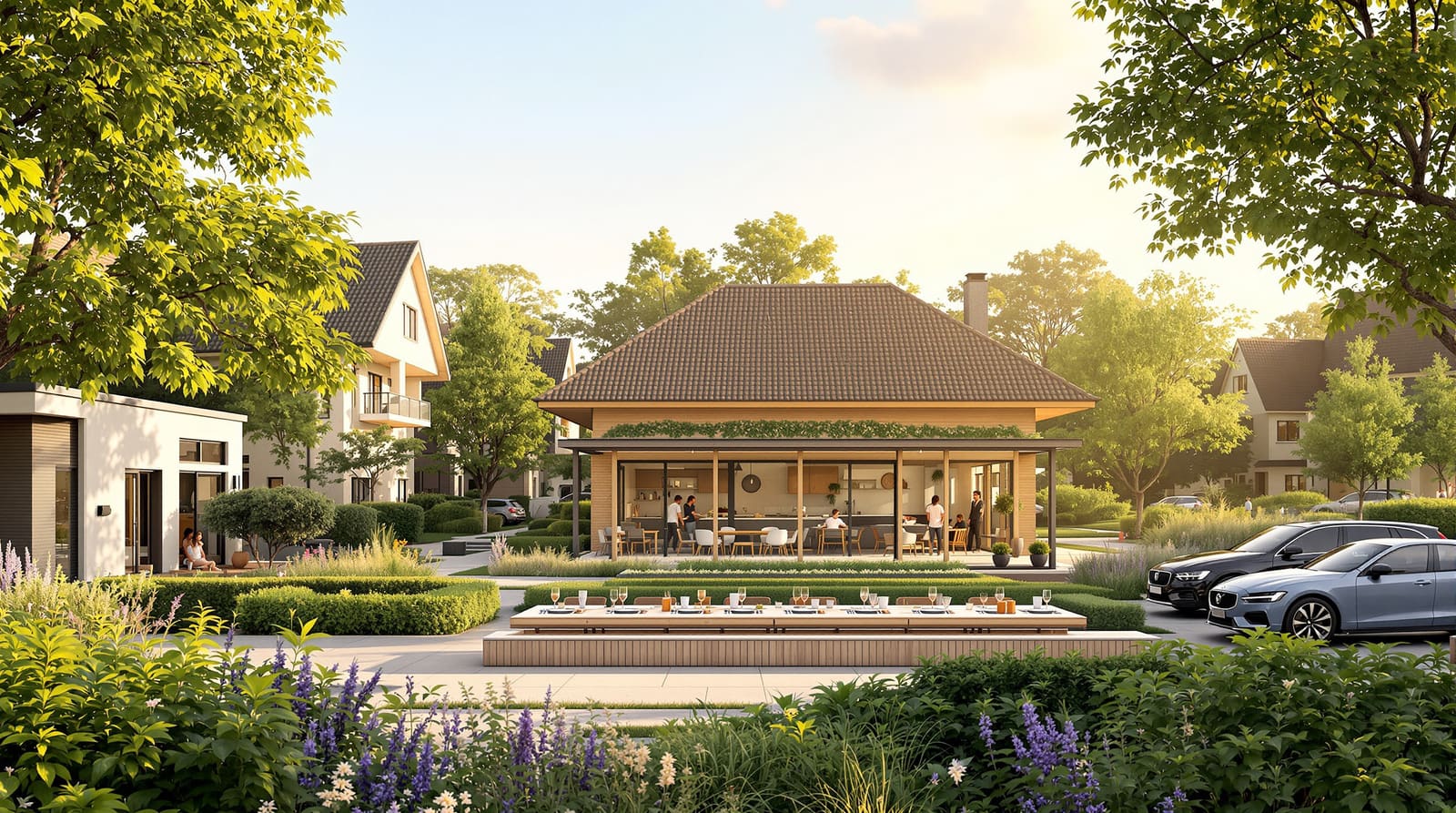
On the first Sunday of every month, the residents of a small co-housing cluster on the edge of Pune walk — not drive — to a low, naturally-lit building they call the common house. Cars stay at the perimeter; the lane between the homes belongs to children on cycles and to a banyan that someone planted twelve years ago. Inside the common house there is a kitchen built for forty, a long dining hall, a laundry with three machines instead of fifteen, two guest rooms for visiting relatives, and a workshop where a retired engineer fixes everyone's furniture. The families cook together three evenings a week. Nobody is obliged to attend; almost everyone does.
These thirty households did not buy into a finished product sold by a developer. They found each other over two years of meetings, argued about everything from the orientation of the dining hall to whether to allow dogs, hired an architect to translate their decisions into a plan, and now govern themselves by consensus. Each family owns a complete, private, lockable home with its own kitchen and finances. What they share — deliberately, by design — is a second, larger life in common. Co-housing is the most structured form of community living we have: a settlement of fully private homes bound together by extensive shared facilities and by residents who choose, design and govern that sharing themselves.
What co-housing actually is
Co-housing is not a vague aspiration to be neighbourly. It is a specific, documented model with a traceable origin. It began in Denmark in the late 1960s and 1970s as bofællesskab — literally "living community" — when a group of families, dissatisfied with both the isolation of the suburban villa and the anonymity of the apartment block, built clusters where private homes faced a shared common house and shared open space. The model spread to the Netherlands, Sweden, Germany, the United Kingdom and the United States, where the architects Kathryn McCamant and Charles Durrett gave it the English name and a set of recurring ingredients that still define it.
Those ingredients are remarkably consistent across countries:
- Private, self-contained homes. Every household has a complete dwelling — its own kitchen, bathroom, bedrooms and front door. Co-housing is not a hostel and not a dormitory. Your home is yours, and so are your finances.
- Extensive shared facilities, centred on a common house. The common house is the heart of the model: a shared kitchen and dining hall large enough for the whole community to eat together, plus a constellation of facilities that no single family needs full-time — a laundry, guest rooms for visitors, a workshop, a children's playroom, a library or quiet room, sometimes a shared office. Outside, there is shared garden, productive land and play space.
- Resident participation in design and management. The future residents are involved before the first wall is built. They shape the brief, often co-design with the architect, and then run the place themselves once they move in. This participation is what makes the community deliberate rather than accidental.
- Deliberate, non-hierarchical community. Shared meals, regular work-days and consensus decision-making are structural features, not nice-to-haves. The community is intentional: people chose it.
- Cars to the edge. Almost every co-housing scheme pushes parking to the perimeter and gives the interior to people, so that the everyday route from your door to the common house is a social one. This is the same physical logic as cluster housing explained — homes grouped tightly around shared space — applied with an explicit social programme.

What is shared, what stays private
The single most useful thing to understand about co-housing is the boundary between the private and the common — because getting that boundary right is what distinguishes it from both a normal housing society and a commune. You keep a complete home and full financial independence; you gain access to a richer set of shared facilities than any one household could justify owning alone.
| Dimension | Private to each household | Shared by the community |
|---|---|---|
| Dwelling | Full home — kitchen, bath, bedrooms, own front door | The common house: large shared kitchen & dining hall |
| Daily life | Your own meals, routines, guests inside your home | Optional common meals several evenings a week |
| Utilities & chores | Your own bills & budget | Shared laundry, workshop, tools, guest rooms |
| Money | Each household owns its home & keeps its own finances | A common fund for shared facilities & maintenance |
| Outdoor space | A small private terrace or garden, if any | Generous shared garden, play space, productive land |
| Decisions | What you do inside your own four walls | Design, rules & management — by participation & consensus |
| Cars | Your own vehicle | Parking pooled at the edge; interior kept car-light |
The table makes the trade visible: you give up a little private redundancy — the second guest room you would use twice a year, the lawnmower, the giant party kitchen — and in return you get all of those things at community scale, plus the company.
The co-housing spectrum
Co-housing is a single model with several flavours, sorted mostly by who the residents are and what they value. This is where it overlaps with the broader idea of community-centric housing: community-centric housing is the principle — designing for connection rather than isolation — and co-housing is its most formal, structured expression.

- Senior co-housing is built by and for older adults who want to age among friends rather than alone or in an institution. The shared meals and the everyday eyes-on-the-lane are quietly powerful against loneliness; the guest rooms host visiting children; the design anticipates mobility decline. This is the fastest-growing branch worldwide and, as we will see, the one with the clearest pull in India.
- Multigenerational co-housing deliberately mixes young families, working adults and elders, so that childcare, companionship and care flow both ways across generations — a structure that, to Indian ears, sounds a great deal like a joint family that you choose rather than inherit.
- Eco co-housing organises the community around a light environmental footprint: shared renewable energy, rainwater and greywater systems, productive gardens, low-car living. Sharing facilities is itself green — fewer kitchens, fewer machines, less land per home.
- Intentional, values-based communities form around a shared philosophy, spiritual practice or way of life. India's Auroville, near Puducherry, is the best-known example — an experimental township founded in 1968 around a stated ideal of human unity. It is larger and more ideologically defined than a typical Danish co-housing cluster, but it shares the DNA: people who chose to live and govern together around a common purpose.
How co-housing differs from a gated society and from a commune
Most Indians already live, or aspire to live, in a gated apartment society. It is worth being precise about how co-housing is different, because the two can look superficially alike — both have boundaries, both have shared amenities, both have a residents' association.
A gated society is, in practice, an accidental community. People buy flats independently for price, location and security; the "amenities" — clubhouse, pool, gym — are sold as features and are often under-used; governance is a transactional Resident Welfare Association whose main job is collecting maintenance and resolving disputes; and the design, by privatising the commons behind a wall while leaving the interior car-dominated, often produces social segregation rather than connection.
Co-housing inverts almost every one of these. It is intentional — you join because you want this specific community, not despite it. It is participatory — residents shape the design and run the place, rather than receiving a finished product. Shared meals and shared work are central, not optional luxuries. And governance is non-hierarchical, typically by consensus or sociocracy rather than a managing committee imposing rules from above.
It is equally important to say what co-housing is not. It is not a commune. In a commune, people pool income, share ownership and often eat every meal together; the individual household dissolves into the collective. In co-housing you keep your own home, your own salary, your own bank account and your own front door. You opt into the common life as much or as little as you like. This distinction — private ownership and private finances, plus a generous shared layer — is exactly what makes co-housing legible to mainstream homebuyers in a way a commune never will be.
The economics: why sharing is cheaper and lighter
The case for co-housing is partly social and partly arithmetic. Because facilities are shared rather than duplicated, the per-home cost and footprint fall. Thirty families do not each need a guest room, a workshop, a party-sized kitchen or a ride-on mower; one good common house serves them all. Smaller private homes — confident that the overflow lives in the commons — mean less land, less material and lower bills. Sharing land for parking at the edge frees the interior for gardens that would be unaffordable per household.
There is also sweat equity. Residents who participate in design, who run their own management, who cook the common meals and fix things in the shared workshop, replace a slice of the paid services that a conventional development charges for. The flip side is honest: that participation is real, ongoing work, and it depends on a level of trust and time that not everyone can give.
Co-housing and the Indian context
India should, on paper, take to co-housing more readily than almost anywhere. The joint-family instinct — multiple generations under shared facilities, pooled childcare and elder-care, eating together — is precisely the social pattern co-housing recreates by choice. As that joint family fragments under urban migration and nuclear-household economics, two needs grow sharply: dignified senior living for parents whose children have moved away, and an answer to the quiet epidemic of urban loneliness. Senior and multigenerational co-housing speak directly to both.
Real and emerging Indian experiments exist, though they remain few and varied. Auroville is the long-running intentional-community precedent. A small but growing set of senior-living and "active-ageing" communities — clustered homes with shared dining, care and social programming — borrow much of the co-housing logic even when they do not use the name, and several resident groups in cities such as Bengaluru, Pune and around the hill towns have attempted member-led, shared-facility communities. These are early, mixed in outcome, and worth watching honestly rather than celebrating prematurely.
The legal vehicle in India is familiar: a co-operative housing society, a registered trust, or a company that holds the common land and the common house while individual homes are owned by members — much as any apartment society is structured, but with the shared assets and the participatory rules written deliberately into the bye-laws. RERA governs the development and sale stage. None of this is exotic; the instruments already exist.
Why it is still rare in India — and how to make it real
Co-housing remains rare in India, and it is worth being clear-eyed about why. Land is the first wall: assembling a buildable parcel at a price a self-organising group can afford, in or near a city, is genuinely hard, and developers are not structured to sell a half-finished idea that residents must co-design. Trust and governance are the second: consensus decision-making across thirty households is slow and demands social skills that the transactional RWA culture has not cultivated; one or two dominant personalities can sour the whole experiment. There is a liquidity and resale question — a deeply community-specific home is harder to sell to a stranger than a standard flat. And there is the simple fact that the gated society is the default product, marketed relentlessly, financed easily and understood by every bank and buyer, while co-housing has to be explained from scratch each time.
The route to making it real, then, is incremental and honest. Start small — a cluster of a dozen to thirty households is more manageable than a township. Get the governance written down early, before the building, so that the rules of participation, the consensus process and the exit and resale terms are clear from day one. Use an enabling developer or a non-profit to solve the land-assembly and finance problem that a loose group cannot. Anchor the model where the need is sharpest — senior and multigenerational living, where the social return is highest and the buyer most motivated. And recognise co-housing as the most structured rung on a longer ladder: it is one expression of community-centric housing, it shares its physical form with cluster housing explained, and at scale these clusters become the building blocks of the future Indian township — the neighbourhood, designed around people rather than cars, that the next generation of Indian developments will be judged against.
References
1. McCamant, K. & Durrett, C., Creating Cohousing: Building Sustainable Communities — the foundational English-language account of the Danish bofællesskab model and its core ingredients.
2. Vestbro, D. U. (ed.), Living Together — Cohousing Ideas and Realities Around the World (Royal Institute of Technology, Stockholm) — comparative study of co-housing across countries.
3. URDPFI Guidelines 2014, Ministry of Urban Development, Government of India — norms for residential community planning and shared facilities.
4. Gehl, J., Cities for People (Island Press) — the human-scale, car-light design principles underlying the co-housing layout.
5. Auroville Foundation Act, 1988, Government of India — the legal basis of India's best-known intentional community.
6. IGBC Green Townships Rating System, Indian Green Building Council — framework for the resource-sharing and footprint logic of eco co-housing.
7. UK Cohousing Network, Cohousing: A Guide — practical guidance on the legal vehicles, governance and resident-led development process.
Read this alongside community-centric housing — the broad principle of which co-housing is the formal model — and cluster housing explained, its physical form, then plan your own community with DesignAI.
Export this guide
Related Guides — Deep-dive reading
Quinta Monroy: How ELEMENTAL Built Half a Good House and Let the Residents Finish It
In Iquique, Chile, Alejandro Aravena and ELEMENTAL answered an impossible social-housing budget by building only the half of each dwelling that families could never build themselves — the structure, kitchen, bathroom and stair — and leaving a deliberate void for the other half. This is the case study in incremental housing, participatory design, and why the future of shelter may lie in the unfinished.
The Future of ArchitectureHow to Plan a Home for Multi-Generational Living
Designing for grandparents, parents and children under one roof — privacy, accessibility and harmony
Home PlanningBelapur Incremental Housing: How Charles Correa Gave the Poor a House That Could Grow
In Navi Mumbai, Charles Correa refused the housing block. Instead he gave roughly 550 families a small plot, an open-to-sky courtyard, and — crucially — no shared walls, so each house could be extended by its own occupants over decades. It is India's most quietly radical answer to where affordable housing should go next.
The Future of ArchitectureRelated Tools — Try Free
Apartment Furniture Size Chart
Standard furniture dimensions for Indian apartments — sofas, beds, tables, dining, storage.
Reference ChartFull-Room BOQ — Living, Bedroom, Kitchen, Bath
Room-wise BOQ across living, bedrooms, kitchen, utility, and bathrooms with line-item pricing.
Full-Room BOQApartment Video Door System Planner
Enter flats, entrances, floors and guard desk for a first-pass building intercom plan — door stations, indoor monitors, guard station, the right architecture and an indicative cost band.
Building Planner