
Resilient Community Planning
Planning a community to absorb shocks — climate and disaster resilience, redundancy and decentralisation, social cohesion, and the lessons of India's floods, heatwaves and the pandemic
In December 2015, the rain over Chennai did not stop. Over a few days the city took in more water than it had in a century, and the neighbourhoods that drowned were not the slums alone — they were the new gated enclaves built across the Pallikaranai marsh, the IT corridors raised over old water bodies, the apartment towers whose ground-floor parking became a tank. Families who had bought into the idea of a self-contained community discovered that self-contained meant cut off: one access road, one power feed, one borewell pump, all underwater at the same time. The lifts stopped. The pumps stopped. The water in the overhead tanks ran out in two days. What saved people, in the end, was not the brochure's clubhouse but the neighbour two floors up with a gas stove and a willingness to share, the WhatsApp group that found a boat, the local kirana owner who kept his shutter half-open and his prices honest.
That fortnight was a lesson in what a residential community actually is when the systems it depends on fail all at once. A few hundred kilometres up the coast, communities that had grown around a working tank, a shaded commons and a thicket of social ties came through the same monsoon battered but functioning. The difference was not luck or even money. It was design — or the absence of it. A resilient community is not one that escapes shocks; it is one that anticipates them, absorbs them without collapsing, recovers quickly, and adapts so the next shock hurts less — and that capacity has to be built into the layout, the services and the social fabric from the start, never bolted on after the flood.
What resilience actually means
The word is used loosely, so it is worth pinning down. Resilience is the capacity of a system — here, a residential community of a few hundred to a few thousand homes — to keep delivering the things people depend on (shelter, water, power, food, safety, connection) through and after a disturbance. The 100 Resilient Cities programme and the disaster-risk literature break that capacity into a cycle of four verbs: anticipate the shocks a place is exposed to, absorb their impact without catastrophic failure, recover core function quickly, and adapt so the community is stronger against the next event. A flood, a heatwave, a cyclone, a grid failure, a pandemic and an economic downturn are all shocks; resilience is the same underlying property tested by different stresses.
This is a broader idea than adaptability alone. Our companion guide on future-ready residential layouts treats the layout as something that should flex and evolve over decades — that is the adaptability methodology, the slow change. Resilience overlaps with it but adds the sudden change: the day the river comes over the bund, the week the temperature does not drop below 40 degrees at night, the month the city shuts down. It also adds dimensions adaptability does not foreground — social cohesion and economic security — because in a real disaster these matter as much as any engineered defence. Think of resilience as a full model with five interlocking dimensions: climate, disaster, social, economic, and the infrastructure redundancy that underwrites them all.
Climate and disaster resilience: designing with the shock, not against it
India already lives inside the climate scenarios that other regions only model. The Chennai floods of 2015, the Mumbai deluge of 26 July 2005 when roughly 944 mm fell in a single day, the near-annual urban flooding of Bengaluru and Hyderabad, the lengthening heatwaves across the north and the cyclones that walk up the eastern coast each season — these are not future risks to plan for but present conditions to plan with. The honest starting point is that India's urban-flooding crisis is largely self-inflicted: we built over the wetlands, lakes and natural drains that used to absorb the monsoon, then expressed surprise when the water reclaimed its path.
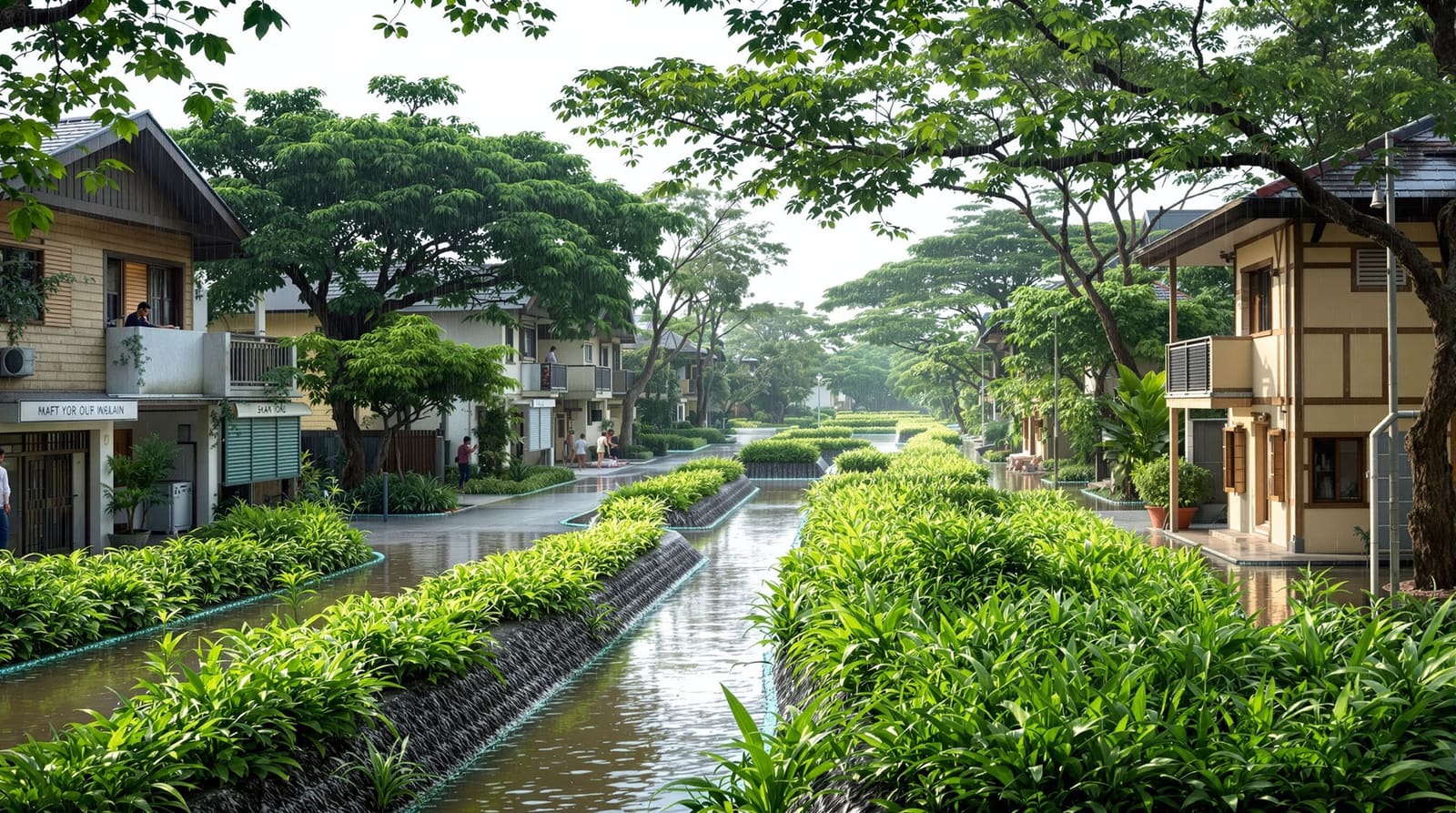
The first move in flood resilience is therefore to work with water rather than wall it out. This is the logic of the "sponge" neighbourhood — the community equivalent of the sponge city — where the ground is allowed to hold and slowly release rain instead of shedding it instantly into an overwhelmed drain. The mechanics belong to two sibling guides: water-sensitive urban design for the catchment-scale thinking and blue-green infrastructure for the swales, retention ponds, rain gardens and permeable surfaces that do the work. At the community-planning level the responsibility is to set homes and critical equipment above the design flood level, to keep the natural drainage line as open green space rather than build across it, and to make the lowest, wettest land the park rather than the parking.
Heat resilience is the quieter killer and is designed through canopy and form. A continuous tree canopy over streets and the commons, narrow and shaded pedestrian routes, light-coloured and reflective surfaces, cross-ventilated building forms and orientation that catches the prevailing breeze can hold the lived temperature of a neighbourhood several degrees below the bare-concrete alternative. Cyclone and earthquake exposure ask for region-appropriate structural standards, wind-resilient built form and, critically, designated safe assembly and refuge spaces — a robust community hall, a raised flood-safe floor, an open ground clear of falling hazards — that people already know and can reach on foot. And because the grid and the municipal supply are the first things to fail, every resilient community needs back-up power and water during outages: rooftop solar with battery storage for essential loads, a stored-water reserve sized for several days, and a back-up pump that does not depend on the main feed.
Redundancy: the lesson of centralised fragility
The deepest engineering lesson of the Chennai fortnight was about centralisation. A community served by a single substation, a single trunk water main, a single sewage pumping station and a single access road has multiple single points of failure, any one of which can take the whole settlement offline. The resilient alternative is redundancy and decentralisation — distributing water, energy and services so that no single failure is catastrophic.
In practice this means several smaller, independent systems rather than one large dependent one: localised solar generation with storage at the cluster level so a few homes keep their lights and pumps when the grid is down; rainwater harvesting and a treated-greywater loop so water does not rely solely on a tanker or a distant reservoir; decentralised wastewater treatment so a failure does not back up across the whole community; and more than one way in and out so a blocked road is an inconvenience, not a siege. Decentralisation costs a little more in capital and asks more of governance, but it buys the one thing centralised efficiency cannot — graceful failure, where the system degrades in pieces instead of all at once. This is also the structural argument running through net-zero residential communities, where distributed generation and closed water and waste loops happen to make a place far harder to knock out.
Social and economic resilience: the part you cannot engineer
Here is the finding that disaster researchers repeat and planners keep forgetting: in a crisis, the strongest predictor of who survives and recovers is not the seawall or the building code but social ties. After the deadly heatwaves and floods of the last two decades, the neighbourhoods that fared best were the ones where people knew each other, checked on the elderly, shared what they had and organised faster than any official agency could arrive. Social cohesion is infrastructure. It is built the same way physical infrastructure is — by design — through a genuine commons where people meet daily, through mixed incomes so a community is not a monoculture that empties out when one industry falters, through local networks and resident bodies that already function before the emergency, and through the small, walkable scale that lets a community actually be one. This is the heart of community-centric housing: the commons is not amenity, it is the place people rally.
Economic resilience follows the same grain. A community of dormitory homes whose every earner commutes to one corridor is fragile; when that corridor stalls, the whole settlement's income stalls with it. Mixing uses — workspaces, local retail, the kirana and the clinic, room for home-based livelihoods — keeps money and activity circulating locally and gives people a fallback when the wider economy lurches. The pandemic taught this in real time. The communities that coped were the ones with open space to step into, streets safe and pleasant enough to walk, the option to work from home, and a local supply chain — the neighbourhood shop, the vegetable cart, the chemist — within walking distance, so that "lockdown" did not mean "cut off". Each of these is a resilience feature that also happens to make daily life better, which is the point: the dimensions reinforce one another.
Shock and response: the resilient design playbook
| Shock | The resilient design response |
|---|---|
| Urban flooding & cloudburst | Build above design flood level; keep natural drains as green space; sponge layout with swales & retention; permeable surfaces; multiple access routes |
| Heatwave | Continuous tree canopy; shaded walks; reflective surfaces; cross-ventilated form; cool refuge spaces with back-up power |
| Cyclone & high wind | Region-appropriate structural standards; wind-resilient form; designated safe refuge; secured services |
| Earthquake | Seismic-zone-compliant structures; clear open assembly ground; resilient lifelines & utilities |
| Grid & water outage | Distributed solar with storage; multi-day stored-water reserve; decentralised treatment; cluster-level back-up |
| Pandemic & lockdown | Generous open space; walkability; work-from-home capacity; local supply & services within walking distance |
| Economic downturn | Mixed incomes & mixed use; space for local livelihoods; community institutions that hold people together |
Does it work in India — and how to make it real
The encouraging news is that resilience is not exotic; much of it is how Indian settlements worked before we forgot. The traditional tank-and-temple village anticipated the monsoon, stored its water, shaded its streets and rallied around a shared commons — a working resilience model long before the term existed. The problem is that the dominant new product, the standard gated community, often engineers fragility into the layout: one entrance, one set of centralised services, a privatised and under-used commons, near-total car dependence, and a social monoculture that scatters the moment trouble arrives. Each of those choices trades resilience for the appearance of order.
Making resilience real in India runs into three honest obstacles. The first is affordability — raised plinths, distributed solar and back-up storage cost more up front, and the market rarely pays for risk it has not yet experienced; the counter is that retrofitting after a disaster costs far more, and that many resilience moves (canopy, open drains, a real commons, walkability) are cheap or free. The second is governance: a resilient community is only as good as the resident body that runs the pumps, maintains the swales and keeps the social fabric alive, and India's mixed record with RWA-led maintenance is a real constraint that must be planned for, not wished away. The third is the planning frame itself — the URDPFI guidelines and state township policies give a structure, but resilience standards still need to be written into the layout sanction rather than left to the developer's conscience. None of this is a reason to wait. The shocks are already here; the only question is whether the next community is designed to absorb them. That design intent — testing a layout against flood, heat and outage before a single foundation is poured — is exactly the kind of scenario modelling DesignAI is built to make routine, so resilience becomes a starting assumption rather than a post-mortem.
References
1. Judith Rodin, The Resilience Dividend / Rockefeller Foundation, 100 Resilient Cities programme framing (anticipate, absorb, recover, adapt).
2. Yu Kongjian, "Sponge City" concept and Chinese sponge-city pilot programme guidelines.
3. URDPFI Guidelines 2014, Ministry of Urban Development, Government of India — norms for layouts, open space and infrastructure.
4. National Disaster Management Authority (NDMA), India — guidelines on urban flooding and on heatwave action plans.
5. Daniel P. Aldrich, Building Resilience: Social Capital in Post-Disaster Recovery — on social ties as the determinant of recovery.
6. IGBC Green Townships / LEED-ND rating systems — community-scale sustainability and resilience criteria.
7. Jan Gehl, Cities for People — on walkability, the commons and the human scale of resilient neighbourhoods.
Read this alongside the future Indian township and community-centric housing, and model your own resilient layout with DesignAI.
Export this guide
Related Guides — Deep-dive reading
The Sponge City: How Kongjian Yu Taught China's Cities to Drink the Rain
Landscape architect Kongjian Yu and his firm Turenscape reframed the flood-prone city as a living sponge — a national programme, launched in 2013–14 across dozens of Chinese cities, that swaps concrete pipes for wetlands, rain gardens and terraces. A study of its ecological logic, its flagship parks, and the hard question of what a sponge can and cannot hold.
The Future of ArchitectureCircular Water Management for Buildings & Cities: The Closed-Loop Guide
How to stop treating water as a one-way flow and design a closed loop — treat, reuse, recharge, repeat — with a sewage treatment plant at its core, for Indian buildings, campuses and cities.
Sewage Treatment PlantsFuture-Ready Residential Layouts
Designing a layout for the next 30-50 years — climate resilience, EV and solar readiness, water-sensitive design, mixed use, digital infrastructure and adaptability over time
Residential Layout DesignRelated Tools — Try Free
Rainwater Tank Sizer
How big should your rainwater tank be? Computes annual harvest, recommended tank capacity in litres, water-bill savings, and payback — for 10 Indian cities.
RWH CalculatorApartment Video Door System Planner
Enter flats, entrances, floors and guard desk for a first-pass building intercom plan — door stations, indoor monitors, guard station, the right architecture and an indicative cost band.
Building PlannerCross-Ventilation Analyzer
Estimate airflow and air changes per hour (ACH) from room size, window areas, layout, and local wind — with NBC 2016 Part 8 compliance check.
Ventilation Calculator