
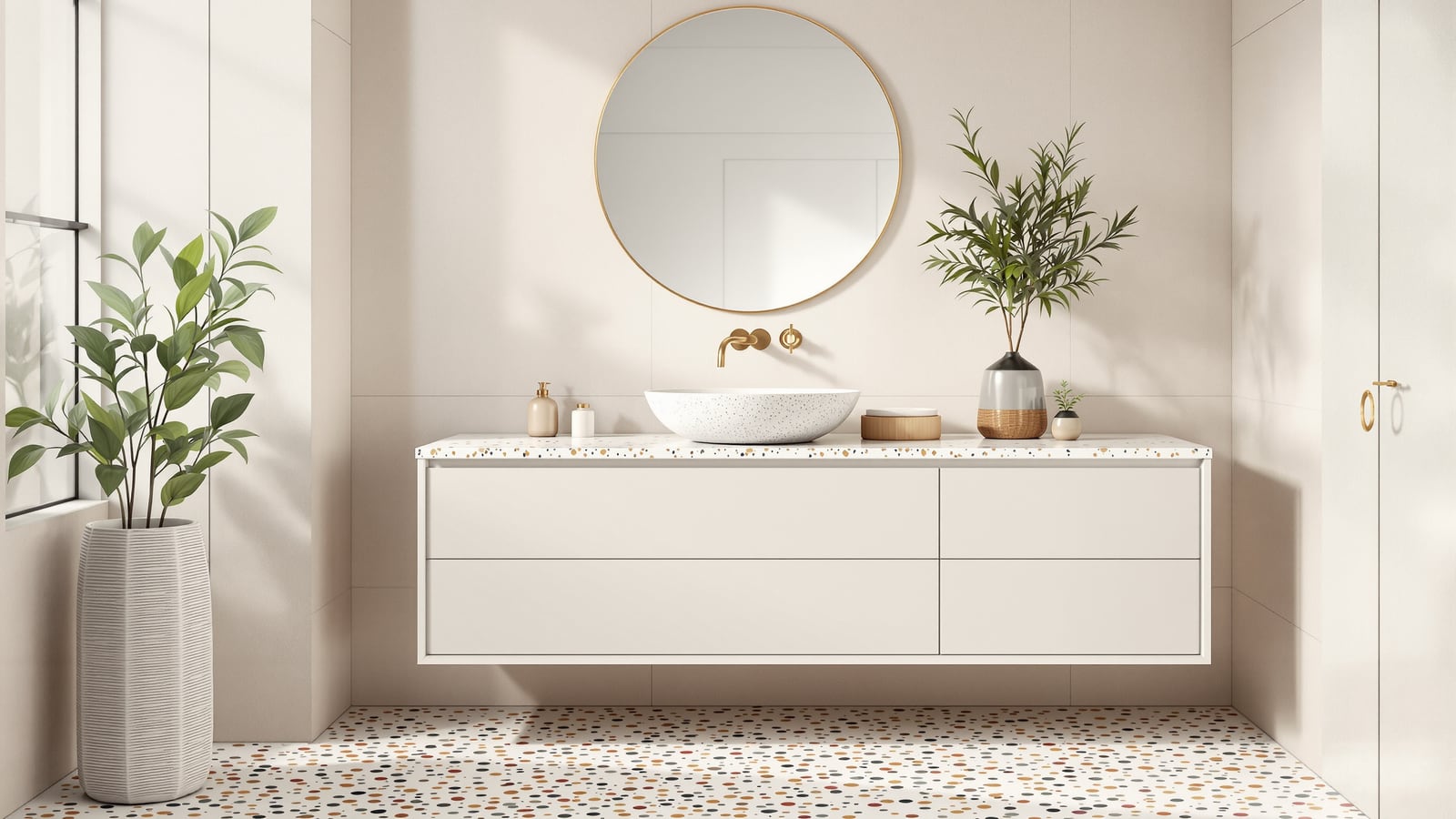
Terrazzo Bathroom India: Chip-in-Cement Floors, Walls & Basins (2026)
The revived speckled terrazzo look for Indian bathrooms — traditional in-situ IPS terrazzo versus modern precast tiles and slabs, on floors, walls, counters and basins, plus sealing, slip, custom chip colours and honest rupee costs.
Terrazzo is the material your grandparents called mosaic flooring — marble and stone chips broadcast into a cement matrix, then ground and polished until the chips gleam flush with the surface. For two generations it was the default Indian floor, poured in-situ across verandahs, staircases and bathrooms, cheap and near-indestructible. Then vitrified tiles arrived and terrazzo fell out of fashion. It is now firmly back, but as a design choice rather than a budget default: the speckled, confetti-like surface reads as both heritage and thoroughly modern, and it works on far more than the floor. This guide is about terrazzo as a whole-bathroom material — floors, walls, counters and basins — in Indian conditions.
India-first means real constraints: hard water that leaves scale on any porous surface, a health faucet that keeps the floor genuinely wet, monsoon humidity that never lets a bathroom fully dry, and apartment-society rules that may forbid the wet grinding an in-situ floor needs. For the wider surface menu, start at the bathroom flooring guide for India; this page is only about terrazzo, and it pairs naturally with a matching bathroom vanity.
Terrazzo is only as durable as its seal. The cement version is a porous stone floor pretending to be finished — leave it unsealed in a hard-water bathroom and it will drink stains, dull and scale within a season.
Two very different terrazzos
The single most important decision is which terrazzo you are actually buying. The word covers two materials that behave completely differently.
- Cement terrazzo (traditional / in-situ IPS). Marble chips in a grey or white cement matrix, either poured on site (in-situ, the true monolithic "mosaic" floor) or bought as pressed tiles. It is porous, must be sealed, and is laid in a thick cement bed. This is the heritage material and the honest, breathable, repairable one.
- Resin / agglomerate terrazzo (modern). The same chips bound in an epoxy or polyester resin, always factory-made as thin tiles or big slabs. It is near-non-porous, comes in bright designer chip-and-base colours, and is cut and installed like engineered stone. This is the material behind most of the "trendy terrazzo" you see in magazines.
Neither is better outright. Cement terrazzo is cheaper, breathable, seamless when poured in-situ and endlessly repairable, but porous and slow to lay. Resin terrazzo is stain-resistant, colour-vivid and quick to fit, but a manufactured product with joints and a higher price. For the resin family in general — including how it compares with poured epoxy floors — see composite bathroom materials.
Where terrazzo works in a bathroom
The revival is really about using one speckled material across several surfaces so the room reads as a single, quiet, tactile whole.
- Floors. The classic use. Seamless when poured in-situ, or as 300–600 mm tiles. Always specify a honed matt finish in a wet bathroom, never mirror-polished.
- Walls. Precast terrazzo tiles or thin slabs make a dramatic feature wall or a full wet-zone lining; poured terrazzo can be carried up as a coved skirting so the floor and lower wall are one surface. It sits well alongside other decorative bathroom wall finishes.
- Counters and vanity tops. Resin terrazzo slabs make excellent vanity tops — non-porous, seamless with an under-counter basin, and available in bold chip colours to match or contrast the floor.
- Basins. Cast terrazzo (usually resin-bound) countertop basins are a signature look — a solid, speckled bowl that turns the wash area into a sculpture rather than plumbing.
The speckled look — chips and colour
Terrazzo's whole personality is in the aggregate. You are, in effect, choosing a scatter pattern.
- Chip size ranges from fine (2–6 mm, a subtle sand-like speckle) to bold (10–25 mm, big confetti terrazzo). Large chips are the fashionable, graphic look; fine chips read quieter and more classic.
- Chip material is traditionally marble, but granite, quartz, recycled glass, mother-of-pearl and coloured stone all feature. Recycled-glass and mixed-stone chips give the punchy modern palettes.
- Base colour — the matrix — can be pigmented. A charcoal or terracotta base with white chips looks completely different from white chips in a pale grey base. Custom chip-and-base combinations are exactly what makes terrazzo feel bespoke.
- Density of chips, from sparse to packed, changes the whole read of the surface. Ask your supplier or in-situ contractor for physical samples in your light — terrazzo photographs very differently from how it looks underfoot.
Sealing — the non-negotiable for cement terrazzo
Cement terrazzo is a porous cement-and-stone floor. Unsealed, in an Indian bathroom, it will absorb soap, oils, hard-water scale and dye, and go patchy fast. Sealing is not optional.
- Use a penetrating (impregnating) sealer that soaks in and repels water and oil without leaving a slippery film — not a surface "glaze" that peels.
- Reseal periodically: typically every 1–3 years in a wet bathroom, sooner in a hard-water house. A quick water-drop test tells you when: if water darkens the surface instead of beading, it is time.
- Wipe up hard-water splashes and coloured products (hair dye, mehndi, strong cleaners) promptly on cement terrazzo — acids etch it and dyes stain unsealed patches.
- Resin terrazzo is near-non-porous and needs little or no sealing — one of its main advantages, and why it suits busy wet zones.
Slip, and why finish matters
A high-polish terrazzo floor is beautiful and, under a health-faucet spray, genuinely dangerous. The grinding process can be stopped at different grits, and that choice is a safety decision.
- Specify a honed / matt finish for bathroom floors — polished terrazzo belongs on dry lobby floors, not wet zones.
- For extra grip you can have the floor lightly acid-etched or given an anti-slip treatment, or choose a finer, more textured aggregate mix.
- Aim for the wet slip-resistance targets NBC 2016 and good practice set for bathroom floors — an R11-class ramp rating or a wet pendulum value comfortably above 36 for barefoot wet areas.
- Keep the glossiest terrazzo for vertical surfaces — walls, counter fronts — where slip is irrelevant and the polish reads as luxury.
In-situ versus precast — the practical trade-off
| Factor | In-situ cement | Precast cement tiles | Resin tiles / slabs |
|---|---|---|---|
| Joints | None — seamless | Grout lines | Thin joints (tiles) / few (slabs) |
| Porosity | Porous, seal essential | Porous, seal essential | Near-non-porous |
| Install time | Slow: bed, cure, grind, polish | Faster; on-site grind | Fastest; cut and fix |
| Wet grinding on site | Yes (messy, water + slurry) | Usually yes | No |
| Repairability | Excellent — patch and re-grind | Replace a tile | Hard to match |
| Chip colour range | Wide, custom | Wide | Widest, brightest |
| Best surface | Large seamless floors | Floors, budget walls | Counters, basins, feature walls |
In-situ terrazzo needs space, water and days for grinding and polishing — check whether your apartment society even permits it, because the slurry and noise are considerable. If not, precast tiles or resin slabs give a similar look with far less on-site disruption.
Cost in India
Terrazzo spans a wide band because "terrazzo" covers three products. Indicative 2026 supply-and-lay rates:
| System | Typical rate (₹/sq ft) | Notes |
|---|---|---|
| Precast cement terrazzo tiles | ₹80–200 | Budget end; on-site grind extra |
| In-situ cement terrazzo (IPS) | ₹150–350 | Includes bed, grind, polish |
| Resin terrazzo tiles | ₹250–500 | Non-porous, designer colours |
| Resin terrazzo slabs (counters) | ₹350–900+ | Vanity tops, feature walls |
| Cast terrazzo countertop basin | ₹6,000–20,000 each | Signature statement piece |
| Sealing (impregnating) | ₹15–40 add | Cement terrazzo, plus resealing |
A small 35 sq ft bathroom floor in a mid in-situ cement terrazzo lands roughly ₹6,000–12,000 plus sealing — competitive with mid-range vitrified tiles, and cheaper over the floor's life because it can be re-ground rather than ripped out.
Pros, cons and who it suits
| Pros | Cons |
|---|---|
| Distinctive speckled, heritage-meets-modern look | Cement version porous — sealing and resealing essential |
| In-situ is seamless and endlessly repairable | Polished finish slippery when wet |
| Works across floors, walls, counters and basins | In-situ is slow, wet and messy to lay |
| Extremely durable — a genuine lifetime floor | Society may forbid on-site grinding |
| Custom chip and base colours | Resin version is the costliest bathroom floor |
Best for: design-led bathrooms that want one tactile, characterful material carried across floor, wall and vanity — and owners willing to seal a cement floor or pay for resin. Think twice if: you need a fast, no-mess fit-out, your society bans wet grinding, or you will not commit to a maintenance seal.
For the full menu of surfaces and where terrazzo sits beside tiles, stone and resin floors, return to the bathroom flooring guide for India; to see how the resin-bound family behaves more broadly, read composite bathroom materials; for the walls around it, see decorative bathroom wall finishes; and to match a terrazzo counter to its cabinetry, plan the bathroom vanity.
References
- National Building Code of India (NBC) 2016, Part 3 and Part 9 — bathroom floor falls, drainage and non-slip finish requirements.
- IS 15622 — Pressed ceramic tiles: the wet-area anti-slip benchmark terrazzo floors are specified against.
- IS 1237 — Cement concrete flooring tiles (the standard governing precast cement / terrazzo floor tiles in India).
- IS 2114 — Code of practice for laying in-situ terrazzo and cement concrete flooring.
- CPWD Specifications — terrazzo and IPS flooring, bedding and polishing practice for in-situ work.
- IGBC Green Homes / GRIHA — low-VOC, recycled-content and durability criteria relevant to terrazzo and its sealers.
Export this guide
Related Guides — Deep-dive reading
Granite Bathroom Countertop India: Vanity Tops, Sealing, Finishes & Cost
A practical, India-first guide to granite vanity countertops for the bathroom — why granite is the durable, heat- and scratch-resistant budget favourite, how to seal a porous stone against hard water and staining, polished versus leather and honed finishes, edge profiles, basin cut-outs, thickness, and honest ₹ per sq ft versus quartz, marble and solid surface.
BathroomsQuartz Bathroom Countertop India: Engineered Quartz Vanity Tops, Cost & vs Granite/Marble
A practical, India-first guide to engineered quartz vanity tops for bathrooms — why the non-porous, no-seal surface beats granite and marble on a wet counter, plus thickness, seams, heat caution, brand quality and honest ₹ per sq ft costs.
BathroomsEpoxy Bathroom Flooring India: Seamless Resin Floors, Cost & Slip (2026)
How seamless epoxy and resin bathroom floors work in Indian homes — no grout lines means fully waterproof and hygienic, plus anti-slip additives, colours, curing, the wet-floor slip risk, an IPS comparison, and honest rupee costs per sq ft.
BathroomsRelated Tools — Try Free
Flooring Cost Calculator
Estimate the all-in cost of a floor — material, laying, wastage, skirting and GST — by area and material.
Flooring CalculatorMonsoon-Readiness Checklist
Pre-rain home audit across 9 categories — terrace, drains, waterproofing, electrical, HVAC, pest, vehicles, documents.
Seasonal AuditApartment Video Door System Planner
Enter flats, entrances, floors and guard desk for a first-pass building intercom plan — door stations, indoor monitors, guard station, the right architecture and an indicative cost band.
Building Planner