
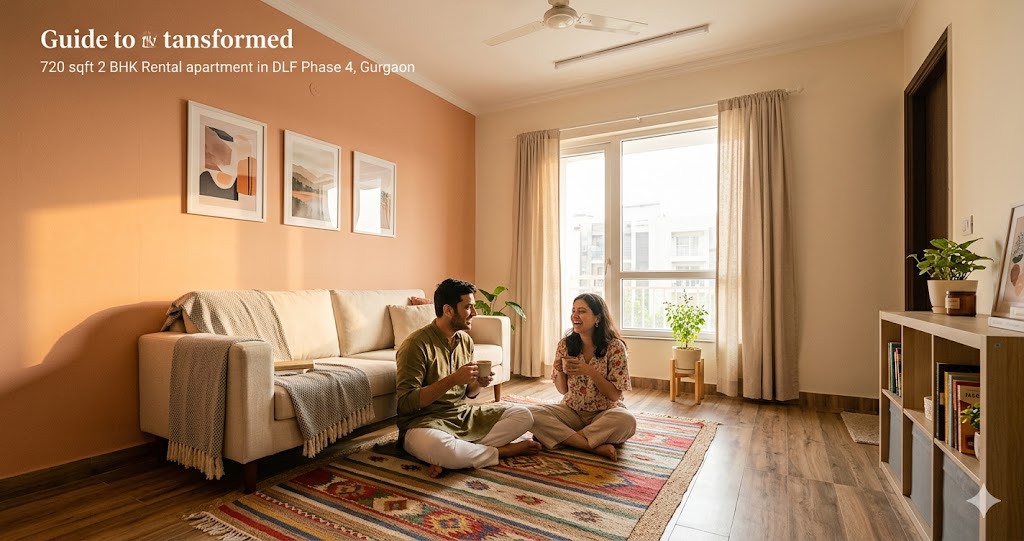
Rental Apartment Interiors — Tenant-Friendly Transformations for Indian Renters (2026)
Reversible upgrades · Deposit-safe · 11 vs 24 month lease · Peel-stick wallpaper · Velcro hangs · ₹50K-₹2L budgets
Rental apartment interiors are the discipline of making a home that is not yours look, feel and function like one — without losing your deposit when you leave. In 2026 India, roughly 45 percent of urban families live in rented homes (Knight Frank India, JLL urban housing trackers), most on an 11-month registered leave-and-licence agreement that explicitly bars drilling, plumbing changes and permanent paint. The interior playbook for a tenant is therefore the opposite of an owner's — every choice has to be reversible, portable and deposit-safe.
This guide is for the renter who has just signed for a 1BHK in Whitefield or a 2BHK in Andheri East or a builder-floor in Gurgaon, and is staring at chalk-white walls, a builder-grade kitchen and a deposit cheque worth three months' rent that they desperately want back. We will cover what your agreement actually permits, which transformations are reversible in five minutes, which Indian vendors sell peel-and-stick wallpaper that actually peels off, how to negotiate a 24-month tenancy that earns you the right to drill, and the sunk-cost discipline of not over-investing in a home you will leave in 11 months.
"The rented home is the only interior project in India where success is measured at move-out, not move-in. The deposit cheque is the report card."
For homeowners with permanent walls, read budget-luxury-interiors, smart-storage-interiors and space-efficient-homes for the long-haul playbook; for tenants juggling tight square footage on top of tight terms, compact-urban-living is the natural companion to this guide.
This guide refreshes every 12 months. Last verified: May 2026 · Next verify: May 2027.
What Rental Apartment Interiors Actually Mean in 2026 India
Rental apartment interiors in 2026 India is a tightly bounded design problem: take a builder-handed-over flat — typically 450 to 1,100 sq ft for a 1BHK or 2BHK in the major metros — and transform it into a home that reflects the tenant's taste, supports their work-from-home setup, accommodates their possessions, and can be undone in a single weekend at the end of the lease. Every material, fixture and piece of furniture is evaluated on a single axis the homeowner never has to think about: reversibility.
The Indian context sharpens this further. Standard tenancy agreements registered under the Maharashtra Rent Control Act, the Karnataka Rent Act, or the Model Tenancy Act 2021 (which several states have adopted in modified form) typically run 11 months — short enough to avoid mandatory long-tenancy clauses, long enough for the landlord to amortise broker fees. Security deposits in Bengaluru still average 10 months' rent for premium 2BHKs (the highest in India); Mumbai sits at 2-3 months; Delhi NCR 2-3 months; Pune 2-4 months; Chennai 5-10 months. That deposit is the leverage every tenant negotiates against. A scratched wall, a drilled hole the landlord notices, a non-original light fixture — any of these can become a deduction.
Five things rental apartment interiors are NOT:
1. Not the same as homeowner interiors at a lower budget. The constraints are different in kind, not degree. A homeowner with ₹50K can still drill, paint and re-tile; a tenant with ₹2 lakh often cannot. Budget alone does not capture the difference.
2. Not "temporary" in a dismissive sense. The median urban Indian tenancy lasts 2.7 years (Magicbricks rental churn study, 2025) — long enough to justify real investment in comfort, just not in the fabric of the building.
3. Not the landlord's problem. The builder-handed-over flat is the baseline; the landlord is not contractually obliged to upgrade lighting, repaint between tenants in most metros, or replace dated bathroom fittings unless the agreement explicitly says so. The tenant either lives with it or transforms it themselves.
4. Not a place for built-ins. Built-in wardrobes, fixed kitchen islands, plastered TV units and any joinery screwed to the wall belong to owned homes. The rental equivalent is the free-standing piece that walks out with you.
5. Not paint-and-pray. Painting a feature wall without written landlord permission is the single most common deposit-deduction in Indian metros. The mature rental playbook treats permanent paint as a last resort, not a first move.
The mental model: you are a curator of objects in a leased gallery. The gallery walls belong to someone else. Everything that is yours, must be yours to walk out with.
Why Rental Apartment Interiors Matter Now
Three forces have collided in urban India to make rental interiors a fast-growing search query and a real industry segment in 2026.
First, the rental cohort itself has expanded. Knight Frank India's 2025 urban housing affordability index shows that Bengaluru, Mumbai and Hyderabad now require 8.5x, 14.3x and 6.2x annual household income respectively to buy a median-priced apartment. For the under-35 urban professional, ownership has been deferred or abandoned. JLL's residential trends report estimates that 45 percent of urban Indian families now rent — and within the 25-35 age bracket in metros that number rises to 68 percent. This is a cohort with disposable income, design awareness from social media, and a permanent expectation of mobility (job changes every 2-3 years, city changes every 4-5).
Second, the supply has consolidated around co-living and branded rental. Stanza Living, Colive, Zolo, Settl. and Your-Space have brought hotel-style, design-led rental product to the metros — and reset the tenant's expectations. A renter walking into a builder-handed-over unfurnished flat in 2026 has just been benchmarked against a Stanza Living unit with engineered-wood flooring, Philips Hue lighting and Wakefit mattresses. The pressure to transform the bare flat is now baked into the cohort.
Third, the e-commerce stack for renters has matured. Wallmantra (peel-and-stick wallpaper), Pepperfry (free-standing furniture with assembly), Urban Ladder (modular sofas), IKEA India (post-2018 expansion now covers 8 cities), Amazon Basics (peel-stick floor tiles, Command strips, tension rods), and a long tail of Instagram-led brands (Nestasia, House of Things, Freedom Tree, Address Home) have made the transformation kit available with two-day delivery. As recently as 2018, the tenant had to assemble all of this from kiraana shops, MR Mart and Lifestyle Home Centre. Today the entire kit ships in a single Amazon basket.
The result: a tenant in Koramangala or Powai in 2026 can transform a 750 sq ft 2BHK from builder-grade to magazine-shoot-worthy for ₹85,000 to ₹1.4 lakh, with everything reversible at move-out. That price-point — call it the ₹50K-2 lakh tenant tier — is what this guide addresses.
The Seven Defining Characteristics of Rental Apartment Interiors
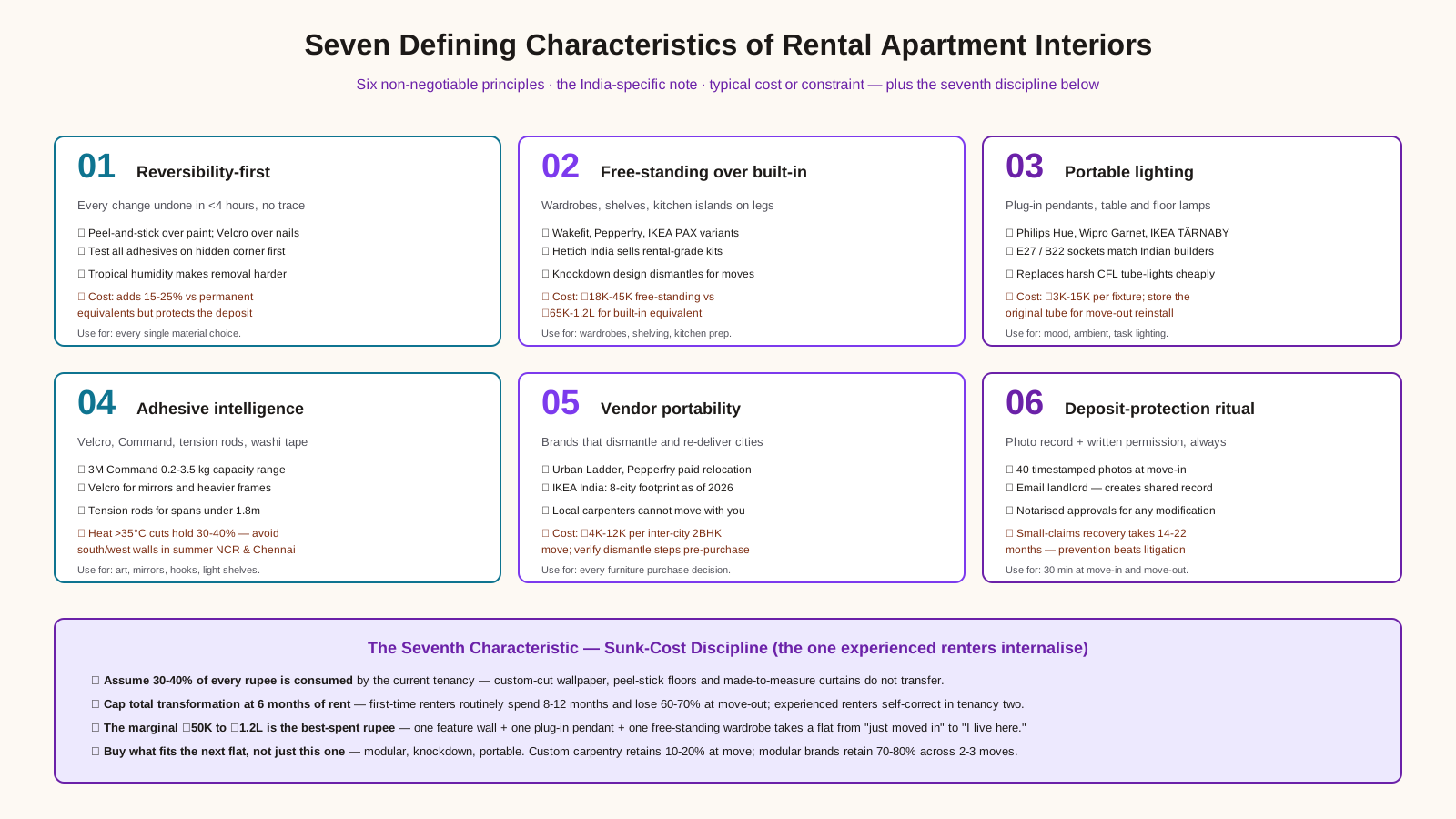
The tenant playbook revolves around seven non-negotiable principles. Violate any one and either the deposit suffers, or the move is logistically brutal, or the design simply does not work.
| Characteristic | What It Means | India-Specific Note | Typical Cost or Constraint |
|---|---|---|---|
| Reversibility-first | Every material change must be undone in under 4 hours without trace | Indian tropical humidity makes adhesive removal harder — test all peel-stick products on a hidden corner first | Adds 15-25% to materials cost vs permanent equivalents |
| Free-standing over built-in | Wardrobes, bookshelves, kitchen islands all on legs, not screwed in | Hettich India and Hafele India now sell heavy-duty free-standing wardrobe kits designed for rentals | ₹18K-45K for a 4-door free-standing wardrobe vs ₹65K-1.2 L for built-in |
| Portable lighting | Plug-in pendants, table lamps, floor lamps replacing harsh CFL tube-lights | Indian builder-grade flats use B22 / E27 sockets — replacement bulbs/fixtures must match | ₹3K-15K per fixture; original fixture stored for move-out |
| Adhesive intelligence | Velcro, Command strips, tension rods, washi tape over nails and screws | Tropical heat (above 35°C) weakens 3M adhesive — Indian summer reduces hold strength by 30-40% | ₹500-2K per wall art / shelf mount |
| Vendor portability | Buying from brands that deliver, dismantle and re-deliver across cities | Urban Ladder, Pepperfry, IKEA India offer paid relocation services; local carpenters do not | ₹4K-12K per inter-city move for a 2BHK |
| Deposit-protection ritual | Photographic record at move-in and move-out, written permissions for any modification | Indian small-claims for deposit recovery take 14-22 months — prevention is cheaper than litigation | 30 minutes at move-in, 30 minutes at move-out |
| Sunk-cost discipline | Accepting that 30-40% of investment will not survive the move and budgeting accordingly | Indian tenants overspend on first rental, then learn — typical correction in second tenancy | Budget ceiling = 6 months of rent for total transformation |
The seventh — sunk-cost discipline — is the one that experienced renters internalise and first-time renters learn the hard way. The custom-cut peel-and-stick wallpaper you bought for the bedroom feature wall? It does not transfer to the next apartment, because the wall dimensions will be different. The peel-stick floor tiles you laid in the kitchen? They come off the original floor cleanly, but the adhesive backing is single-use. The made-to-measure curtains for the living room? The new place will have different window sizes. Assume 30-40 percent of every rupee spent on transformation is consumed by the current tenancy.
A Worked Example: A 750 sq ft 2BHK in HSR Layout, Bengaluru
Priya, a 29-year-old product manager at a Bengaluru SaaS firm, signs an 11-month registered tenancy for a 750 sq ft 2BHK in HSR Layout Sector 2 at ₹42,000 per month, with a ₹4.2 lakh deposit (10 months) and a ₹15,000 monthly maintenance. The flat is on the 7th floor of a 2018-built tower, handed over by the previous tenant in fair condition: chalk-white walls, beige vitrified tile flooring throughout, builder-grade modular kitchen with a basic chimney, no false ceiling, harsh CFL tube-lights in every room, builder-installed window grilles and aluminium-frame sliding windows facing east (the living room) and north (both bedrooms).
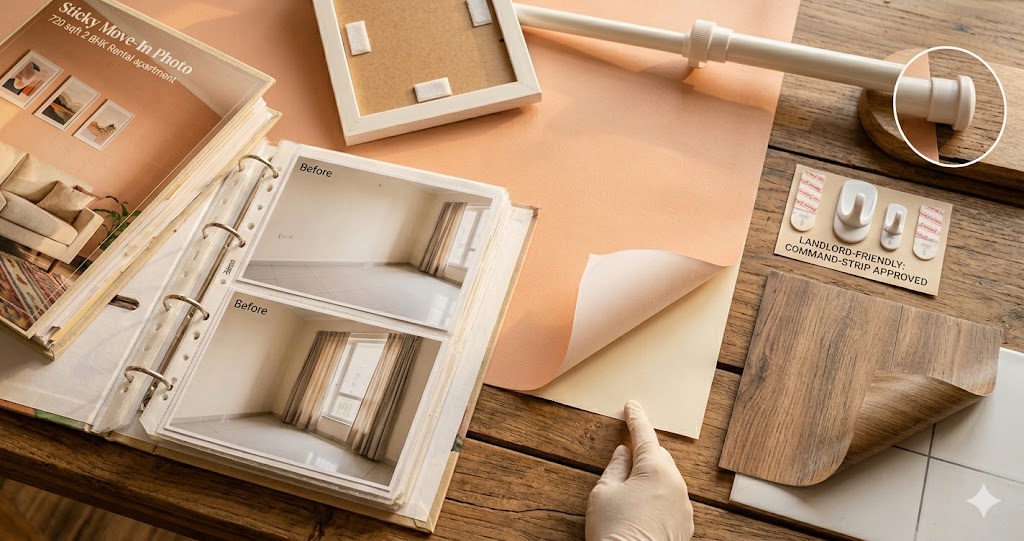
The landlord's written agreement permits: changing light bulbs, hanging wall art with Command strips or Velcro, free-standing furniture of any kind, replacement of curtain rods if originals are reinstalled at move-out, peel-and-stick wallpaper on any one wall per room provided it leaves no residue. It explicitly bars: drilling beyond two pre-existing nail holes per wall, painting any wall any colour, removing or modifying the modular kitchen, removing the builder grilles, plumbing changes including the bathroom fittings, and false-ceiling installation.
Budget: ₹1.35 lakh total (3.2 months of rent — within the 6-month ceiling).
Living room (₹52,000):
- Pepperfry Brando 3-seater modular sofa in slate-grey fabric: ₹38,000 (delivered, assembled, dismantles for moves)
- Wallmantra peel-and-stick brick-pattern wallpaper, single feature wall behind sofa (3.6m x 2.7m): ₹4,500
- IKEA TÄRNABY arc floor lamp with E27 plug-in: ₹3,800
- Cotton dhurrie from Jaipur Rugs (Fabindia online) 6x9 ft, defining the seating zone: ₹4,200
- Tension-rod curtain system from Amazon Basics + linen-look curtains from D'Decor: ₹1,500 rods + ₹0 (carried from previous flat)
Master bedroom (₹38,000):
- Wakefit free-standing 4-door wardrobe (engineered wood, knockdown design for moves): ₹24,000
- Urban Ladder Mintwood bedside table x 2: ₹4,800
- IKEA RANARP plug-in clamp lamps as bedside reading lights: ₹2,400 for two
- Hettich India Velcro-mount mirror panel, 1.2m x 0.4m, behind wardrobe door: ₹1,800
- Peel-and-stick wallpaper from Asian Paints Wallskin range, geometric pattern, single accent wall behind bed (3m x 2.7m): ₹3,800
- Replacement of harsh CFL tube with a Philips Hue White E27 plug-in pendant (original tube stored in cupboard for move-out): ₹1,200
Second bedroom (converted to home office) (₹22,000):
- Wakefit Wendell standing desk, free-standing: ₹14,500
- Urban Ladder Cooper office chair: ₹6,200
- Command-strip-mounted pegboard from Amazon for cable management and stationery: ₹800
- Plug-in LED strip from Philips for under-desk warm lighting: ₹500
Kitchen and bathroom (₹15,000):
- Peel-and-stick subway-tile pattern backsplash from Wallmantra, applied over existing builder-grade tile dado (1.8m x 0.6m): ₹2,800
- Free-standing kitchen trolley from Pepperfry for prep workspace: ₹6,500
- Bathroom: Velcro-mount magnetic strip for toothbrush holders (Amazon): ₹400; peel-stick anti-skid floor decals from Nestasia: ₹1,800; tension rod with separate shower curtain (since the builder shower has no enclosure): ₹3,500
Miscellaneous (₹8,000):
- Move-in photographic record session (40 photos, every wall, ceiling, floor, fitting): ₹0 (self, on phone)
- 11-month replenishment of Command strips, Velcro, washi tape: ₹2,500
- Plant kit from Ugaoo (4 indoor plants in self-watering pots): ₹4,200
- Deposit-protection notarised email trail to landlord acknowledging all peel-and-stick installations as removable: ₹1,300 (legal stationery, courier)
At move-out 11 months later: Priya removes peel-and-stick wallpaper in three rooms (4 hours), reinstalls original CFL tube and builder light fixtures (45 minutes), removes Velcro and Command strips with hairdryer to soften adhesive (90 minutes), dismantles Wakefit wardrobe and Pepperfry sofa for inter-city move to Hyderabad (where she has accepted a new role), and lists the IKEA arc lamp, free-standing kitchen trolley, peel-stick subway tiles (unused box) on OLX and Quikr for ₹6,200 collected from the incoming tenant of the same building.
Net sunk cost: ₹1.35 lakh - ₹6,200 resale - ₹95,000 carried-forward furniture = ₹33,800 truly consumed by the 11-month tenancy. Roughly 25 percent of the gross spend — within the discipline.
Rental Apartment Interiors vs Adjacent Categories
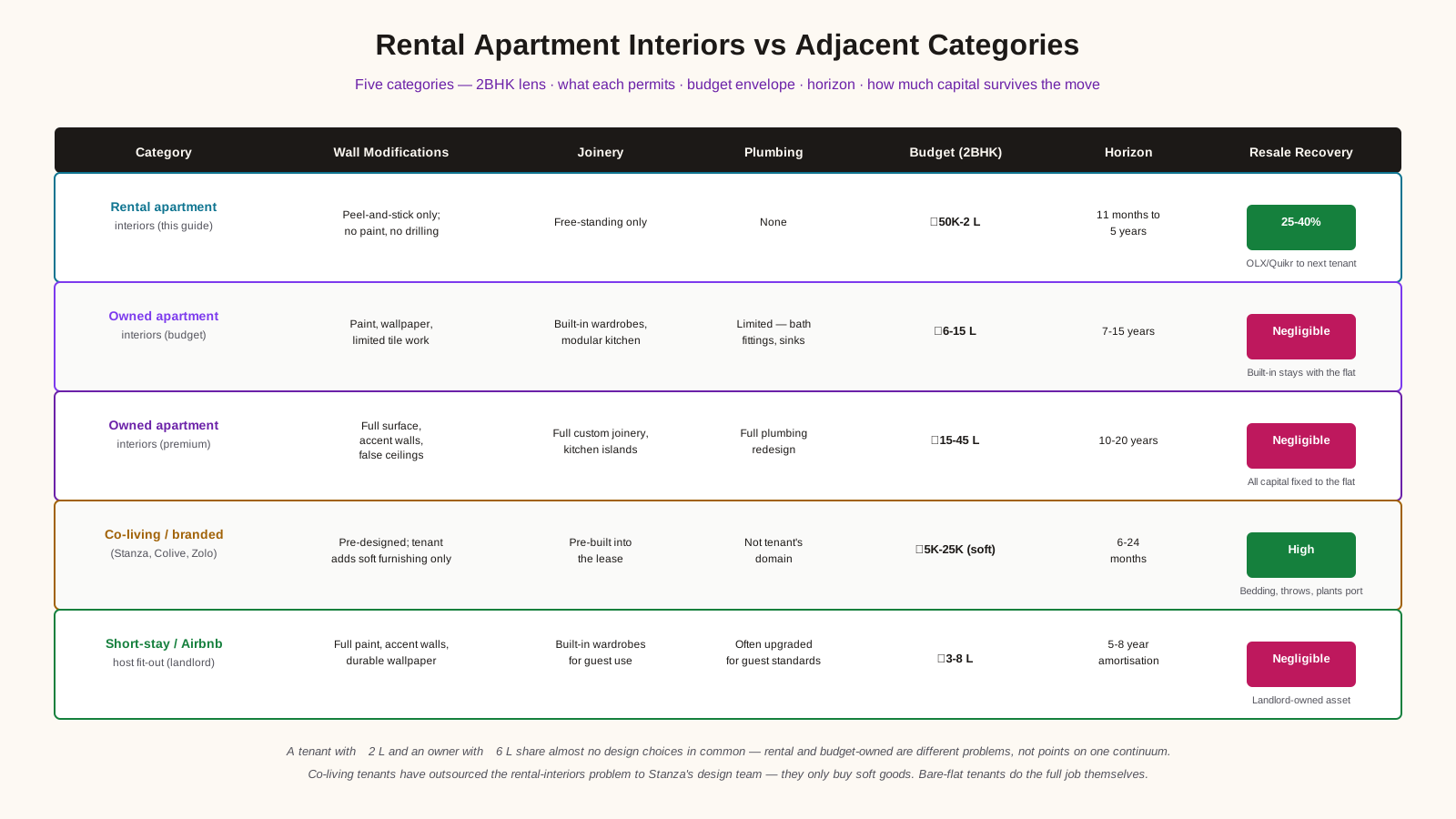
Tenants often conflate rental interiors with adjacent design categories and end up over-spending or under-protecting themselves. The differences are real and budget-defining.
| Category | Wall Modifications | Joinery | Plumbing | Typical Budget (2BHK) | Time Horizon | Resale of Materials |
|---|---|---|---|---|---|---|
| Rental apartment interiors (this guide) | Peel-and-stick only; no paint, no drilling | Free-standing only | None | ₹50K-2 L | 11 months to 5 years | 25-40% via OLX/Quikr to next tenant |
| Owned apartment interiors (budget) | Paint, wallpaper, limited tile work | Built-in wardrobes, modular kitchen | Limited (bath fittings, sinks) | ₹6-15 L | 7-15 years | Negligible — built-in |
| Owned apartment interiors (premium) | Full surface treatment, accent walls, false ceilings | Full custom joinery, kitchen islands | Full plumbing redesign | ₹15-45 L | 10-20 years | Negligible |
| Co-living / branded rental (Stanza, Colive) | Pre-designed; tenant adds only soft furnishing | Pre-built into the lease | Not tenant's domain | ₹5K-25K (soft only) | 6-24 months | High portability of soft goods |
| Short-stay / Airbnb host fit-out (for landlords) | Full paint, accent walls, durable wallpaper | Built-in wardrobes for guest use | Often upgraded for guest standards | ₹3-8 L | 5-8 year amortisation | Negligible — landlord asset |
Two distinctions matter most. First, rental interiors and budget owned interiors are not points on the same continuum — they are different problems. A tenant with ₹2 lakh and an owner with ₹6 lakh share almost no design choices in common. Second, the co-living tenant has effectively outsourced the rental-interiors problem to Stanza Living's design team — they only buy soft furnishings (bedding, throws, plants, one wall art piece) for ₹5K-25K. The bare-flat tenant is doing the full job themselves.
Materials, Finishes and Brand Landscape
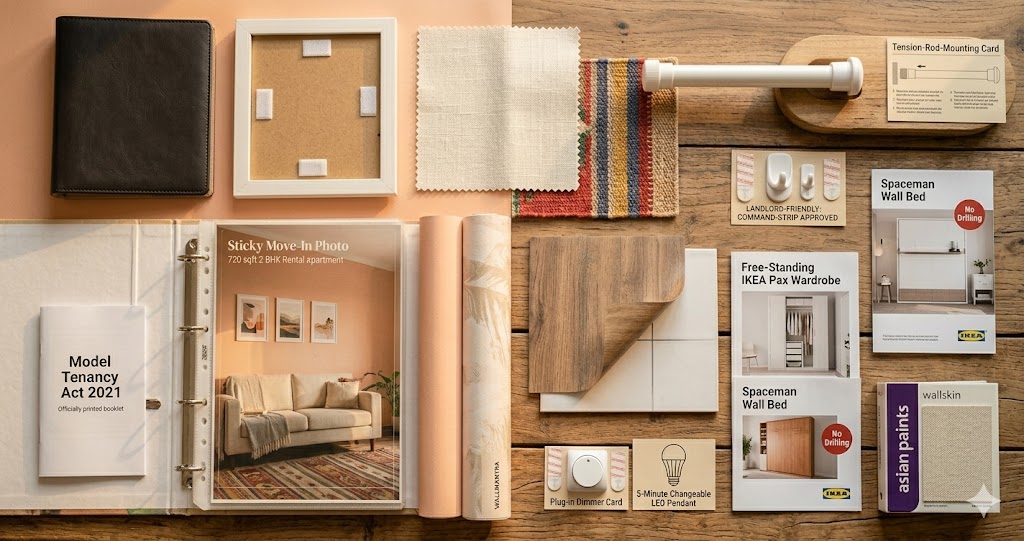
The Indian rental-friendly product stack has matured in three categories: removable surface treatments, free-standing furniture and reversible hardware.
| Category | Brand | Product | Reversibility Rating | Price Range (2026) | Notes for Indian Climate |
|---|---|---|---|---|---|
| Peel-and-stick wallpaper | Wallmantra | Self-adhesive vinyl rolls, geometric/textured/photographic | Excellent (residue-free up to 18 months) | ₹250-600 per sq ft | Tested on Bengaluru / Pune; humidity beyond 80% can curl edges |
| Peel-and-stick wallpaper | Asian Paints Wallskin | Premium PVC-free range, 50+ patterns | Excellent | ₹400-900 per sq ft | India-formulated for monsoon humidity |
| Textured wall coating | Asian Paints Roller-Tex | Roller-applied texture; landlord-permission only | Poor (requires re-painting at move-out) | ₹35-65 per sq ft | NOT a rental product — included to warn against confusion |
| Free-standing wardrobe | Wakefit | Knockdown engineered-wood, 2/3/4 door variants | Excellent (dismantles in 25 minutes) | ₹14K-42K | Engineered wood handles humidity well |
| Free-standing wardrobe | IKEA India (PAX free-standing variant) | Solid frame, drawer/shelf modular interior | Good (heavy; needs two-person move) | ₹22K-65K | Bengaluru, Mumbai, Hyderabad, Delhi NCR stores |
| Free-standing sofa | Pepperfry, Urban Ladder | Modular 2/3-seater with detachable legs | Good (re-assembles after move) | ₹22K-85K | Cotton/linen upholstery preferred over leather in tropical climate |
| Plug-in pendant lights | Philips Hue, Wipro Garnet, IKEA | E27 / B22 plug-in with hanging cord | Excellent | ₹1,500-12K | E27 fits most Indian builder-grade sockets |
| Tension-rod curtain system | Amazon Basics, Daiso India | Spring-loaded rods, no drilling | Excellent | ₹500-2,500 | Limited to spans under 1.8m; long living-room windows need alternative |
| Command strips and hooks | 3M Command (Amazon India) | Damage-free adhesive, 0.2-3.5 kg capacity | Excellent (warm-water removal) | ₹300-1,500 per pack | Heat above 35°C reduces hold by 30-40% — avoid south-facing walls in summer |
| Velcro fastener strips | Velcro Brand (Amazon India), Hettich India | Industrial-strength self-adhesive | Good (some residue possible) | ₹400-2,000 per pack | Excellent for mirror panels, light frames |
| Peel-and-stick floor tiles | FloorPops (Amazon India), Wallmantra | Vinyl tile-over-tile, 12x12 inch | Good (single-use adhesive) | ₹120-380 per sq ft | Works over vitrified; not recommended over uneven tile or marble |
| Area rugs (zone-makers) | Jaipur Rugs, Fabindia, IKEA, Address Home | Cotton dhurries, jute, wool blends | Excellent (fully portable) | ₹3K-45K | Cotton/jute preferred for monsoon dampness; wool only in dry-climate cities |
| Free-standing kitchen trolley | Pepperfry, IKEA RÅSKOG, Wakefit | Wheeled prep surface and storage | Excellent | ₹4K-14K | Adds counter space to builder kitchens |
| Plug-in dimmer | Wipro, Havells (plug-in modules) | Inline dimmer for E27 / B22 lamps | Excellent | ₹800-2,200 | Avoids wired-dimmer drilling into landlord wall |
| Magnetic kitchen strip | Hafele India, Amazon Basics | Self-adhesive magnetic strip for utensils | Good (heat-affected near hob) | ₹600-2,800 | Mount away from cooktop |
| Free-standing bookshelf | Urban Ladder, Wakefit, IKEA BILLY (free-standing variant) | 3-5 shelf configurations | Excellent | ₹5K-22K | Bolt to wall NOT required if shelf depth >25cm |
A subtle but important note on adhesive products in Indian summers: 3M's published Command-strip performance assumes temperatures below 35°C. In Delhi NCR, Hyderabad, Ahmedabad and Chennai, sustained internal wall temperatures on south or west-facing walls in May-June regularly exceed 38-40°C — and the adhesive softens. Renters in these cities should avoid mounting heavy items (mirrors, large frames, shelving) on summer-exposed walls. North-facing walls in the same flat are safe year-round.
Eight Pitfalls Common in 2026 India
1. Painting a feature wall "because the landlord won't notice." The landlord always notices. Indian landlords routinely deduct ₹15,000-40,000 from the deposit for repainting a single feature wall — far more than the actual paint cost, because the deduction is punitive. Mitigation: peel-and-stick wallpaper costs ₹3,500-8,000 for the same feature-wall effect and leaves no trace. If you must paint, get written landlord permission and a written reduction in the move-out repaint deduction.
2. Drilling for a TV mount. The wall-mounted TV is the single most-requested modification in rental flats and the second-largest source of deposit deductions after paint. Mitigation: free-standing TV consoles from Urban Ladder or Pepperfry (₹8K-25K) work for screens up to 65 inches. If you absolutely need a wall mount, use a free-standing TV stand designed to hold the mount (Bonum, OnePlus stands, Amazon Basics range), or negotiate the drilling in writing in advance with a fixed move-out repair cost (typically ₹2,000-4,000).
3. Over-investing in the first tenancy. First-time renters routinely spend 8-12 months of rent on transformation and lose 60-70 percent of it at move-out. Mitigation: cap total transformation spend at 4-6 months of rent for the first tenancy. Buy free-standing, portable, modular pieces that carry forward to the next 2-3 flats. The ceiling is a discipline, not a target.
4. Choosing the wrong adhesive for the wall texture. Indian builder walls are often POP-finished with a slight texture that defeats Command strips. The strip "holds" for two weeks and then fails, taking a chunk of POP with it. Mitigation: test all adhesive products on a hidden patch (behind a wardrobe, inside a cupboard door) for 48 hours before committing to a wall.
5. Skipping the move-in photo set. Without a timestamped, comprehensive photographic record of every wall, ceiling, floor, fitting and fixture at move-in, the tenant has no defence against move-out deductions for pre-existing damage. Mitigation: spend 30 minutes at move-in photographing every surface, including the inside of cupboards and the bathroom ceiling. Email the set to yourself (timestamps the record) and to the landlord (creates a shared record).
6. Ignoring the 11-month vs 24-month negotiation. The 11-month tenancy is a tax/regulatory convenience for landlords (avoids long-tenancy clauses under various state Rent Control Acts), but it constrains the tenant's willingness to invest. A 24-month tenancy (registered as two consecutive 11-month + 1-month overlap, or under the Model Tenancy Act 2021 in adopting states) typically earns the tenant the right to: limited drilling, one painted wall, replacement of light fixtures, fixed annual rent escalation. Mitigation: negotiate the longer tenancy at lease signing, in exchange for committing to a longer stay and accepting a 5-7 percent annual rent increase.
7. Buying non-portable furniture that "fits" the current flat. L-shaped sofas custom-sized to a specific living-room corner do not fit the next flat. Custom-built study tables for an alcove do not fit the next study. Mitigation: buy modular, knockdown furniture from brands designed for relocation (Wakefit, IKEA, Pepperfry's Brando line). Verify dismantle-and-reassemble instructions before purchase.
8. Forgetting to budget for the move-out reversal. The hairdryer rental, the peel-and-stick removal weekend, the touch-up of any Command-strip residue, the reinstallation of original light fixtures — all of this takes time and a small amount of money (₹2,000-5,000). Mitigation: allocate one full weekend and a ₹5,000 budget for move-out reversal. Schedule it before the landlord's pre-move-out inspection, not after.
India-Specific Considerations
Rental interiors in India sit at the intersection of state-specific tenancy law, municipal building rules, society/RWA bye-laws and the Vastu sensitivities of both tenant and landlord. These overlays are not optional.
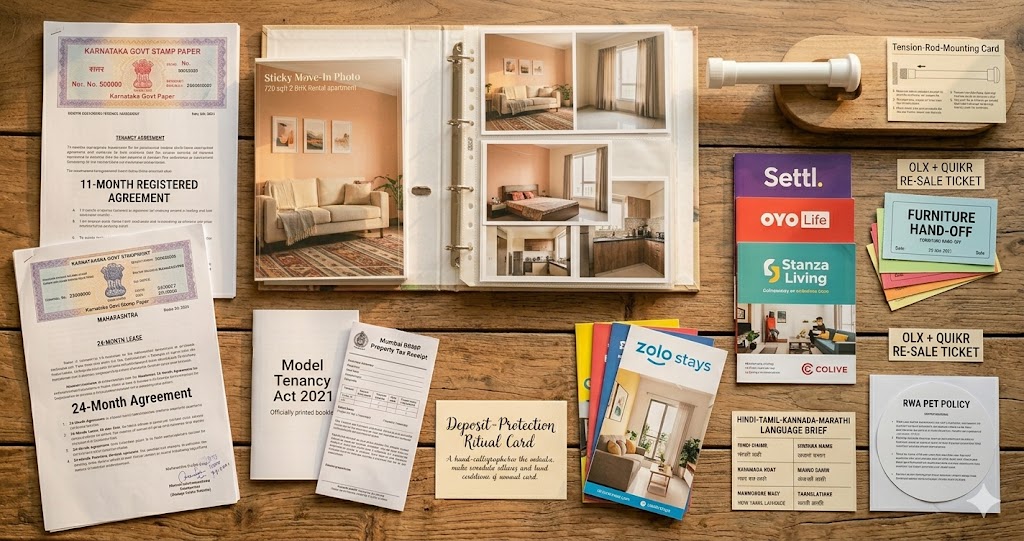
Tenancy law by state. Maharashtra (Mumbai, Pune) operates under the Maharashtra Rent Control Act 1999 and increasingly the Model Tenancy Act 2021 (adopted in modified form for new tenancies post-2022). Karnataka (Bengaluru) uses the Karnataka Rent Act 1999 with state-specific deposit norms (10-month deposits remain customary despite the Model Tenancy Act's 2-month cap recommendation). Delhi operates under the Delhi Rent Control Act 1958 for older buildings and the Model Tenancy Act for new agreements. Tamil Nadu (Chennai) uses the Tamil Nadu Regulation of Rights and Responsibilities of Landlords and Tenants Act 2017. Each state's deposit recovery process — small-claims forum, escalation to civil court — takes 14 to 26 months. Prevention via written permissions and photographic records is always cheaper than litigation.
Society and RWA rules. Apartment societies (under the Maharashtra, Karnataka, Delhi co-operative housing society acts) enforce bye-laws that affect tenants directly: move-in/move-out timing (often weekdays only, 9 am to 6 pm), furniture delivery notice (24-48 hours in advance to the society office), restrictions on contractor entry (most societies require tenant or landlord to be present), noise hours for drilling or hammering (often banned 10 am - 6 pm to protect work-from-home neighbours, then permitted 7 am - 9 am and 6 pm - 8 pm). Premium societies (Lodha World One, Oberoi Realty 360 West, Prestige Falcon City, Brigade Exotica, DLF The Camellias, Hiranandani Powai) impose additional aesthetic restrictions: balcony enclosures, external-facing curtain colours, even visible window-grill colours. Always read the society's tenant-bye-laws document before the first transformation.
NBC 2016 and IS code touch-points. Most tenant transformations are below the threshold that triggers NBC compliance (you are not altering structural walls, not adding plumbing loads, not changing electrical load). The one exception: if you add a portable air-conditioner, water-purifier with separate drain, or any appliance drawing above 2,000 watts continuously, IS 732 (Indian electrical wiring standards) applies via the society's electrical capacity. Always verify with the society engineer that your appliance load fits the unit's sanctioned capacity (most builder-grade 2BHK flats are sanctioned for 3-5 kW; adding a second AC in the home-office bedroom may exceed that).
DPDP Act 2023 and smart-home devices. Tenants installing Philips Hue, Amazon Alexa, Google Nest, Realme Smart cameras and other connected devices in rental flats need to be aware that the DPDP Act 2023 makes the device-installer responsible for personal data captured by the device. A tenant who installs a smart camera that captures the landlord's contractor visiting for a repair is a "data fiduciary" for that visitor's image. Practical mitigation: keep cameras pointed inward, disable when third parties enter, and disclose presence at the lease level.
Vastu compatibility. A meaningful share of Indian landlords — and an even larger share of incoming tenants — care about Vastu. Free-standing furniture re-positioning by the tenant is generally Vastu-neutral (you are not changing the building, only its contents). The exceptions: mirrors directly facing the bed, study desk facing the wrong cardinal direction, and pooja-corner placement. For tenants who care about this, vastu-modern-homes and vastu-for-bedroom cover the principles; for landlords who care about it, the conversation is best had before lease signing rather than after.
Climate zone variation. Peel-and-stick wallpaper behaves differently in Bengaluru (mild year-round, low risk of edge-curl) versus Chennai (high humidity, monsoon-driven edge failures), versus Delhi NCR (extreme summer wall-temperature, adhesive softening), versus Mumbai (sea-salt air, slow degradation of adhesive over 12+ months). Always specify your city when buying from Wallmantra or Asian Paints Wallskin; their customer service will recommend the appropriate adhesive variant. The Studio Matrx furniture planner can help verify that any free-standing piece you are considering fits the actual clearance and circulation envelope of your rental layout before purchase — a small step that prevents the "doesn't quite fit" return logistics that punish renters most.
Regional vendor reach. Bengaluru, Mumbai, Delhi NCR, Hyderabad and Pune have full vendor reach (IKEA, Pepperfry, Urban Ladder, Wakefit, Wallmantra all deliver within 3-5 days). Chennai, Kolkata and Ahmedabad have partial reach (some brands deliver in 7-12 days; some products are only available online). Tier 2 cities (Indore, Jaipur, Lucknow, Coimbatore, Kochi) have selective reach — Wakefit and Pepperfry deliver everywhere, but Wallmantra and IKEA do not yet ship to all PIN codes. Verify deliverability before lease-signing if your transformation plan depends on specific brands.
The Budget Bands for 2026 India
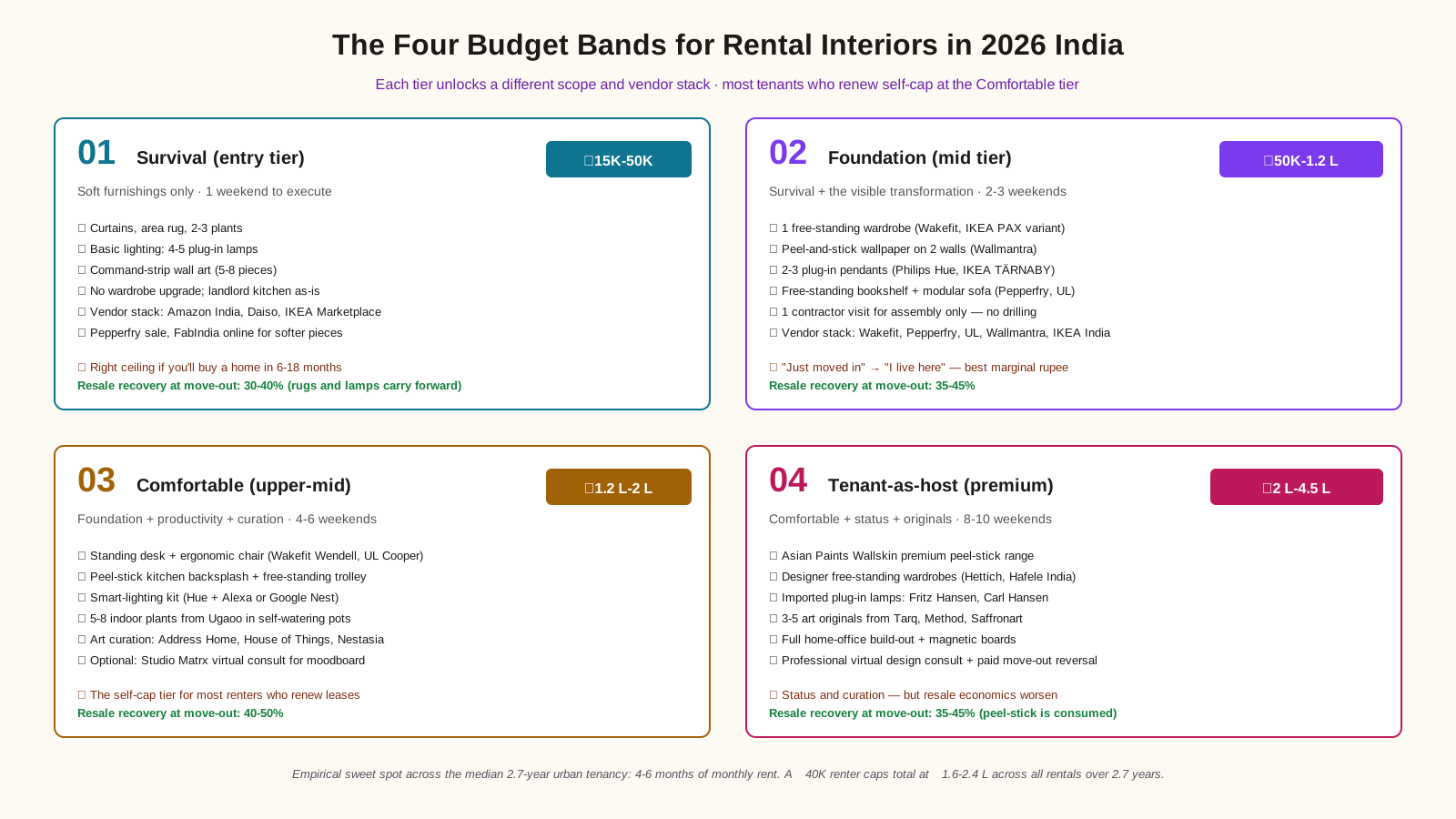
The tenant transformation budget falls into four well-defined tiers. Each unlocks a different scope and a different vendor stack.
| Tier | Budget Range | What It Covers | Vendor Stack | Time to Execute | Resale Recovery at Move-Out |
|---|---|---|---|---|---|
| Survival (entry) | ₹15K-50K | Soft furnishings only: curtains, area rug, 2-3 plants, basic lighting upgrade (4-5 plug-in lamps), Command-strip wall art (5-8 pieces) | Amazon India, Daiso, Pepperfry sale, IKEA Marketplace, FabIndia online | 1 weekend | 30-40% (rugs and lamps carry forward) |
| Foundation (mid) | ₹50K-1.2 L | Survival tier + free-standing wardrobe (1), peel-and-stick wallpaper (2 walls), plug-in pendants (2-3), free-standing bookshelf, modular sofa | Wakefit, Pepperfry, Urban Ladder, Wallmantra, IKEA India, Philips Hue | 2-3 weekends + 1 contractor visit (assembly only) | 35-45% |
| Comfortable (upper-mid) | ₹1.2 L-2 L | Foundation tier + standing desk, ergonomic chair, peel-stick kitchen backsplash, peel-stick floor accents, free-standing kitchen trolley, smart-lighting kit (Hue/Alexa/Google Nest), 5-8 indoor plants from Ugaoo, art curation from Address Home or House of Things | Foundation brands + Hettich India, Hafele India, Address Home, House of Things, Ugaoo, Smart-home brands | 4-6 weekends, possibly with a Studio Matrx virtual consult | 40-50% |
| Tenant-as-host (premium rental) | ₹2 L-4.5 L | Comfortable tier + premium peel-stick wallpaper (Asian Paints Wallskin premium range), designer free-standing wardrobes, Fritz Hansen / Carl Hansen plug-in lamp (imported), curated art (3-5 originals from Tarq, Method, Saffronart), magnetic boards, professional virtual interior design consult, full home-office build-out, professional move-out reversal service | Foundation + Premium brands + Tarq, Method, Saffronart, professional virtual design service | 8-10 weekends with professional support | 35-45% (premium soft goods retain value but peel-stick is consumed) |
A few patterns worth naming. The marginal rupee from ₹50K to ₹1.2 L delivers the most visible transformation — adding a single peel-and-stick feature wall, a plug-in pendant and a free-standing wardrobe takes the flat from "I just moved in" to "I live here." The marginal rupee from ₹1.2 L to ₹2 L delivers comfort and productivity (the standing desk, the ergonomic chair, the smart lighting). The marginal rupee from ₹2 L to ₹4.5 L delivers status and curation, but at increasingly poor resale-recovery economics. Most tenants who renew tenancies (the 2.7-year median tenant) self-cap at the Comfortable tier.
"The best-spent rupee in a rental is on a piece of furniture that fits the next flat. The worst is on a piece of joinery that fits only this one."
When Rental Apartment Interiors Are NOT the Right Fit
The rental playbook is the wrong playbook for several adjacent situations, and applying it anyway leads to over-spending or under-design.
You are about to buy your own home in 6-18 months. The deposit on the next purchase, the home loan EMI, and the eventual transformation of the owned flat will consume the capital that a rental transformation would have absorbed. Survival-tier (₹15K-50K) is the right ceiling for the bridging rental. Save the design energy for the owned flat.
You have signed a 5+ year tenancy. Long tenancies (rare in India outside of Bengaluru corporate leases and Hyderabad family-rental arrangements) justify owner-grade interiors. With written landlord agreement, you can negotiate a transformation budget shared between tenant and landlord, with the landlord absorbing a portion in exchange for an asset that improves the post-tenancy rental price. The rental-only playbook (free-standing, peel-stick, reversible) under-serves a 5-year horizon.
You are renting from family. The deposit-protection ritual and the reversibility-first principle are over-engineered for a tenancy where the landlord is a parent, sibling, or in-law. The right approach is closer to a budget owned-home transformation with explicit written agreement on what reverts to the property owner at move-out.
You are in a co-living or branded rental arrangement. Stanza Living, Colive, Zolo, Settl. and Your-Space deliver the interior as part of the lease. The tenant's design budget is properly limited to soft furnishings (bedding, throws, plants, a single wall art piece) for ₹5K-25K. Buying free-standing wardrobes or peel-stick wallpaper for a co-living unit is wasted capital.
You are house-sitting or in a 1-3 month short stay. Tension rods, plug-in lamps and a single area rug. Nothing more.
The landlord is selling the property within your tenancy. Any transformation may be reversed at the new owner's discretion. The deposit dispute risk is also elevated (handover from old to new owner often creates a gap in the deposit chain). Survival tier only.
The 5-Year Trajectory: 2030 Outlook
Three forces will reshape rental apartment interiors in India between 2026 and 2030.
Co-living will normalise the design baseline. As Stanza Living, Colive and others push branded rental to 8-12 percent of urban rental supply by 2030 (current: ~3-4 percent, per JLL co-living tracker), the unfurnished builder-flat tenant will increasingly benchmark against design-led inventory. Landlords of bare units will either upgrade (light fixtures, better paint, peel-and-stick-friendly wall finishes) or accept a 10-15 percent rental discount versus design-led equivalents.
Modular and knockdown furniture will dominate. IKEA India's expansion to 12+ cities, Wakefit's continued knockdown-focused product line, and the rise of D2C furniture brands (Furlenco, Rentomojo for rental furniture, Wakefit and Pepperfry for purchased) will make true modular furniture the default for the under-35 urban cohort by 2030. Custom carpentry for tenants — already declining — will become a niche choice for the over-45 tenant who values craft over portability.
Peel-and-stick will reach surface parity with paint for tenants. Asian Paints' Wallskin range and competitors will hit the price-per-sq-ft of premium paint by 2028-2029, removing the cost premium that today still exists for the highest-quality peel-and-stick. The 2030 tenant will default to peel-and-stick for any feature-wall treatment, with paint reserved only for the rare long-tenancy or owner-permission scenario.
DPDP Act compliance will mature. Smart-home device-makers (Philips Hue, Amazon, Google, Xiaomi) will ship India-specific privacy controls by 2028. The tenant who today has to manually disable cameras when the landlord's contractor visits will, by 2030, have a one-tap "third-party present" mode that documents disclosure and consent.
Virtual design will absorb the tenant segment. The economics of a site-visit interior designer (₹15K-25K minimum project fee plus 8-15 percent of execution) do not work for a ₹85K rental transformation. Virtual design platforms — including virtual-interior-design services and AI-led tools — will absorb 30-40 percent of urban rental design queries by 2030. Studio Matrx's tenant-focused flow (free moodboard, free room visualisation, paid consult only if the tenant wants human review) is sized exactly for this cohort.
Climate adaptation will become an explicit design parameter. As Bengaluru summers cross 38°C with rising frequency, Chennai monsoons intensify, and Delhi NCR winters drop colder, the tenant's adhesive-product choice, plant selection and lighting palette will become explicitly climate-zoned. Wallmantra and Asian Paints Wallskin already segment by climate; by 2030 every major rental-friendly brand will.
Frequently Asked Questions
Q: Can my landlord deduct from my deposit for peel-and-stick wallpaper if I remove it cleanly?
A: Legally, no — if the agreement permits peel-and-stick (most do, since it is residue-free) and you have written confirmation that you have removed it. Practically, landlords in deposit disputes often try to deduct anyway. The defence is: written permission at install, photographic record at install, photographic record at clean removal, and a notarised email exchange confirming the wall is in original condition. If the landlord still deducts, small-claims forums in your state (Karnataka KAREDA, Maharashtra MahaRERA's tenancy adjudication, Delhi DRO) are the recovery channel. Recovery typically takes 14-22 months.
Q: How much should I spend on rental interiors as a percentage of my rent?
A: The empirical sweet spot, based on the median 2.7-year urban tenancy, is 4-6 months of monthly rent spread across the full tenancy. A renter paying ₹40,000/month should cap total transformation at ₹1.6-2.4 lakh across all rentals over 2.7 years. First-time renters routinely exceed this and learn the hard way; experienced renters self-cap.
Q: Is it worth getting an interior designer for a rental?
A: For ₹50K-1.2 L budgets, a traditional site-visit interior designer's minimum project fee (₹15-25K plus execution markup) does not pencil. Virtual design — Studio Matrx's flow, or the lighter peer-to-peer Instagram designer route — is correctly sized for the rental segment. For ₹2 L+ premium rental tier, a paid virtual consult (₹3K-8K) for moodboard validation and material selection is worthwhile. See choosing-an-interior-designer-india for the broader framework.
Q: Are Command strips really safe for builder-grade walls in India?
A: Mostly yes, with caveats. POP-finished walls (the Indian builder default) hold Command strips well at temperatures below 32°C. Above 35°C internal wall temperature — common on south/west-facing walls in Delhi NCR, Hyderabad, Ahmedabad and Chennai in May-June — adhesive strength drops 30-40 percent. Mitigation: avoid heavy items on summer-exposed walls; use Velcro fastener strips (slightly more residue but heat-resilient) for items above 1.5 kg.
Q: Can I install an air-conditioner in a rental flat?
A: Window-mounted ACs typically require drilling — needs explicit landlord permission and a written move-out reversal cost (₹3K-6K for plaster repair). Split ACs require external-unit installation, electrical load addition and refrigerant piping through the wall — landlord permission is mandatory and reversal at move-out is substantial (₹8K-15K). Portable plug-in ACs (Cruise, LG, Symphony air-coolers, or true portable ACs from BlueStar and Voltas) are the rental-friendly alternative — ₹18K-45K, fully portable, no installation, no deposit risk. Verify society electrical-load capacity (3-5 kW typical) before adding.
Q: How do I handle the deposit when leaving a Bengaluru rental with a 10-month deposit?
A: The Bengaluru 10-month deposit is the highest in India and the most-disputed at move-out. Mitigation: 30-day written move-out notice (per agreement), pre-move-out inspection by landlord with photographic record of the reverted-to-original state, deposit return within 30 days (specify in agreement), forfeiture-protection clause limiting deductions to documented damage with vendor quotations. If the landlord delays or under-pays, the small-claims process via the Karnataka small-causes court is the recovery channel — 14-18 months typical.
Q: What's the best way to handle storage in a rental kitchen with no pantry?
A: Free-standing kitchen trolleys (IKEA RÅSKOG ₹4-7K, Pepperfry equivalents ₹5-12K) on wheels provide pull-out pantry storage. Free-standing wire racks from Hettich India and Hafele India can stack to ceiling height without drilling. Magnetic strips on the fridge side (not on the wall) hold knives and small tools. For deeper analysis, see smart-storage-interiors.
Q: Should I negotiate an 11-month or 24-month tenancy in 2026?
A: For a tenant who is reasonably sure they will stay 2+ years and wants the right to drill, paint one wall, and replace light fixtures, the 24-month tenancy (registered under the Model Tenancy Act in adopting states, or as two-consecutive-11-month + 1-month-overlap in non-adopting states) is the better deal. The trade-off is a 5-7 percent annual rent escalation built in. For tenants whose horizon is uncertain (job changes, city changes), the 11-month with renewal option is more flexible. Bengaluru landlords increasingly accept 24-month tenancies in exchange for the longer-stay commitment.
Q: How do I make a builder-grade bathroom feel less utilitarian without plumbing changes?
A: Tension-rod-mounted shower curtain (replaces the bare-glass-divider look), peel-stick anti-skid floor decals, Velcro-mounted magnetic strip for toothbrush and razor storage, a free-standing wooden bath stool from Nestasia or Address Home, 2-3 monstera or pothos plants in the window (high-humidity-tolerant), peel-stick mirror frame (around the existing builder mirror), a single piece of small wall art on Command strips. Total budget: ₹4K-9K. The bathroom is the most transformable rental space per rupee because expectations start so low.
Q: Is it worth buying premium furniture for a rental knowing I'll move?
A: Yes — if it is portable. Wakefit, Pepperfry, Urban Ladder and IKEA India design furniture explicitly for moves (knockdown, modular, dismantle-reassemble). Premium versions of these (Pepperfry's premium ranges, Urban Ladder's higher-tier collections, IKEA's PAX systems) retain 70-80 percent value across 2-3 moves. Custom carpentry — even premium custom — retains 10-20 percent at best because it is fitted to one flat. The rule: premium is fine, custom-built is not.
References
1. Knight Frank India, Urban Housing Affordability Index 2025, Knight Frank Research, 2025.
2. JLL India, Residential Market Update H2 2025, JLL Research, 2025.
3. Magicbricks, Rental Tenant Churn Study 2025: Urban India, Magicbricks Insights, 2025.
4. Anarock Group, India Real Estate – Rental Yields and Tenant Trends 2025, Anarock Research, 2025.
5. Ministry of Housing and Urban Affairs, Model Tenancy Act 2021, Government of India, 2021.
6. Government of Karnataka, Karnataka Rent Act 1999, Department of Housing, 1999.
7. Government of Maharashtra, Maharashtra Rent Control Act 1999, Department of Housing, 1999.
8. Government of Tamil Nadu, Tamil Nadu Regulation of Rights and Responsibilities of Landlords and Tenants Act 2017, Department of Housing, 2017.
9. Bureau of Indian Standards, National Building Code of India 2016 (Part 8 – Building Services), BIS, 2016.
10. Ministry of Electronics and IT, Digital Personal Data Protection Act 2023, Government of India, 2023.
11. Bureau of Indian Standards, IS 732:2019 – Code of Practice for Electrical Wiring Installations, BIS, 2019.
12. CBRE India, India Co-Living Market Outlook 2025-2030, CBRE Research, 2025.
13. IBEF (India Brand Equity Foundation), Indian Real Estate Industry Report Q4 FY25, IBEF, 2025.
14. Houzz India, 2025 Indian Renters Design Survey, Houzz Research, 2025.
15. Asian Paints, Wallskin Range Product Technical Sheet 2026, Asian Paints R&D, 2026.
16. 3M India, Command Adhesive Performance Guide for Indian Climate Zones, 3M Technical Bulletin, 2024.
17. RICS South Asia, Tenant-Landlord Dispute Resolution Practice in Urban India, RICS Research, 2024.
18. NAREDCO, Rental Housing Policy Recommendations 2024, National Real Estate Development Council, 2024.
Related Guides
- budget-luxury-interiors — when the budget moves into owned-home or premium-rental territory and the playbook changes
- smart-storage-interiors — the storage discipline that compact rentals demand
- compact-urban-living — the lifestyle context that frames most metro rentals
- space-efficient-homes — design principles for under-1,000 sq ft homes, owned or rented
- choosing-an-interior-designer-india — the broader framework for when (and when not) to hire a designer
- virtual-interior-design — the rental-sized alternative to a full site-visit design engagement
Export this guide
Related Guides — Deep-dive reading
Security for Tenants in India (2026): Protect Your Rented Home and Your Privacy Without Losing the Deposit
Renting is home too. This guide covers a tenant's twin needs - securing a rented home with reversible, take-it-with-you measures the lease allows, and standing on your privacy rights so a landlord cannot surveil you inside your own walls. Practical, India-real, and firmly on the renter's side.
SecuritySecurity Systems in Rented Buildings in India (2026): Tenant, Landlord and the Fixtures
You want your rented home or shop to feel secure, but you do not own the walls. Here is how tenants and landlords in India can add cameras, locks and alarms fairly — reversibly, respectfully, and always in writing.
SecurityStudio Apartment Design — The 1RK 250-450 sqft Indian Cornerstone (2026)
1RK studio · 5 zones in 350 sqft · Bed-as-sofa · Co-living adjacent · Mumbai BKC ₹35K rent
Design StylesRelated Tools — Try Free
False Ceiling Cost Estimator
Live ₹/sqft across 8 ceiling types — POP, gypsum, designer, metal, PVC, wooden — with cove and spot lighting for 20 Indian cities.
Cost CalculatorCross-Ventilation Analyzer
Estimate airflow and air changes per hour (ACH) from room size, window areas, layout, and local wind — with NBC 2016 Part 8 compliance check.
Ventilation CalculatorApartment Video Door System Planner
Enter flats, entrances, floors and guard desk for a first-pass building intercom plan — door stations, indoor monitors, guard station, the right architecture and an indicative cost band.
Building Planner