

STP vs Municipal Sewer Connection: What Every Developer Should Know
Treat sewage on-site with an STP or pipe it to the city sewer? A clear, Indian-context comparison of availability, capacity, cost, water reuse and compliance — with a side-by-side table and verdict guidance by location and building size.
Every building produces sewage, and there are only two honest ways to deal with it: clean it yourself, on your own land, in a Sewage Treatment Plant (STP) — or pipe it away to the city's municipal sewer and let a distant treatment works handle it. For a developer planning a project in an Indian city, this is one of the earliest and most consequential decisions, and it is often made carelessly, on the assumption that a sewer connection is always available, always cheaper, and always simpler. In much of urban India, none of those three things is reliably true.
This guide lays the two options side by side — availability, capacity, permissions, cost, water reuse, and compliance — so you can decide with your eyes open. If you are still new to the machinery itself, start with what a sewage treatment plant actually is; if you already know the basics, read on.
In theory a municipal sewer is the easy option: connect a pipe and forget it. In practice, in most Indian cities, the sewer either does not reach your plot, cannot accept your load, or comes with conditions that quietly push you back toward building an STP anyway.
The two options in one sentence each
- Municipal sewer connection — your building's raw sewage flows into the city's underground sewer network, is carried to a central municipal sewage treatment works, and treated there. You pay a connection charge and, usually, a recurring sewerage tariff. You treat nothing on site.
- On-site STP — your building treats its own sewage to a legal standard within the plot, reuses most of the treated water, and discharges only the surplus. You own the plant, its power bill, and its upkeep. For the full picture of how that plant works stage by stage, see how an STP works.
The instinct is to reach for the sewer because it looks like less work. But the sewer is only an option if it genuinely exists at your gate with spare capacity — and that is where reality intervenes.
The availability problem: does the sewer even reach you?
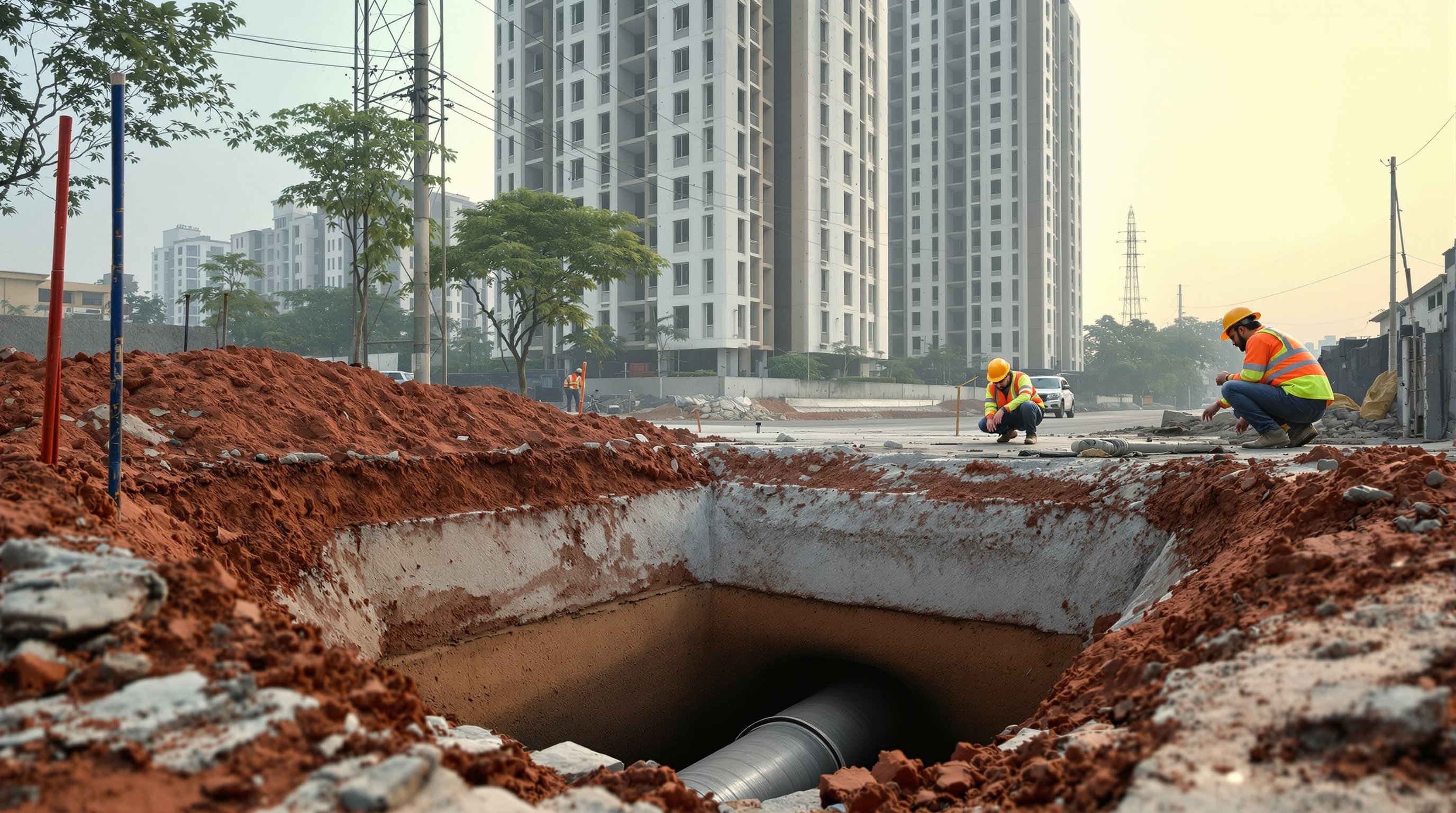
India's cities have grown far faster than their underground sewerage. In most metros, piped sewer networks cover only a fraction of the built-up area — often the older, planned core — while vast swathes of newer development on the urban edge, exactly where large residential and commercial projects go up, have no sewer line at all. A trunk sewer two kilometres away is not a connection; it is a wish.
Even where a sewer exists on paper, three things can make it unusable in practice:
- Capacity is already exhausted. Many municipal networks and their treatment works run at or beyond design load. The utility can, and does, refuse new connections that would overload the system.
- The line is at the wrong level. Sewers flow by gravity. If the municipal invert level is higher than your outfall, you would have to pump — adding cost and a permanent point of failure.
- Permission is discretionary and slow. A "No Objection Certificate" or connection sanction from the water/sewerage board can take months, and the board may attach conditions — including, increasingly, a requirement that you pre-treat your sewage on site first.
This is the crucial twist for developers: for medium and large projects, India's pollution-control framework (CPCB and the state boards, read alongside the National Building Code) already mandates an on-site STP as a condition of environmental clearance and occupancy — regardless of whether a sewer exists. In other words, for most projects above a modest size, the STP is not the alternative to the sewer; it is compulsory, and the sewer connection is at best a way to dispose of the surplus treated water. Our guide on why every modern building needs an STP covers where those thresholds bite.
The cost comparison: connection and tariff vs capex and opex
Money is where the two options are most misunderstood. A sewer connection is not free, and an STP is not purely a cost — it pays part of itself back through water reuse.
The sewer side carries a one-time connection/development charge levied by the water board (which can be substantial for a large development), plus an ongoing sewerage tariff, usually billed as a percentage of your water consumption or on a per-kilolitre basis. Every kilolitre you send down the sewer, you pay to send — forever. And you still buy every kilolitre of fresh water you use, because nothing comes back.
The STP side carries a real upfront capital cost — tanks, blowers, pumps, filters, civil works — and a genuine operating cost: electricity for aeration (the single biggest line item), operator salaries, chemicals, and periodic sludge removal. But against that sits the reuse benefit: an STP recovers 80–85% of the water the building consumes, water you then do not buy for flushing, landscaping and cooling. In a water-scarce, tanker-dependent city, that avoided-water value is large and rises every year.
| Factor | Municipal sewer connection | On-site STP |
|---|---|---|
| Availability | Only where the network reaches, with spare capacity | Works anywhere — self-contained on the plot |
| Upfront cost | Connection / development charge to the board | Capex: tanks, blowers, pumps, filters, civil |
| Recurring cost | Sewerage tariff (per KL or % of water bill), forever | Opex: power, operator, chemicals, sludge disposal |
| Water reuse | None — sewage leaves, you buy all fresh water | 80–85% recovered for flushing, gardens, cooling |
| Space needed | Just an outfall connection | Dedicated area / basement plant room |
| Control & reliability | Depends on the utility's uptime and capacity | You control it — and you own its failures |
| Compliance burden | Utility treats it; light on you | You must meet discharge norms and report |
| Mandated for large projects? | Never sufficient on its own | Yes — required by pollution-control norms |
The honest reading of this table: for a small building where a working sewer exists, the connection can genuinely be the cheaper, simpler answer. For a medium or large project, you will almost certainly build the STP regardless, and the sewer becomes a secondary discharge route — so the real question is not "which one" but "STP plus what disposal for the surplus."
The reuse dividend — the deciding factor

This is the argument that most cleanly separates the two options. A sewer connection is a one-way street: water comes into your building clean and expensive, becomes sewage, and leaves forever. You then buy it all again. An STP closes the loop. The same water flushes toilets, waters the garden, and feeds the cooling towers a second time before any of it leaves the plot.
If you want to see the scale of this for a specific project, run your occupancy through the sewage generation calculator to see how many litres a day your building produces, then the STP capacity calculator to size the plant. For a large complex the recovered water runs to lakhs of litres a month — a permanent hedge against tanker prices and supply cuts that a sewer connection can never offer. Where water is scarce and expensive, the reuse dividend often outweighs the STP's operating cost entirely.
Compliance: who carries the burden?
With a sewer connection, the compliance is mostly the utility's problem. You must connect correctly, not dump anything the sewer is not built for (no industrial effluent — that is what an ETP is for), and pay your tariff. The central treatment works is responsible for meeting discharge standards.
With an STP, the responsibility lands squarely on you. You must treat your sewage to the prescribed norms — driving down BOD, COD and TSS — keep records, and in many states report to the pollution-control board, sometimes with online monitoring. That is a real, ongoing obligation. But it is also within your control, and it is the price of the reuse and independence the STP buys you. Note that this is a different question from the septic tank, which does not treat to a reusable standard at all — see STP vs septic tank if that is the comparison on your mind.
The verdict — by location and building size
There is no single winner. Match the option to your situation:
- Small building (a few homes / a villa), working sewer at the plot, no STP mandate. A municipal sewer connection is usually the right call — lowest cost and complexity, and the reuse dividend is too small to justify running a plant. A septic system may even suffice.
- Medium or large residential / commercial project, anywhere. You will be required to build an STP — treat that as settled. Use the sewer, if available, only to discharge the treated surplus. Design for maximum reuse.
- Project on the urban edge with no sewer. The STP is not a choice; it is the only lawful way to handle your sewage. Consider a decentralised (DEWATS) or constructed-wetland approach if land and load suit.
- Water-scarce, tanker-dependent location. Lean hard toward the STP even if a sewer exists — the recovered water pays back the plant, and a zero-liquid-discharge philosophy may be worth the extra step.
The bottom line
The sewer-versus-STP question is rarely the free choice it appears to be. For most serious buildings in India, the STP is mandatory, the sewer is unreliable or absent, and the reuse of treated water turns an apparent cost into a long-term saving. Think of the municipal sewer not as the easy alternative to treating your own sewage, but as an occasional outlet for the small surplus a well-run STP cannot reuse. Build the plant well, reuse as much as you can, and let the sewer take only what is left. To go deeper on technologies and sizing, browse the full sewage treatment plants guide library.
Export this guide
Related Guides — Deep-dive reading
STP for Farmhouses: Off-Grid Wastewater Treatment & Reuse Guide
Farmhouses sit on big plots far from any municipal sewer, are used in bursts, and often run on weak or intermittent power. This guide covers the low-maintenance STP options that actually suit that reality — and how to reuse every drop for irrigation.
Sewage Treatment PlantsSTP vs Septic Tank: Which Is Better for Your Building?
A plain-language decision guide comparing a modern sewage treatment plant against a traditional septic tank — how each works, whether the water becomes reusable, and which one your building actually needs, from an isolated bungalow to a regulated apartment complex.
Sewage Treatment PlantsWhy Every Modern Building Needs an STP: The Legal, Water & Money Case
Why buildings need an STP is no longer an open question in urban India — it is a condition of occupancy, a water-security strategy, and a public-health duty rolled into one. Here is the full case, in plain language.
Sewage Treatment PlantsRelated Tools — Try Free
CPCB Compliance Checklist for STPs
Tick off CPCB/SPCB outlet standards, monitoring duties and record-keeping to score your sewage treatment plant's compliance readiness.
ChecklistApartment vs Villa Interior Planning Guide
Compare ceiling height, structural flexibility, lighting, storage, and services between apartments and villas.
Planning GuideRainwater Tank Sizer
How big should your rainwater tank be? Computes annual harvest, recommended tank capacity in litres, water-bill savings, and payback — for 10 Indian cities.
RWH Calculator