
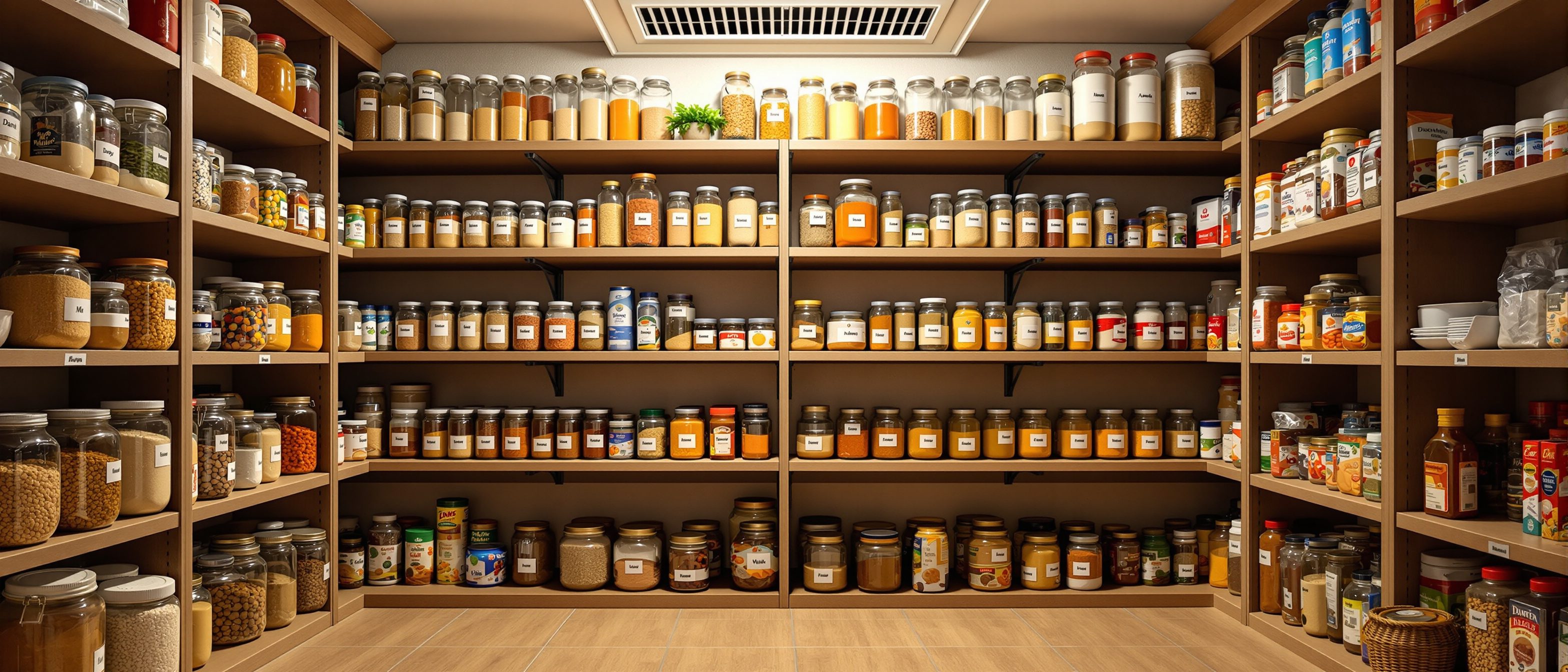
Walk-In Pantry Design
How to design the dedicated larder the Indian kitchen actually needs — for bulk rice and atta, masala stock, monthly rations and festival cooking — with sizing, shelving, ventilation and pest control that survives the monsoon.
Walk into almost any Indian kitchen mid-month and you will find the truth of how we cook spilling out of every cabinet: a 10 kg sack of rice against the wall, oil tins under the counter, a clattering shelf of masala dabbas, the big steel atta drum no door will close over, and — usually on top of the fridge — the box of festival cookware that comes down twice a year. The builder gave you four cabinets and a couple of drawers. Indian cooking asked for a larder.
This is the gap a walk-in pantry fills. Not the in-cabinet storage inside your kitchen — that is a separate craft, covered in our kitchen storage planning guide — but a dedicated small room (or, in a flat, a tall floor-to-ceiling unit) whose only job is to hold what a household actually buys: the monthly ration, bulk grains and pulses, the spice stock, the bottles and tins, and the appliances you want off the worktop. In older Indian homes this was simply the store room; the modern flat quietly deleted it, and the kitchen has been overflowing ever since.
Designed well, a pantry does three things at once: it clears your worktops so the kitchen breathes, it lets you buy in bulk (which is how Indian households save real money), and — critically — it gives grains the cool, dry, ventilated, pest-controlled conditions they need to last. Get the ventilation or the damp control wrong and you are not storing rice, you are farming weevils.
A pantry is not extra cabinets in a spare corner — it is a climate-controlled room for the way Indian households actually buy and cook, and it must be designed for air, depth and rotation, not just shelf-metres.
1. Why the Indian kitchen specifically needs a pantry
Western pantry design assumes packaged, processed food in modest quantities. Indian provisioning is the opposite, and that difference is the whole reason this room earns its floor area:
- Bulk staples. A family doesn't buy a 1 kg packet of rice — it buys a 10–25 kg sack, the same for atta, and three or four kinds of dal at a time. Heavy, dense, needing a real footprint.
- Oil and ghee in tins. 5- and 15-litre oil tins, ghee, vanaspati — bulky, occasionally leaky, best kept low and contained.
- The masala wall. A working Indian kitchen runs on 30–60 distinct spices and ingredients — whole and ground, lentils, dried chillies, tamarind, hing, dry coconut. Each wants its own labelled jar.
- The monthly ration. Most households shop in a big monthly cycle — sugar, salt, jaggery, poha, rava, vermicelli, dry fruits, pickles, papad — a month of provisions arriving in one go and needing a home.
- Festival and seasonal cooking. Diwali sweets, big-batch cooking for weddings and pujas, the special vessels and moulds — stored eleven months and used in one.
- Appliances off the counter. Mixer-grinder, wet grinder, food processor, air-fryer, idli steamer. Indian counters are small; the pantry is where these live when not in use.
Add the joint-family reality — more mouths, larger batch cooking — and a few kitchen cabinets simply cannot cope. For the philosophy of treating storage as a planned discipline, our professional companion piece on storage as a design discipline goes deeper; here we stay practical and room-specific.
2. What a pantry stores, and the conditions each thing needs
Before you draw a single shelf, list what the room must actually hold — and notice that different goods want different shelf depths and very different conditions. This table is the brief for everything that follows.
| What it stores | Shelf type & depth | Conditions it needs |
|---|---|---|
| Rice, atta, bulk flours | Floor drums / pull-out trays, 450 mm | Dry, ventilated, off the floor, airtight, rotate monthly |
| Dals & pulses | Shallow shelf, airtight jars, 300 mm | Dry, dark; neem/bay leaf deterrent; FIFO |
| Whole & ground masala | Eye-level shelf, small jars, 250 mm | Cool, dark — light and heat kill aroma |
| Oil & ghee tins | Low shelf with a lip/tray, 450 mm | Cool, dark, contained against spills |
| Sugar, salt, jaggery | Mid shelf, airtight, 300 mm | Very dry (salt/jaggery clump in damp) |
| Pickles & preserves | Mid/low shelf, 300 mm | Cool, dark, away from direct sun |
| Onions, potatoes, garlic | Open ventilated basket/crate, 350 mm | Airy, dark, never sealed (they sweat & rot) |
| Dry fruits, special stock | High airtight, 250 mm | Dry, sealed, cool |
| Appliances | Worktop / deep shelf, 450–600 mm | A power point, wipeable surface |
| Festival cookware, extras | Top shelf, 250 mm | Dry; light items only, step-stool access |
Two conditions repeat down that whole column: dry and dark/cool. Those two words drive the ventilation and the layout more than anything else in this guide.
3. Sizing the pantry — how much room you actually need
A pantry can be as small as a deep cupboard or as generous as a 2 m × 2 m room. Size it to your household and cooking volume, not to a magazine photo. The rule: enough shelf-metres for a full monthly cycle plus a clear 900 mm aisle to stand and turn in.
| Household / cooking volume | Pantry footprint | Layout that fits | Linear shelving |
|---|---|---|---|
| 1–2 people, light cooking | Tall unit, 600 × 600 mm | Single tall pantry cabinet | ~3–4 m |
| Nuclear family (3–4), regular cooking | 1.2 × 0.9 m alcove | Galley / single-wall walk-in | ~6–8 m |
| Family (4–5), bulk + festival cooking | 1.8 × 1.6 m | L-shape walk-in (see Figure 1) | ~10–12 m |
| Joint family / heavy entertaining | 2.0 × 2.0 m+ | U-shape walk-in | ~14–18 m |
The non-negotiable is the aisle. A walk-in needs a minimum clear aisle of 750 mm, and 900 mm is far more comfortable once you are crouching to a low drum with a jar in the other hand. With shelving on two facing walls (galley or U), keep the walls at least 1500 mm apart so a person and an open door are not wedged. To turn these into real numbers for your own provisions, our storage capacity calculator sizes shelf-metres against what you list, and the room measurement tool helps you check a candidate alcove before you commit.
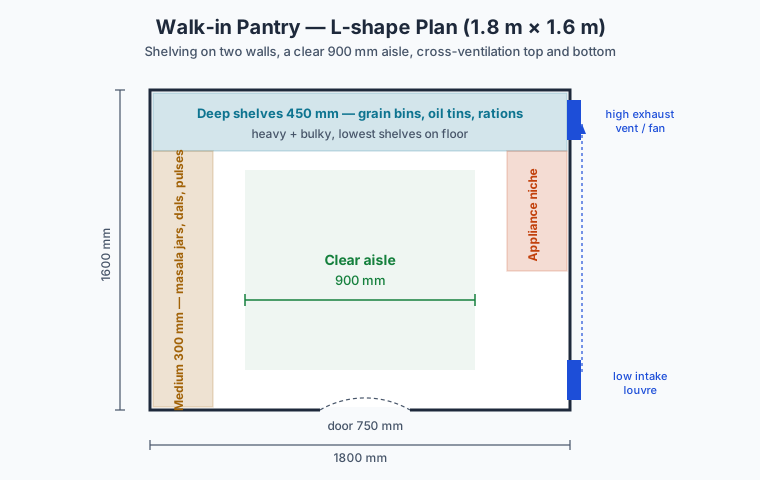
Figure 1: An L-shaped 1.8 × 1.6 m walk-in for a bulk-cooking family — deepest shelves on the back wall for grains and tins, shallow jar shelves on the side wall, an appliance niche by the door, and a low-intake / high-exhaust ventilation pair to keep air moving over the grains.
4. Layout: U, L or galley
Three shapes do almost all the work, and which you choose is decided by the wall or alcove you can spare.
- Galley / single-wall — shelving on one wall, you stand in the doorway or a short aisle. Cheapest and the easiest to retrofit into a passage or a widened utility nook. Best for nuclear families.
- L-shape — shelving on two adjacent walls (Figure 1). Roughly 50% more shelf-metres than a galley in not much more floor area; the corner is the one weak spot, so put your least-reached bulk there.
- U-shape — shelving on three walls, you stand in the middle. Maximum capacity, ideal for joint families, but needs that 2 m × 2 m room and good lighting so the side walls aren't gloomy.
Whatever the shape, follow one ergonomic law: heavy and bulky low, daily at eye level, light and seasonal up high. A 25 kg rice drum belongs on a pull-out tray near the floor, never on a shelf you must lift it onto. Everyday dal and masala jars sit in the golden zone between roughly 1100 and 1600 mm where you neither stoop nor reach. Papad tins and festival moulds go above 1600 mm where a step-stool is fine. For laying the room out against the kitchen and utility area, the layout planner tests the door swing and aisle before anything is built.
5. Shelving — depths, heights and the materials that survive
The single most common pantry mistake is making shelves too deep. A 600 or 750 mm shelf feels generous and turns into a black hole: the dal tin at the back is invisible, forgotten, discovered six months later with weevils. Keep shelves shallow; let nothing sit two rows deep that you can't see.
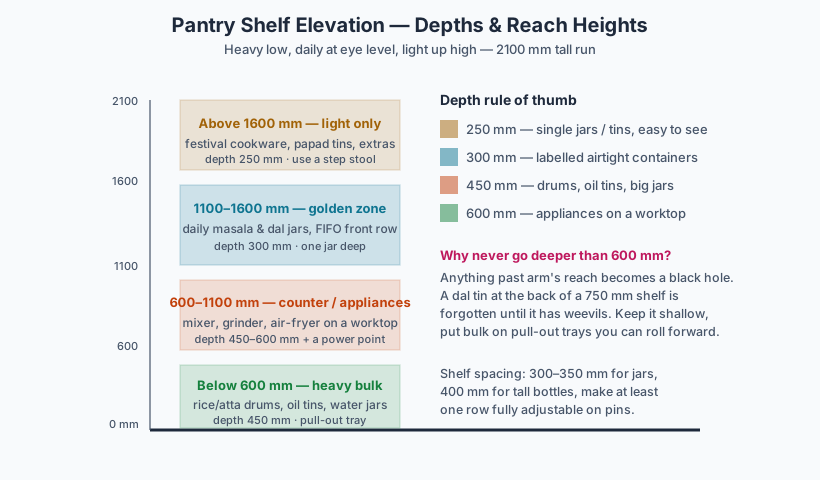
Figure 2: The pantry in section. Match depth to contents — 250 mm for single jars and tins so you can see every label, 300 mm for daily airtight containers, 450 mm for drums and oil tins, and a 600 mm worktop only where an appliance needs it. Make at least one row adjustable on shelf pins.
Working depths and spacings that actually work in Indian pantries:
- 250 mm — masala and spice jars, dry fruits, tins. One jar deep, every label visible. This is your most valuable shelf because it never hides anything.
- 300 mm — daily dals, pulses, sugar, salt in airtight containers; pickle jars.
- 450 mm — bulk drums, oil tins, large jars; put these on pull-out trays so the heavy stuff rolls forward to you.
- 600 mm — reserve only for an appliance worktop, and give it a 16 A power point.
- Shelf spacing — 300–350 mm clear between shelves for jars, 400 mm for tall bottles and the wet grinder. Adjustable pins beat fixed shelves every time, because what you store changes.
On materials, the monsoon is the test. Raw MDF and unsealed particleboard swell and harbour damp; favour marine/BWR plywood with laminate, powder-coated steel, or stainless-steel wire shelving that lets air pass through. Keep the lowest shelf at least 150 mm off the floor so a wet mop, an ant trail or a monsoon seep never reaches your grains, and leave a small gap between shelf-backs and the wall so air can move behind. The same depth-and-reach discipline applies to wardrobes; if you are planning storage across the home, our wardrobe planning notes carry the idea into the bedroom.
"Have a place for everything and keep the thing somewhere else; this is not a piece of advice, it is merely a custom." Mark Twain's joke is the exact failure a pantry exists to prevent — and the antidote, as Julie Morgenstern argues in Organizing from the Inside Out, is to design storage around how you actually retrieve things, not around how neatly they stack.
6. Ventilation, damp and pest control — the part that fails homes
This is where pantries succeed or rot. Grains are hygroscopic — they pull moisture from the air — and the Indian monsoon delivers months of it. A sealed, unventilated cupboard becomes a humid box where atta cakes, salt clumps, jaggery weeps, and weevils (the little sossa in your rice) and ants thrive. The defence is layered, from the room shell inward to the grain itself.
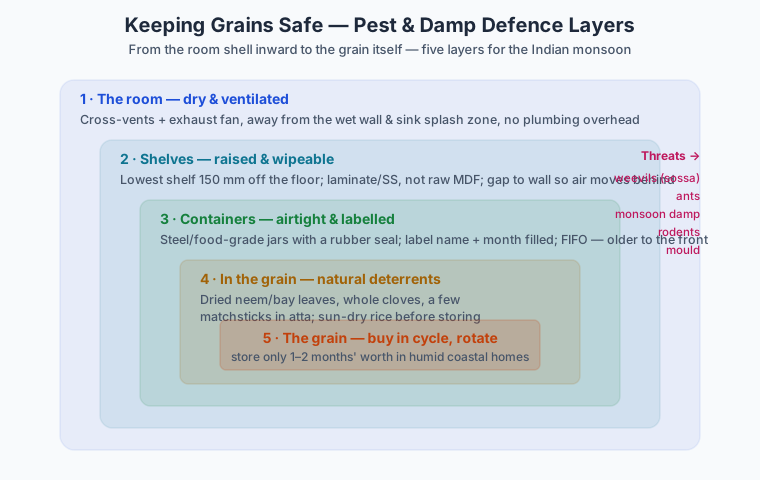
Figure 3: Five layers of defence. Each ring catches what the last one missed — a ventilated dry room, raised wipeable shelves, sealed labelled jars, natural deterrents in the grain, and finally buying in a sensible cycle so nothing sits long enough to spoil.
The practical measures, in order of importance:
- Cross-ventilation. A pantry must breathe. Provide a low intake and a high exhaust — a louvre near the floor and a vent or small exhaust fan high up (Figure 1) so air rises across the shelves. Even a louvred door plus a high gap helps. The National Building Code of India 2016 treats ventilation of habitable and service spaces as a basic requirement for exactly this reason.
- Site it dry. Keep the pantry off the bathroom/plumbing wall and out of the sink's splash zone; never run a water line over it. Damp coming through a shared wet wall will defeat every container.
- Airtight, labelled containers. Steel or food-grade jars with a rubber seal. Label each with the contents and the month it was filled, and practise FIFO — older stock to the front, new behind — so nothing is forgotten at the back.
- Natural deterrents. Dried neem or bay leaves, whole cloves, even a few matchsticks tucked into the atta and dal; sun-dry rice and dals before storing in humid coastal homes.
- Raised, wipeable, sealed. Lowest shelf 150 mm up, laminate or steel surfaces you can wipe, and gaps that let air move. Seal wall cracks so rodents and ants have no highway in.
- Buy in cycle. In humid coastal cities (Mumbai, Kochi, Chennai), store only one to two months' worth of grain rather than a year's. This is the single biggest difference between a dry-belt and a coastal pantry. Our guide to seasonal storage solutions carries this rhythm across the rest of the home.
7. The apartment alternative — when a room isn't possible
Most builder flats have no spare room for a pantry, and that is fine: the principles scale down into a tall floor-to-ceiling pantry unit that does the same job in a 600 mm-wide cabinet. The trick is to make it work like a pantry, not just look like one.
- Tall pantry tower — a full-height unit (typically 600 mm wide, 2100–2400 mm tall) with pull-out wire baskets so you see everything from the side; depth 450–500 mm with door-mounted racks for jars.
- Larder pull-outs — a narrow 300–450 mm tall pull-out beside the fridge or at the end of a run holds a surprising amount on both faces.
- Convert the utility area — many flats hide real potential in the service balcony; our guide to utility-area optimisation shows how to claim it for dry storage.
- Borrow a passage wall — a 250–300 mm deep run of shallow shelving along a corridor wall holds the entire masala collection on full view.
Even in a tower, hold the rules: heavy low, daily at eye level, shallow depths, and a louvred or vented door so the grains breathe. For the wider toolkit of squeezing storage out of a small flat, see storage solutions for compact apartments.
8. A do / don't checklist
| Do | Don't |
|---|---|
| Keep shelves 250–450 mm deep, one item visible | Build 600–750 mm shelves that hide stock at the back |
| Put heavy drums and oil tins low, on pull-out trays | Lift a 25 kg sack onto a high shelf |
| Provide a low intake + high exhaust for cross-air | Seal the pantry into an airless box |
| Site it on a dry internal wall, off the plumbing | Share a wall with the bathroom wet zone |
| Use airtight, dated, labelled jars with FIFO | Tip new grain on top of old in an open dabba |
| Raise the lowest shelf 150 mm off the floor | Stand sacks directly on the floor |
| Buy in a 1–2 month cycle in humid cities | Stockpile a year of atta on the coast |
| Reserve one worktop with a power point for appliances | Pile the mixer-grinder on a sagging shelf |
"In a house designed for living, every room should have at least one place where there is room to store the things that belong there." Christopher Alexander's pattern language returns again and again to the idea that storage must be near where things are used — which is precisely why the pantry belongs beside the kitchen, not in a distant box room.
Sources & further reading
- Bureau of Indian Standards — National Building Code of India 2016, Part 8 (ventilation of service & habitable spaces). bis.gov.in
- Christopher Alexander, Sara Ishikawa & Murray Silverstein — A Pattern Language (storage near point of use; the larder pattern), Oxford University Press, 1977.
- Julie Morgenstern — Organizing from the Inside Out (designing storage around retrieval & FIFO), Owl Books.
- Marie Kondo — The Life-Changing Magic of Tidying Up (one-home-for-everything principle), Ten Speed Press.
- ICAR / Indian Institute of Food Processing Technology — domestic grain storage & stored-grain pest guidance (neem-leaf & airtight-storage practice).
- Anthropometric reach-zone standards (golden-zone 1100–1600 mm; 750–900 mm aisle clearance), as applied in Indian kitchen & storage ergonomics.
If this is your first attempt at planning storage room-by-room, start with the cluster pillar, storage planning before interior design, then read seasonal storage solutions for the Indian home for the rotation rhythm your pantry will live by, and home organisation through design to keep the whole house — not just the larder — working the way this room does.
Export this guide
Related Guides — Deep-dive reading
Storage Planning Before Interior Design
Why storage must be planned first — audited, budgeted and given its floor area — before a single layout, colour or sofa is chosen. The homeowner's plan-it-first master guide for Indian homes.
StorageKitchen Storage Planning Guide
Tall pull-outs, corner carousels, pantry zoning, and the drawers-beat-shelves rule for a real Indian kitchen
Kitchen DesignSmart Storage Interiors — A 2026 Working Reference for Indian Homes
Inventory-driven · Floor-to-ceiling · Hardware-engineered · Zone-mapped
Room PlanningRelated Tools — Try Free
Cross-Ventilation Analyzer
Estimate airflow and air changes per hour (ACH) from room size, window areas, layout, and local wind — with NBC 2016 Part 8 compliance check.
Ventilation CalculatorApartment Interior Planning Checklist
51-item checklist across structural, ceiling, lighting, furniture, storage, electrical, kitchen, bathroom.
ChecklistWardrobe Storage Capacity Calculator
India-specific garment math — sarees, lehengas, kurtas, shirts, shoes. Pick a layout (2-door → walk-in), see live fill and saturation gauges.
Capacity Calculator