
Family-Based Storage Planning
Storage that follows the people, not the floor plan — designing for newborns, school kids, teenagers, elderly parents and the joint-family realities of an Indian home.
Walk into almost any Indian flat and you can read the family's history in its cupboards. The lowest shelf in the bedroom wardrobe holds a creche of plastic toys because a toddler arrived three years ago. A loft is stacked with a pram nobody can reach. Grandma keeps her medicines on the dining table because the only spare shelf is at 1900mm and she will not climb a stool. The teenager's clothes have colonised half the parents' wardrobe. Nothing here was planned — it accreted, member by member, as the household changed.
This is the gap in most storage advice. We plan storage around rooms — the kitchen needs cabinets, the bedroom needs a wardrobe — and forget that a room is just a container for people whose needs keep changing. A newborn, a nine-year-old, a sixteen-year-old and an eighty-year-old grandparent need radically different things from the same four walls. In a joint family those needs collide: whose shelf is whose, who reaches the loft, where do four people's festival clothes go.
The best Indian storage is planned around who lives in the home and what life stage they are in — because the family changes far faster than the furniture, and storage that ignores the people becomes clutter within a year.
1. Plan for the person, not just the room
The orthodox storage sequence — audit your possessions, set a volume budget, allocate floor area — is sound, and our pillar guide on storage planning before interior design walks through it in full. But before any of that, list your household by name and age, not your rooms. A four-person family with a five-year-old and a grandparent has a completely different storage problem from a four-person family of two working couples, even in an identical 2BHK.
For each person, ask three questions: what do they own, how often do they reach for it, and can they physically reach it safely. The third question is the one builder flats and quick modular jobs ignore entirely. A shelf only counts as storage if the person who needs it can use it without a stool, a stretch or a deep bend.
The single most useful idea in family storage is the reach zone — the band of height a given body can comfortably and safely use. It is different for a child, an adult and an elder, and getting it right removes most daily friction.
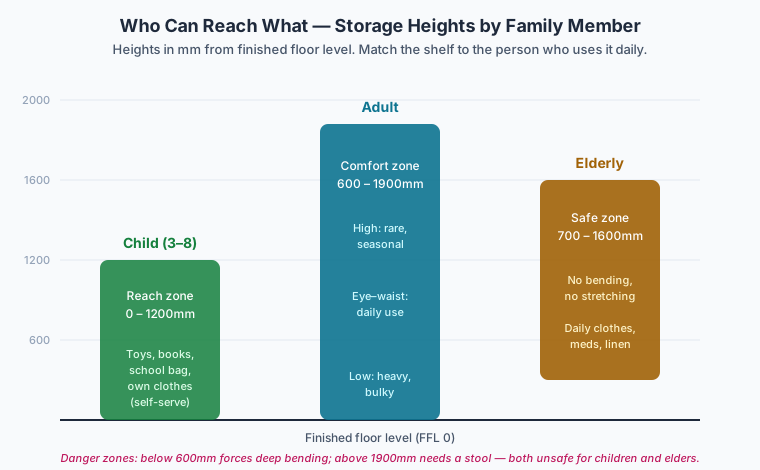
Figure 1: Reach zones by member. A child self-serves below 1200mm; an adult comfort band runs roughly 600–1900mm; an elder should keep everyday items between 700 and 1600mm to avoid bending and stretching. Match the shelf to the body that uses it daily.
"Storage is not about square feet; it is about the relationship between a thing, the person who uses it, and the moment they reach for it." — paraphrasing Julie Morgenstern, Organizing from the Inside Out, on storing by use rather than by category.
2. Storage that changes with the child's life stage
No member changes faster than a child. The storage you build for a newborn is obsolete in eighteen months; the wardrobe a five-year-old uses is wrong for a teenager. The mistake is building fixed furniture for a moving target — the EMI on a fitted kids' wardrobe outlives its usefulness by years.
The fix is to build one adjustable carcass and re-fit it at each stage. A 600mm-deep wardrobe with shelf pins drilled every 32mm and one removable hanging rod can serve the same person from cot to college. You move the rod up as the child grows, swap bins for drawers for hanging space, and never demolish anything.
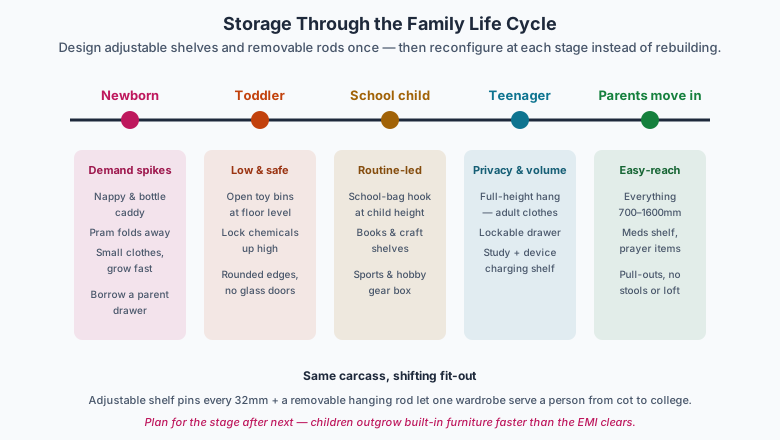
Figure 3: The same carcass, re-fitted at each stage. Adjustable shelves and a removable rod let one wardrobe follow a person across two decades — and let the room absorb an ageing parent without rebuilding.
| Family member / life stage | Dominant storage needs | Easy-reach zone & form |
|---|---|---|
| Newborn (0–1) | Nappies, bottles, tiny fast-outgrown clothes, pram | Adult-height — parent serves the child; pram folds into a loft or under-bed drawer |
| Toddler (1–4) | Open toy bins, board books, one set of own clothes | 0–900mm, open + soft; lock chemicals and medicines up high (above 1500mm) |
| School child (5–11) | School bag, books, craft, sports gear, uniform | Hook + shelf at 900–1200mm so the child packs their own bag — builds routine |
| Teenager (12–18) | Full adult wardrobe volume, devices, one lockable private drawer | 600–1900mm full-height; privacy and a charging shelf matter as much as space |
| Elderly parent moving in | Everyday clothes, medicines, prayer items, mobility aids | 700–1600mm only; soft-close pull-outs, no loft, no bending — see Section 4 |
Two India-specific notes. First, children's medicines, cleaning chemicals and pest control go above 1500mm in any home with a toddler — the most important storage decision you make in those years. Second, resist the temptation to over-build a themed "kids' room" wardrobe; the cartoon laminate that delights a four-year-old mortifies a fourteen-year-old, and you will pay to redo it.
3. The joint family: shared versus personal storage
In a multi-generational Indian household — grandparents, a couple, their children, perhaps an unmarried sibling — storage is as much about boundaries as about volume. The recurring source of friction is not too little storage; it is unclear ownership. When no shelf belongs to anyone, every shelf fills with everyone's overflow and nothing can be found.
The principle is simple: every member gets a personal zone they own outright, and the family shares only what genuinely belongs to everyone. Personal zones protect privacy and end the daily "who moved my things" argument. Shared zones — festival goods, guest bedding, the family store-room — are allocated deliberately, with one person responsible for each.
| Storage type | Allocation | Who controls it | Typical contents |
|---|---|---|---|
| Personal wardrobe bay | One bay per adult / teen, lockable drawer each | The individual | Clothes, documents, jewellery, devices |
| Children's open storage | Shared low zone in kids' room | Parents supervise | Toys, books, school gear |
| Master linen + bedding | Shared, one cupboard | Eldest woman of house, typically | Bedsheets, blankets, guest bedding, mosquito nets |
| Festival & ceremony store | Shared loft or store-room | Rotating / one nominated person | Diyas, decorations, brass, festival clothes, gifting stock |
| Kitchen bulk + provisions | Shared | Whoever runs the kitchen | Grain drums, masala stock, festival cooking vessels |
| Documents & valuables | Personal lockable + one family safe | Head of household | Property papers, gold, certificates |
| Helper / domestic-staff storage | Dedicated, near service area | Defined, respected | Cleaning kit, uniform, personal locker |
A shared family wardrobe — common when two or three people share one bedroom — works only if it is zoned by member, not pooled. Give each person a labelled vertical bay; reserve the top loft for goods the family has agreed belong to everyone.
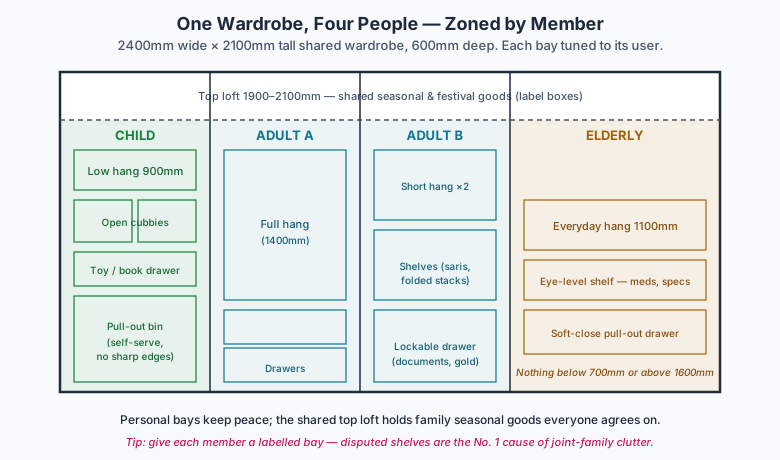
Figure 2: A 2400mm shared wardrobe zoned by member — child bay with low hang and open cubbies, two adult bays with full hang and a lockable drawer each, an elderly bay kept entirely between 700 and 1600mm, and a shared top loft for festival goods. Personal bays keep the peace.
If you are setting out a shared wardrobe, the wardrobe planning tool lets you lay the bays and internals to scale, and our deeper wardrobe and closet planning guide covers internal dimensions in detail. To size the whole household's needs honestly, run the numbers through the storage capacity calculator.
4. Elderly parents: safe, easy-reach storage
When an ageing parent moves in — increasingly the norm as families consolidate — their storage must change the rules. Bending to a 300mm shelf or stretching above 1900mm is not an inconvenience for an eighty-year-old; it is a fall risk. The governing rule is that everything they use daily lives between 700mm and 1600mm, the band reachable without bending or stretching from a standing or seated position.
Practical moves: soft-close pull-out drawers instead of deep shelves (no groping into the dark), a dedicated eye-level shelf for medicines and spectacles, D-shaped or loop handles rather than knobs for arthritic hands, and a small bedside drawer for night-time essentials so nothing requires walking in the dark. Prayer and pooja items deserve their own accessible niche — for elders this is daily-use storage, not décor. Keep a clear 1050mm circulation path to the wardrobe so a walker or stick fits.
| Item | Wrong place (common) | Right place for an elder |
|---|---|---|
| Daily medicines | Kitchen shelf at 1800mm | Bedroom pull-out at 900–1100mm, eye-level |
| Everyday clothes | Loft or below-knee drawer | Hanging rod at 1100mm, drawers at 600–900mm |
| Spectacles, phone, keys | Wherever they land | Fixed bedside drawer, same place every day |
| Prayer / pooja items | High mandir shelf | Accessible niche, 900–1400mm, with task light |
| Spare bedding | Top loft | Mid-height shelf or ottoman they can open seated |
5. Children's storage: accessible and safe
The flip side of the elderly zone is the child zone. The design goal here is self-service with safety: storage low enough that a child puts their own things away (the only reliable way a child's room stays tidy), but engineered so the child cannot hurt themselves and cannot reach what is dangerous.
Low open bins beat closed cupboards for under-sevens — a child returns a toy to a basket but will not open a drawer and lift a lid. A school-bag hook at 1100mm and a shelf for the next day's clothes teaches routine better than any instruction. Above the child's zone, everything sharp, toxic or breakable lives above 1500mm: medicines, cleaning fluids, scissors, glass. Anchor tall units to the wall — toddlers climb open shelving, and an unanchored unit is a genuine hazard. Avoid glass shutters and sharp corners in any furniture below 1200mm.
6. Storage for the whole family's festivals and ceremonies
The Indian home stores something the storage textbooks never mention: a large, lumpy, sentimental, collective inventory of festival and ceremony goods. Diwali diyas and lights, the brass and silver pooja vessels, festival clothes worn twice a year, the decorations, the rangoli stencils, the gifting stock bought on offer, the heavy cooking vessels that only come out for a function. None of it is anyone's personal property — it belongs to the family — and all of it sits idle eleven months of the year.
This is shared, seasonal, deep storage, and it belongs in the least valuable real estate: high lofts, a dedicated store-room shelf, the tops of wardrobes. The trick is labelled, stackable boxes with one person responsible for the inventory, so nobody buys a second set of fairy lights because the first set is lost behind the suitcases. Our seasonal storage guide covers the rotation and damp-proofing in depth; the key family point is that this inventory is collective, so it needs a collective home, not a corner of someone's personal wardrobe.
The National Building Code of India (NBC 2016) sets a minimum clear ceiling height of 2.75m for habitable rooms — which is precisely the headroom that makes a 600–750mm-deep loft above wardrobes viable for this kind of deep seasonal storage in most Indian homes.
7. The people who help run the home
A family-based storage plan that ignores domestic help is incomplete, because in many Indian homes a cook, a maid or a live-in helper is part of the daily household. They need storage too, and giving it to them deliberately is both practical and respectful. A defined cleaning-kit cupboard near the service balcony, a locker or shelf for a part-time helper's bag and footwear, and — for live-in staff — a private, lockable personal storage space are basic dignities that also keep their things from migrating into family cupboards.
The service zone is where this lives: near the utility area, the kitchen service door or the back balcony. Our utility-area optimization guide covers the wider service zone; for family planning, the point is simply to name the helper as a member of the storage plan rather than leaving them to improvise.
8. Designing storage that grows with the family
The family is not static, so the storage must not be either. The flat that houses a couple today will house a child, then a teenager, then perhaps a grandparent within fifteen years — the span of a single home loan. Design for that arc from the start.
Three durable principles. First, buy adjustability once: shelf pins, removable rods and modular drawer inserts cost little extra and let a unit re-fit itself at every stage. Second, keep one zone deliberately empty — a 15–20% buffer of unallocated storage absorbs the next baby, the next move-in, the next phase without a crisis. Christopher Alexander's A Pattern Language makes the case that rooms must be able to change use over a family's lifetime; storage is the same. Third, plan for the stage after next, not just the one you are in — the family that storage-plans only for today's toddler rebuilds within five years.
"A building or a town will only be alive to the extent that it is governed by the timeless way" of adapting to its inhabitants' changing lives. — Christopher Alexander, A Pattern Language.
When you put all of this together, the home stops fighting its own family. The child packs their own bag, the grandmother reaches her medicines without help, the teenager has privacy, the festival boxes have a home, and nobody argues about whose shelf is whose. To turn the principles into specific cupboards and capacities, work through the storage capacity calculator and the wardrobe planning tool, and read our broader home organization through design guide for the systems that keep it all working day to day.
Sources & further reading
- Bureau of Indian Standards / Ministry of Housing — National Building Code of India 2016, Part 4 (room heights and dimensions).
- Julie Morgenstern — Organizing from the Inside Out (storing by use and by person, not by category).
- Christopher Alexander — A Pattern Language (rooms and storage that adapt over a family's lifetime; patterns on children's realm and old-age homes within a household).
- Marie Kondo — The Life-Changing Magic of Tidying Up (per-person ownership of belongings and storage).
- Ernst & Peter Neufert — Architects' Data (anthropometric reach ranges and standard wardrobe/shelf dimensions).
- Bureau of Indian Standards — IS 17847 / accessibility guidelines (reach ranges and clearances for elderly and differently-abled users).
If this matched your household, read the cluster pillar on storage planning before interior design, then the companion guides on seasonal storage solutions for the family's festival and off-season goods, and home organization through design for the day-to-day systems that keep a multi-generational home in order.
Export this guide
Related Guides — Deep-dive reading
How to Plan a Home for Multi-Generational Living
Designing for grandparents, parents and children under one roof — privacy, accessibility and harmony
Home PlanningStorage Planning Before Interior Design
Why storage must be planned first — audited, budgeted and given its floor area — before a single layout, colour or sofa is chosen. The homeowner's plan-it-first master guide for Indian homes.
StorageSmart Storage Interiors — A 2026 Working Reference for Indian Homes
Inventory-driven · Floor-to-ceiling · Hardware-engineered · Zone-mapped
Room PlanningRelated Tools — Try Free
Child & Elder Home-Safety Audit
Room-by-room safety audit for households with children or seniors — 10 categories, 70+ checkpoints tagged by audience.
Safety AuditApartment Furniture Size Chart
Standard furniture dimensions for Indian apartments — sofas, beds, tables, dining, storage.
Reference ChartStorage Capacity Calculator
Calculate optimal wardrobe and storage volume for your home by family size and usage.
Volume Calculator