
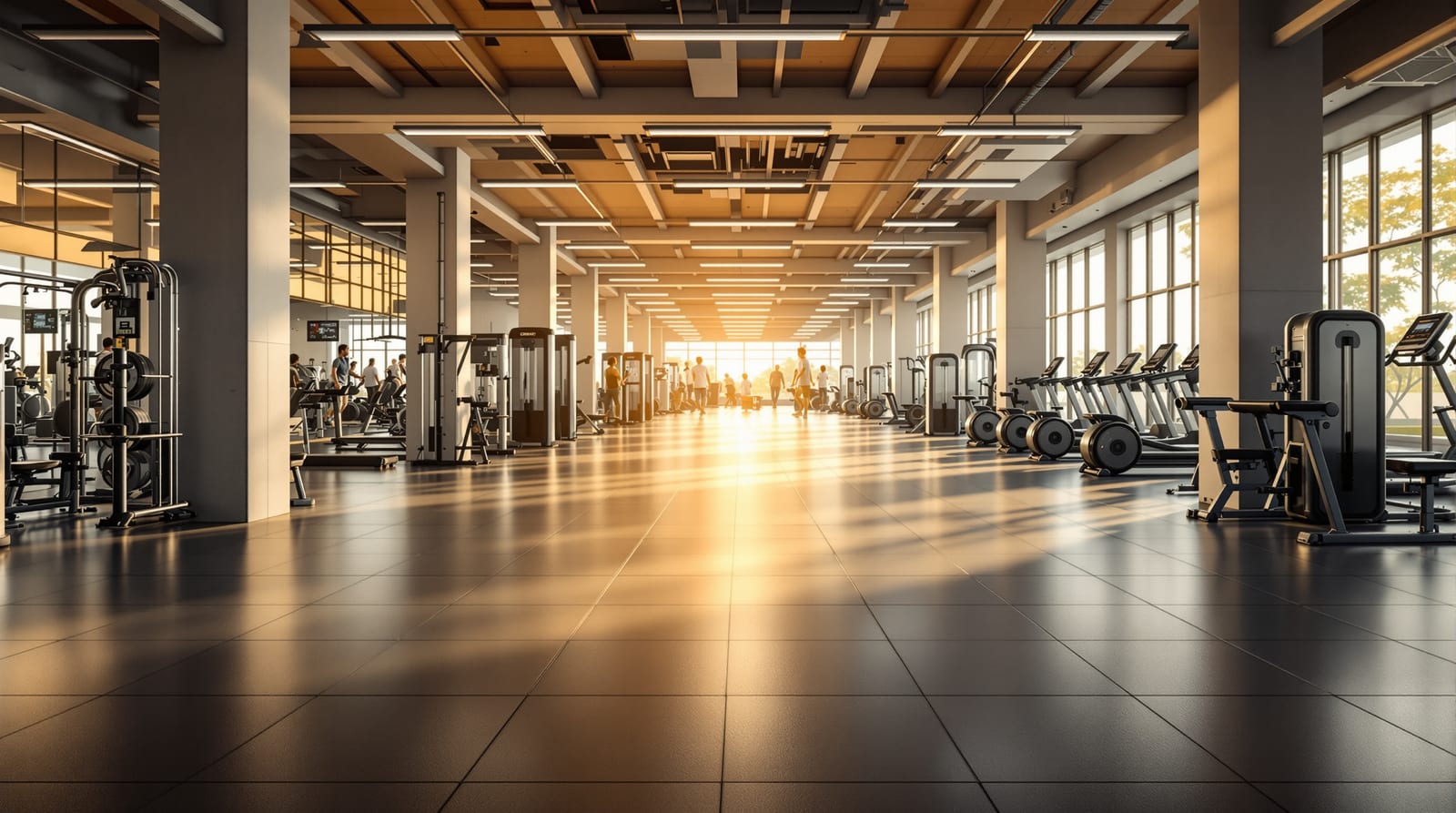
Gym Flooring India: Commercial Fitness-Centre Floors by Zone, with Thickness and Costs
How to floor a commercial gym in India zone by zone — heavy rubber for free-weights and drop zones, vinyl or rubber rolls for cardio, artificial turf for the functional lane, sprung wood or cushioned vinyl for the studio, cork or foam for yoga, and anti-slip vitrified or LVT for reception and lockers — with thickness, impact, noise, grip, hygiene and ₹/sq ft for each.
A commercial gym is not one floor — it is five or six floors stitched into one box. The free-weights pit, the treadmill row, the turf lane, the aerobics studio, the yoga room and the reception each punish the floor in a completely different way, and laying a single material across all of them either overspends on cardio or under-protects the lifting zone. This guide treats a fitness centre the way an experienced fit-out contractor does: zone by zone, with the right material, the right thickness, the slip and noise logic behind it, and what each zone costs per sq ft in India in 2026. If you are kitting out a spare bedroom instead, the lighter, DIY-friendly logic is in the home gym flooring guide for India — a commercial floor is bigger, zoned, fixed and built for all-day abuse.
Why a commercial gym floor is a different animal
Before any material, understand what separates a fitness centre from a home setup. These six demands drive every decision below.
- Continuous impact, not occasional. A commercial free-weights area takes hundreds of dropped loaded barbells a day, every day, for years. The floor and the slab beneath must survive that fatigue, not a weekend lifter's odd drop.
- Equipment and subfloor protection. Loaded olympic bars, drop sets and machine point-loads concentrate huge force. The floor protects both the costly equipment (a bar bouncing off bare concrete is ruined) and the structural slab.
- Noise control to the floors below. Most Indian gyms sit on an upper floor of a commercial building or a mall, above a shop, office or clinic. Dropped plates transmit as structure-borne thud and are the single biggest source of tenant complaints and shutdown notices. Thickness, density and platforms are the only real defence.
- Grip and hygiene under sweat. Heavy footfall plus pooled sweat plus the odd spilled water bottle make slip a genuine liability under NBC and your insurer. Every zone needs a matte, high-friction, easily disinfected surface; sweat-soaked open foam grows odour and bacteria fast in Indian humidity.
- Durability under commercial traffic. Spin-class footfall, rolling equipment, dragged benches and trolleys mean wear that a home floor never sees. Lifecycle cost — replacement frequency, not just first cost — decides the real budget.
- Zone-specific performance. Impact absorption helps a lifter but ruins a treadmill (which needs a hard, flat base) and a dancer (who needs energy-returning spring, not dead mush). One floor cannot serve all six zones, which is exactly why we zone.
For the broader sector framework — offices, retail, hospitals and more — see the commercial flooring guide for India.
The gym, zoned
A fitness centre floorplan is really a map of impact and movement. Lay the floor to that map.
Zone 1 — Free weights and lifting
This is the demanding zone and the one that justifies the whole "don't lay one floor" argument. Loaded barbells, dumbbells and kettlebells get dropped here all day, so the floor must absorb the strike, protect the slab, kill the boom to the floor below and grip through sweat. The answer is dense recycled-rubber tiles or rolls, and thickness scales with what gets dropped: 15mm for a general dumbbell and machine floor, 20-30mm across a dedicated free-weights area, and 40mm tiles (or a built-up lifting platform) directly under squat racks, deadlift bars and drop zones where loaded olympic bars come down from lockout. For serious lifting and olympic stations, build a proper lifting platform — two layers of ply with a hardwood or rubber top — which spreads the load, saves the slab and dramatically cuts noise transmission. Use solid black or EPDM-speckled commercial-grade rubber, not thin home crumb mat. The full material logic, densities and bonded-versus-loose options are in the rubber flooring guide for India, and you can size a job with the rubber flooring calculator.
Zone 2 — Cardio
Under treadmills, ellipticals, spin bikes, rowers and stair-climbers you want the opposite of the lifting zone: a hard, flat, dimensionally stable surface that machine feet sit dead-level on, drains sweat off easily and wipes clean. Soft rubber here lets treadmills rock and walk. The two good options are a 6-8mm dense rubber roll (for grip, a little vibration damping and continuity with the weights floor) or a commercial-grade vinyl/LVT (cleaner-looking, easy to disinfect, warmer underfoot). Rubber rolls win where machines are heavy and noise damping matters; vinyl/LVT wins where the cardio mezzanine is a brand showcase. See luxury vinyl tile (LVT) for India for the commercial vinyl spec. A thin closed-cell acoustic underlay below either layer takes the edge off machine drone to the floor below.
Zone 3 — Functional and turf lane
CrossFit-style functional zones, sled pushes, prowler drags, tyre work, bear crawls and plyometrics need a different surface again: a 1.5-2m wide artificial-turf strip running the length of the room. Turf gives a low-friction glide for sleds, grip for sprints and protects the floor from the abrasion those drags cause — bare rubber wears bald under a loaded sled in months. Lay the turf over a rubber sub-layer so the impact protection stays continuous, and keep a marked distance line down it for conditioning sets. This is a niche lane, not a whole-floor finish. It belongs to the family of purpose-built sports flooring systems used in India.
Zone 4 — Group exercise / aerobics studio
The studio (Zumba, aerobics, HIIT classes, dance) needs energy return and joint protection, not dead cushion. Two routes work. The premium route is a true sprung wood floor — a battened or foam-block subframe under an engineered or solid timber top — which gives the responsive, forgiving bounce dancers and high-impact classes want; the material side is covered in the wooden flooring guide for India. The value route is a cushioned-back commercial vinyl or a point-elastic vinyl sports floor laid over a foam underlay, which delivers much of the shock absorption at a fraction of the cost and is far easier to clean after a sweaty class. For heated, humid Indian cities the cushioned vinyl route is often the practical pick — it shrugs off sweat and mopping that punish timber.
Zone 5 — Yoga, stretch and recovery
A yoga or stretching room wants warmth, quiet, a little softness and easy cleaning — bare tile is cold and unforgiving, and high-impact rubber is overkill. Cork is the natural-material choice: warm, quiet, antimicrobial and comfortable underfoot. Where budget or moisture rules cork out, a cushioned commercial vinyl or a dense closed-cell foam gives the same warmth and give with simpler maintenance. Keep this room visually calm and acoustically separated from the clang of the weights floor. Closed-cell materials matter here because open foam soaked in sweat goes funky fast in Mumbai or Chennai humidity.
Zone 6 — Reception, lockers and wet areas
Front of house and changing rooms are about first impressions, hygiene and slip safety, not impact. Use a large-format anti-slip vitrified tile or a commercial LVT at reception for a clean, branded, hard-wearing look. In changing rooms, showers and the wet path from the pool or steam room, slip is a code and liability issue: specify a tile with a DIN 51130 rating of R10-R11 (R11 or higher with drainage for shower floors), coved skirting where you can, and falls to drains. The slip-rating logic for wet zones is in the anti-slip flooring for wet areas guide. Keep the locker-room floor seamless and easy to disinfect — grouted small mosaic or sheet vinyl beats large rigid tile where water pools.
Zone-by-zone recommendation and cost (India, 2026)
Indicative supplied-and-laid ₹/sq ft. Density, brand and city move these; commercial-grade rubber and EPDM-speckled tiles sit at the upper end.
| Zone | Recommended floor | Thickness | ₹/sq ft | Key driver |
|---|---|---|---|---|
| Drop zone / olympic lifting | 40mm rubber tiles or lifting platform | 40mm (or platform) | 350-650 | Max impact absorption, slab protection, noise |
| Free weights / dumbbells | Rubber tiles or rolls | 20-30mm | 250-450 | Heavy impact + grip through sweat |
| General strength / machines | Rubber tiles or rolls | 15mm | 180-320 | Point-load protection, durable, wipeable |
| Cardio | Rubber roll or commercial vinyl/LVT | 6-8mm | 150-350 | Hard, flat, stable, easy-clean |
| Functional / sled lane | Artificial turf over rubber | turf + 8mm | 180-380 | Glide + abrasion + grip |
| Aerobics / dance studio | Sprung wood, or cushioned vinyl | sub-frame / 4-6mm | 280-800 | Energy return, joint protection |
| Yoga / stretch | Cork, cushioned vinyl or foam | 6-12mm | 150-400 | Warm, quiet, antimicrobial |
| Reception / front of house | Anti-slip vitrified or LVT | 8-10mm | 120-300 | Brand image, durable, grip |
| Locker / shower / wet | Anti-slip tile or sheet vinyl, R10-R11+ | 8-10mm | 120-280 | Slip safety, hygiene, drainage |
For a full per-material cost reference across the building, see the flooring cost per square foot guide for India.
Noise, the slab and the building
The complaint that closes gyms is noise to the floor below, so design for it from day one. Verify the slab can carry concentrated drop loads — a structural check before you commit racks is cheap insurance. Stack defences in the lifting zone: dense 30-40mm rubber, a closed-cell acoustic underlay beneath it, and a floating lifting platform that decouples the strike from the structure. Where the gym sits above sensitive tenants (a clinic, an office, residences), consider a fully floating floated sub-floor under the free-weights area. Falls of 1:60 to 1:80 toward drains in wet and locker zones keep water moving and slip risk down, in line with NBC drainage practice. Accessibility still applies — reception and circulation routes should meet NBC 2016 and RPwD 2021 thresholds (level entry, ramp at 1:12 where there is a level change, anti-slip on the path).
Design and specification tips
- Map drops before you spec. Walk the proposed equipment plan and put the thickest rubber and platforms exactly where loaded bars will land, not uniformly.
- Match colours to zones so members and trainers read the space — dark rubber for weights, a lighter cardio finish, a branded studio floor.
- Specify commercial density. Home crumb mat compresses and tears under commercial traffic; insist on commercial-grade EPDM or high-density recycled rubber with a stated warranty.
- Plan transitions. Use proper edge ramps and reducer strips between rubber, turf, vinyl and tile so there are no trip lips — a trip claim is expensive.
- Keep wet zones seamless and graded. Coved skirting, drains and R10-R11+ ratings are non-negotiable in showers and locker rooms.
- Buy 10% extra rubber for cuts and future tile-by-tile replacement; dye-lots vary between batches.
Do and don't
- Do zone the floor — thickest rubber and platforms under drops, hard flat base under cardio, spring under the studio.
- Do treat noise to the floor below as a structural problem, not a mat problem.
- Don't run soft thick rubber under treadmills and bikes — machines rock, walk and wear unevenly.
- Don't use open-cell foam or carpet in sweat-heavy zones in humid Indian cities; it traps moisture, smells and harbours bacteria.
- Don't skip the slip rating in wet and locker areas — it is a code and insurance exposure.
- Don't lay turf directly on concrete in the sled lane without a rubber sub-layer; it shears and wears out fast.
Care and cleaning
Vacuum or sweep grit daily so it does not abrade rubber, turf and vinyl. Mop hard surfaces with a pH-neutral disinfectant — avoid solvents and oil-based cleaners that degrade rubber and turf backing. Disinfect locker, shower and reception zones daily. Lift interlocking rubber tiles periodically to clear trapped sweat and inspect the slab in damp seasons, and replace worn turf in the sled lane before it bald-spots. The safe-product details for each surface are in the floor cleaning guide for India.
Frequently asked questions
How thick should gym flooring be in a commercial fitness centre?
It scales with the zone. A general strength and machine floor wants 15mm rubber, a free-weights area 20-30mm, and the drop zone under squat racks and deadlift stations 40mm tiles or a built-up lifting platform. Cardio needs no cushion — a hard 6-8mm rubber roll or commercial vinyl. Studio floors use a sprung subframe or 4-6mm cushioned vinyl.
What is the best flooring for the free-weights area of a gym?
Dense commercial-grade recycled-rubber tiles or rolls, 20-40mm thick, with a lifting platform under olympic and deadlift stations. Rubber absorbs the strike of dropped loaded bars, protects both the equipment and the slab, grips through sweat and is the only practical way to control noise to the floor below.
How do I stop dropped weights disturbing the floor below my gym?
Treat it as a structural problem. Verify the slab loading, then stack defences in the lifting zone: 30-40mm dense rubber, a closed-cell acoustic underlay beneath it, and a floating lifting platform that decouples the strike from the structure. Where you sit above sensitive tenants, a fully floated sub-floor under the weights area is worth the cost.
What flooring suits an aerobics or dance studio in a gym?
A sprung wood floor is the premium choice — a battened or foam-block subframe under a timber top gives the energy return and joint protection high-impact classes need. The value option is a cushioned-back or point-elastic commercial vinyl over foam underlay, which delivers much of the shock absorption and is far easier to clean after sweaty classes — often the practical pick in humid Indian cities.
What slip rating do gym locker rooms and showers need in India?
Specify DIN 51130 R10-R11 for changing-room floors and R11 or higher with surface drainage for shower areas, plus coved skirting and falls to drains. Heavy footfall, pooled sweat and wet feet make slip a genuine NBC and insurance exposure, so the wet and locker zones are where the anti-slip spec really matters.
Export this guide
Related Guides — Deep-dive reading
Commercial Flooring Guide India: The Right Floor for Every Sector, with Costs and Codes
The complete commercial flooring decision framework for India — how commercial differs from home (footfall, durability, slip, fire and accessibility codes, hygiene, lifecycle cost, downtime, brand image), plus the recommended floor, ₹/sq ft and key driver for offices, retail, restaurants, hotels, hospitals, schools, gyms, salons, banks, malls, warehouses, commercial kitchens and data centres.
Flooring & SurfacesEngineered Wood Flooring in India: Layers, Wear Layer, Install & Cost (2026)
Engineered wood is a real-wood top veneer bonded over a cross-laminated plywood or HDF core, which makes it far more dimensionally stable than solid wood in Indian humidity — the practical way to get a genuine timber floor here. This guide covers the layer build-up, wear-layer thickness, click vs glue-down install, where it suits, ₹/sq ft, brands and maintenance.
Flooring & SurfacesSupermarket Flooring in India: Zone-by-Zone Floors for Aisles, Fresh & Wet Areas, Checkout, Cold Storage and Loading
How to specify a trolley-tough, anti-slip, fast-to-clean floor across every zone of a supermarket or hypermarket — large-format vitrified or polished concrete for the aisles, R11 anti-slip for fruit-veg and dairy, PU resin for cold rooms, and VDF for the back-of-house and loading bay — at the lowest lifecycle cost per square foot.
Flooring & SurfacesRelated Tools — Try Free
Acoustic Privacy (STC) Visualizer
Indian healthcare acoustic visualizer — compare wall assemblies and noise sources, see received SPL after STC attenuation, and check FGI 2018 / IS 1950 / NABH speech-privacy compliance with live dual-canvas waveform.
Acoustic ToolFlooring Cost Calculator
Estimate the all-in cost of a floor — material, laying, wastage, skirting and GST — by area and material.
Flooring CalculatorHealing View Impact Calculator
Evidence-Based Design dashboard quantifying the recovery impact of nature view + daylight factor on analgesic use, length of stay, and HCAHPS patient-experience uplift. Calibrated against Ulrich 1984 (Science), Park & Mattson 2008, and the CHD EBD evidence base.
EBD Calculator