
Understanding Wind Analysis for a Comfortable Home
How to read your site's breeze and design openings that keep an Indian home naturally cool — long before you switch on an air-conditioner.
Picture two identical 30×40 plots in a Bengaluru layout. One family orients the living room and bedrooms to the south-west and keeps openings on opposite walls; by April evening their rooms are pleasant with the fans off. The neighbour, who simply pointed the front door at the road, lives with stuffy afternoons and a ceiling fan that only stirs warm air. Same plot, same budget — the difference is whether anyone read the wind.
Wind is the most under-used free resource on an Indian site. A well-ventilated home can stay 2–4°C cooler than a sealed one on the same day, cut your reliance on air-conditioning, flush out cooking smells and morning humidity, and simply feel alive. Yet most homeowners never ask which way the breeze comes from before finalising their plan.
This guide is about wind for comfort — airflow you can feel. It is not about wind as a structural load (the pressure a cyclone puts on your roof and walls). Those are two completely different conversations, and we keep them separate below.
Read your site's prevailing breeze first, then place openings so cool air enters low on the windward side and leaves high on the leeward side — design the airflow path, not just the windows.
1. Comfort wind vs structural wind — don't confuse the two
Before anything else, a clarification that saves a lot of muddled thinking. "Wind" means two very different things in home design:
- Comfort / ventilation wind (this guide): gentle, everyday air movement of roughly 0.5–2 m/s that you channel through the house to cool people and refresh air.
- Structural wind load: the design wind pressure — basic wind speeds in IS 875 (Part 3) range from about 33 m/s in sheltered interior zones up to 50–55 m/s along cyclone-prone coasts — that engineers use to size roofs, anchorage, and lateral bracing so the building does not lift or rack in a storm.
They share a name and almost nothing else. You want to invite comfort wind in and resist structural wind. If your question is "will my roof survive a coastal cyclone, and how is anchorage designed?", that is a structural-engineering topic — read our companion guide on wind loads on buildings. Everything from here on is about airflow you can feel on your skin.
| Comfort / ventilation wind | Structural wind load | |
|---|---|---|
| Typical speed of interest | 0.5–2 m/s breeze | 33–55 m/s design gusts |
| Goal | Invite it through the house | Resist it; protect the envelope |
| Governed by | NBC 2016 Part 8 (ventilation), passive design | IS 875 Part 3, structural design |
| Decided by | Architect / homeowner, at planning | Structural engineer, at design |
| This guide covers it? | Yes | No — see the structural guide |
2. Where India's wind comes from
Most of India's warm-season comfort breeze is driven by the south-west monsoon: from roughly June to September, moisture-laden winds sweep in from the Arabian Sea and Bay of Bengal, broadly from the south-west and west. For large parts of peninsular and western India this means the reliable cool breeze arrives from the south-west — which is exactly why so much traditional planning opens the main living spaces that way.
But prevailing direction is regional, and the hot pre-monsoon months (March–May) often bring a different, less welcome wind: the loo, a hot, dry, dusty wind from the west and north-west across the Indo-Gangetic plain. So a Jaipur or Delhi home wants to catch the south-west monsoon breeze while buffering the western loo — two opposite instincts on the same site.
The table below is a quick orientation aid, not a substitute for measured local data. Treat it as a starting hypothesis you then confirm for your specific plot.
| City / zone | Climate type | Cool breeze (welcome) | Wind to buffer |
|---|---|---|---|
| Bengaluru (Deccan plateau) | Moderate | South-west / west monsoon | Little extreme; dust off open ground |
| Chennai (east coast) | Warm-humid | Sea breeze from the east by day | Stagnant, humid still air |
| Mumbai / Konkan | Warm-humid | South-west monsoon, sea breeze | Salt-laden gusts in heavy monsoon |
| Jaipur / Delhi | Composite / hot-dry | South-west evening breeze | Hot dusty W/NW 'loo' (Apr–Jun) |
| Ahmedabad | Hot-dry | South-west late-day breeze | Western afternoon heat-laden wind |
| Kolkata | Warm-humid | South / south-west monsoon | Humid stagnation; Nor'wester squalls |
How to find your own site's prevailing wind
Do not rely on the table alone — microclimate (a ridge, a tall neighbour, a lake, a row of trees) bends the wind locally. Four practical methods:
1. Wind rose data. The India Meteorological Department (IMD) publishes wind roses and climatological tables for many stations; a wind rose shows, petal by petal, how often and how strongly wind blows from each direction. The longest petal is your prevailing direction.
2. Ask the neighbours and walk the site. Visit on a hot afternoon and again in the early evening across different seasons if you can. Where does the breeze actually come from? Which corner feels stuffy?
3. A simple ribbon or smoke test. Tie light ribbons to poles at the four corners and watch them over a few visits. Cheap, and surprisingly honest about your specific plot.
4. Model it. Our cross-ventilation analyzer lets you set a prevailing direction and test how openings on each wall would draw air through your plan — far faster than guesswork, and it pairs naturally with the sun-path analyzer since you must balance both.
3. Cross-ventilation: the single most important principle
Cross-ventilation is air entering one opening (the inlet, on the windward side facing the breeze) and leaving another (the outlet, on the leeward, downwind side). Wind hitting the windward wall creates higher pressure; the leeward side sits in lower pressure. Air flows from high to low pressure — so the breeze is effectively pulled through the room. No fan required.
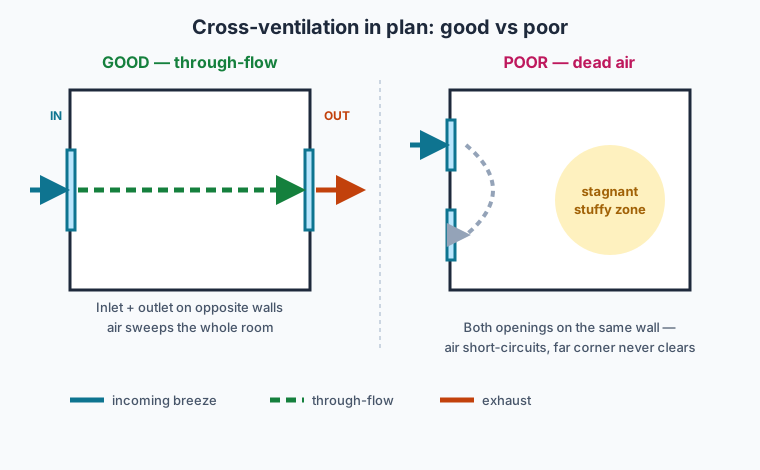
Figure 1: Inlet and outlet on opposite walls sweep the whole room (left); two openings on the same wall let air short-circuit, leaving a stuffy dead zone (right).
The golden rules:
- Inlet and outlet on opposite or adjacent walls, never the same wall. Two windows on one wall just let air loop straight back out — the far side of the room stays dead.
- Keep the path clear. Tall solid furniture, full-height partitions, or a closed internal door blocks the flow. Design the route the air takes, room to room.
- Outlet at least as large as the inlet — ideally larger. A bigger outlet relative to the inlet speeds the air up as it leaves, which increases the breeze velocity you feel inside.
- Lower the inlet to where people are. A window sill at sitting/standing height delivers breeze to the body; a high-only inlet cools the ceiling, not you.
"A room with windows on only one side will not be properly ventilated. There should be windows on at least two sides so that air can move through." — adapted from the ventilation principles in Christopher Alexander, A Pattern Language (Pattern 159, Light on Two Sides of Every Room, and the through-ventilation patterns).
4. The stack effect: ventilation when there is no wind
Some of the hottest days are dead still — no breeze to harvest. This is where the stack effect earns its keep. Warm air is lighter than cool air, so it rises. If you give a tall space a low inlet and a high outlet, the rising warm air escapes at the top and pulls fresh, cooler air in at the bottom. The taller the vertical distance between the two openings, the stronger the natural draught — even with zero wind outside.
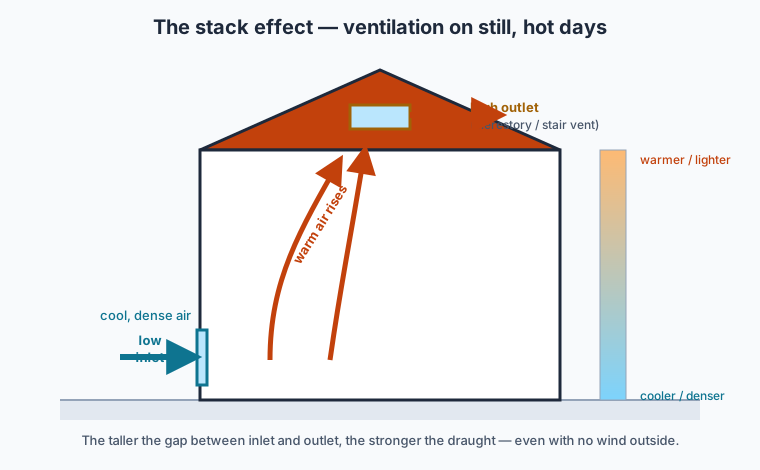
Figure 2: The stack effect — cool air in low, warm air out high. The greater the height between inlet and outlet, the stronger the pull.
In Indian homes this is what makes traditional devices work: the stairwell acting as a chimney, a double-height living space, a jaali-screened clerestory near the roof, or the classic courtyard that vents hot air upward at night. Practical levers:
- Put an operable high vent (clerestory, ventilator over the staircase, ridge vent) on the warmest, leeward, upper part of the house.
- Use the staircase as a vertical air column — a vent or openable skylight at its top exhausts the whole house.
- A roof or attic vent lets the hottest air under the roof escape instead of radiating down into bedrooms.
5. Placing and sizing openings
Now combine wind and stack thinking into actual window decisions. Open your habitable rooms — living, dining, bedrooms — to the cool prevailing side, and let service spaces (stores, stairs, utility, toilets) sit as a buffer on the hot side.
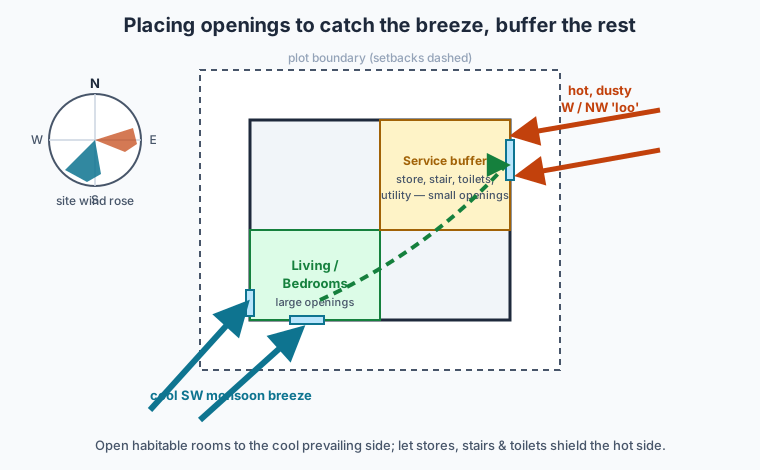
Figure 3: Open habitable rooms to the cool prevailing breeze; let stores, stairs and toilets shield the hot, dusty side. A wind rose confirms the directions.
Sizing rule of thumb. NBC 2016 (Part 8) and most municipal bylaws require habitable-room openable area of at least about one-tenth (10%) of the floor area for light and ventilation; for genuine comfort cooling in a hot climate, aim higher where you can — closer to 15–20% on the breeze side — split between a generous inlet and an equal-or-larger outlet.
Use this do / don't checklist when you mark windows on your plan:
| Do | Don't |
|---|---|
| Put inlet and outlet on opposite (or adjacent) walls | Put both openings on the same wall |
| Make the outlet equal to or larger than the inlet | Make the outlet much smaller (it throttles flow) |
| Set inlet sills at occupant height (breeze on the body) | Rely only on high windows for cooling people |
| Keep the internal air path clear, room to room | Block the path with full-height cupboards or shut doors |
| Open living/sleeping rooms to the cool prevailing side | Open big windows straight onto the hot western sun-and-loo |
| Add a high vent / stair vent for still days (stack) | Assume there is always a breeze to harvest |
| Confirm direction with a wind rose or the analyzer | Guess from the road or the entrance gate |
6. Courtyards, venturi and the tricks of form
The building's shape moves air too, not just its windows.
- Courtyards (aangan / nadumuttam). A central open court is a time-tested Indian cooling device. By night it radiates heat to the sky and fills with a pool of cool air; by day the warm air above it rises and draws ventilation through the surrounding rooms. It pairs beautifully with the stack effect.
- The venturi effect. When you funnel air through a narrowing — a gap between two blocks, a tapering passage, a wind-catching wing wall — it speeds up. A narrow side-yard between your house and the compound wall can be shaped to accelerate breeze toward an inlet, turning a sluggish wind into a noticeable one.
- Wing walls and offset openings. A short projecting wall (a 'wing wall') beside a window can deflect a glancing breeze straight into the room, useful when the wind arrives at an angle to your wall rather than head-on.
- Jaalis and louvres. Perforated screens and adjustable louvres let you keep airflow while cutting glare, dust and prying eyes — invaluable on the street side.
7. Blocking the bad wind: the loo, dust and salt
Reading wind is as much about exclusion as invitation.
- The loo (hot dry W/NW wind). In the north Indian plains, the pre-monsoon western wind is hot and dust-laden. Buffer that side with service rooms, a thick wall, a planted screen of trees, or jaali openings rather than large clear glass. The aim is to keep big habitable windows off the loo side and on the cool south-west side instead.
- Dust. Plant a windbreak of trees or shrubs upwind of dusty open ground or an unpaved road; it filters airborne grit before the breeze reaches your inlets.
- Coastal salt and squalls. On the Konkan or Coromandel coast, the sea breeze is your friend most days, but heavy monsoon gusts carry salt that corrodes fittings — use sheltered, deep verandahs and louvred openings you can close down in a squall.
8. The humid-coast exception
Everything above assumes you want maximum airflow. In hot-dry climates (Jaipur, Ahmedabad) you do — but you also want thermal mass and shaded, controlled openings. The strategy flips in degree on the warm-humid coast.
In Chennai, Mumbai, Kochi, Kolkata or coastal Odisha, the enemy is not so much raw heat as humidity and stagnation — still, sticky air that never lets sweat evaporate. Here ventilation is not optional, it is the primary cooling strategy:
- Maximise cross-ventilation at body level — large, openable, opposite-wall windows, raised plinths to catch the breeze, and deep shaded verandahs so you can keep windows open even in rain.
- Prioritise constant air movement over thermal mass. Lightweight, well-shaded, breeze-open construction beats a heavy sealed box.
- Day sea breeze, night land breeze. Coasts reverse: a cool sea breeze blows inland by day, a land breeze seaward by night. Openings on the seaward and the opposite side let you ride both.
- Keep bathrooms and kitchens cross-vented so the humidity they add gets flushed straight out.
Wind and sun must be solved together — the same south-west breeze side can also be a hot-sun side at certain hours. Sort the airflow here, sort the light and heat with the sun-path guide, and decide where the house sits and faces with the orientation guide. All three feed the bigger picture in the pillar site analysis for homeowners.
Sources & further reading
1. National Building Code of India 2016 (NBC 2016), Part 8 — Building Services, Section 1: Lighting and Ventilation. Bureau of Indian Standards. Minimum openable areas and natural ventilation provisions for habitable rooms.
2. IS 875 (Part 3): Design Loads (Other than Earthquake) for Buildings and Structures — Wind Loads. Bureau of Indian Standards. (Referenced here only to distinguish structural wind from comfort wind.)
3. Energy Conservation Building Code (ECBC), Bureau of Energy Efficiency, Government of India. Passive design, natural ventilation and envelope guidance.
4. India Meteorological Department (IMD), Pune & mausam.imd.gov.in. Climatological tables and wind-rose data for Indian stations.
5. Christopher Alexander et al., A Pattern Language (1977). Patterns on through-ventilation and light on two sides of every room.
6. Francis D. K. Ching, Architecture: Form, Space & Order. Principles of how building form shapes airflow.
7. Manual of Tropical Housing & Building — Koenigsberger et al. Foundational reference on ventilation, stack effect and passive cooling in hot climates.
Next, pair this with the companion site-reading guides: Understanding Sun-Path Analysis to balance breeze against light and heat, Site Orientation Explained to decide which way the house should face, and the pillar Site Analysis for Homeowners that ties wind, sun, slope and views together.
Export this guide
Related Guides — Deep-dive reading
Orientation, Light & Views: Designing With Your Space, Not Against It
How reading your plot's sun, breeze and views — and placing each room on the right face — gives an Indian home that is cooler, brighter and quietly right, instead of one that fights its site forever.
Design PrinciplesUnderstanding Cross Ventilation
The single most important everyday way to keep an Indian home fresh, cool and healthy — explained plainly: air in one opening, out another, and the layout that makes or breaks it.
Healthy HomesWindow Design for Cross Ventilation (India): Inlet, Outlet and the Path of the Breeze
How to size, place and choose windows so a breeze actually crosses the room, windward inlet to leeward outlet, with the right window types and a clear flow path.
Windows & GlazingRelated Tools — Try Free
Cross-Ventilation Analyzer
Estimate airflow and air changes per hour (ACH) from room size, window areas, layout, and local wind — with NBC 2016 Part 8 compliance check.
Ventilation CalculatorBrise-Soleil Visualizer
Interactive horizontal-louvre cut-off angle calculator — sun altitude, louvre depth, and spacing inputs with a live shadow preview. Computes θ = arctan(spacing/depth) for façade shading, ECBC envelope compliance, hospital daylight design, and tropical sun-control detailing.
Sun Shading ToolWindow Orientation Planner
Pick the best window type, glass and shading by wall direction — north, east, south and west.
Window Tool