
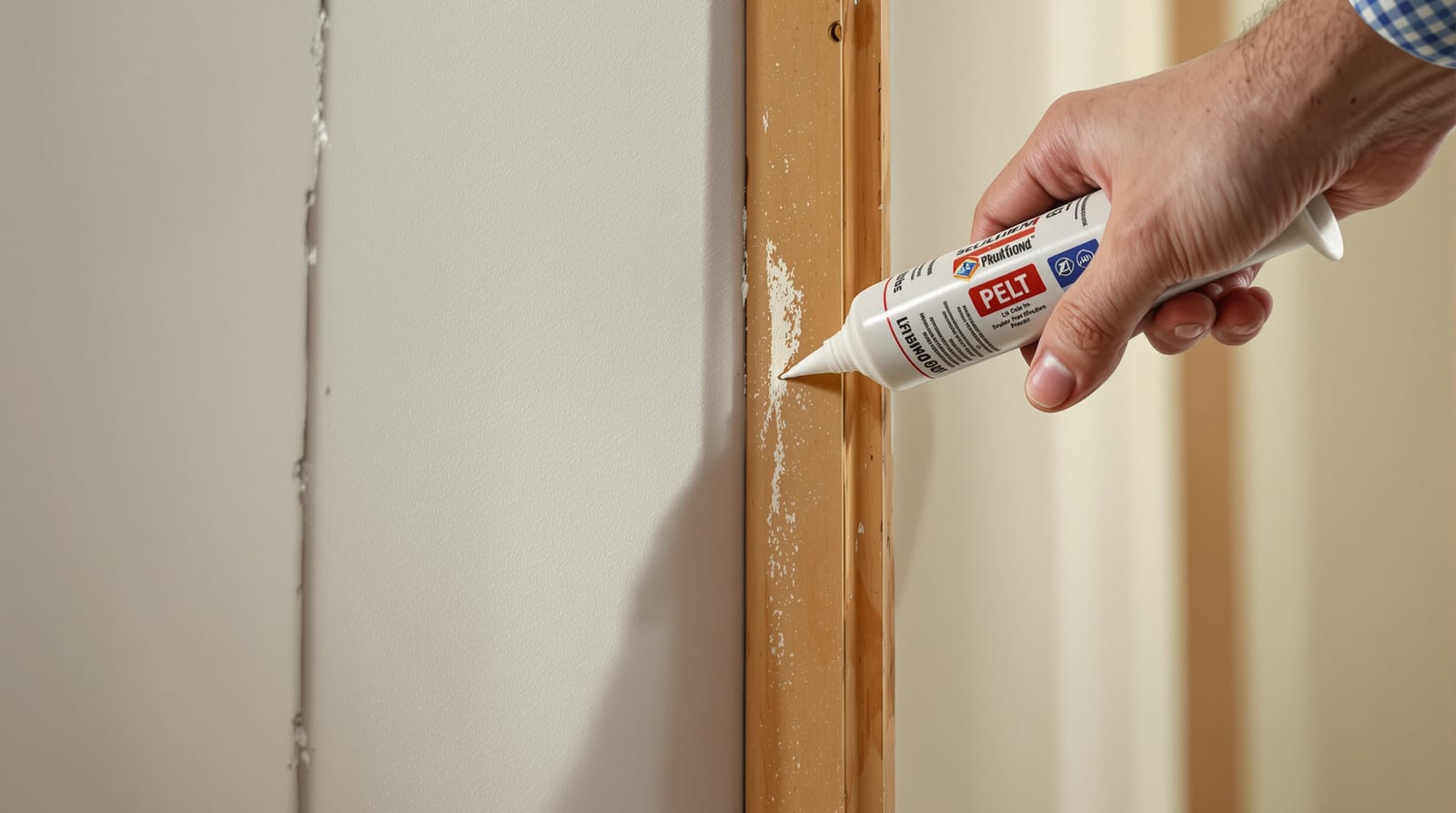
Sealing Around Door Frames: Caulk vs Silicone (India 2026)
Which sealant goes on the frame-to-wall junction — paintable acrylic inside, silicone outside and wet — plus rebate gaskets, threshold seals and monsoon-proofing.
A door can be plumb, the leaf perfectly hung and the architrave mitred sweetly, and the opening will still leak air, water, dust and sound if the thin line where the frame meets the wall is left open. Sealing around door frames is that last, easily-skipped step — running the right sealant into the frame-to-wall junction, fitting a gasket in the rebate, and closing the threshold so the chowkhat becomes a weather-tight, quiet, monsoon-proof part of the building. This is a different job from sealing the leaf: weatherstripping the moving shutter is covered in door seals and weatherstripping. Here we deal with the static joint around the frame — the one that, in Indian conditions, decides whether your wall plaster stays dry through the monsoon and whether the bathroom frame rots in two years.
The frame-wall junction vs the leaf seal
Think of two separate gaps. The dynamic gap is between the moving leaf and the frame rebate — it opens and shuts every time you use the door, and it needs a compressible weatherstrip or brush. The static gap is between the fixed frame and the masonry/plaster around it — it never moves once the frame is set, and it needs a flexible sealant or foam-plus-sealant.
Get them mixed up and you waste money: silicone smeared on a leaf edge tears off in days; a foam draught-strip stuffed into the frame-wall gap looks rough and fails on water. This guide is about the static joint. The gap behind the architrave is first closed with foam or backer rod (see door frame gap filling); sealant is the finishing, weather-tight skin over the top.
Which sealant for sealing around door frames: acrylic vs silicone
The single most useful rule in Indian homes: paintable acrylic caulk for dry internal junctions, neutral-cure silicone for everything external or wet. Acrylic takes emulsion paint so it disappears into the wall; silicone stays flexible and waterproof but cannot be painted, so you buy it in a matched colour (white, grey, clear, brown).
| Sealant | Best for | Paintable? | Water/UV | Movement | Indicative ₹ (cartridge) |
|---|---|---|---|---|---|
| Acrylic / painter's caulk | Internal frame-wall junction, architrave gaps | Yes | Low — keep dry | Moderate | ₹120-250 |
| Neutral-cure silicone | External doors, bathroom & kitchen frames, thresholds | No (colour-matched) | Excellent | High | ₹200-450 |
| Acetoxy silicone | Glazed/aluminium frames (not on marble) | No | Excellent | High | ₹180-350 |
| Hybrid MS polymer | Premium external + bonding, paintable | Yes | Excellent | Very high | ₹400-700 |
| Polyurethane (PU) sealant | Wide structural joints, heavy traffic | Some grades | Good | High | ₹350-600 |
A few India-specific cautions. Use neutral-cure (not acetoxy) silicone next to natural stone — granite and marble thresholds and surrounds can stain or be etched by the acetic acid that acetoxy types release while curing. For external main doors that bake in the sun, a hybrid MS-polymer sealant holds colour and flex far better than cheap acrylic. And never rely on acrylic caulk in a bathroom or balcony frame — it softens and lets water through; that junction must be silicone or MS polymer.
Rebate gaskets and threshold seals
Sealant closes the gap to the wall, but two other seals finish the system around the frame:
- EPDM / rubber rebate gasket. A self-adhesive or kerf-in EPDM (ethylene-propylene rubber) gasket pressed into the frame rebate gives a soft, durable lip the leaf shuts against. EPDM outlasts cheap PVC and foam in Indian heat and UV; it is the right choice for external and AC-room doors where draught and dust control matter. (This sits in the rebate, so it overlaps with leaf weatherstripping — fit it to the frame, not the leaf.)
- Threshold seal. At the bottom, an aluminium threshold strip with a rubber or brush insert, or a finned weather-bar threshold, closes the gap under the leaf where most draught, water and insects enter. For external doors pair it with a sloped, throated sill — see door weather bar and door saddle installation.
For a draught-sealing or AC-tight door, the combination is: EPDM in the rebate around head and jambs, a threshold seal at the bottom, and silicone closing the frame to the wall. That three-sided-plus-bottom loop is what makes a door genuinely weather-tight.
Application: how to get a clean, lasting bead
Sealant fails far more often from bad application than from a bad product. The frame-wall junction in India also has to survive thermal movement, monsoon wetting and the odd termite-treatment chemical, so surface prep matters.
| Step | What to do | Why |
|---|---|---|
| 1. Clean & dry | Remove dust, old caulk, oil; let plaster cure fully | Sealant will not bond to damp or dusty surfaces |
| 2. Back the gap | Push backer rod or trim cured foam below the face | Gives the bead the right depth and a 2-point bond |
| 3. Mask | Run painter's tape both sides of the joint | Crisp lines; less clean-up |
| 4. Prime if needed | Use sealant-maker's primer on porous/wet substrates | Bond on tricky surfaces |
| 5. Gun the bead | Cut nozzle to gap width, steady continuous pull | Even fill, no air gaps |
| 6. Tool | Smooth with a wet finger / spatula (soapy water for silicone) | Forces sealant into the gap, neat concave finish |
| 7. Peel tape | Remove tape while still wet | Clean edge |
For a durable joint, aim for a sealant bead roughly half as deep as it is wide, with backer rod or foam behind so it bonds only to the two sides (not the back) and can stretch. Don't over-fill: a thick slug of sealant cracks at the edges. For external and bathroom frames, keep the bead continuous and unbroken all the way down to the threshold, because a single skipped few centimetres is where monsoon water finds its way behind the frame.
Monsoon, damp and draught realities in India
Waterproofing external and wet-area frames
The frame-wall junction on an external or bathroom door is a primary leak path. Seal it with neutral-cure silicone or MS polymer, integrate the bead with the wall's waterproofing where there is a membrane, and make sure the external sill slopes outward with a drip/throating groove so water runs off rather than tracking back to the joint. In bathrooms, a frame made of WPC, uPVC, RCC or aluminium (not untreated timber) plus a silicone-bedded granite saddle is the durable combination — covered in waterproofing door thresholds and door frame damp-proofing. The frame base should always sit on a DPC or stone block, never directly on a wet floor.
Draught and dust sealing
For AC rooms and dusty city homes, the junction sealant plus an EPDM rebate gasket and a threshold seal cut the air leakage that drives up cooling bills and lets fine dust settle indoors. Keep the leaf's own undercut as small as the floor finish allows — a smaller undercut means less to seal at the bottom.
Sound sealing
Most door sound leaks through gaps, not the leaf. An air-tight perimeter — continuous junction sealant, a soft EPDM rebate gasket and a drop-down or brush threshold seal — noticeably quietens a room. For a serious acoustic door, an acoustic-grade sealant at the frame-wall joint and a compressible gasket loop matter more than the leaf's mass.
Sealing the frame is a job a careful homeowner can do, but on external main doors, wet areas and anywhere the waterproofing membrane is involved, get a skilled carpenter or applicator to detail it — a mis-sealed junction shows up as damp plaster months later. For the foam-and-packing stage read door frame gap filling; for the covering trim see architraves and door trim; and for paint-grade finishing of the frame itself, door frame finishing. The frame layer overall starts at door frames, and the whole topic at the complete door guide. Size the gap before you buy with the door gap foam calculator, and pick the right frame for wet areas with the door frame material selector.
Frequently asked questions
Should I use acrylic caulk or silicone around a door frame?
Use paintable acrylic caulk on dry internal frame-wall junctions — it takes emulsion paint and disappears into the wall. Use neutral-cure silicone (or MS polymer) on external doors, bathroom and kitchen frames, and thresholds, because it stays flexible and waterproof. Never use acrylic in wet areas; it softens and leaks.
What is the difference between sealing the frame and weatherstripping the door?
Sealing the frame closes the static gap between the fixed frame and the wall with caulk or silicone, so it never moves once set. Weatherstripping seals the dynamic gap between the moving leaf and the rebate with a compressible EPDM, brush or foam strip. You usually need both.
How do I stop monsoon water leaking around my main door frame?
Run a continuous neutral-cure silicone or MS-polymer bead down the full frame-wall junction with no gaps, integrate it with the wall waterproofing, slope the external sill outward with a drip groove, and sit the frame base on a DPC. A single skipped section is where water gets behind the frame.
Can I paint over silicone around the door frame?
No — standard silicone cannot be painted; emulsion beads up and peels off. Buy it in a colour matched to the frame or wall (white, grey, brown, clear). If you need a paintable external seal, use a hybrid MS-polymer or paint-grade acrylic on dry areas only.
Do I need a rubber gasket as well as sealant?
They do different jobs. Sealant closes the frame-to-wall gap; an EPDM rebate gasket gives the leaf a soft, draught- and dust-tight lip to shut against. For AC rooms, external doors and quiet rooms, fit both plus a threshold seal for a fully weather-tight loop.
Will sealing the frame help with noise and dust?
Yes. Most door noise and dust enters through perimeter gaps, not the leaf itself. A continuous junction sealant, a soft EPDM rebate gasket and a threshold seal together close those gaps, noticeably reducing draught, dust ingress and sound transfer — far more effective than upgrading the leaf alone.
Export this guide
Related Guides — Deep-dive reading
Waterproofing Door Thresholds in India (India 2026)
Stopping water tracking under bathroom and external door frames with a raised kerb, granite saddle and a membrane that turns up into the threshold.
Home Doors & EntrancesDoor Frame Rebate Explained: Depth, Width & Seal (India 2026)
What the rebate (check) in a chowkhat actually is, how deep and wide it should be, and why it decides whether your door draught-proofs, sound-proofs and locks securely.
Home Doors & EntrancesDoor Saddle Installation: Threshold Fitting (India 2026)
How to fit a granite or aluminium saddle threshold on mortar or adhesive, level it true, and seal it against monsoon water ingress.
Home Doors & EntrancesRelated Tools — Try Free
Bathroom Sealant Calculator
How many tubes of silicone sealant a bathroom needs and the cost — by joints to seal, lengths and bead size, with an anti-fungal note.
Bathroom CalculatorAcoustic Privacy (STC) Visualizer
Indian healthcare acoustic visualizer — compare wall assemblies and noise sources, see received SPL after STC attenuation, and check FGI 2018 / IS 1950 / NABH speech-privacy compliance with live dual-canvas waveform.
Acoustic ToolBathroom Door Material Selector
Get the best wet-area door material — WPC, FRP, PVC, marine ply or aluminium — ranked for your bathroom or utility.
Material Selector