
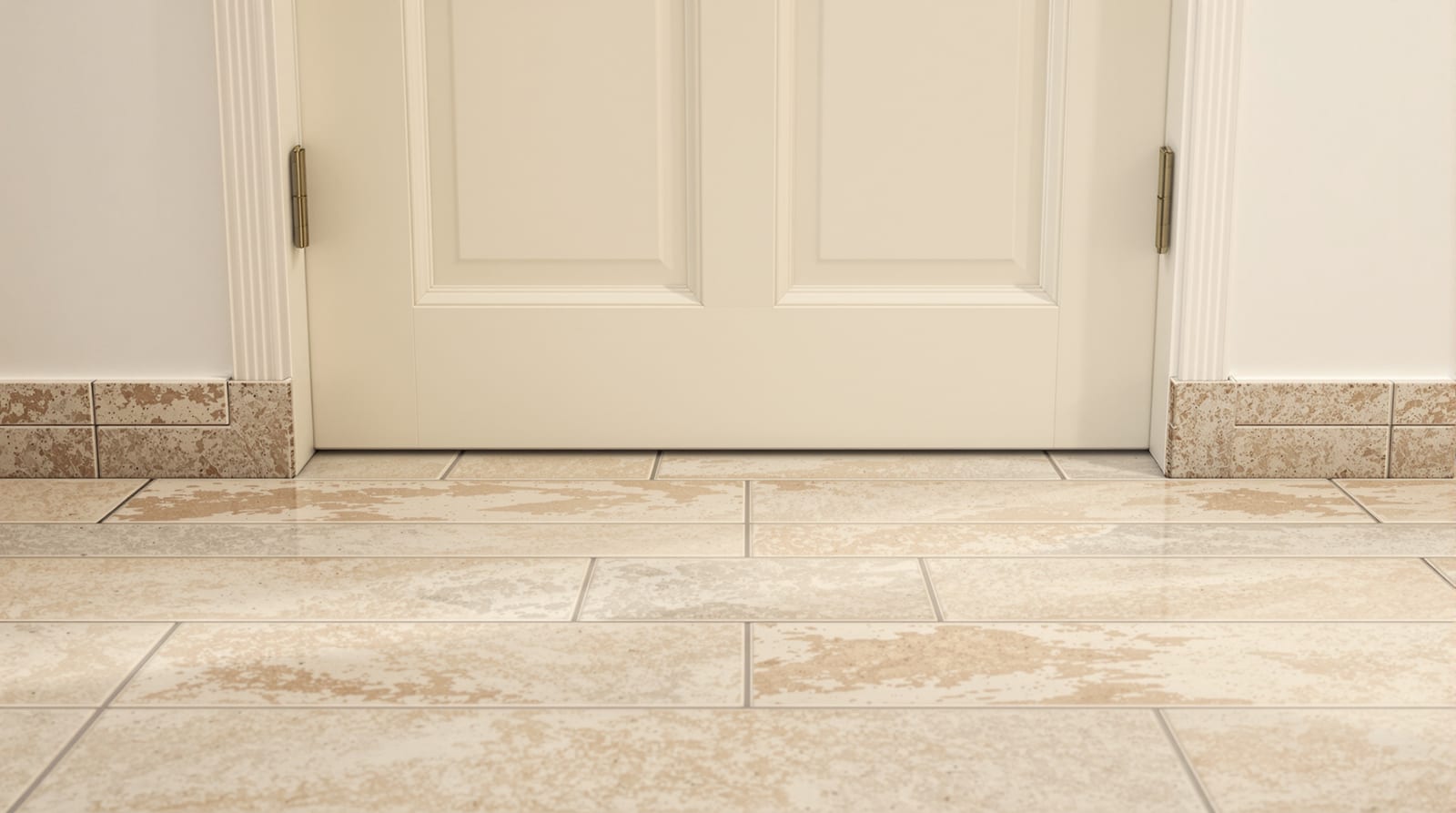
Door Undercut Clearance & Bottom Floor Gap (India 2026)
How much gap to leave under a door leaf in India — 6-12mm for tile, marble, carpet and ventilation, and when to fit a threshold or seal instead.
The door undercut clearance is the deliberate gap left between the bottom of the door leaf and the finished floor. It looks like an afterthought, but it is a designed dimension that decides whether your door drags on the new tile, whether the air-conditioned bedroom can actually breathe, whether the bathroom clears its steam, and whether a wheelchair or a toe catches on a step. In Indian homes the standard undercut runs 6-12mm over the finished floor — tighter where a threshold or seal is fitted, larger where carpet, return-air or ventilation demands it. This guide explains how much gap to leave, how floor-finish thickness (tile, marble, carpet) eats into it, why HVAC and bathrooms need a generous undercut, when you should fit a threshold or door-bottom seal instead of an open gap, and how to trim a leaf bottom without ruining the door.
What the undercut is and why it exists
The undercut is the air gap under the closed leaf. Unlike the side and top margins of a door, which sit at 2-4mm, the bottom gap is deliberately larger. It does several jobs at once:
- Clears the floor finish. The frame (chowkhat) is fixed before the final finish goes down. The undercut absorbs the thickness of the tile, marble or carpet plus its bed so the leaf still swings free.
- Stops the door dragging. Floors are never perfectly level. A gap lets the leaf swing across small undulations without scraping, which would otherwise wear a scuff arc and bind the door.
- Lets air move. A closed door with no bottom gap seals a room airtight. The undercut is the deliberate path for HVAC return air, bathroom extract, and cross-ventilation.
- Absorbs floor-level changes. Where one room is tiled and the next is marble or has a step, the undercut lets a single leaf clear both finishes.
As a rule of thumb, leave 10-12mm where the door must pass return air or sits over carpet, 8-10mm for a normal internal tiled door, and 6mm or less only where a threshold or door-bottom seal closes the gap deliberately.
Door undercut clearance: how much to leave
| Door / situation | Recommended undercut over finished floor | Why |
|---|---|---|
| Internal door, tile/marble floor | 8-12mm | Clears finish, allows cross-ventilation |
| AC bedroom / room with HVAC return air | 12mm (10-15mm) | Passes return air so the AC balances |
| Door over carpet / rug | leaf bottom ~12mm above carpet pile | Clears compressed pile, no drag |
| Bathroom / WC door | 12-15mm | Clears steam, passes extract-fan make-up air |
| Kitchen door | 10-12mm | Ventilation, clears any threshold |
| Door with bottom seal / drop-seal | 3-6mm (seal closes gap) | Acoustic / draught / smoke control |
| External / main door with threshold | 3-5mm over threshold + seal | Weather and dust exclusion |
| Fire-rated door | <=3mm + intumescent/smoke seal | Tighter gaps required for rating |
The undercut is always measured above the finished floor, not the bare slab. If the carpenter measures off the screed and the tiler later lays 10mm tile on 8mm adhesive, you lose ~18mm of clearance and the door binds. Always confirm the final finish before the leaf bottom is cut.
Floor-finish thickness eats the gap
The single most common Indian site mistake is hanging the leaf to the wrong floor datum. The frame goes in early; the finish goes down later. If the leaf is cut to clear the screed and the finish then rises, the door scrapes. Typical finish build-ups:
| Floor finish | Finish + bed thickness (typical) | Effect on a door cut to the screed |
|---|---|---|
| Ceramic / vitrified tile | 8-12mm tile + 6-10mm adhesive/bed | Lose ~15-22mm clearance |
| Marble / granite slab | 18-20mm slab + 20-25mm mortar bed | Lose ~40mm+ |
| Engineered wood / laminate | 8-12mm board + underlay | Lose ~12-15mm |
| Carpet | 6-12mm pile + underlay | Lose ~10-18mm |
| Vinyl / SPC click | 4-8mm | Lose ~5-10mm |
The fix is sequencing: hang and trim the leaf after the finished floor is down, or hold the leaf high and trim it as the last step. If the leaf must be hung before the finish, set the undercut generously and trim to final clearance once the floor is complete. A marble threshold or a tile-to-marble step at a doorway also has to be allowed for, or one swing position fouls the step.
HVAC return air and the door undercut
In an air-conditioned room the supply air has to return to the unit to be re-cooled. If the return grille is in a corridor and the bedroom door is shut, the only return path is the gap under the door. Starve that path and the room over-pressurises, airflow drops, and the AC short-cycles. A 10-12mm undercut on a standard 750-825mm leaf gives roughly the free area a single room's transfer air needs as a rule of thumb; tightly sealed or high-airflow rooms may need a dedicated transfer grille instead. So in any AC home, do not seal the bottom of a bedroom door tight — keep the undercut, or fit a louvred transfer grille if you also want acoustic separation.
Bathrooms, kitchens and ventilation
A bathroom needs make-up air for its extract fan and a path to clear steam and odour; the undercut is that path. Keep a 12-15mm gap under a bathroom door, and choose a moisture-proof frame and leaf (WPC, PVC, uPVC or aluminium) rather than untreated timber that will swell and rot at the foot. The same logic applies to kitchens and utility rooms with exhaust fans. The trade-off is privacy of sound and light, which a louvred leaf or a transfer grille higher up can restore without choking the airflow.
Undercut detail (cross-section)
When to fit a threshold or seal instead
An open undercut is right for most internal doors, but sometimes you want the gap closed. The choice is between leaving the gap, fitting a threshold (saddle) the leaf clears, or fitting a door-bottom seal that closes the gap when shut.
| Goal | Best solution | Undercut to leave |
|---|---|---|
| Normal internal ventilation | Open undercut | 8-12mm |
| AC return air | Open undercut or transfer grille | 10-12mm |
| Acoustic / privacy bedroom | Drop-down (automatic) bottom seal | 3-6mm (seal closes it) |
| Draught / dust / AC efficiency | Brush or fin door-bottom seal | 4-6mm |
| Smoke / fire control | Intumescent + smoke seal | <=3mm |
| External / main door | Threshold + weather bar + seal | 3-5mm over threshold |
| Wet-area containment | Raised kerb / granite saddle | per saddle height |
| Level change between rooms | Ramped (bevelled) threshold | clears both finishes |
A drop-seal (automatic bottom seal) is the smart answer when you want both ventilation when needed and a tight seal when shut — the seal drops only as the door closes against the frame. For an external door, pair a sloped threshold and weather bar with the undercut so wind-driven monsoon rain is shed outward. For accessibility, the RPwD Act 2016 and the Harmonised Guidelines 2021 require thresholds to be <=12-13mm and bevelled if over 6mm, preferably flush — so on an accessible route, do not solve a gap with a tall step.
Trimming the leaf bottom safely
If a door drags after the floor is finished, the cure is to trim the leaf bottom — done carefully, not hacked.
1. Mark the cut to the finished floor. With the door hung, scribe a line that gives the target undercut, allowing for any high spot in the floor across the swing.
2. Respect the bottom rail. A flush door has a solid lipping rail of only ~50-90mm at the bottom; a panelled door has a thicker bottom rail. Never cut past the solid rail into the hollow core, or you expose the void and weaken the leaf. Limit a trim to roughly 6-12mm, and never more than the bottom rail allows.
3. Cut clean. Score the veneer with a sharp knife along the line to stop chip-out, then plane or saw to the line. Take equal amounts if the floor slopes, keeping the leaf bottom parallel to the finished floor.
4. Re-seal the cut edge. A bare cut edge wicks moisture, which in Indian humidity swells and rots the rail. Prime and paint or polish the cut edge, and on a hollow-core door re-glue the rail block into the void.
5. Re-check the swing across the whole arc, not just the closed position, because the high spot is usually mid-swing.
If a door already binds, see the targeted fixes in fix a gap under the door and door rubbing the frame. For the wider fitting picture, the undercut is part of the overall margins in door clearances and tolerances, and the floor side is decided when you set the door rough opening and choose a door threshold. For a level, accessible saddle see zero-threshold doors. The full sequence sits in the complete door guide and the frame layer in the door frames guide. To plan the gaps numerically, use the door clearance checker and the door threshold selector.
Frequently asked questions
How much gap should there be under a door in India?
Leave a 6-12mm undercut over the finished floor for a normal internal door, 10-12mm for an air-conditioned room that needs return air, and 12-15mm for a bathroom that has to clear steam and feed an extract fan. Tighten to 3-6mm only where a threshold or door-bottom seal closes the gap deliberately.
Should I measure the undercut from the slab or the finished floor?
Always from the finished floor. The most common mistake is cutting the leaf to the bare screed, then losing 15-40mm of clearance once tile, marble or carpet goes down, so the door drags. Confirm the final floor finish before the leaf bottom is trimmed.
Why does an air-conditioned room need a bigger gap under the door?
The AC needs supply air to return to the unit. With the door shut, the undercut is the return-air path. A tight gap over-pressurises the room, drops airflow and makes the AC short-cycle, so keep a 10-12mm undercut or fit a louvred transfer grille for the room to balance.
When should I fit a threshold or seal instead of leaving a gap?
Fit a door-bottom seal or drop-seal when you want acoustic privacy, draught and dust exclusion or AC efficiency; fit a sloped threshold and weather bar on an external door to shed monsoon rain. On accessible routes keep any threshold to 12mm or less and bevelled, per the RPwD Harmonised Guidelines.
How much can I safely cut off the bottom of a door?
Trim only as far as the solid bottom rail allows, usually about 6-12mm and never into the hollow core of a flush door, or you expose the void and weaken the leaf. Cut equally if the floor slopes, then prime and seal the cut edge against humidity.
Do bathroom doors need a larger undercut?
Yes. A bathroom door wants a 12-15mm undercut so it clears steam and feeds make-up air to the extract fan. Use a moisture-proof WPC, PVC, uPVC or aluminium frame and leaf rather than untreated timber, which swells and rots at the foot in the wet zone.
Export this guide
Related Guides — Deep-dive reading
Zero Threshold Doors in India: Level Access (India 2026)
How to detail a flush, step-free door threshold for wheelchairs and ageing-in-place while still keeping monsoon water out.
Home Doors & EntrancesDoor Threshold Standards for Indian Homes: Sill, Weather Bar & Accessibility (2026)
What the strip under your door actually does - water, dust, draft and insect barrier, level transition and trip-safe accessibility - with the right material, the 12 mm accessibility limit, weather-bar and drip-groove detailing for external doors, and the wet-bathroom threshold.
Home Doors & EntrancesDoor Frame Rebate Explained: Depth, Width & Seal (India 2026)
What the rebate (check) in a chowkhat actually is, how deep and wide it should be, and why it decides whether your door draught-proofs, sound-proofs and locks securely.
Home Doors & EntrancesRelated Tools — Try Free
Acoustic Privacy (STC) Visualizer
Indian healthcare acoustic visualizer — compare wall assemblies and noise sources, see received SPL after STC attenuation, and check FGI 2018 / IS 1950 / NABH speech-privacy compliance with live dual-canvas waveform.
Acoustic ToolDoor Material Comparison Tool
Compare 2–4 door materials on cost, durability, maintenance, security and moisture resistance.
Comparison ToolCross-Ventilation Analyzer
Estimate airflow and air changes per hour (ACH) from room size, window areas, layout, and local wind — with NBC 2016 Part 8 compliance check.
Ventilation Calculator