
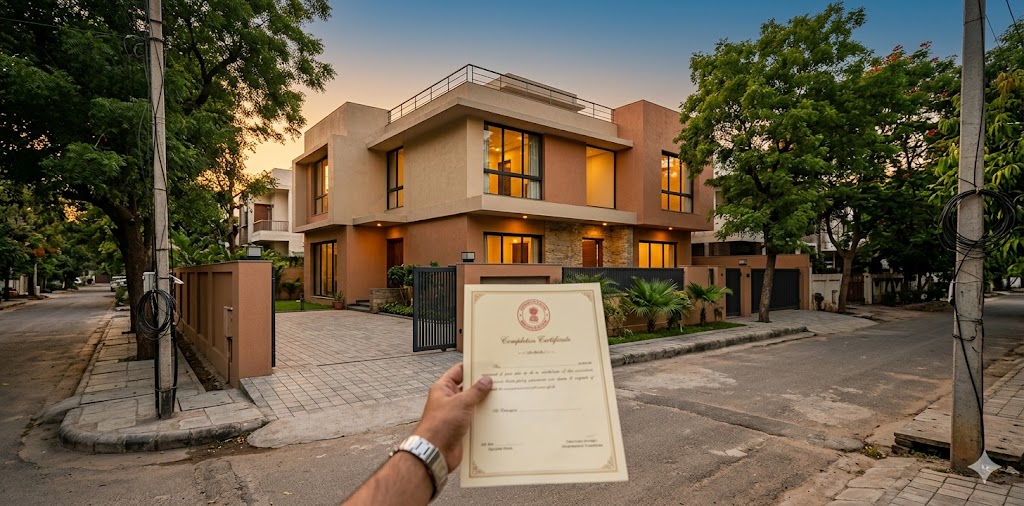
OC, CC & Plinth Verification in India
The Architect's Submission Workflow for Statutory Completion Milestones
The architectural project is not complete on the day the contractor hands over keys. It is complete when the Occupancy Certificate (OC) is issued by the local authority — the statutory document that legally permits human occupation of the building. Between Stage 6 of construction and that OC sit three statutory milestones the architect must navigate: plinth verification, completion certificate (CC) issuance, and the OC itself, with a stack of inter-departmental No Objection Certificates (NOCs) gating each.
This guide is the architect's working reference for that pipeline. It covers what each milestone is, what drawings and documents are filed at each, which NOCs the building requires before OC, the deviation tolerance under different jurisdictions' regularisation schemes, and the RERA implications of operating without an OC. It is intended as a practical companion through the final 6–12 months of any residential project — and as a planning reference at Stage 1, when the architect must factor approval timelines into the project schedule.
"It is not enough to build well; one must also be permitted to inhabit." — Aphorism in Indian architectural practice circles, capturing the OC's role
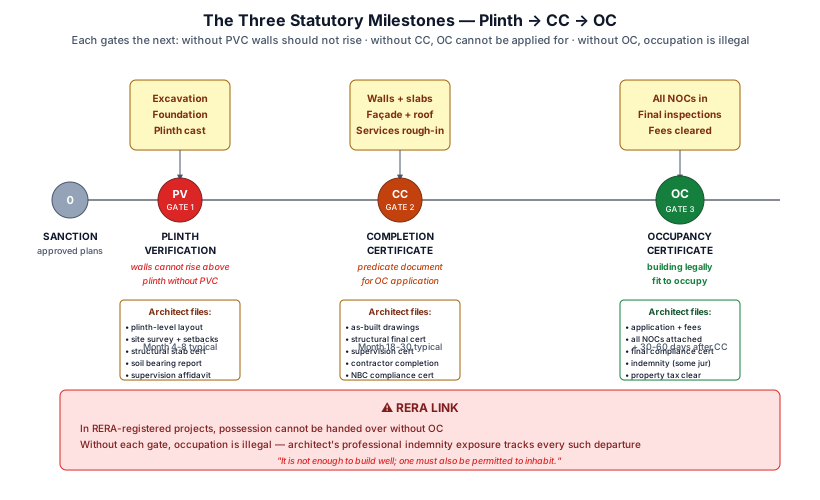
1. The Three Statutory Milestones
Indian municipal building law treats construction as a regulated, three-stage process:
| Milestone | When It Fires | What the Architect Files | Authority Issues |
|---|---|---|---|
| Plinth Verification | After foundation and plinth slab cast, before walls rise | Plinth-level drawing showing footprint matches sanctioned plan; structural cert; site-photographs | Plinth Verification Certificate (PVC) |
| Completion Certificate (CC) | When construction is structurally + envelope complete | As-built drawings; structural stability cert; supervision certificate; soil-bearing test report | Completion Certificate |
| Occupancy Certificate (OC) | After all NOCs received and inspections cleared | Application with all NOCs attached; final compliance certificate | Occupancy Certificate |
Source: Synthesised from National Building Code 2016 Part 2 (Administration), Unified Building Bye-Laws 2016 for Delhi, BBMP Building Bye-Laws, BMC DCPR 2034, GHMC Building Rules.
The three milestones gate construction progression: without PVC, walls should not rise above plinth; without CC, OC cannot be applied for; without OC, occupation is illegal (and in RERA-registered projects, possession cannot be handed over). In practice, contractors and clients sometimes proceed without each — and the architect's professional indemnity exposure tracks every such departure.
"Compliance is not optional architecture; it is the framework within which architecture happens." — Practitioner aphorism
2. Plinth Verification — The First Gate
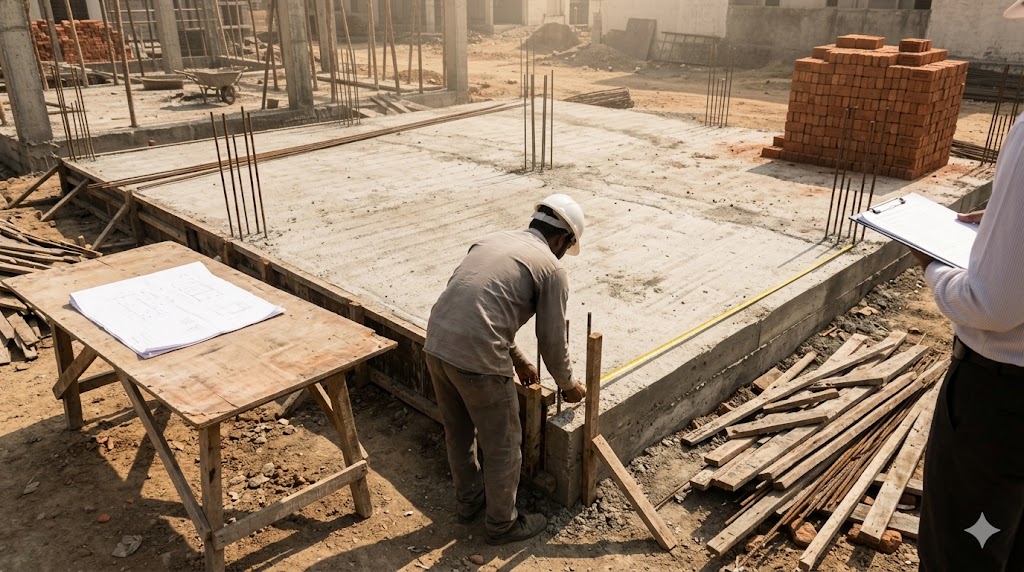
Plinth verification is the authority's first physical inspection of the project. After excavation, foundation, and plinth slab are cast, the contractor stops; the authority's officer visits site, measures the plinth, and verifies that the actual footprint matches the sanctioned plan within tolerance.
What the Architect Must File
| Document | What It Shows | Common Tolerance |
|---|---|---|
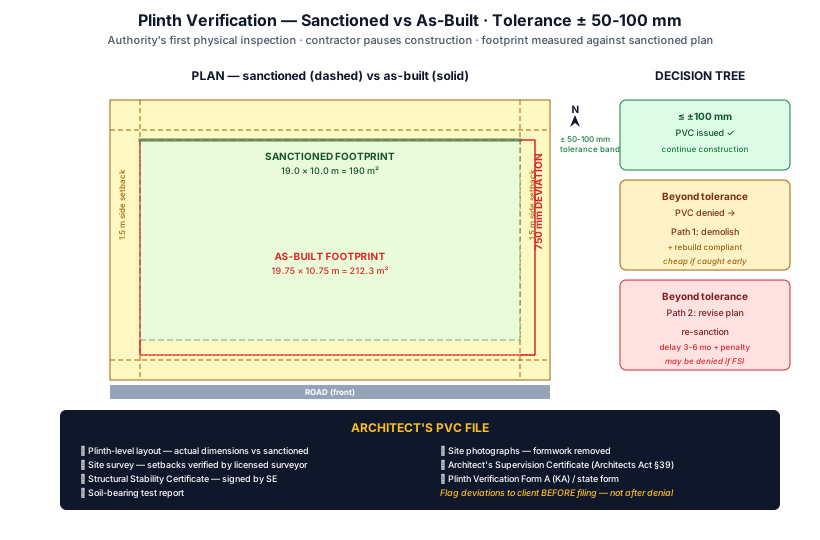
| Plinth-level layout | Actual built footprint with dimensions | ±50–100mm typical |
| Site survey at plinth | Setbacks measured from boundary; verified by surveyor | Within sanctioned setback |
| Structural Stability Certificate | Foundation design conformance, signed by structural engineer | Mandatory |
| Soil-bearing test report | Proof that as-built foundation is on adequate soil | Mandatory in most jurisdictions |
| Site photographs | Plinth condition, formwork removed | Indicative |
| Architect's Supervision Certificate | Architect's affidavit of supervision under §39 of Architects Act 1972 | Mandatory |
Source: BBMP Plinth Verification Form A; MCD UBBL Annexure on plinth verification; BMC Plinth Certificate procedure under DCPR 2034; cross-referenced against NBC 2016.
The deviation issue: if the as-built plinth deviates from sanction by more than the tolerance — most commonly because the contractor encroached on a setback — plinth verification is denied and the project enters one of two paths:
1. Demolish and rebuild the offending portion to comply with sanction
2. File a revised plan for re-sanction, accepting whatever delay (and penalty) that entails
Architects who detect plinth deviations at supervision should flag them to the client before plinth verification application is filed — not after the authority denies it. Early-stage demolition of one wall is far cheaper than three months of re-sanction delay.
3. Completion Certificate (CC)
The Completion Certificate is the authority's confirmation that construction is complete, structurally sound, and conforming to the sanctioned plan. It is the predicate document for OC application — most jurisdictions require CC before they will entertain an OC application.
What CC Application Requires
| Document | Source | Notes |
|---|---|---|
| As-Built Drawings | Architect | Must reflect on-site reality; deviations from sanction must be highlighted |
| Structural Stability Certificate | Structural engineer | Final, confirming no structural deviation from design |
| Architect's Supervision Certificate | Architect | Confirming architect supervised construction as per Architects Act |
| Contractor's Completion Certificate | Contractor | Confirming work executed per drawings and specifications |
| Soil-bearing test report | Geotechnical consultant | If not filed at plinth, must be filed now |
| Photographs | Architect / contractor | All facades, key sections, completed condition |
| NBC compliance certificate | Architect | For NBC-applicable projects (hospital, school, hotel, multi-storey residential) |
| Application form + fee | Client / architect | Per local schedule |
The CC is typically issued within 30–60 days of complete application, subject to one or more authority site visits. Common reasons for CC delay or refusal:
- Setback encroachment detected at site visit (parking shed in setback, balcony extending beyond)
- FSI overrun — actual built area exceeds sanctioned by more than tolerance
- Use deviation — building used for a purpose other than sanctioned (residential plan, commercial use)
- Missing documents — most often a structural stability certificate that hasn't been signed off
- Pending fees / penalty for any earlier compoundable deviation
"In construction, the document arrives late but the deviation arrived early." — Site engineer's lament
4. NOCs Required Before OC — The Inter-Department Stack

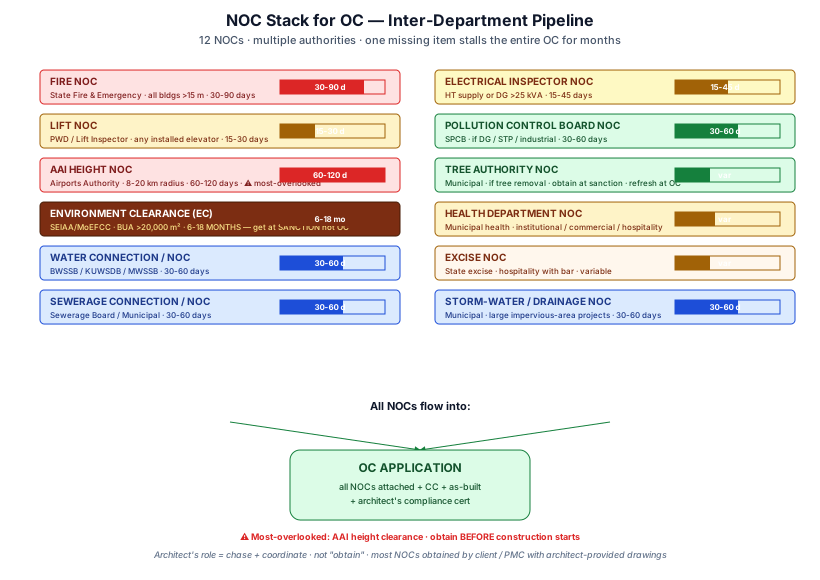
Before OC can be issued, multiple departments must each sign off via No Objection Certificates. The list varies by jurisdiction and building type, but the canonical residential set:
NOC Stack for Residential OC
| NOC | Issuing Authority | When Required | Typical Lead Time |
|---|---|---|---|
| Fire NOC | State Fire & Emergency Services | All buildings >15m height; institutional, hospital, school always | 30–90 days |
| Lift NOC | State Public Works Department / Lift Inspector | Any building with installed elevator | 15–30 days |
| AAI (Airports Authority) Height NOC | AAI regional office | Plots within airport-influence zone (typically 8–20 km radius) | 60–120 days |
| Environment Clearance (EC) | SEIAA / MoEFCC | Built-up area >20,000 sqm typical residential threshold | 6–18 months — must be obtained at sanction stage, not OC |
| Water Connection / NOC | Water Supply Board (BWSSB, KUWSDB, MWSSB, etc.) | Mandatory for OC | 30–60 days |
| Sewerage Connection / NOC | Sewerage Board / Municipal | Mandatory for OC | 30–60 days |
| Electrical Inspector NOC | State Electrical Inspectorate | Buildings with HT supply or generator >25 kVA | 15–45 days |
| Pollution Control Board NOC (PCB) | State Pollution Control Board | If DG set, STP, or specific industrial uses | 30–60 days |
| Tree Authority NOC | Municipal tree authority | If tree removal or transplantation occurred | Should be obtained at sanction; refresh on completion |
| Health Department NOC | Municipal health | For institutional / commercial / hospitality | Variable |
| Excise NOC | State excise | For hospitality with bar | Variable |
| Storm-water / Drainage NOC | Municipal | For projects with significant impervious area | 30–60 days |
Source: Composite from BBMP Building Approval Process (2024); BMC OC Application Procedure under DCPR 2034; MCD UBBL Annexure on completion documentation; GHMC Building Rules; CMDA Tamil Nadu CDBR 2019.
The architect's role in this NOC pipeline is chase and coordinate, not "obtain" — most NOCs are obtained by the client (or their PMC) with the architect providing technical drawings and certifications. The architect's submission to OC is incomplete without each applicable NOC, and a missing single NOC can stall the entire OC for months.
The single most-overlooked NOC in residential practice is AAI height clearance for plots near airports. Bengaluru, Mumbai, Delhi, Chennai, Hyderabad, and Kolkata all have substantial AAI-restricted zones. Failure to obtain AAI NOC before construction starts is a common cause of forced height reduction at OC stage — a project demolishes its top floor to fit AAI envelope.
5. Occupancy Certificate (OC) — The Final Document

The OC is the Goldilocks of Indian building regulation — the moment when everything that needed to happen has happened, every authority that needed to inspect has inspected, every NOC that needed to be in place is in place. The OC is then issued, and the building is legally fit for human occupation.
OC Application Components
| Component | Description |
|---|---|
| Application form | Per jurisdiction (Form A in Karnataka, Form 2 in Maharashtra, etc.) |
| All NOCs | As listed above, attached |
| CC + as-built drawings | Predicate documents |
| Architect's final compliance certificate | Affidavit confirming construction matches sanctioned + as-built |
| Photographs | Final condition, all facades |
| Indemnity bond | In some jurisdictions, indemnifying the authority against future deviation discovery |
| Property tax clearance | Updated to current period |
| Sanction fee balance / OC fee | Per fee schedule |
Why OC Applications Are Refused
| Refusal Reason | What Triggers It | Resolution Path |
|---|---|---|
| Deviation > tolerance | As-built dimensions exceed sanctioned by more than the local tolerance | Regularisation (where available) or demolition |
| Setback encroachment | Compound wall, parking shed, or projection in setback | Demolition or compounding |
| FSI overrun | Built-up area exceeds sanctioned FSI | Penalty + regularisation or partial demolition |
| Missing NOC | Any required NOC not obtained | Obtain before re-application |
| Mismatched use | Sanctioned residential, used commercial | Use-conversion sanction or cease |
| Structural concern | Authority engineer's site visit raises structural flag | Independent structural audit |
| RERA escrow not closed | Project cannot show RERA-mandated escrow compliance | Reconcile RERA filings |
"Every OC ever issued was preceded by at least one moment of architect's panic." — Practitioner aphorism that holds true across India
6. Deviation, Regularisation, and Compounding
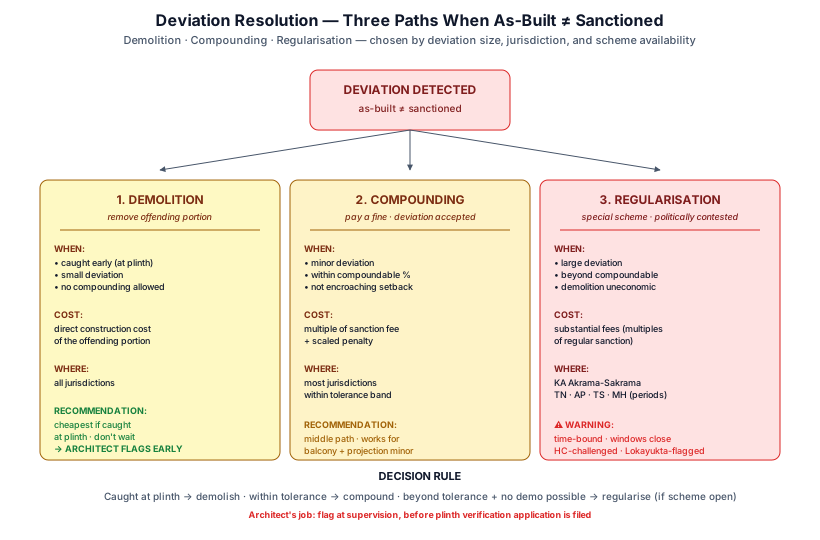
When the as-built deviates from the sanctioned plan, three paths exist:
The Three Resolution Paths
| Path | Mechanism | Indicative Cost | Where Available |
|---|---|---|---|
| Demolition | Remove the offending portion | Direct construction cost | All jurisdictions |
| Compounding | Pay a fine; deviation is "compounded" and treated as if sanctioned | Multiple of fee + penalty | Most jurisdictions, within tolerance |
| Regularisation | Apply under a special scheme; deviation is regularised on payment | Higher fee + penalty | Karnataka (Akrama-Sakrama), Tamil Nadu, Andhra/Telangana, Maharashtra (in periods) — schemes come and go |
The regularisation scheme is the architect's last-resort option when deviations are too large to compound but demolition is uneconomical. India has had multiple state-level schemes — Karnataka's Akrama-Sakrama is the best-known; Tamil Nadu, Andhra Pradesh, Telangana, and Maharashtra have run similar one-time schemes. The schemes:
- Are time-bound — they open for a window (often 6–18 months) and close
- Charge substantial fees — typically multiples of regular sanction fee
- Are politically contested — the Akrama-Sakrama scheme has been challenged in the Karnataka High Court multiple times since 2014; the Lokayukta has flagged it
- Do not regularise everything — typically not setbacks below threshold, not FSI overruns above threshold
The architect's professional position on regularisation is conservative: design and supervise to comply with sanction; treat regularisation as a last-resort fallback for the client to choose, not the architect to recommend.
7. RERA Linkage
The Real Estate (Regulation and Development) Act 2016 ties OC tightly to project lifecycle for any project that crosses the RERA registration threshold (typically 500 sqm built-up area or 8 apartments).
RERA OC Implications
| Requirement | Why It Matters |
|---|---|
| Possession only after OC | Section 11(4)(c) — promoter cannot hand possession without OC |
| Defect liability for 5 years | Section 14(3) — defects discovered within 5 years of possession the promoter is liable to remedy at no cost |
| Project completion date | Filed at registration; delay in OC triggers RERA delay-compensation claims |
| Quarterly disclosures | Promoter must update RERA portal on OC progress |
| Escrow compliance | 70% of buyer payments must be in escrow until 'milestones'; final 30% released against OC + handover |
For RERA-registered projects, an OC delay is not just a regulatory inconvenience — it triggers buyer compensation claims under §18 of RERA, calculated typically as bank-rate-plus-2% interest on the buyer's investment for the delay period. The architect's role in RERA-registered projects is to maintain a realistic OC timeline through the construction stage, with monthly updates to the client/promoter, so that RERA disclosures reflect reality.
"The OC is the architect's last drawing. It is also the architect's first line of defence." — Practitioner observation on professional indemnity
8. State-Specific Submission References

Major Indian states use specific forms and procedures for each milestone. The architect's working knowledge:
Submission Forms by State (Indicative)
| State | Plinth Verification | Completion / OC | Online Portal |
|---|---|---|---|
| Karnataka (BBMP) | Form A (Plinth) | Form 11 (CC), Form 12 (OC) | bbmp.gov.in / Sakala portal |
| Maharashtra (BMC, PMC) | Plinth checking application | OC application under DCPR 2034 | autodcr.com / municipal portal |
| Delhi (DDA, MCD, NDMC) | Plinth check | CC + OC under UBBL | mcdonline.nic.in |
| Tamil Nadu (CMDA, DTCP) | Plinth approval | CC + OC under TNCDBR 2019 | tnoc.tn.gov.in |
| Telangana (GHMC, HMDA) | Plinth verification | OC under GHMC Building Rules | tsbpass.telangana.gov.in |
| Gujarat (AUDA, SUDA, etc.) | Plinth verification | CC + OC under GDCR | townplanning.gujarat.gov.in |
| West Bengal (KMC) | Plinth approval | CC + OC under KMC Building Rules | kmcgov.in |
Source: Each state's principal authority's official portal; verification mandatory before each application.
Most major Indian municipalities have moved to online submission portals in 2020–2025, accepting digital drawings, NOCs, and applications. This has substantially reduced OC processing times in compliant jurisdictions but introduced new traps — document format, file size limits, digital signature requirements — that the architect must check before submission.
9. The Architect's Closing Note
OC is the document that closes the architect's professional engagement — and the document against which everything that came before is judged. A project that runs smoothly through Stages 1–6 but stalls at OC for six months because a single NOC was missed is, from the client's perspective, a failed project. From the architect's perspective, it is a defensible failure if the chase-and-coordinate role was discharged competently and a non-defensible failure if the architect did not flag the missing NOC at Stage 4.
The discipline is to maintain an OC checklist from Stage 4 onwards, listing every applicable NOC, the issuing authority, the lead time, and the responsible party (architect, client, PMC, contractor). The checklist is reviewed at every site meeting. By Stage 6 month 6, every long-lead NOC (AAI, EC, fire) should be already filed; by Stage 6 month 12, every short-lead NOC should be queued; by Stage 7, only the OC application itself should remain.
Architects who operate this way deliver OC within 30–90 days of construction completion. Architects who don't deliver OC at unpredictable intervals — sometimes 6 months, sometimes 18 months, sometimes never. The difference is not technical skill; it is administrative discipline applied early.
Cross-References Within Studio Matrx
- Building Plan Approval Process in India — the Stage 3 submission that precedes this milestone pipeline
- The Architect's Scope of Services in India — Stage 7 deliverables include OC support
- RERA Guide for Homebuyers & Architects — possession / handover obligations under §11
- Architect's Site Supervision Checklist — Stage 6 routines that prevent OC-stage surprises
- FSI / FAR Computation in India — the FSI compliance that is verified at CC and OC stages
- Use the Approval Roadmap to track multi-NOC progress for a project
- Use the Construction Approval Checklist to verify documents before each milestone
References
1. Bureau of Indian Standards (2016) National Building Code of India 2016, Part 2 (Administration). New Delhi: BIS.
2. Government of NCT of Delhi (2016) Unified Building Bye-Laws for Delhi. New Delhi: MoHUA.
3. Bruhat Bengaluru Mahanagara Palike BBMP Building Bye-Laws and Plinth/CC/OC Procedure. Bengaluru: BBMP.
4. Brihanmumbai Municipal Corporation Development Control and Promotion Regulations 2034 — Completion and Occupancy Procedure. Mumbai: BMC.
5. Government of India (2016) Real Estate (Regulation and Development) Act 2016. New Delhi: MoHUA.
6. Greater Hyderabad Municipal Corporation GHMC Building Rules — Completion Procedure. Hyderabad: GHMC.
7. Government of Tamil Nadu (2019) Tamil Nadu Combined Development and Building Rules 2019. Chennai: GoTN.
8. Architects Act 1972, particularly §39 (Architect Supervision Provisions).
9. Airports Authority of India (2015) NoC Procedure for Building Construction in the Vicinity of Aerodromes. New Delhi: AAI.
10. Karnataka State Government (2017, with renewals) Karnataka Town and Country Planning (Regularisation of Unauthorised Development or Constructions) Rules. Bengaluru: GoK.
11. Ministry of Environment, Forest and Climate Change (2020) Environment Impact Assessment Notification 2020 — Built-Up Area Threshold. New Delhi: MoEFCC.
12. Indian Institute of Architects (various) Practice Notes on Plinth, CC, and OC Submission Procedures across States.
Author's Note: OC is the document architects love to discuss after a project is completed and dread before. The discipline of maintaining a multi-NOC tracker through Stage 6 is what separates predictable practices from chaotic ones. This guide is one of a Studio Matrx series on practice operations; the companion approval-roadmap utility on the site is built to operationalise the tracker concept.
Disclaimer: This article is for informational and educational purposes only. It does not constitute legal or planning advice. NOC requirements, regularisation schemes, and submission procedures vary by jurisdiction and change with notifications. Architects must verify against current municipal and state authority publications and consult qualified counsel before submission. Studio Matrx, its authors, and contributors accept no liability for decisions based on this guide.
Interactive · Plinth + OC + CC inspection checklist
Plinth-level verification · 0/5 critical
When: After foundation + plinth-beam casting, before super-structure
Authorities involved: Local body engineer + architect (mandatory inspection)
Outcome: Plinth CC (Commencement Certificate Stage 2) — needed before super-structure can rise.
References: NBC 2016 Part 4 (Fire), Part 9 (Plumbing); CDP byelaws; local body inspection manuals. Many states require a sworn architect declaration + photo evidence at plinth + OC stages.
Export this guide
Related Guides — Deep-dive reading
RERA Buyer Rights: A Homeowner's Guide (2026)
What RERA actually gives you as a home buyer -- registered projects, sale on carpet area, an escrow rule that curbs fund diversion, defined possession dates with delay compensation, a defects-liability period, and a real complaint route -- plus how to check a project on your state RERA portal before you pay a rupee.
Building RegulationsCommon Approval Mistakes That Delay Projects in India
The avoidable errors that stall building-plan sanction and possession, and how first-time builders can sidestep each one
Building Regulations & ComplianceScope Boundaries — Architect, Interior Designer & Contractor
The Architects Act 1972, the IIID Code, BOCW 1996 & RERA 2016 — Stage-by-Stage Role Map, Hot Boundary Zones, Liability Matrix, and the Tri-Party Contracting Discipline for Indian Residential Practice
ConstructionRelated Tools — Try Free
Property Tax Calculator — 10 Indian Cities
Estimate annual municipal property tax across BBMP / MCD / MCGM / GHMC / GCC / KMC / PMC / AMC / TMC / PCMC — with self-occupied, tenanted, and age-rebate adjustments.
Property TaxPre-Possession Inspection Checklist
Inspect your flat before registration — 10 categories, 70+ checkpoints across legal, carpet area, structure, finishes, and deviations.
Homebuyer ChecklistBuilding Bylaw Checker
Check FAR, setbacks, and height limits for 12 Indian cities (BBMP, CMDA, BMC, DDA, and more).
ArchitectAI