

Snagging & Punch List Standards for Handover
RERA 2016 §14, the COA Stage-8 Discipline, IS 13311 / IS 1542 / IS 14687 / NBC 2016 Part 6, RICS Snagging Standards — Three-Tier Severity Classification, the Eight Defect Zones, Tolerance Tables, the Punch-List Document Protocol, Retention-Tranche Discipline, and the Architect-Led Handover Workflow for Indian Residential Practice in 2026
Snagging is the architect's last act of architectural judgment before the keys change hands. It is also the single contractual stage at which the difference between a competent residential project and a mediocre one becomes most visible — to the client, to the contractor, to the interior designer, and to the architect's reputation. A residential project that has been planned competently, sanctioned correctly, supervised carefully, and certified properly can still produce a bad handover — and the bad handover, more than any earlier stage failure, is what the client remembers and what the client refers (or does not refer) by word-of-mouth.
This guide is the architect's working snagging-and-handover map. It is the Stage-8 counterpart to the Site Supervision Checklist for Indian Architects — that guide covers Stages 5–7 (construction supervision); this guide covers the snagging-rectification-handover-DLP loop that closes the project, returns the retention, and triggers the post-occupancy review. The orientation is towards Indian residential practice in 2026 — independent houses, villas, apartment renovations, small redevelopments — under the COA Conditions of Engagement and the Real Estate (Regulation and Development) Act, 2016.
The treatment is operational. The Real Estate (Regulation and Development) Act 2016 (with state RERA Rules), the Architects Act 1972 (with the COA Code of Conduct of Architects, 1989, and Conditions of Engagement and Scale of Charges 2020), the National Building Code of India 2016 (Parts 6, 11, 12), and a working set of Indian Standards — IS 13311 (non-destructive concrete testing), IS 1542 (sand for plaster), IS 14687 (ceramic tile flooring), IS 1077 (clay bricks), IS 4326 (earthquake-resistant construction), and IS 875 (loads) — form the underlying authority. The Royal Institution of Chartered Surveyors (RICS) Snagging Reports framework provides the international comparator; this guide adapts it to the Indian residential context.
"The architect who manages the snagging period with discipline is the architect whose contractor returns to the next project. The architect who treats snagging as an afterthought is the architect whose phone stops ringing." — Common observation in residential-architecture mentorship
1. Why Snagging Discipline Matters
Snagging is the highest-leverage stage of the residential project for the architect's reputation and the second-highest for the architect's liability. The reasons are structural:
- It is the last stage at which the architect can correct without cost. A defect identified during snagging is rectified by the contractor within the contract; the same defect identified six months after handover triggers a defect-liability dispute, with retention forfeiture and possible litigation.
- It is the stage at which the client notices the architect. During design and construction, the architect is one of three or four professionals on the project. At handover, the architect is the certifying professional — the one who issues the practical-completion certificate, the one who hands over the as-built drawings, and the one who walks the client through the punch list.
- It is the stage at which post-occupancy disputes originate. Empirical Indian construction-management research (Doloi, JCEM 2013; Iyer & Jha, IJPM 2005) places snagging-stage failures at roughly 30 percent of residential post-occupancy disputes — the third-largest category after cost-overruns and schedule-overruns, and the largest category of recoverable disputes (in the sense that disciplined snagging would have prevented them).
- It is the stage at which retention is released. The contractor's retention — typically 5–10 percent of the contract value — is released in tranches linked to snagging milestones. Without disciplined snagging, the retention release is either contested or arbitrarily granted, and the contractor's contractual incentive to rectify dissolves.
- It is the stage at which RERA's defect-liability period (DLP) begins. Under the Real Estate (Regulation and Development) Act 2016 §14(3), the promoter has a five-year statutory defect-liability obligation in respect of any structural defect or workmanship defect discovered after handover. This DLP runs from the date of handover; the snagging records become the baseline against which post-handover defect claims are evaluated.
The architect who understands these five reasons — and who designs the project's Stage-8 (snagging and handover) protocol with the same rigour as Stage 2 (statutory submission) and Stage 5 (construction supervision) — is the architect whose handover stage closes cleanly and whose post-occupancy phase produces referral business rather than legal correspondence.
2. Snagging, Punch List, Commissioning, DLP — Definitions and Distinctions
Four overlapping terms appear in residential handover documentation. Confusing them is the first source of contractual ambiguity at this stage.
| Term | Meaning | Owner | Timing |
|---|---|---|---|
| Snagging | The inspection process — the act of identifying defects (snags). British/Commonwealth term; Indian residential default. | Architect (lead) + Interior Designer (interior layer) + Client | 2–4 weeks before practical completion; repeated at OC; repeated at end-of-DLP |
| Punch List | The document — the categorised list of identified snags. American term; widespread in Indian commercial and increasingly in residential. | Architect (drafts and maintains) | Generated at first snag; updated through rectification cycles |
| Commissioning | The functional testing of MEP systems (electrical earth, plumbing pressure, HVAC balance, drainage flow). Distinct from snagging — commissioning tests function; snagging identifies defect. | Architect + MEP Consultant + specialist commissioning agencies | Final 2–3 weeks before handover |
| Defect Liability Period (DLP) | The contractual and (under RERA §14) statutory period after handover during which defects must be rectified by the contractor / promoter at no cost. Typical residential contract DLP is 12 months; RERA statutory DLP is 5 years for structural / workmanship. | Architect (administers) + Contractor (rectifies) | Post-handover, 12 months contractual + 5 years RERA-statutory |
The architect's discipline is to use these four terms in their precise sense in all client and contractor correspondence. "Snagging" is not synonymous with "punch list," and neither is synonymous with "commissioning"; conflating them in an engagement letter creates ambiguity about who owns what when something goes wrong.
3. The Four Snagging Gates
Indian residential practice in 2026 operates with four distinct snagging gates. Each has a different purpose, a different lead, and a different document output. The architect's job is to schedule all four, attend all four, and document all four.
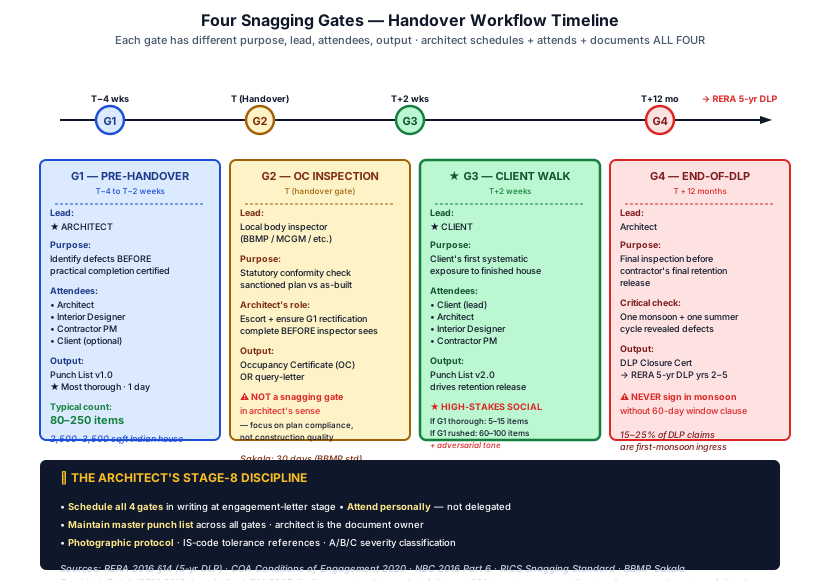
Gate 1 — Pre-Handover Snagging (T-4 to T-2 weeks)
| Aspect | Pre-Handover Snagging |
|---|---|
| Purpose | Architect-led identification of construction defects before practical completion is certified |
| Attendees | Architect, Interior Designer (where engaged), Contractor's Project Manager, Client (optional) |
| Method | Room-by-room walk with the snag-checklist; photographic documentation of each snag; categorisation per the A/B/C severity system (§4) |
| Output | Punch List Version 1.0 — the master snag document; circulated to contractor for rectification |
| Rectification window | 1–3 weeks; contractor returns the punch list with status against each item |
This is the architect's most thorough inspection. The protocol is systematic, not opportunistic — the architect must commit a full working day to a typical 2,000–3,500 sqft Indian residence, with explicit time allocated per zone (entrance, living, dining, kitchen, bedrooms, bathrooms, balconies, terrace, services). The checklist is the site supervision checklist re-purposed for finished-state inspection.
Gate 2 — Occupancy Certificate (OC) Inspection
| Aspect | OC Inspection |
|---|---|
| Purpose | Statutory inspection by the local body (BBMP / MCGM / equivalent) to verify the project conforms to sanctioned plans and is fit for occupation |
| Attendees | Local-body inspector (Town Planning section), Architect, Contractor (escort) |
| Method | Conformity check — sanctioned plan vs as-built; plinth-verification certificate; FAR / setback / parking verification; structural certificate; fire NOC; BWSSB / BESCOM / equivalent connections |
| Output | Occupancy Certificate (or query-letter requiring rectification) |
| Rectification window | Local-body Sakala timelines (e.g., BBMP — 30 days standard) |
The OC inspection is not a snagging inspection in the architect's sense; it is a regulatory inspection focused on planning compliance, not construction quality. The architect's role is to ensure that pre-handover snagging has rectified any plan-deviations before the OC inspector sees them — see the OC, CC & Plinth Verification guide for the detailed OC workflow.
Gate 3 — Client Walk-Through Snagging
| Aspect | Client Walk-Through |
|---|---|
| Purpose | Client-led identification of defects, with architect and contractor attending; the client's first systematic exposure to the finished house |
| Attendees | Client (lead), Architect, Interior Designer, Contractor's Project Manager |
| Method | Room-by-room walk; client identifies defects; architect classifies (A/B/C) and records; photographic documentation |
| Output | Punch List Version 2.0 — the consolidated architect-and-client snag document |
| Rectification window | 1–4 weeks; rectification status drives final retention release |
Client walk-through snagging is the highest-stakes social occasion in the residential project. The client is seeing the house finished, for the first time, with all three professionals present. Defects identified at this stage by the client — even minor ones — set the emotional tone of the handover. The architect's discipline is to have already pre-emptively snagged everything (Gate 1) so that the client's walk-through identifies few new items, and those mostly cosmetic (Category C).
If Gate 1 was thorough, Gate 3 produces a 5–15 item supplementary list. If Gate 1 was rushed, Gate 3 can produce a 60–100 item list — and the client's handover experience becomes adversarial.
Gate 4 — End-of-DLP Snagging (T+12 months)
| Aspect | End-of-DLP Snagging |
|---|---|
| Purpose | Final inspection at the end of the contractual defect-liability period, before the contractor's final retention is released |
| Attendees | Architect, Interior Designer (where engaged), Contractor's Project Manager, Client |
| Method | Full re-inspection; check rectification of any items raised during the DLP year; identify any defects emerged during one full monsoon and one full summer cycle |
| Output | DLP Closure Certificate; final retention release authorisation; transition into RERA-statutory DLP (years 2–5) |
| Rectification window | 4–8 weeks; depending on items |
The end-of-DLP gate is the architect's final billing milestone under most residential engagement structures. It is also the architect's last contractual opportunity to require rectification by the contractor under the original contract — beyond this, defects fall under the RERA-statutory DLP (§14, five years for structural/workmanship), where rectification is owed by the promoter (typically the developer or — for owner-built homes — the builder), not necessarily the same contracting entity.
The architect should never sign the end-of-DLP closure certificate during the monsoon period without an explicit clause that monsoon-revealed defects in the next 60 days remain within scope. Indian residences reveal new water-ingress paths in their first monsoon at a rate of approximately 15–25 percent of all DLP claims (data from Doloi et al., IJPM 2012, on Indian construction project failures).
4. Three-Tier Severity Classification
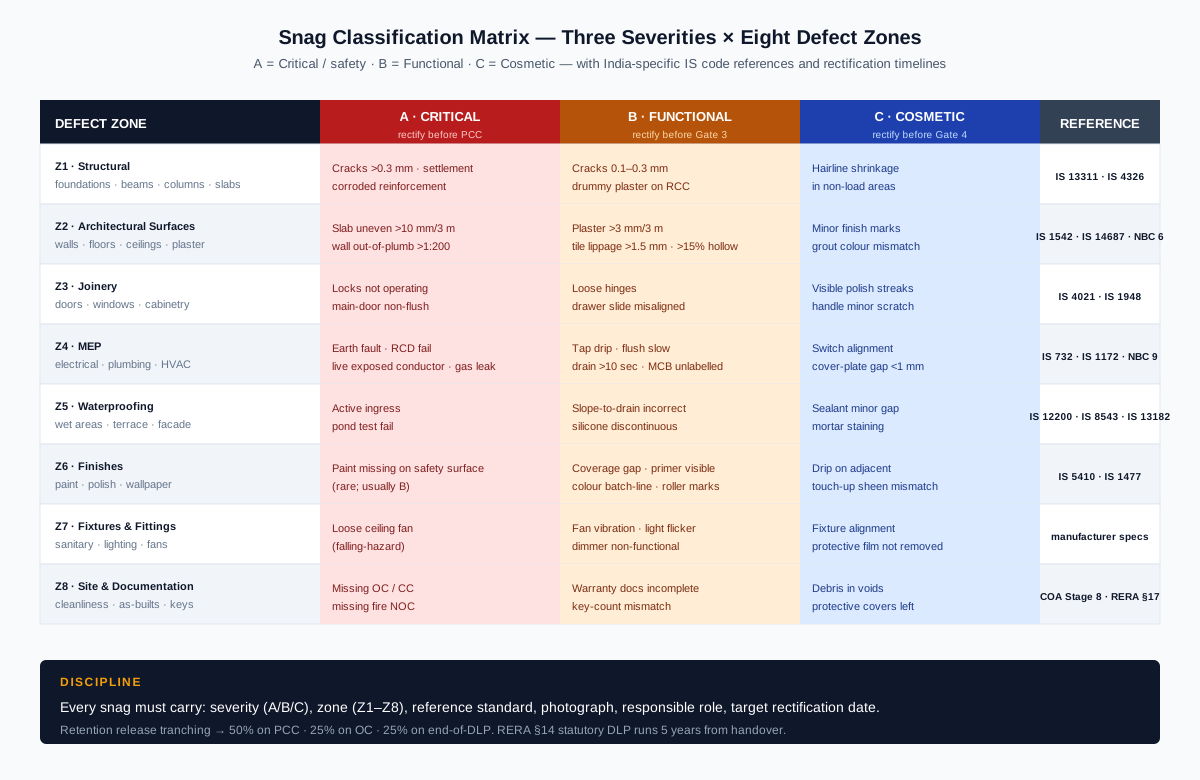
Every snag is one of three severities. The classification drives the rectification timeline, the priority order, and the retention-release linkage.
Category A — Critical / Safety
A-snags pose a safety risk — to occupants, to the structure, or to the building's services. They must be rectified before the architect signs the practical-completion certificate. There is no scenario in which a Category A snag is acceptable for handover.
| Type | Examples |
|---|---|
| Structural | Visible cracking exceeding 0.3 mm width; settlement; bowing or out-of-plumb beyond IS 4326 tolerance; corroded exposed reinforcement |
| Electrical | Earth continuity failure; missing or non-functional RCD; unmarked MCBs; live exposed conductors; non-IS-732-compliant outdoor wiring |
| Plumbing / Drainage | Water leakage from joints under test pressure; sewer backflow; missing P-trap; cross-connection between potable and grey water |
| Fire safety | Missing or non-functional smoke detectors (where required by NBC Part 4); blocked fire-escape route; non-compliant fire-rated door |
| Waterproofing | Active water ingress at the time of inspection; failed pond test on terrace or wet area |
| Gas | LPG line leakage; non-compliant gas-pipe routing; missing shut-off valve |
Category B — Functional
B-snags compromise function but not safety. They must be rectified before client walk-through (Gate 3) ideally, and certainly before final retention release.
| Type | Examples |
|---|---|
| Joinery | Door / window not closing flush; lock not operating; hinges loose; window-pane not fitting frame |
| Hardware | Tap dripping; flush not operating; cabinet handle loose; drawer slide misaligned |
| Floor levels | Floor slope away from drain in wet area (instead of to drain); excessive level mismatch at thresholds (>5 mm) |
| Tile work | Hollow-sound under tap test (>15% of area); lippage exceeding 1.5 mm; cracked or chipped tiles |
| Plaster | Uneven plaster (>3 mm deviation per 3 m straightedge); efflorescence; inadequate curing-cracks |
| Paint | Coverage gap; visible roller marks; colour mismatch on touched-up areas; drying defects |
Category C — Cosmetic
C-snags are cosmetic — visible, but neither functional nor safety. They should be rectified before final retention release; some may be deferred to be rectified at the contractor's discretion within the DLP.
| Type | Examples |
|---|---|
| Paint | Drips on adjacent surfaces; light splatter on glass; missed touch-ups |
| Hardware | Minor scratches on visible surfaces; protective film not removed |
| Joinery | Minor finish blemishes; non-uniform polish sheen on furniture |
| Glazing | Fingerprints; minor edge chips not affecting integrity |
| Site cleaning | Debris in hidden areas; protective covers left in place |
The classification is a judgment call by the architect. There is no statutory framework that defines A/B/C categories in India; the framework above is the architect's working discipline, anchored in the international RICS Snagging Standard and adapted for Indian residential practice. The discipline is to be consistent across projects and to be transparent with the client — every classification recorded in the punch list should be defensible if the client (or, in extremis, an arbitrator) challenges it.
5. The Eight Defect Zones — A Working Inventory
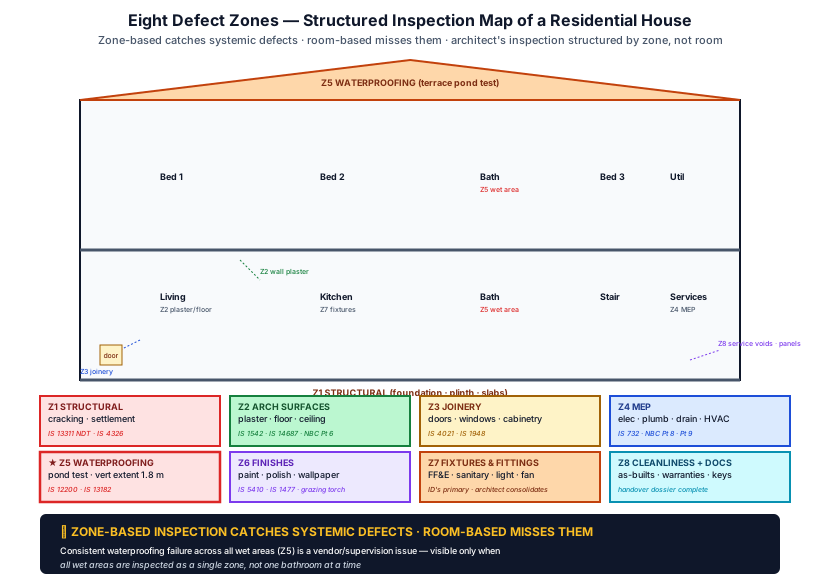
Indian residential projects produce snags from eight recurring zones. The architect's inspection is structured by zone, not by room — a zone-based approach catches systemic defects (e.g., consistent waterproofing failure across all wet areas) that a room-based approach can miss.
Zone 1 — Structural
The architect, with the structural engineer, inspects: foundation cracking (in basements and plinths), beam-column joints, slab undersides for cracking and reinforcement exposure, lintel cracking above openings, terrace slab for ponding and drain falls, parapet wall stability. Tools: torch, crack-width gauge (0.1–2 mm), measuring tape, plumb bob. Reference: IS 13311 (non-destructive testing — rebound hammer for surface hardness, ultrasonic pulse velocity for internal soundness).
Zone 2 — Architectural Surfaces
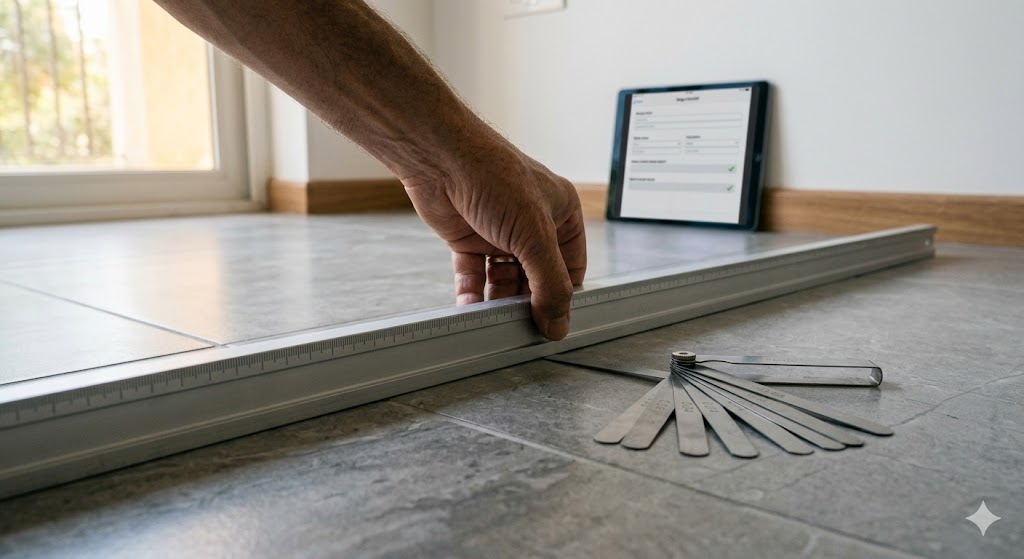
Walls (plumb, alignment, plaster finish), floors (level, slope, tile work), ceilings (level, alignment, gypsum joints), thresholds (level mismatch, water-bar continuity), painted surfaces (coverage, colour consistency, touch-up quality). Tools: 3-metre aluminium straightedge, laser level, spirit level. References: IS 1542 (sand for plaster — particle-size grading), IS 14687 (ceramic floor tiles — flatness ±2 mm), NBC 2016 Part 6 (workmanship).
Zone 3 — Joinery (Doors, Windows, Cabinetry)
Door and window operation (swing, lock, latch), gap consistency (1–3 mm at perimeter, 6–10 mm at sill), glazing (gasket continuity, pane integrity, locking mechanism), cabinetry alignment (drawer slides, hinge tension, handle alignment), hardware finish quality. Tools: feeler gauge, square, flashlight. Reference: IS 4021 (timber doors and windows), IS 1948 (aluminium windows).
Zone 4 — Mechanical, Electrical, Plumbing (MEP)
Electrical: earth continuity (megger test), RCD function test, MCB labelling, switch / socket alignment and operation, light fixture function, fan operation, exhaust function. Reference: IS 732 (electrical wiring code of practice), NBC 2016 Part 8.
Plumbing: water-line pressure test (typically 1.5× operating pressure for 24 hrs), tap and shower flow, basin and tub drainage rate, P-trap presence, water-heater operation. Reference: NBC 2016 Part 9, IS 1172 (water supply requirements).
Drainage: drain-line flow test (water-fill and observe), gully-trap function, septic / STP function. Reference: NBC 2016 Part 9.
HVAC (where present): AC unit operation, drain-line clear, thermostat function. Reference: ISHRAE Standards, IS 8148.
Zone 5 — Waterproofing
Wet-area pond test (24-hour standing-water test on bathroom and balcony floors before tile work, retroactively diagnosable from leakage signs after tile work), terrace pond test (24-hour standing water at 50 mm depth), shower zone vertical waterproofing extent (1.8 m minimum), kitchen counter water-resistance, fenestration weatherstrip integrity, basement waterproofing (where applicable). References: IS 12200 (waterproofing — code of practice), IS 8543 (testing of waterproofing materials), IS 13182 (waterproofing of basements), and the waterproofing guide.
Zone 6 — Finishes (Paint, Polish, Wallpaper, Decorative)
Paint coverage (no see-through to primer), paint colour consistency (no batch-line variation), trim line crispness, polish finish on woodwork (no streaks, no missed areas), wallpaper alignment (vertical and horizontal joints), decorative element alignment (mouldings, cornices). Tools: torchlight at grazing angle (reveals finish defects invisible in flat light), colour-temperature-controlled torch.
Zone 7 — Fixtures & Fittings (FF&E)
Sanitary fittings (operation and seal), light fittings (alignment, function, dimming where specified), ceiling fans (balance, speed control), window treatments (operation), cabinetry handles and pulls, sealant continuity around fittings. Note: the FF&E zone is the interior designer's primary inspection responsibility (see Scope Boundaries §4.5), but the architect maintains the master punch list and consolidates the IDs's findings.
Zone 8 — Site Cleanliness & Documentation
Debris removal, protective covers removal, accessible service voids (electrical panels, water meters, gas meter), as-built drawing handover (architectural, structural, MEP), warranty documentation handover (white goods, MEP equipment), key handover (with documented quantities), maintenance manual handover (HVAC, water heater, STP, etc.).
6. Tolerance Standards — When is a Snag a Snag?
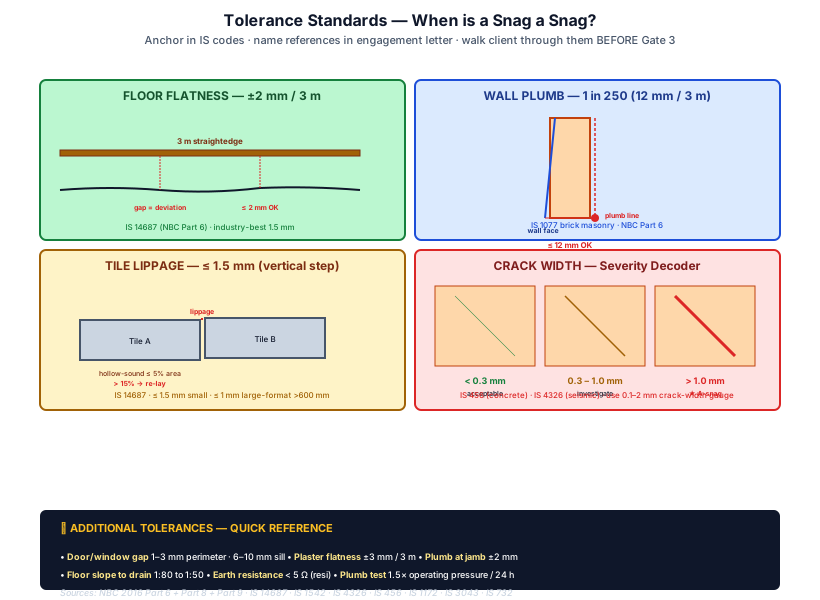
The single most-disputed question in Indian residential snagging is what counts as a defect. A 2 mm floor-level deviation may be acceptable to the contractor and unacceptable to a fastidious client. A 0.2 mm hairline crack in plaster may be cosmetic to the architect and structural to the client. Without an agreed tolerance reference, the snagging discussion becomes subjective and adversarial.
The discipline is to anchor tolerances in IS standards and the NBC, name the references in the engagement letter, and walk the client through them at the start of Gate 3.
Working Tolerance Table — India 2026
| Element | Tolerance | Reference |
|---|---|---|
| Floor flatness | ±2 mm under a 3 m straightedge (NBC Part 6); industry-best 1.5 mm | IS 14687, NBC 2016 Part 6 |
| Wall plumb | 1 in 250 over storey height (i.e., ~12 mm per 3 m wall) | IS 1077 (clay-brick masonry tolerances), NBC Part 6 |
| Wall plaster flatness | ±3 mm under a 3 m straightedge | IS 1542, IS 1661 (plaster) |
| Plumb at door / window jamb | ±2 mm over jamb height | IS 4021, IS 1948 |
| Tile lippage (vertical step at edge) | ≤1.5 mm (ceramic / vitrified); ≤1 mm (large-format >600 mm) | IS 14687; manufacturer specifications |
| Tile hollow-sound (tapping survey) | ≤5% of area; >15% triggers re-laying | IS 14687 (workmanship clauses) |
| Door / window gap | 1–3 mm at perimeter, 6–10 mm at sill | IS 4021, IS 1948 |
| Crack width (cosmetic) | <0.3 mm — acceptable; 0.3–1.0 mm — investigate; >1.0 mm — A-snag | IS 4326 (earthquake-resistant construction); IS 456 (concrete) |
| Paint coverage | No see-through to primer at any point; no batch-line variation visible at 1.5 m | IS 5410 (cement paint); IS 1477 (paints — code of practice) |
| Floor slope to drain | 1:80 to 1:50 (12.5 to 20 mm per metre) for wet areas | NBC Part 9 |
| Plinth / ground level differential | Per sanctioned drawing ±10 mm | BBMP / MCGM bye-laws |
| Electrical earth resistance | <5 ohms (single occupancy); <1 ohm (commercial) | IS 3043, IS 732 |
| Plumbing pressure test | 1.5× operating pressure for 24 hrs without measurable drop | NBC Part 9, IS 1172 |
| Drainage flow rate | No standing water in horizontal runs; gully-trap drainage <10 sec | NBC Part 9 |
| HVAC drain pan / line | No standing water; clear drain run to outdoor | ISHRAE Standards |
This table is the working tolerance — the architect's first reference. Some clients (especially in luxury residential) will negotiate tighter tolerances; the architect's discipline is to agree the tolerance set in writing at the engagement-letter stage, not at the Gate-3 walk-through.
7. The Punch-List Document — Format and Discipline
The punch list is a working document — not a one-time deliverable. It is generated at Gate 1, updated through rectification cycles, re-issued at Gate 3, and closed at Gate 4. The architect is the document's author and curator throughout.
Minimum Columns of an Indian-Residential Punch List
| Column | Content | Purpose |
|---|---|---|
| Item No. | Sequential, never re-used | Tracking and reference |
| Date Identified | DD/MM/YYYY | Chronology; basis for rectification timeline |
| Gate | 1 / 2 / 3 / 4 (per §3) | Tracks which inspection generated the item |
| Location | Room / area / zone | Spatial reference |
| Zone | 1–8 (per §5) | Defect-zone classification; enables systemic-defect analysis |
| Severity | A / B / C (per §4) | Rectification priority |
| Description | Plain-language defect description | Self-explanatory record |
| Photograph / Reference | Filename or URL of photograph; sketch reference if applicable | Evidentiary basis |
| Reference Standard | IS / NBC clause where applicable | Tolerance basis (e.g., IS 14687 for tile lippage) |
| Responsible Role | Architect / Interior Designer / Contractor / Client | Accountability allocation |
| Target Rectification Date | DD/MM/YYYY | Rectification deadline |
| Rectification Status | Pending / In Progress / Done / Disputed / Closed | Workflow tracking |
| Sign-off Date | DD/MM/YYYY | Closure record |
| Signatory | Initials of architect / client | Closure authority |
| Comments | Free-text | Workflow nuance, exceptions |
A residential punch list of moderate scope (2,500–3,500 sqft Indian house) typically runs 80–250 items at Gate 1, reducing to 5–25 items by Gate 3 (after Gate 1 rectification), and 0–5 items at Gate 4 closure. Excel, Google Sheets, or a punch-list app (Bluebeam Studio, PlanGrid, Procore, or the Studio Matrx Site Inspection utility) all serve.
Photographic Documentation Protocol
Every snag must be photographed. The protocol:
1. Wide shot — establishing the location (room, wall, surface)
2. Close-up shot — the defect itself, with a measuring tool (ruler, gauge, coin) for scale
3. Annotation — written label (date, item number, location) visible in or alongside the photo
4. Filename convention — [Project_ID]_[ItemNo]_[Date]_[ZoneCode]_[Severity].jpg for searchable archival
5. Storage — project cloud folder with read-only access for client and contractor
Photographic documentation is the primary evidence in any subsequent dispute about whether a defect existed at handover. Architects who rely on verbal walk-through descriptions almost always lose contested positions; architects who maintain a photographic punch list almost always prevail.
8. Retention-Tranche Discipline — Linking Payment to Rectification
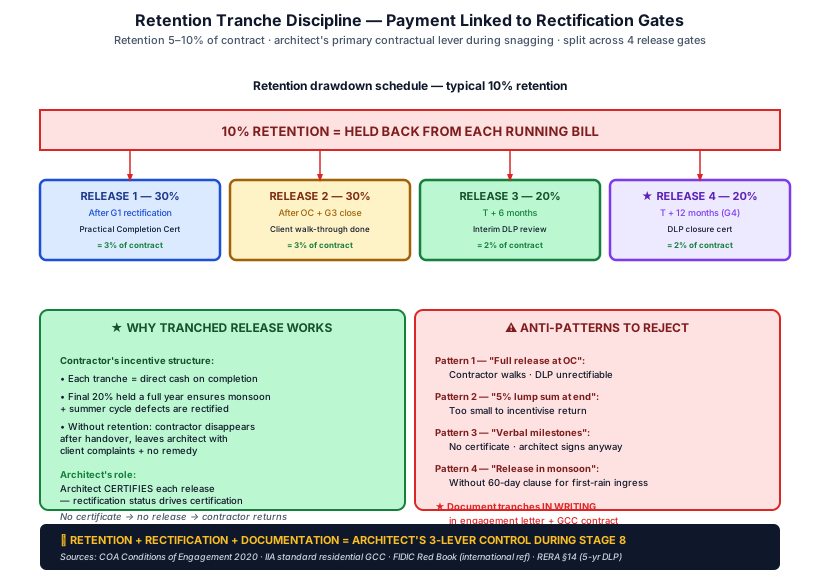
The contractor's retention is the architect's primary contractual lever during the snagging stage. Without retention, the contractor's economic incentive to return for rectification is weak; with retention, the contractor's incentive is precisely calibrated.

Standard Retention Structure for Indian Residential
| Stage | Retention Released | Linked To |
|---|---|---|
| On practical completion (Gate 1 rectification done) | 50% of retention | Architect's practical-completion certificate; Punch List Version 1.0 closed except for deferred Cat-C items |
| On OC issuance (Gate 2) | 25% of retention | OC certificate from local body |
| On end-of-DLP closure (Gate 4) | Final 25% of retention | DLP closure certificate; all rectification completed; no outstanding warranty claims |
The 50/25/25 split is the architect's recommended structure — not a regulatory mandate. Contracts vary. The architect's discipline is to ensure the structure is named in the contract, not assumed; and that the trigger documents (PCC, OC, DLP closure) are architect-issued, not contractor-self-certified.
Common Retention Disputes — and Resolution Patterns
| Dispute | Resolution Pattern |
|---|---|
| Contractor argues retention release should not be tied to specific snag rectification | Engagement-letter retention clause referenced; architect's certificate is the trigger document, not contractor's invoice |
| Contractor claims a snag is not their responsibility (e.g., subcontractor defect) | Contractor's contract-tier responsibility for subcontractors; main-contractor retention covers all sub-tier defects |
| Client refuses to release retention beyond punch-list scope | Engagement-letter scope clause referenced; new defects not captured in punch list discussed separately as variations or warranty claims |
| Contractor walks off site with rectification incomplete | Architect's engagement letter and contract typically allow client to engage substitute contractors at original contractor's cost; retention is the funding source |
| Defect discovered during Gate-4 inspection that was concealed at Gate-1 | Snag falls within DLP scope; contractor obligation regardless of timing of discovery; retention release contingent on rectification |
The Contingency, Provisional Sums & Risk Allocation guide covers retention-clause drafting in detail.
9. RERA §14 and the Five-Year Defect-Liability Period
The Real Estate (Regulation and Development) Act 2016 §14(3) imposes a statutory five-year defect-liability period on the promoter in respect of structural defects, workmanship defects, quality of services defects, and any provisions of the agreement that the promoter has failed to honour. This DLP runs from the date of handover (possession).
Who is the Promoter?
Under RERA §2(zk), the promoter is the person who develops or causes to be developed the project. For:
- Owner-built homes (homeowner engages architect + contractor directly, no developer): the contractor / builder is typically the deemed promoter for RERA-registered projects above the 500 sqm / 8-unit threshold. For below-threshold owner-built homes (most independent residences), RERA does not apply and the DLP is contractual only (12 months typical).
- Developer-built apartments / villas: the developer / builder entity is the promoter; RERA registration is mandatory; the five-year DLP applies.
- Joint-venture projects (landowner + developer): the developer is typically the deemed promoter; agreements can vary.
What the Five-Year DLP Covers
Under RERA §14(3), the promoter must rectify, without further charge to the allottee, any defect:
- In workmanship — finishing, joinery, plumbing, electrical, painting
- In quality of services — water supply, drainage, electrical service
- In provision of services — agreed amenities, common areas
- In structural integrity — foundations, beams, columns, slabs
…provided the defect is brought to the promoter's notice within five years of the date of handover. The promoter must rectify within 30 days of notice; failing which, the allottee is entitled to compensation.
What the Architect's Snagging Records Establish
The snagging records — the punch list, the photographs, the closure certificates — become primary evidence in any RERA defect-liability dispute. Specifically, the records establish:
- What was identified at handover — the baseline; defects on this list are deemed pre-handover
- What was rectified before handover — defects with closure documentation
- What was deferred to DLP — defects identified but with mutual agreement to rectify within DLP
A defect raised during years 1–5 not matching any pre-handover record is presumed to have emerged after handover and falls squarely within RERA §14 scope. A defect raised that was on the pre-handover punch list but was marked closed will face an evidentiary contest about whether the original closure was genuine.
Architect's RERA-DLP Discipline
| Discipline | What |
|---|---|
| Maintain the snagging archive | Photographs, sign-offs, contractor rectification records — for the full five years |
| Document the closure of each item | Photographic evidence of rectification, not just contractor self-certification |
| Respond to DLP claims promptly | Architect's rate of acknowledgment within 7 days, inspection within 30 days, rectification report within 60 days |
| Distinguish RERA-DLP claims from out-of-scope claims | Wear-and-tear, misuse-driven damage, unauthorised modifications by allottee — outside RERA scope |
| Coordinate with promoter / developer | Architect typically advises promoter; not the contracting party for rectification but the technical reference |
The architect who treats the five-year DLP as a passive period (waiting for claims) is the architect whose DLP closes with disputes. The architect who treats it as an active period (proactive 6-month and 12-month inspections offered to client) is the architect whose post-handover phase produces referral business.
10. Twelve-Test Diagnostic — Is the Project Ready for Handover?
Before the architect issues the practical-completion certificate at Gate 1, the following twelve tests should pass. Failing any test is not an absolute bar — but the failure must be remedied or formally accepted by the client before handover.
| Test | Question | Pass Criterion |
|---|---|---|
| 1 | Are all Category A snags rectified? | Zero open A-items in punch list |
| 2 | Are 95%+ of Category B snags rectified? | Open B-items <5% of original count, all logged with rectification target dates |
| 3 | Are MEP commissioning tests complete with documentation? | Earth-continuity, RCD, water-pressure, drain-flow tests certified |
| 4 | Are waterproofing pond tests complete with documentation? | Wet areas + terrace + balcony pond-test certificates on file |
| 5 | Is the OC application filed and OC issued (or filed with no outstanding objections)? | OC certificate or filing receipt with Sakala timeline running |
| 6 | Are BWSSB / BESCOM / equivalent connections live? | Water and electricity connections functional at meter |
| 7 | Are as-built drawings handed over to client? | Architectural, structural, MEP — soft and hard copies |
| 8 | Are warranty documents handed over for white goods and MEP equipment? | Sanitary, lighting, fans, water heater, AC, STP — manufacturer warranties |
| 9 | Are maintenance manuals handed over? | HVAC, water heater, STP, sump-pump operation manuals |
| 10 | Is the retention structure documented and 50% release authorised? | Architect's PCC certificate; contractor's retention release for first tranche signed off |
| 11 | Is the punch list handover-ready, with photo references? | Punch List Version 1.0 closed; Version 2.0 ready for Gate 3 |
| 12 | Is the handover ceremony scheduled with all parties? | Date confirmed; client, architect, IDs, contractor attending |
Architects who issue PCCs with three or more failing tests have an above-average probability of post-handover disputes within the first 12 months.
11. Common Snagging Disputes — Resolution Patterns
| Dispute | Pattern That Resolves It |
|---|---|
| Client identifies new defects at Gate 3 not flagged at Gate 1 | New defects are added to Punch List Version 2.0; contractor rectification within agreed window; architect's classification as A/B/C drives priority |
| Contractor argues a defect is "within tolerance" | Tolerance table (§6) referenced; IS code or NBC clause invoked; contractor's interpretation overruled where standard is exceeded |
| IDs blames contractor for finish defect; contractor blames IDs for specification | Specification clarity referenced — was the specification clear (IDs's responsibility) or was the execution sub-standard (contractor's)? Engagement letter's IDs / contractor coordination clause referenced |
| Defect emerges during monsoon (T+3 months) — within DLP | Contractual DLP scope applies; contractor obligation to rectify; if monsoon waterproofing failure is systemic, retention is held until full rectification across all wet areas |
| Defect emerges in year 3 — RERA-DLP | Promoter (RERA-registered) obligation; architect advises but does not contract for rectification; promoter engages contractor (original or substitute) |
| Client wants to add scope beyond punch list (e.g., upgrade fittings) | Out of snagging scope; treated as variation; engagement-letter scope clause referenced |
| Contractor delays rectification beyond agreed window | Architect's engagement letter typically allows architect to engage substitute rectification at contractor's cost; retention funds the substitute work |
The pattern is consistent: the punch list, the photographic record, and the contractual tolerance table are the primary evidence in any snagging dispute. Architects who maintain disciplined documentation almost always prevail; architects who rely on informal walk-throughs almost always lose.

12. The Handover Ceremony — A Discipline, Not a Photograph
Indian residential practice has acquired (in the post-2020 period) the convention of a handover ceremony — a final meeting at which keys are transferred, documents are handed over, and (frequently) photographs are taken for the architect's portfolio and the client's records. The ceremony is an opportunity — not a substitute for snagging discipline. The discipline behind a ceremony that closes the project cleanly:
T-7 days from ceremony:
- Punch List Version 2.0 closed (all A and B items, 90%+ of C items)
- All as-built drawings printed and bound (architectural, structural, MEP)
- All warranty documents collated in a project folder
- All maintenance manuals digitised and printed
- Final retention release authorisation prepared
T-1 day from ceremony:
- Final cleaning of the residence
- Final electrical / water / gas function check
- All keys collected from contractor and counted
- Photography for project documentation (architect's portfolio)
Day of ceremony:
- 30-minute walk-through with client, architect, IDs, contractor
- Document handover (binder + USB or cloud link)
- Key handover (with documented count)
- Signature on punch-list closure (Version 2.0)
- Signature on PCC certificate
- Photographs (formal + informal)
- Tea / refreshment (Indian residential convention)
T+1 to T+7 days:
- Architect's thank-you correspondence to client and contractor
- Architect's project archive — folder structure for the next 5+ years (RERA DLP retention)
- Final invoice from architect (Stage-8 fee tranche)
The ceremony is the architect's first opportunity to ask for a referral. The discipline of the ceremony — visible to the client through the smoothness with which the documentation flows, the keys are counted, and the punch list is closed — is what determines whether the architect's next residential project comes from this client's network or from cold calls.
13. Indian Regulatory Anchors — Quick Reference
| Source | Authority over | Relevance |
|---|---|---|
| Architects Act 1972 | Architects (statutory) | Stage-8 obligations under COA Conditions of Engagement |
| COA Conditions of Engagement and Scale of Charges 2020 | Architects | Stage-8 (Completion) scope of services — practical completion certificate, defect-liability period administration, end-of-DLP closure |
| Real Estate (Regulation and Development) Act 2016 §14 | Promoters | Five-year statutory DLP for structural / workmanship / services defects |
| Real Estate (Regulation and Development) Act 2016 §17 | Promoters | Conveyance and physical possession |
| National Building Code of India 2016 Parts 6, 9, 11, 12 | All construction | Workmanship, MEP services, building services, asset management |
| IS 13311 (Parts 1 and 2) | Concrete | Non-destructive testing — ultrasonic and rebound hammer |
| IS 1542 | Plaster | Sand grading |
| IS 14687 | Tile work | Ceramic / vitrified flooring tolerances |
| IS 1077 | Brickwork | Common burnt clay building bricks |
| IS 4326 | Earthquake-resistant construction | Crack-width and structural-tolerance basis |
| IS 4021 / IS 1948 | Joinery | Timber and aluminium doors / windows |
| IS 12200 / IS 8543 / IS 13182 | Waterproofing | Specification and testing basis |
| IS 732 | Electrical | Electrical wiring code of practice |
| NBC 2016 Part 4 | Fire safety | Fire-detection and protection-system handover |
| BBMP / MCGM Bye-laws | Local body | OC issuance, plinth verification, plan-conformity check |
| RICS Snagging Standard (international comparator) | All — voluntary | Methodology basis for residential snagging reports |
14. Companion Studio Matrx Guides
- Site Supervision Checklist for Indian Architects — the supervision counterpart to this snagging guide
- The Architect's Scope of Services in India — Stage 8 in the COA scope
- OC, CC & Plinth Verification in India — Gate 2 of the snagging system
- Working Drawings Documentation in India — as-built drawings deliverable
- Scope Boundaries — Architect, Interior Designer & Contractor — IDs / contractor coordination at handover
- Contingency, Provisional Sums & Risk Allocation in Indian Construction Contracts — retention clause drafting
- Where Projects Fail — A Causal Map for Indian Architects — handover-stage failures in the project-failure context
- Architect Fee Structures in India — Stage 8 fee tranche
- Waterproofing Guide for Indian Homes — Zone 5 reference
- Building Quality Construction Assessment — quality-assessment framework
Companion Studio Matrx Tools
- Site Inspection — daily and snagging-stage checklist
- Pre-Possession Checklist — homeowner-facing handover checklist
- Move-in Checklist — post-handover homeowner orientation
- Construction Approval Checklist
- Red Flag Checklist
- Risk Index
- Approval Roadmap — city-by-city OC chain
- Warranty Tracker
15. References
Primary Statutes and Codes
- Architects Act 1972 (Act No. 20 of 1972) — establishment of the Council of Architecture; Architects' obligations.
- COA Conditions of Engagement and Scale of Charges 2020 — Stage 8 (Completion) scope of services.
- Real Estate (Regulation and Development) Act 2016 — §14 (defect liability), §17 (conveyance and possession), §18 (return with interest).
- National Building Code of India 2016 — Parts 4 (fire safety), 6 (structural design + workmanship), 9 (plumbing), 11 (asset management), 12 (testing and quality).
Indian Standards Referenced
- IS 13311 (Parts 1 and 2) — Non-destructive testing of concrete: Ultrasonic pulse velocity (Part 1) and Rebound hammer (Part 2).
- IS 1542 — Sand for plaster: specification.
- IS 14687 — Ceramic floor tile flooring: code of practice.
- IS 1077 — Common burnt clay building bricks: specification.
- IS 4326 — Earthquake-resistant construction.
- IS 875 (Parts 1–5) — Code of practice for design loads.
- IS 4021 — Timber doors, windows and ventilators: specification.
- IS 1948 — Aluminium windows for residential and commercial buildings.
- IS 12200 — Code of practice for waterproofing.
- IS 8543 — Methods of test for waterproofing materials.
- IS 13182 — Code of practice for waterproof barrier in basements.
- IS 732 — Code of practice for electrical wiring installations.
- IS 3043 — Earthing — code of practice.
- IS 1172 — Water supply for domestic, commercial and industrial buildings.
- IS 5410 — Cement paint: specification.
- IS 1477 (Parts 1 and 2) — Code of practice for painting.
- IS 1661 — Plastering with cement, lime and lime-cement: code of practice.
International Comparator Standards
- RICS Snagging Standard — Royal Institution of Chartered Surveyors, residential snagging-report methodology.
- NHBC Standards — National House Building Council (UK), construction-quality benchmarks.
- ISHRAE Standards — Indian Society of Heating, Refrigeration and Air-Conditioning Engineers.
Practice Notes and Commentary
- COA Bulletins — periodic Council of Architecture notifications.
- CREDAI Industry Reports — developer-side snagging and DLP commentary.
- Architecture - Time, Space & People — Council of Architecture monthly journal, peer-reviewed editorial board.
- Construction Law Reporter (Sweet & Maxwell India) — case digests on residential DLP and handover disputes.
Peer-Reviewed Academic References — Indian Construction Practice
- Iyer, K. C., & Jha, K. N. (2005). Factors affecting cost performance: Evidence from Indian construction projects. International Journal of Project Management, 23(4), 283–295.
- Doloi, H., Sawhney, A., Iyer, K. C., & Rentala, S. (2012). Analysing factors affecting delays in Indian construction projects. International Journal of Project Management, 30(4), 479–489.
- Doloi, H. (2013). Cost overruns and failure in project management: Understanding the roles of key stakeholders in construction projects. Journal of Construction Engineering and Management, 139(3), 267–279.
- Iyer, K. C., & Jha, K. N. (2006). Critical factors affecting schedule performance: Evidence from Indian construction projects. Journal of Construction Engineering and Management, 132(8), 871–881.
- Jha, K. N., & Iyer, K. C. (2007). Commitment, coordination, competence and the iron triangle. International Journal of Project Management, 25(5), 527–540.
- Mahalingam, A., & Levitt, R. E. (2007). Institutional theory as a framework for analyzing conflicts on global projects. Journal of Construction Engineering and Management, 133(7), 517–528.
Peer-Reviewed Academic References — Defects, Quality & Handover
- Forcada, N., Macarulla, M., Gangolells, M., & Casals, M. (2014). Posthandover housing defects: Sources and origins. Journal of Performance of Constructed Facilities, 28(4), 04014006.
- Sommerville, J. (2007). Defects and rework in new build: An analysis of the phenomenon and drivers. Structural Survey, 25(5), 391–407.
- Georgiou, J. (2010). Verification of a building defect classification system for housing. Structural Survey, 28(5), 370–383.
- Chong, W.-K., & Low, S.-P. (2006). Latent building defects: Causes and design strategies to prevent them. Journal of Performance of Constructed Facilities, 20(3), 213–221.
- Mills, A., Love, P. E. D., & Williams, P. (2009). Defect costs in residential construction. Journal of Construction Engineering and Management, 135(1), 12–16.
- Love, P. E. D., Edwards, D. J., & Smith, J. (2016). Rework causation: Emergent theoretical insights and implications for research. Journal of Construction Engineering and Management, 142(6), 04016010.
Peer-Reviewed Academic References — Coordination & Dispute
- Mitropoulos, P., & Howell, G. (2001). Model for understanding, preventing, and resolving project disputes. Journal of Construction Engineering and Management, 127(3), 223–231.
- Cheung, S. O., & Yiu, T. W. (2007). A study of construction mediator tactics. Construction Management and Economics, 25(7), 691–700.
- Chan, D. W. M., & Kumaraswamy, M. M. (1997). A comparative study of causes of time overruns in Hong Kong construction projects. International Journal of Project Management, 15(1), 55–63.
Standard Treatises
- Murdoch, J., & Hughes, W. (2015). Construction Contracts: Law and Management (5th ed.). Routledge.
- Bunni, N. G. (2003). Risk and Insurance in Construction (2nd ed.). Spon Press.
- Hudson, A. A. Hudson's Building and Engineering Contracts (current edition). Sweet & Maxwell.
- Furst, S., & Ramsey, V. Keating on Construction Contracts (current edition). Sweet & Maxwell.
- Pollock, F., & Mulla, D. F. The Indian Contract and Specific Relief Acts (current edition). LexisNexis.
Indian Legal Periodicals
- National Law School of India Review (NLSIR) — peer-reviewed; articles on RERA §14 jurisprudence and post-handover defect-claim case law.
- NUJS Law Review — peer-reviewed; articles on consumer-protection / RERA overlap in residential possession disputes.
- Indian Journal of Arbitration Law (IJAL) — peer-reviewed; construction-arbitration commentary on retention disputes.
- Indian Council of Arbitration — ICA Arbitration Quarterly — case digests on Indian construction arbitration awards involving DLP.
Companion Studio Matrx Guides
See §14 above for the full cross-reference list.
Author's Note: Snagging is the architect's last act of architectural judgment, and it is also — uniquely among the Stage-8 deliverables — an act of social judgment. The architect at the Gate-3 walk-through is reading the client's expectations, the contractor's defensiveness, the interior designer's pride, and the silent gaps where each party is choosing what to challenge and what to let pass. The architect who manages this stage with discipline — the punch list maintained, the photographs catalogued, the tolerances anchored in IS code, the retention released in tranches against documented rectification, the RERA-DLP archive maintained for five years — is the architect whose handover stage closes cleanly and whose post-occupancy phase produces the quiet, recurring referrals on which a sustainable residential practice is built. The architect who treats snagging as a one-day task is the architect whose phone, six months after handover, rings with the wrong calls. The map in this guide is the discipline; its daily practice is what separates the architect whose Stage-8 closes the project from the architect whose Stage-8 opens the next one.
Disclaimer: This article is for informational and educational purposes only. It does not constitute legal advice or a substitute for engagement-specific contract drafting. The Real Estate (Regulation and Development) Act 2016, the COA Conditions of Engagement, the National Building Code of India 2016, and the Indian Standards referenced are subject to amendment and (in the case of state RERA Rules) state-specific notifications. Architects must verify the current text of all referenced statutes and codes at the time of any specific engagement; engage qualified construction-law counsel for the drafting of retention, defect-liability, and handover clauses; and engage specialist surveyors / NDT agencies / commissioning agencies for technical inspections beyond the architect's direct expertise. Studio Matrx, its authors, and contributors accept no liability for decisions based on this guide.
Export this guide
Related Guides — Deep-dive reading
Scope Boundaries — Architect, Interior Designer & Contractor
The Architects Act 1972, the IIID Code, BOCW 1996 & RERA 2016 — Stage-by-Stage Role Map, Hot Boundary Zones, Liability Matrix, and the Tri-Party Contracting Discipline for Indian Residential Practice
ConstructionSTP Final Handover Checklist: Documents, Spares, Training & Defect Liability
The complete handover from contractor to owner: the drawings, O&M manuals, warranties and test reports you must collect, the spares and tools to count, the operator training to insist on, and the defect-liability terms that protect you for the next year.
Sewage Treatment PlantsBathroom Planning for New Homes in India: Get It Right Before You Build
The bathroom decisions you cannot undo once the slab is cast — location and stacking, sunken vs non-sunken slabs, waterproofing, and the plumbing, electrical and ventilation you must coordinate with the civil work, stage by stage.
BathroomsRelated Tools — Try Free
Pre-Possession Inspection Checklist
Inspect your flat before registration — 10 categories, 70+ checkpoints across legal, carpet area, structure, finishes, and deviations.
Homebuyer ChecklistElectrical Safety & Load Audit
Home electrical audit — 10 categories, 65+ checkpoints across earthing, RCCB, MCB, wiring, switchboards, appliance circuits, DG/inverter backup.
Safety AuditCross-Ventilation Analyzer
Estimate airflow and air changes per hour (ACH) from room size, window areas, layout, and local wind — with NBC 2016 Part 8 compliance check.
Ventilation Calculator