
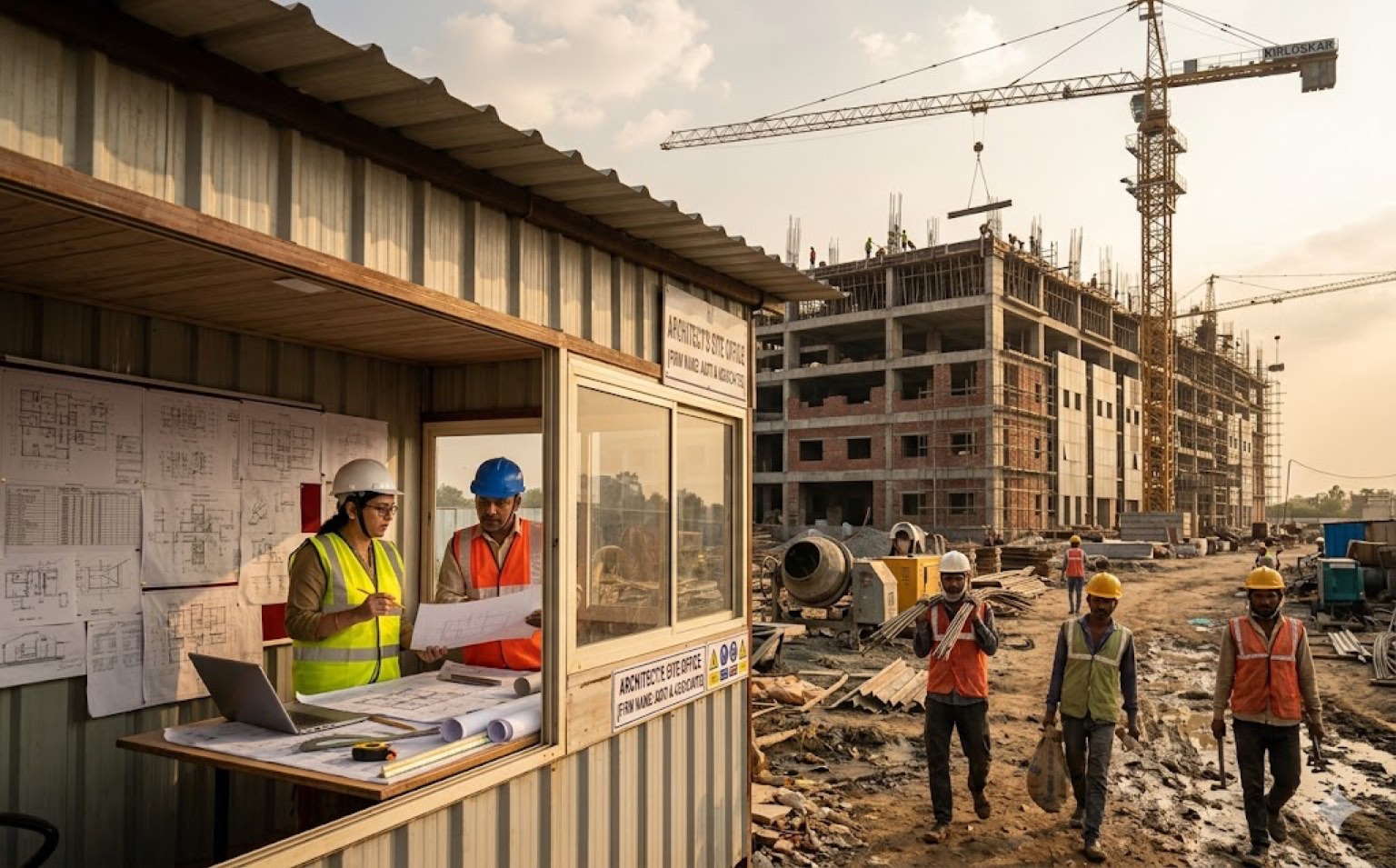
Healthcare Architecture Commissions in India — Fees, BOQ, PM, Client
An Architect's Working Reference — Fee Scales for Healthcare Projects, Healthcare-Specific BOQ Considerations, Project Management for Hospitals, Client Typologies (Doctor-Promoter / Trust / Corporate / Government), Risk and Professional Indemnity, Construction Phase Management, Commissioning Workflow, and the Healthcare Commission Toolkit
Healthcare architecture is a specialised commission with distinct commercial dimensions that distinguish it from residential, commercial, or even general institutional practice. Healthcare projects are larger, longer, more regulated, and more risk-laden than typical commissions — and they involve client structures (trusts, doctor-promoters, corporates, governments) that the architect must learn to navigate professionally. This final guide in the design-focused series addresses the business of healthcare commissions: how the architect prices the work, what BOQ specifics to expect, how to manage the construction phase, the four major client types and their working logic, the risk and indemnity considerations, and the commissioning workflow that closes the project.
The guide assumes the reader has read the regulatory series and the design-focused series up to this point. It does not constitute legal or financial advice; it provides the architect with the working understanding to engage healthcare clients, propose appropriate fees, manage the commission, and close the project successfully.
"In healthcare architecture, the building is half the deliverable. The other half is the relationship — with the client, with the regulators, with the contractors, with the future operators. The architect who understands this gets a second commission." — Anonymous senior healthcare architect on the importance of practice management
"A hospital is the most demanding building you can design as an architect. It is also the most rewarding — because it is the only building type where lives are saved or lost on the basis of what you drew." — Dr. Bobby John, public-health policy advisor, paraphrased
1. Fee Scales for Healthcare Architecture
The Council of Architecture (CoA) publishes recommended fee scales under its Conditions of Engagement and Scale of Charges (latest revision 2017). Healthcare projects are categorised under "Special Buildings" — Class V, attracting the highest fee scale.
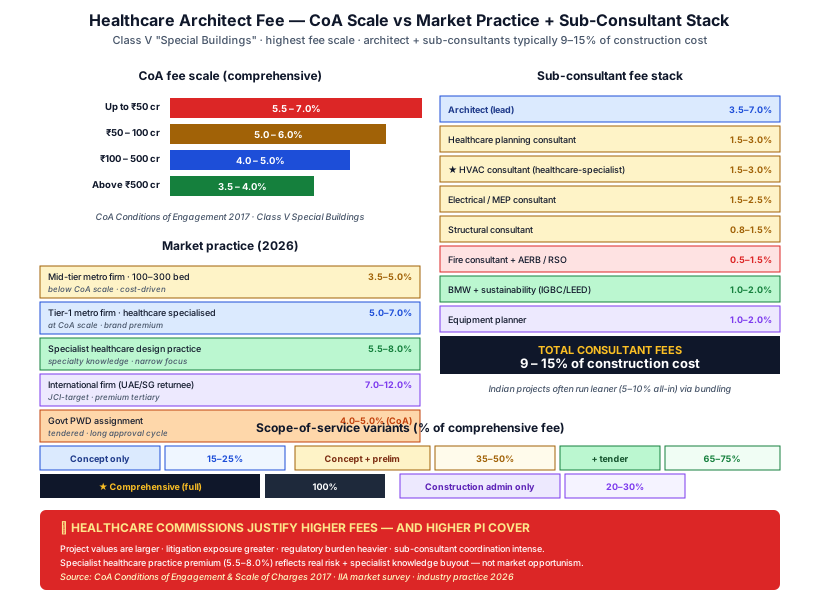
CoA fee scale for healthcare projects (indicative)
| Scope of Service | Project Cost Range | Fee % (Comprehensive) |
|---|---|---|
| Up to ₹50 crore | 5.0–7.0% | 5.5–7.0% |
| ₹50 crore to ₹100 crore | 4.5–6.0% | 5.0–6.0% |
| ₹100 crore to ₹500 crore | 3.5–5.0% | 4.0–5.0% |
| Above ₹500 crore | 3.0–4.0% | 3.5–4.0% |
Fees are over project cost (excluding land + furniture + equipment).
Market practice vs CoA scale
Indian market practice in 2026:
| Practice Type | Typical Fee Range |
|---|---|
| Mid-tier metropolitan firm — 100–300 bed hospital | 3.5–5.0% |
| Tier-1 metropolitan firm with healthcare specialisation | 5.0–7.0% |
| Specialist healthcare design practice | 5.5–8.0% |
| International firm (UAE, Singapore returnee) | 7.0–12.0% |
| Government PWD assignment | Per CoA scale, often 4–5% |
| Healthcare consultancy + architect bundle | 6–10% combined |
The fee includes:
- Concept design
- Preliminary design + statutory submissions
- Detailed design (plans, sections, elevations, services)
- Tender documentation
- Construction administration
- Site supervision (variable inclusion)
Excluded typically:
- Healthcare planning consultancy (often separate consultant)
- HVAC, MEP, structural detailed engineering (sub-consultants)
- Equipment planning
- Interior FF&E
- Landscape
Scope-of-service variants
| Scope | Description | Typical Fee % of Comprehensive |
|---|---|---|
| Concept only | Brief to schematic | 15–25% |
| Concept + preliminary | Concept to building permit | 35–50% |
| Concept + DD + tender | Through tender drawings | 65–75% |
| Comprehensive (full) | Concept to handover | 100% |
| Construction admin only | Engagement post-tender | 20–30% |
| Site supervision only | Per attendance | Hourly or % of cost |
Healthcare-specific fee elements
| Service | Typical Charge |
|---|---|
| Healthcare planning consultant | 1.5–3.0% of project cost |
| HVAC consultant | 1.5–3.0% (highly specialised in healthcare) |
| Electrical/MEP consultant | 1.5–2.5% |
| Structural consultant | 0.8–1.5% |
| Fire consultant + AERB | 0.5–1.5% |
| BMW + sustainability + LEED/IGBC | 1.0–2.0% |
| Equipment planner | 1.0–2.0% |
| Total consultant fees (typical) | 9–15% of project cost |
The architect's primary fee + sub-consultant fees thus typically aggregate to 9–15% of the construction cost. Indian projects often run leaner (5–10% all-in) due to bundled services or in-house teams.
2. Project Cost Benchmarks per Bed

| Hospital Type | Cost per Bed (2026 indicative ₹ lakhs) |
|---|---|
| Government district hospital — IPHS spec | 25–40 |
| Government tertiary medical college | 50–70 |
| Mid-tier private hospital — basic spec | 40–60 |
| Private multi-specialty hospital — NABH | 60–90 |
| Private tertiary — NABH + specialty | 80–120 |
| International standard / JCI tertiary | 120–180 |
| Specialty (cardiac, cancer) standalone | 90–150 |
| Premium private (luxury / international) | 150–250+ |
Costs include construction + medical equipment + furniture + signage. Excluded: land cost, working capital.
A 100-bed mid-tier private hospital typically costs ₹40–60 crore (₹40–60 lakh × 100); a 200-bed tertiary ₹120–180 crore; a 500-bed academic medical centre ₹400–600 crore.
3. Healthcare BOQ Specifics
Healthcare BOQ (Bill of Quantities) differs from general construction in several important areas.
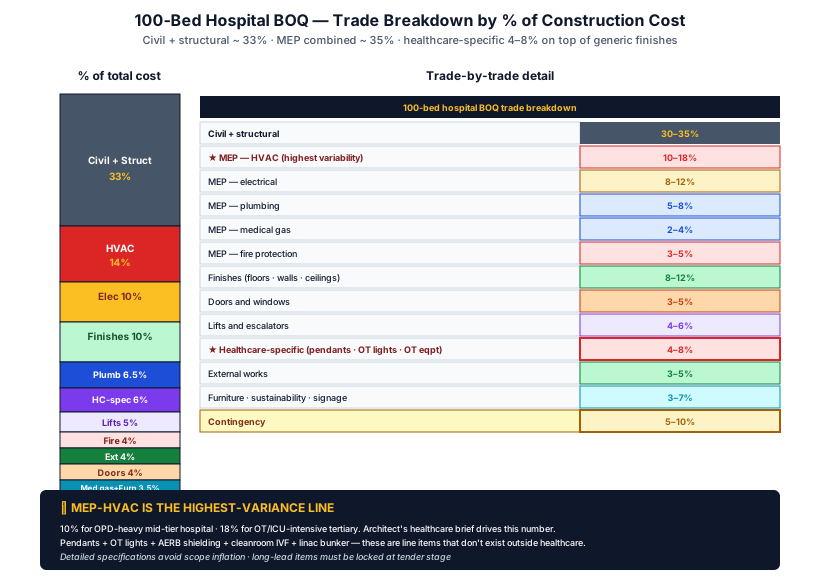
BOQ structural breakdown (typical 100-bed hospital)
| Trade | % of Total Cost |
|---|---|
| Civil + structural | 30–35% |
| MEP — electrical | 8–12% |
| MEP — HVAC | 10–18% (depending on OT/ICU intensity) |
| MEP — plumbing | 5–8% |
| MEP — medical gas | 2–4% |
| MEP — fire protection | 3–5% |
| Finishes (floors, walls, ceilings) | 8–12% |
| Doors and windows | 3–5% |
| Lifts and escalators | 4–6% |
| Furniture and equipment (basic) | 2–4% |
| Healthcare-specific (pendants, surgical lights, OT equipment) | 4–8% |
| Signage | 0.5–1% |
| Sustainability features (solar, RWH) | 1–3% |
| External works | 3–5% |
| Contingency | 5–10% |
| Professional fees | (separate) |
Healthcare-specific BOQ items
| Item | Description |
|---|---|
| HEPA filter terminal modules | Per OT, ICU |
| Pendants (anaesthesia, surgical, cardiac, perfusion) | Ceiling-mounted; structural integration |
| Surgical lighting (shadowless) | Per OT |
| Conductive vinyl flooring | OT, cathlab, cardiac OT, isolation |
| PVC wall panels | OT, ICU, NICU |
| Hermetic sliding doors | OT entries |
| Lead-shielded walls / doors / glazing | AERB rooms |
| Modular OT walls and ceilings | Pre-fabricated systems |
| Medical gas pipeline (copper) | Per linear metre |
| Medical gas outlets (NIST/DIN) | Per outlet |
| LMO tank + manifold | Lump sum |
| Pressure monitoring panels | Per OT, ICU isolation |
| Antimicrobial paints / panels | High-touch zones |
| BMS integration | Lump sum per zone |
| Modular CSSD pass-through autoclaves | Per autoclave |
| Patient lift (stretcher) — 1100 × 2400 cabin | Per lift |
| Fire-rated doors (90-min) | Per door |
| Specialty equipment (CT, MRI, cathlab, linac, gamma knife) | Per machine; equipment planner role |
| Embryology lab cleanroom (Grade A/B) | If IVF |
| Radiology lead shielding | Per AERB calculation |
Common BOQ pitfalls
| Pitfall | Mitigation |
|---|---|
| Provisional sums for major items | Detailed specifications avoid scope inflation |
| Healthcare equipment cost outside BOQ | Include in project budget; often separate procurement |
| Vendor change after BOQ | Long lead-time items locked at tender |
| Field-built where pre-fab is cheaper | Pre-fab OT walls evaluated at concept |
| Imported items vs domestic | Currency hedging or domestic specification |
| Non-NABH compliant specifications | Architect verifies NABH alignment |
4. Project Management for Hospitals
Hospital construction is more complex than general institutional construction. PM tools and processes:
| PM Element | Hospital-Specific Application |
|---|---|
| Schedule | 24–36 months for 100-bed; 30–42 months for 200-bed; 36–48 months for 500-bed |
| Critical path | OT/ICU finishing, lifts, AERB-licensed equipment commissioning |
| Stakeholder coordination | Architect + 8–14 sub-consultants + main contractor + 30+ specialty vendors |
| Approvals tracking | Dashboard of 14–22 statutory approvals |
| Quality control | NABH pre-assessment readiness audit during construction |
| Risk register | Healthcare-specific risks (regulatory delay, equipment lead-time, vendor failure) |
| Change orders | High frequency; clinical scope evolves |
| Claims | Common; healthcare-specific knowledge required |
| Commissioning | 6–12 month commissioning before opening |
Project organisation chart
| Role | Responsibilities |
|---|---|
| Project Director (Client) | Overall accountability; investment decisions |
| Project Manager (Client or Consultant) | Day-to-day project leadership |
| Architect (Lead Consultant) | Design, statutory, coordination |
| Healthcare Planner | Programme briefing; clinical input |
| HVAC Consultant | Specialty HVAC design |
| MEP Consultants | Electrical, plumbing, gas, fire |
| Structural Engineer | Loading, seismic |
| Sustainability Consultant | IGBC/LEED |
| Equipment Planner | CT, MRI, cathlab, linac, lab, OT equipment |
| Main Contractor | Civil + finishes + general MEP |
| Specialty Contractors | OT modular, HVAC, lifts, medical gas, AERB shielding |
| Construction Manager / PMC | Site supervision, quality, programme |
| Cost Consultant / Quantity Surveyor | BOQ, valuation, payments |
| Commissioning Consultant | Final commissioning |
The architect's role in this org chart is lead consultant — coordinating design across all sub-consultants and managing the design–construction interface. The PM role can be inside or outside the architect's scope; clarification at engagement is critical.
5. Client Typologies — Four Major Patterns
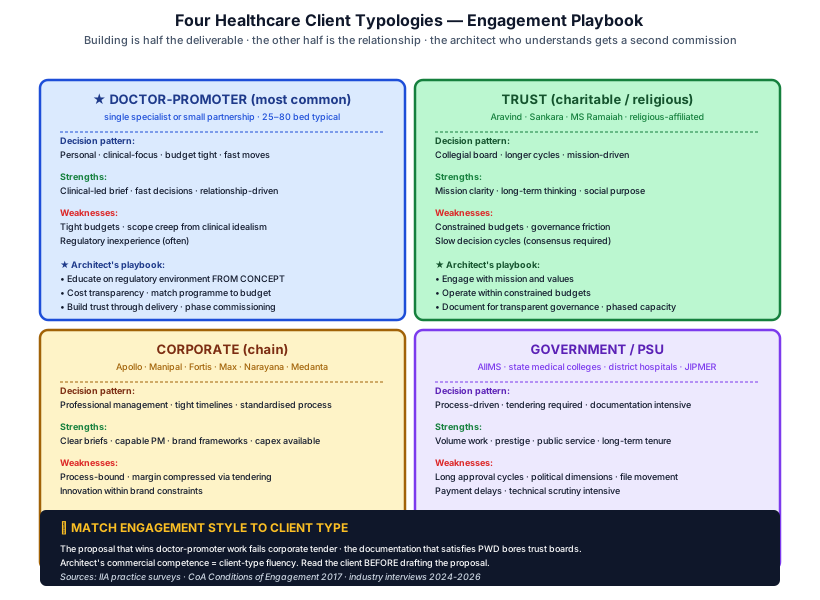
| Client Type | Decision-Making Pattern | Architect's Engagement Style |
|---|---|---|
| Doctor-promoter (single doctor or small partnership) | Personal, often clinical-focus; budget tight | Educate on design, regulatory, brief carefully; build trust |
| Trust (hospital trust, religious/charitable) | Collegial board; longer cycles; mission-driven | Engage with mission; budget often constrained |
| Corporate (Apollo, Manipal, Fortis, Max, Narayana) | Professional management; tight timelines; standardised processes | Process-driven; deliverables-focused; competitive |
| Government / PSU (PWD, CPWD, state PWD) | Process-driven; tendering required; documentation intensive | Bid-and-deliver; political dimensions; PWD coordination |
Doctor-promoter clients
The most common Indian healthcare client. Often a single specialist (cardiologist, gynaecologist, surgeon) building their own hospital. Strengths: clinical-led brief, fast decisions, relationship-driven. Weaknesses: tight budgets, scope creep from clinical idealism, regulatory inexperience.
Architect's playbook:
- Educate on regulatory environment from concept
- Provide cost transparency
- Match programme to budget
- Build trust through delivery
- Phase commissioning to reduce upfront cost
Trust clients
Examples: Sankara Nethralaya, MS Ramaiah trust, Aravind Eye Care, religious-affiliated hospitals.
Architect's playbook:
- Engage with mission and values
- Operate within constrained budgets
- Document for transparent governance
- Plan for incremental capacity expansion
Corporate clients
Examples: Apollo Hospitals, Manipal, Fortis, Max Healthcare, Narayana, Medanta.
Architect's playbook:
- Match corporate process and timeline
- Standardise where the chain has prototypes
- Innovate within brand framework
- Provide robust documentation
- Work with corporate procurement teams
Government clients
Examples: AIIMS, state medical colleges, district hospitals, JIPMER.
Architect's playbook:
- Comply with PWD documentation
- Tender via government processes
- Engage with technical scrutiny committee
- Manage long approval cycles
- IPHS adherence mandatory
6. Risk and Professional Indemnity
| Risk | Architect's Exposure | Mitigation |
|---|---|---|
| Regulatory non-compliance | Re-design cost; project delay | Audit compliance from concept; documentation |
| Design error | Re-work; legal claim | Peer review; checking; PI insurance |
| Fire NOC failure | Major rework | Design to state code first |
| AERB rejection | Shielding rework | RSO engagement at concept |
| Bed-area shortfall vs state CEA | Re-plan | State act schedule from concept |
| Construction defect | Litigation | Site supervision; quality control |
| Vendor failure | Equipment delay; substitute cost | Multiple supplier qualification |
| Cost overrun | Client dispute | Cost transparency; change order discipline |
| Schedule overrun | Liquidated damages | Realistic schedule; risk register |
| Patient injury post-handover | Litigation | Documentation; site signoff |
Professional indemnity insurance
Indian PI insurance for architects:
| Cover | Premium | Notes |
|---|---|---|
| ₹1 crore PI cover | ₹15,000–₹25,000/year | Adequate for general practice |
| ₹2 crore PI cover | ₹25,000–₹40,000/year | Recommended for healthcare |
| ₹5 crore PI cover | ₹60,000–₹1,00,000/year | For specialist healthcare practice |
| ₹10 crore + PI cover | ₹1,50,000+/year | Major institutional / multi-project |
Healthcare commissions justify higher PI cover than general practice — both because project values are higher and because litigation exposure is greater.
Engagement letter / contract recommendations
| Element | Specification |
|---|---|
| Scope of services | Clearly defined; deliverables listed |
| Fee schedule | Stages with linked deliverables |
| Time-line | Realistic; with allowances for regulatory cycle |
| Change orders | Process; pricing |
| Indemnity / liability | Cap on liability; PI cover declared |
| Dispute resolution | Arbitration vs court |
| Termination | Notice; fee for completed stages |
| IP / drawings | Architect retains; client gets use license |
| Force majeure | Pandemic, regulatory change |
7. Construction Phase Management
| Construction Phase | Architect's Activities |
|---|---|
| Pre-construction | Tender review; contractor selection input; pre-construction meeting |
| Mobilisation | Site approval; insurance review; method statements |
| Foundation / structure | Site visits weekly; inspection; quality |
| Wet trades | Inspection; coordination |
| First-fix services | Coordination drawings; clash resolution |
| Finishes | Sample approval; mock-up review |
| Second-fix services | Commissioning prep; testing |
| Healthcare-specific equipment | Coordination with vendors; AERB-compliant installation |
| Statutory testing / commissioning | Fire, electrical, lift, medical gas, AERB, etc. |
| NABH pre-assessment readiness | Documentation; gap closure |
| Snag / defects | Punch list; closure |
| Handover | Documentation; warranties; manuals |
Site visit frequency for healthcare projects:
| Stage | Visits per Week |
|---|---|
| Foundation / structure | 1–2 |
| Wet trades | 2 |
| First-fix services | 2–3 |
| OT / ICU / specialty critical zones | 3–4 (during finishing) |
| Healthcare-specific commissioning | Daily (final 4–8 weeks) |
8. Commissioning Workflow
The 6–12 month period before a hospital opens is the commissioning phase — when systems are tested, documentation finalised, and the building transitions from construction site to operating facility.
| Commissioning Activity | Architect's Role |
|---|---|
| HVAC commissioning (OT pressure, ICU, isolation) | Coordinate with HVAC consultant |
| Medical gas commissioning (pressure, alarm) | Coordinate with gas consultant |
| Fire commissioning (sprinkler, alarm, PA) | Coordinate with fire consultant |
| Lift commissioning | Coordinate; sign-off |
| Electrical (DG, UPS, earthing) commissioning | Coordinate with MEP consultant |
| AERB licensing — per machine | Coordinate with RSO |
| BMW authorisation | Submission |
| Drug license (pharmacy) | Submission |
| State CEA / NH registration | Submission |
| NABH pre-assessment | Documentation review |
| Furniture and FF&E installation | Verification |
| Signage installation | Final checks |
| Wayfinding system live | Verify |
| Cleaning protocol initiation | Confirm with O&M team |
| Staff training (architecture-related) | Provide as-built; emergency procedures |
| As-built drawings | Final delivery |
| Operations & maintenance manuals | Delivery |
| Defect liability period start | Documentation |
9. Common Commercial Pitfalls
| # | Pitfall | Prevention |
|---|---|---|
| 1 | Fee underquoted for healthcare scope | Use CoA scale + healthcare premium |
| 2 | Scope creep without change orders | Documented change-order process |
| 3 | Sub-consultant fees not aligned | Single-source bundled fees |
| 4 | PI insurance under-coverage | ₹2+ crore for healthcare |
| 5 | Delayed payments by client | Stage-linked payment schedule |
| 6 | Vendor lead-time not factored | Long lead-time list at tender |
| 7 | Regulatory delay not in client risk allocation | Time extension clauses |
| 8 | Defect liability period inadequate | 24+ months for healthcare |
| 9 | NABH gap discovered post-handover | Pre-assessment audit during construction |
| 10 | Cost overrun without negotiation | Cost-management discipline |
| 11 | Equipment specification ad-hoc | Equipment planner from concept |
| 12 | Engagement letter informal | Formal contract; legal review |
10. Architect's Healthcare Commission Toolkit
| # | Step | Output |
|---|---|---|
| 1 | Client briefing — scope, type, budget, timeline | Brief document |
| 2 | Fee proposal — scoped, with assumptions | Proposal |
| 3 | Engagement letter / contract | Signed agreement |
| 4 | Project organisation — sub-consultants identified | Org chart |
| 5 | Project plan — milestones, deliverables, payments | Project plan |
| 6 | Concept design + statutory pre-application | Concept package |
| 7 | Building permit + AERB + fire NOC + state CEA prep | Statutory packages |
| 8 | Detailed design + tender documentation | DD + tender package |
| 9 | Tender administration + contractor selection | Tender outcome |
| 10 | Construction administration + site supervision | Field reports |
| 11 | Commissioning coordination | Commissioning programme |
| 12 | Handover + as-built + warranties + O&M | Handover dossier |
| 13 | Post-occupancy evaluation | POE report |
| 14 | Defect liability period management | Defect closure |
References
- Council of Architecture (2017) Conditions of Engagement and Scale of Charges. New Delhi: COA.
- Indian Institute of Architects (2018) Architect's Handbook for Practice. Mumbai: IIA.
- Bureau of Indian Standards (2016) National Building Code of India 2016. New Delhi: BIS.
- Council of Architecture (1972, amended) Architects Act 1972. New Delhi: GoI.
- Facility Guidelines Institute (2022) Guidelines for Design and Construction of Hospitals. St. Louis: FGI.
- Government of India (2020) Real Estate (Regulation and Development) Act 2016 — RERA. New Delhi: MoHUA.
- Joshi, D.C. and Joshi, M. (2018) Hospital Administration. 2nd edn. New Delhi: Jaypee Brothers.
- Kelly, J., Male, S. and Graham, D. (2014) Value Management of Construction Projects. 2nd edn. Chichester: Wiley-Blackwell.
- Lee, B. and Tang, R. (2016) 'Construction risks in hospital projects', Journal of Construction Engineering and Management, 142(7), 04016024.
- NABH (2020) Standards for Hospitals, 5th Edition. New Delhi: NABH.
- PMI (2017) A Guide to the Project Management Body of Knowledge (PMBOK). 6th edn. Newtown Square: Project Management Institute.
- Project Management Association of India (2020) PM Practices for Healthcare Construction. New Delhi: PMA.
- Rastogi, R. (2019) Construction Cost Indices for Hospital Projects in India. New Delhi: NICMAR.
- Sakharkar, B.M. (2009) Principles of Hospital Administration and Planning. 2nd edn. New Delhi: Jaypee Brothers.
- Subramanian, K. (2016) 'Healthcare construction in India: market dynamics and risk assessment', Journal of Construction in Developing Countries, 21(1), pp. 87–105.
- Tata Consulting Engineers (2018) Hospital Project Management Handbook. Mumbai: TCE.
Author's Note: This guide closes the design-focused series. The 22 articles across two ten-and-twelve-part series — regulatory environment and design / practice — together form a complete reference library for the architect on healthcare commissions in India. The intent is that an architect new to healthcare can begin a commission with confidence after reading the relevant guides, and that a practising healthcare architect can use the series as a working reference for specific decisions. The series is open to evolution; corrections, additions, and case studies from practising architects are welcomed.
Disclaimer: This article is for informational and educational purposes only and does not constitute professional financial, legal, or contractual advice. Fee scales, costs, and contracting arrangements depend on specific project parameters and must be assessed project-by-project. Engage qualified legal, financial, and contractual advisors for binding commitments. Studio Matrx, its authors, and contributors accept no liability for decisions made on the basis of the information in this guide.
Interactive · Healthcare commission tiers
Multi-spec hospital · 50-150 beds · ₹40-150 Cr · 18-30 months
Scope
- ▸OPD, IPD, ICU, NICU, OTs
- ▸Diagnostics (Path, CT, MRI)
- ▸Cath lab / dialysis
- ▸Pharmacy + central stores
- ▸Kitchen + laundry
Stakeholders
Architect fee scale
5-8% of construction
Snapshot
Pitfall
Department adjacencies must be drawn before structure starts — relocating ICU after columns are poured is catastrophic.
Budget / fee bands are 2025-26 indicative for Indian commissions; geographic + brand premia vary by 25-40%. Stakeholder counts reflect typical scope, not exhaustive lists.
Export this guide
Related Guides — Deep-dive reading
Scope Boundaries — Architect, Interior Designer & Contractor
The Architects Act 1972, the IIID Code, BOCW 1996 & RERA 2016 — Stage-by-Stage Role Map, Hot Boundary Zones, Liability Matrix, and the Tri-Party Contracting Discipline for Indian Residential Practice
ConstructionSnagging & Punch List Standards for Handover
RERA 2016 §14, the COA Stage-8 Discipline, IS 13311 / IS 1542 / IS 14687 / NBC 2016 Part 6, RICS Snagging Standards — Three-Tier Severity Classification, the Eight Defect Zones, Tolerance Tables, the Punch-List Document Protocol, Retention-Tranche Discipline, and the Architect-Led Handover Workflow for Indian Residential Practice in 2026
ConstructionOT Suite Design in India — Planning, Services, Detailing
From Single OT to 12-OT Campus — Zone Classification, ASHRAE 170 + NABH Plant Design, Pendants and Booms and Lighting, Scrub/Induction/Recovery Geometry, CSSD Interface, Floor and Wall Finishes, and the OT Architectural Toolkit
Healthcare ArchitectureRelated Tools — Try Free
Circadian Light Meter
Patient-centric circadian lighting visualizer for Indian healthcare design — time-of-day × intensity → CCT, melanopic lux (EML / mEDI), melatonin suppression, and an alertness curve. Calibrated against WELL v2 L03 Circadian Lighting Design, CIE S 026:2018, Brainard 2001, and Lucas et al. 2014.
Circadian ToolAcoustic Privacy (STC) Visualizer
Indian healthcare acoustic visualizer — compare wall assemblies and noise sources, see received SPL after STC attenuation, and check FGI 2018 / IS 1950 / NABH speech-privacy compliance with live dual-canvas waveform.
Acoustic ToolContract Studio
AI generates professional architecture service agreements with milestones and scope.
ArchitectAI