
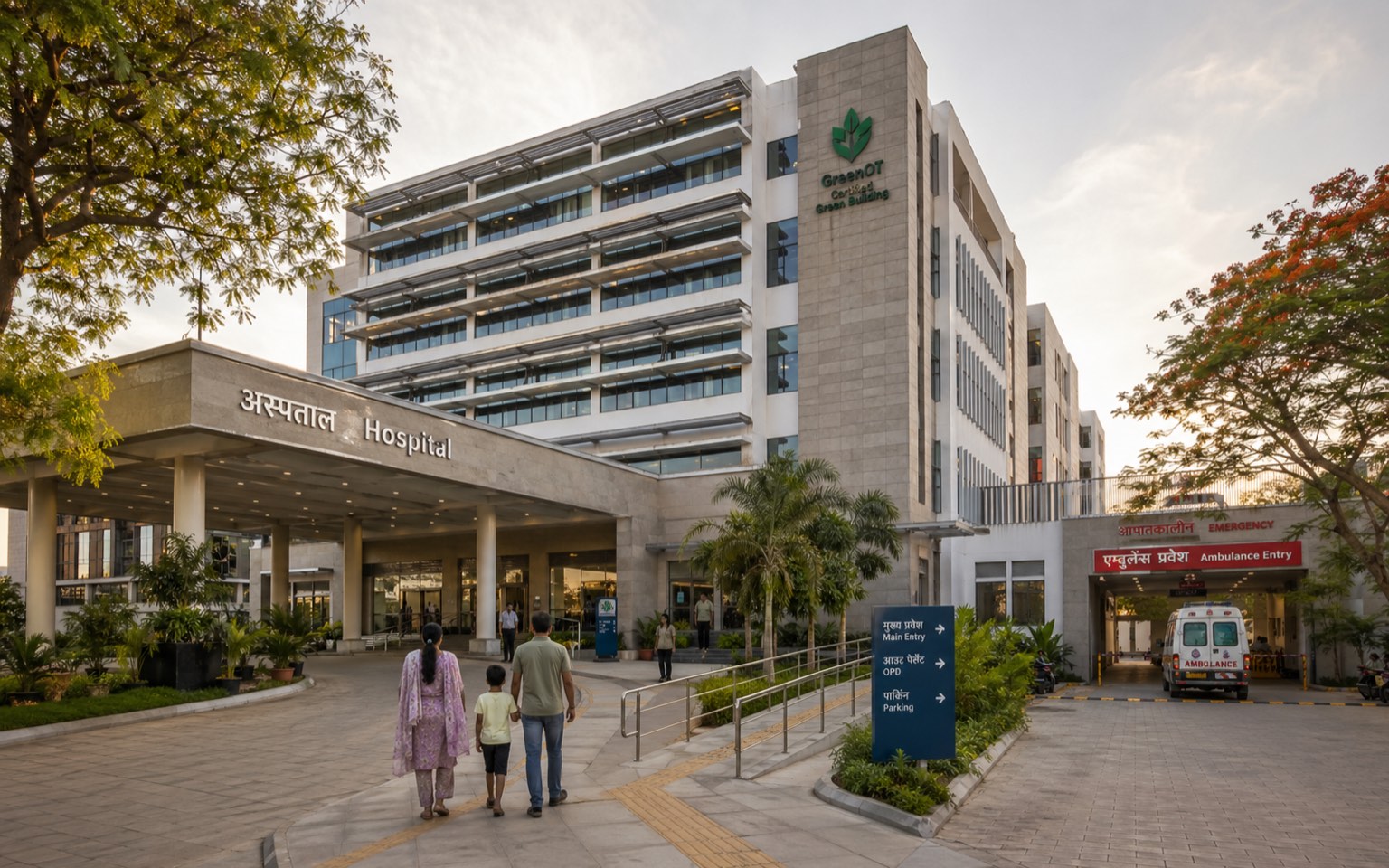
Healthcare Architecture in India: The Regulatory Landscape
A Pillar Reference for Architects — Three Regulatory Layers, Approval Matrix by Facility Type, State-by-State Variation, Sequencing, Stakeholder Map, and the Compliance Deliverables Checklist
Healthcare is the most regulation-dense building typology that an Indian architect can be commissioned to design. A single hospital project is governed simultaneously by the National Building Code, a state-specific Clinical Establishments Act, NABH accreditation requirements, AERB radiation safety codes, the Bio-Medical Waste Rules, the PC-PNDT Act, the Persons with Disabilities Act through the Harmonised Guidelines 2021, the Energy Conservation Building Code, the Environmental Impact Assessment notification, state pollution control board norms, fire service rules, and a long tail of municipal bye-laws. The architect who treats this stack as a checklist to be cleared at the end of design will discover, almost without exception, that one or more approvals will require a re-design — sometimes a fundamental one — that the project budget and timeline cannot absorb.
This guide is the first in a ten-part series on regulatory compliance for healthcare architecture in India. It is the pillar reference: it maps the entire regulatory terrain, locates each statute and code in a three-layer model, provides the approval matrix by facility type and bed strength, sequences approvals across the project timeline, documents state-by-state variation, names the stakeholders an architect must coordinate with, catalogues the most common failure modes, and ends with two practical instruments — a pre-design audit framework and the architect's compliance deliverables checklist.
The position this guide takes is specific: regulatory compliance for healthcare in India is not a downstream administrative task; it is an upstream design constraint that shapes site selection, massing, plan organisation, structural grid, services routing, and cost. The architect who internalises this — who treats the regulatory landscape as a primary design input alongside climate, programme, and brief — produces healthcare buildings that get registered, get commissioned, and stay open. The architect who does not produces buildings that the client cannot legally operate.
"The very first requirement in a Hospital is that it should do the sick no harm." — Florence Nightingale (1820–1910), nursing reformer, from Notes on Hospitals (Nightingale, 1863, Preface)
"Hospitals are not for architects, they are for the sick. The form follows the patient." — Charles Correa (1930–2015), architect, paraphrased from A Place in the Shade (Correa, 2010)
1. Why Healthcare is the Most Regulated Building Typology in India
A residence is regulated primarily by the municipal bye-laws and (in seismic zones) the structural code. An office is regulated additionally by fire safety and accessibility. A school adds the right-to-education infrastructure norms. A hospital adds, on top of all of the above, an entire parallel regulatory architecture concerned with patient safety, infection control, radiation hazard, biomedical waste, drug storage, ionising and non-ionising imaging, controlled substances, gas pipelines, hazardous materials, and the licensing of the clinical establishment itself.
The reasons are concrete:
- Life-safety stakes. A fire in an office may injure occupants who can self-evacuate. A fire in an ICU or operation theatre involves non-ambulatory patients, oxygen-rich atmospheres, and irreplaceable clinical staff who cannot abandon ventilator-dependent patients. The fire code therefore demands compartmentation, refuge, and evacuation strategies that no other building type requires.
- Cross-infection risk. Healthcare buildings host sick patients, healthy visitors, immunocompromised patients, and aerosol-generating procedures in close proximity. Air handling, surface specification, and circulation must prevent pathogen transmission. The codes governing these are dense.
- Radiation and chemical hazards. Diagnostic radiology, nuclear medicine, radiotherapy, and chemotherapy preparation all involve regulated hazards with their own central regulator (AERB) and rules.
- Biomedical waste. A typical 100-bed hospital generates 100–250 kg of biomedical waste per day in segregated streams. Storage, transport, and disposal architecture is non-trivial.
- Controlled medical practice. Healthcare is one of the few professions requiring statutory licensing of the building itself, not only of the practitioner. The Clinical Establishments Act and its state variants are unique to healthcare.
- Public-interest disclosure. PC-PNDT room registration, NABH transparency, and grievance redress mechanisms create an ongoing audit relationship between the building and the regulator that does not end at occupancy.
The composite effect is that a single 100-bed hospital project can require 14–22 statutory approvals, drawn from at least 8 different regulators, with sequencing dependencies among them. Missing any one delays commissioning indefinitely.
"Healthcare buildings are not just buildings. They are instruments of care, and like all instruments, they must be calibrated, certified, and continually maintained. Regulation is the calibration." — D.K. Sarin (b. 1948), former Director, Hospital Services Consultancy Corporation (HSCC India), public lecture (paraphrased)
2. The Three-Layer Regulatory Model
The simplest way to organise the Indian healthcare regulatory landscape is by what each regulator is actually concerned with. Three layers emerge cleanly.
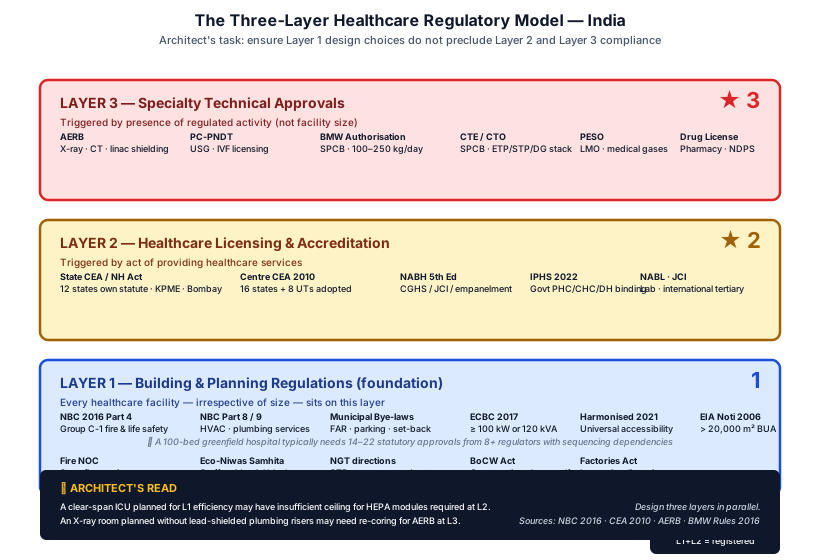
| Layer | Concern | Primary Regulators | Triggered By |
|---|---|---|---|
| Layer 1 — Building & Planning | Is the building itself safe, accessible, energy-efficient, and lawfully sited? | Municipal authority, fire service, MoEFCC, BEE, Chief Inspector of Factories (where applicable) | Any built construction; thresholds for some statutes |
| Layer 2 — Healthcare Licensing & Accreditation | Is the clinical establishment registered to provide healthcare services and (optionally) accredited for quality? | State health department under CEA / state Nursing Home Act; NABH; NABL; MoHFW for IPHS | The act of providing healthcare services; voluntary accreditation otherwise |
| Layer 3 — Specialty Technical Approvals | Are the specific hazardous, sensitive, or specialised activities within the building separately licensed? | AERB (radiation), Drugs Controller (pharmacy), PC-PNDT Authority (genetic), State PCB (waste, ETP), Explosives (medical gases) | Presence of the activity, regardless of facility size |
A facility that meets only Layer 1 is a building, not a healthcare facility. A facility that meets Layer 1 + 2 is a registered healthcare facility but cannot perform regulated specialties (radiology, IVF, etc.). A facility that meets all three layers is a fully compliant healthcare facility — and only then can it be legally commissioned for its full scope.
The architect's primary task is to ensure that Layer 1 design choices do not preclude Layer 2 and Layer 3 compliance. This is harder than it sounds: a clear-span ICU planned for Layer 1 efficiency may have insufficient ceiling height for HEPA-filter terminal modules required at Layer 2; an X-ray room planned without lead-shielded plumbing risers may need to be re-cored for AERB at Layer 3. The architect who designs the three layers in parallel produces compliant buildings; the architect who designs Layer 1 and "deals with the rest later" produces re-design.
3. Layer 1 — Building & Planning Regulations
The building-and-planning layer is the foundation. Every healthcare facility, irrespective of size, sits on this layer. Each statute below applies generally to buildings, with specific clauses or thresholds for healthcare.
| Regulation | Authority | Healthcare-Specific Application | Threshold |
|---|---|---|---|
| NBC 2016, Part 4 — Fire & Life Safety | Bureau of Indian Standards (advisory) + state fire service | Group C-1 Institutional — Hospitals & Sanatoria; specific compartmentation, travel distance, refuge, evacuation rules | Any hospital, nursing home, or clinic with overnight stay |
| NBC 2016, Part 8 — Building Services | BIS + state | HVAC for healthcare (Section 4); water supply (Section 2); lighting; vertical transportation including stretcher lifts | All facilities; varies by scope |
| NBC 2016, Part 9 — Plumbing Services | BIS + state | Hot/cold water demand for hospitals; medical gas piping referenced; sanitary fixtures by occupancy | All facilities |
| State Municipal Bye-laws | ULB (BBMP, MCGM, MCD, KMC, GHMC, etc.) | FAR concession (often 0.25–0.5 extra for healthcare), parking norms (1 car / 4–6 beds typical), setback relaxation in some states | All facilities |
| ECBC 2017 | Bureau of Energy Efficiency (state-adopted) | Envelope, HVAC, lighting, service-water heating performance norms | Connected load ≥ 100 kW or contract demand ≥ 120 kVA |
| Eco-Niwas Samhita | BEE | Residential portion (staff quarters) — applies if separate | Residential blocks within campus |
| Harmonised Guidelines & Space Standards 2021 | MoHUA / Department of Empowerment of Persons with Disabilities | Universal accessibility — wheelchair turning radius, signage, tactile paving, accessible toilets, lifts | All public buildings; healthcare is statutory priority |
| EIA Notification 2006 (as amended) | MoEFCC / SEIAA | Environmental clearance — Building & Construction projects, Item 8(a) | Built-up area > 20,000 m²; modified to > 50,000 m² for some categories under recent amendments |
| National Green Tribunal directions | NGT | STP/ETP capacity, tree felling, groundwater | Project-specific |
| Factories Act / Building Construction Workers Act | State labour department | Construction phase welfare; licensing of large sites | All large sites |
Key state municipal variations (illustrative):
| City / State | FAR for Hospital | Parking | Other Notable Provision |
|---|---|---|---|
| Bengaluru (BBMP RMP-2031 / KTCP) | Base + 0.5 extra for hospitals on plots ≥ 800 m² | 1 ECS / 100 m² built-up | Set-back relaxation if rear access provided |
| Mumbai (DCPR 2034) | TDR-loaded; healthcare in Special Buildings list (Reg. 33(21)) | 1 ECS / 75 m² for hospitals; 1 / 50 m² for OPD-heavy | Compulsory open spaces; hospital permitted in residential zones with conditions |
| Delhi (MPD 2021 / Unified Building Bye-laws 2016) | 175–250 depending on size; plot size minimums by capacity | As per NBC | Separate ambulance entry mandatory above 100 beds |
| Chennai (CMDA Second Master Plan) | 1.5–2.0 with conditions | 1 ECS / 4 beds | Set-back as per NBC; institutional zoning required |
| Hyderabad (GHMC Building Rules 2012) | Up to 12 (high-rise) for healthcare with NOCs | 1 ECS / 60 m² | Hospital allowed in residential subject to building height |
| Kolkata (KMC Building Rules 2009) | As per use & plot size | As per KMC table | Lift mandatory above G+2 for hospitals |
| Ahmedabad (AUDA GDCR) | Variable | 1 ECS / 100 m² | Public health permission required |
The variation between states means there is no "Indian hospital FAR." The architect must read the state bye-law for the specific city before site selection — a 2-acre site that yields 25,000 m² in Hyderabad may yield 8,000 m² in a comparable Bengaluru zone.
"The most sustainable hospital is the one that does not need to be rebuilt because the planners read the bye-law before they bought the land." — Ar. Hafeez Contractor (b. 1950), architect, paraphrased remark at conference
4. Layer 2 — Healthcare Licensing & Accreditation
Healthcare licensing is unique to this typology. The Centre's Clinical Establishments (Registration & Regulation) Act 2010 sets a national framework, but adoption is state-by-state, and several large states have their own independent statutes that pre-date or substitute for the Centre Act.
| Regulation | Authority | Purpose | Architectural Implication |
|---|---|---|---|
| Clinical Establishments (Registration & Regulation) Act 2010 | State health department (where adopted) | Mandatory registration of all clinical establishments to defined minimum standards | Defines space norms by category (Type A/B/C/D facility) — architect provides compliant area schedules |
| State Nursing Homes Acts / state CEAs | State health authority | Pre-existing state statutes (Bombay, Delhi, WB) that license nursing homes; some now harmonised with Centre Act | Specific bed-room area minimums, OT and labour room requirements; vary by state |
| NABH 5th Edition Standards (2020+) | National Accreditation Board for Hospitals & Healthcare Providers (NABH), Quality Council of India | Voluntary accreditation; mandatory for empanelment in CGHS, ECHS, several PSU schemes; AB-PMJAY tier-bonus | Detailed facility, environment, infection-control, signage, and access standards |
| NABH Entry-Level / SHCO (Small Health Care Organisations) | NABH | Lighter version for ≤ 50 bed facilities or non-bed clinics/labs | Reduced documentation; physical infrastructure still required |
| NABL (Labs) | National Accreditation Board for Testing and Calibration Laboratories | Pathology / diagnostic lab accreditation | Lab layout, biosafety levels, BSL-2/3 architecture |
| IPHS 2022 — Indian Public Health Standards | MoHFW | Mandatory norms for govt PHC, CHC, SDH, DH | Defined area schedules and equipment lists; binding for govt projects |
| Joint Commission International (JCI) | JCI, USA (international) | International accreditation; chosen by tertiary private hospitals | Layered onto NABH; particularly demanding on patient flow & life safety |
The CEA / state-statute matrix — all 28 states + 8 UTs (status as of 2026; verify current state notifications before any project):
| State / UT | Adopted Centre CEA 2010? | State-specific statute | Notes |
|---|---|---|---|
| Andhra Pradesh | Yes (with amendments) | AP Allopathic Private Medical Care Establishments Act, earlier | Centre rules notified |
| Arunachal Pradesh | Yes | — | Centre rules apply |
| Assam | Yes | — | Centre rules apply |
| Bihar | Yes | — | Centre rules adopted |
| Chhattisgarh | No | Chhattisgarh Upcharyagriha Tatha Rogopchar Sambandhi Sthapnaye Adhiniyam 2010 | State act |
| Delhi (NCT) | No | Delhi Nursing Homes Registration Act 1953 | Long-standing state act; revisions in process |
| Goa | Yes | — | Centre rules notified |
| Gujarat | No | Gujarat Clinical Establishments (Registration & Regulation) Bill (under process); Bombay NH Act applies historically | Hybrid |
| Haryana | Yes (partial) | Haryana Clinical Establishments Rules | State rules under Centre Act |
| Himachal Pradesh | Yes | — | Centre rules apply |
| Jammu & Kashmir (UT) | Yes | — | Post-2019 reorganisation |
| Jharkhand | Yes | — | Centre rules apply |
| Karnataka | No | Karnataka Private Medical Establishments Act 2007 (KPME), amended 2017 | State act; widely cited |
| Kerala | No | Kerala Clinical Establishments (Registration & Regulation) Act 2018 | State act |
| Ladakh (UT) | Yes | — | Centre rules apply |
| Madhya Pradesh | No | Madhya Pradesh Upcharyagriha Tatha Rajya Chikitsalaya Adhiniyam 1973 (revised) | State act |
| Maharashtra | No | Bombay Nursing Homes Registration Act 1949 (state-amended); Maharashtra CEA Bill pending | State act, very long-standing |
| Manipur | Yes | — | Centre rules apply |
| Meghalaya | Yes | — | Centre rules apply |
| Mizoram | Yes | — | Centre rules apply |
| Nagaland | Yes | — | Centre rules apply |
| Odisha | Yes | — | Centre rules apply (notified) |
| Puducherry (UT) | Yes | — | Centre rules apply |
| Punjab | Yes (in process) | Punjab Clinical Establishments Rules | State-Centre hybrid |
| Rajasthan | No | Rajasthan Clinical Establishments (Registration & Regulation) Act 2017 | State act |
| Sikkim | Yes | — | Centre rules apply |
| Tamil Nadu | No | Tamil Nadu Clinical Establishments (Regulation) Act 2018 | State act, recent |
| Telangana | No | Telangana Allopathic Private Medical Care Establishments (Registration & Regulation) Act 2002 | State act |
| Tripura | Yes | — | Centre rules apply |
| Uttar Pradesh | No | Uttar Pradesh Medical Care Establishments (Registration & Regulation) Act 2020 / earlier UP NH Act | State act |
| Uttarakhand | Yes | — | Centre rules notified |
| West Bengal | No | West Bengal Clinical Establishments (Registration, Regulation and Transparency) Act 2017 | State act, transparency-strong |
Architect's read of this matrix: every project must be checked against the state-specific statute. Most large states (Karnataka, Maharashtra, Tamil Nadu, Delhi, West Bengal, MP, Telangana) operate under their own statute and not the Centre Act. Each state act has its own minimum-area schedules, OT/labour-room requirements, and registration deliverables. A hospital design that meets the Centre Act minimum area but falls short of (say) the Karnataka KPME schedule will not be registrable in Bengaluru. This is the most common compliance error in cross-state practice.
"In India, healthcare is constitutionally a state subject. Architects who treat regulation as a national topic are designing for a country that does not exist." — Dr. K. Srinath Reddy (b. 1949), former President, Public Health Foundation of India, paraphrased
5. Layer 3 — Specialty Technical Approvals
Specialty approvals are triggered by the presence of a regulated activity, not the size of the facility. A 6-bed nursing home with one X-ray machine triggers the same AERB requirement as a 2,000-bed hospital with thirty machines. The architect therefore audits the brief for triggers and provisions every approval space and routing in early design.
| Approval | Authority | Trigger | Architectural Implication |
|---|---|---|---|
| AERB Type Approval & Layout Approval | Atomic Energy Regulatory Board | Any X-ray, CT, mammography, cathlab, fluoroscopy, dental X-ray, mobile X-ray; nuclear medicine; radiotherapy | Lead-shielded walls, doors, viewing windows; minimum room sizes (e.g., 18 m² for general X-ray); console with shielded operator viewing; warning lights; door interlocks |
| PC-PNDT Registration | State PNDT Authority (district CMO typically) | Any ultrasound machine, CT/MR with foetal-imaging capability, IVF, genetic counselling, prenatal diagnostic clinic | Room labelling, F-form display, fixed-position machines (movement requires re-registration); architect provides licensed-room marking |
| Bio-Medical Waste Authorisation | State Pollution Control Board | Generation of biomedical waste — applies to all healthcare facilities including small clinics | BMW storage room (cooled if > 48-hour retention), labelled bin sets, separate access for CBWTF vehicle |
| Consent to Establish (CTE) / Consent to Operate (CTO) | State Pollution Control Board | Hospitals, larger nursing homes (typically > 50 beds); state-specific thresholds | ETP/STP for liquid effluent; emission stack for DG; air ambient monitoring point; ETP/STP space provisioning is non-trivial |
| Drug License (Pharmacy) | State Drugs Controller | Any in-house pharmacy or dispensing | Pharmacy area minimums (10 m² typical), separate cold-storage chamber, schedule-X drug cupboard |
| Narcotic Drugs License | State Drugs Controller (under NDPS Act) | Storage of opioid/controlled drugs (palliative care, anaesthesia) | Locked cupboard, double-key custody, register |
| Medical Gas Pipeline Approval | PESO (Petroleum & Explosives Safety Organisation) for bulk LMO; CDSCO for cylinders | Any centralised medical gas system | Manifold room (separate, ventilated, fire-rated), cylinder storage, alarm panel |
| Lift Inspector Approval | State Public Works / Lift Inspectorate | All lifts | Stretcher lift (minimum 1100 × 2400 mm cabin) for IPD floors; bed lift sizing |
| Electrical Inspectorate Approval | State Electrical Inspectorate | All HT installations and substations | Substation siting, transformer separation distances, DG room separation |
| Fire NOC | State Fire Service | All buildings; healthcare separate priority | Building permit precondition in some states; commissioning precondition in all |
| State Boiler Inspectorate | State Boilers Department | Steam boilers (CSSD, laundry) above threshold | Boiler room, blow-down pit, chimney |
| Central Pollution Control Board — DG Set Norms | CPCB | Diesel generators above 800 kW | Stack height, acoustic enclosure, NOx norms |
| AYUSH licensing | State AYUSH Department | If providing Ayurveda / Yoga / Unani / Homoeopathy services | Separate space, panchakarma room standards if applicable |
The composite architectural impact is large. A 100-bed hospital with diagnostic radiology, ultrasound, BMW generation, ETP, pharmacy, anaesthesia, central medical gas, lifts, HT panel, DG, fire, and CSSD steam will need to satisfy all 13 of the above plus Layer 1 and Layer 2. Each has its own room sizing, separation, and finish requirement.
6. The Approval Matrix by Facility Type and Bed Strength
A compact decision-grid. Each row is a facility tier; each column is an approval; an entry indicates whether the approval is typically required, conditional, or not applicable for that tier. Read this with state-specific overrides — what is "conditional" in one state may be "required" in another.
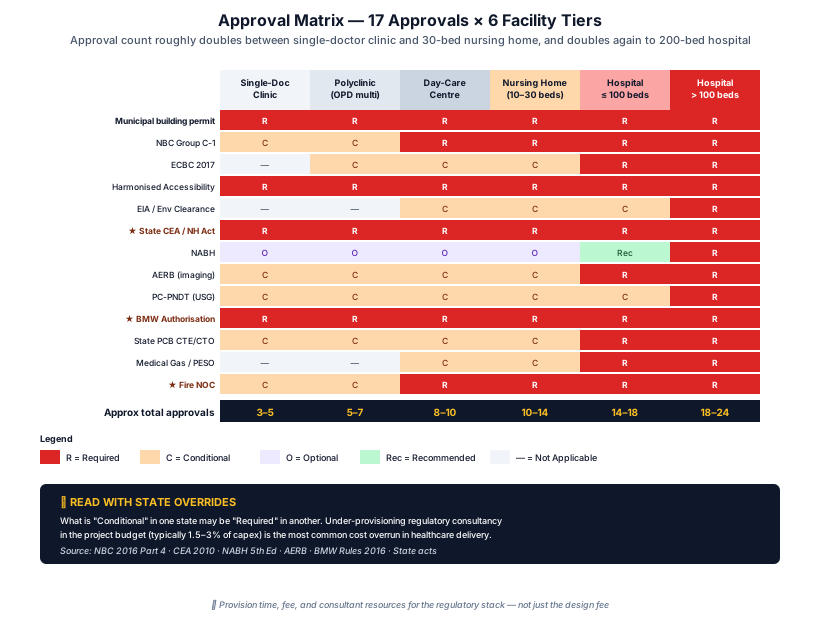
| Approval / Statute | Single-Doctor Clinic (OPD only) | Polyclinic (OPD multi) | Day-Care Centre | Nursing Home (10–30 beds) | Hospital ≤ 100 beds | Hospital > 100 beds |
|---|---|---|---|---|---|---|
| Municipal building permit | Required | Required | Required | Required | Required | Required |
| NBC Group C-1 application | Conditional | Conditional | Required | Required | Required | Required |
| ECBC | Not Applicable | Conditional | Conditional | Conditional | Required (if ≥ 100 kW) | Required |
| Harmonised Accessibility Guidelines | Required | Required | Required | Required | Required | Required |
| EIA / Environmental Clearance | Not Applicable | Not Applicable | Conditional (BUA) | Conditional | Conditional (≥ 20,000 m² BUA) | Required |
| State CEA / Nursing Home Act | Required | Required | Required | Required | Required | Required |
| NABH | Optional | Optional | Optional | Optional (SHCO common) | Recommended | Effectively required (CGHS/JCI/empanelment) |
| IPHS | Not Applicable (private) | Not Applicable | Not Applicable | If govt | If govt | If govt (mandatory) |
| AERB | If imaging present | If imaging present | If imaging present | If imaging present | Required | Required |
| PC-PNDT | If ultrasound present | If ultrasound present | If ultrasound | If ultrasound | If ultrasound / IVF | Required |
| BMW Authorisation | Required | Required | Required | Required | Required | Required |
| State PCB CTE/CTO | Conditional | Conditional | Conditional | Conditional (often) | Required | Required |
| Drug License (Pharmacy) | If dispensing | If dispensing | If dispensing | If dispensing | Required | Required |
| Medical Gas / PESO | Not Applicable | Not Applicable | Conditional (day-care surgery) | Conditional (small OT) | Required | Required |
| Lift Inspector | If lift installed | If lift installed | If lift installed | Usually required | Required | Required |
| Fire NOC | Conditional (height-based) | Conditional | Required | Required | Required | Required |
| AYUSH | If providing | If providing | If providing | If providing | If providing | If providing |
Rule of thumb: the number of statutory approvals roughly doubles between a single-doctor clinic (3–5 approvals) and a 30-bed nursing home (10–14) and doubles again to a 200-bed hospital (18–24). Architects should provision time, fee, and consultant resources accordingly — under-provisioning the regulatory consultancy line in the project budget is one of the most common cost overruns in healthcare delivery.
7. Sequencing — When Each Approval Must Land in the Project Timeline
Compliance is not a single event at the end of a project. It is a sequence of approvals that gate specific phases of design, construction, and commissioning. Mis-sequencing — for example, applying for AERB layout approval after construction is complete — is the single most common cause of healthcare project delay.
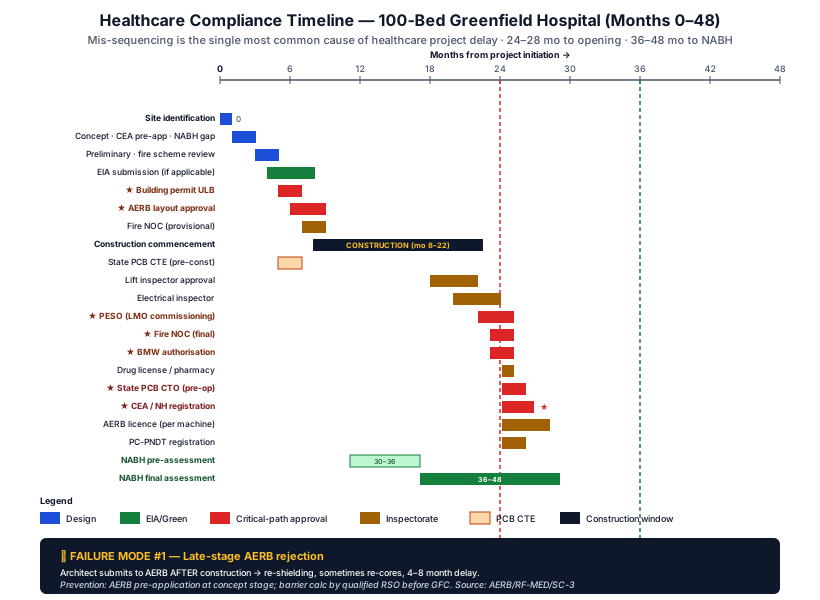
| Project Stage | Approval Action | Architect's Deliverable | Typical Calendar (months from concept) |
|---|---|---|---|
| Site identification | Zoning verification; FAR check; plot frontage check vs ambulance & fire access | Site suitability report | 0 |
| Concept design | Pre-application discussion with state CEA / NH authority; NABH gap analysis if accreditation targeted; AERB pre-consultation for radiology | Block plan, area schedule, capacity statement | 1–2 |
| Preliminary design | Initial submission to municipality; fire scheme review | Preliminary plans, fire & evacuation strategy | 3–4 |
| EIA submission (if applicable) | SEIAA application; public consultation if required | Form 1, Form 1A, ToR, EIA report | 4–8 (parallel) |
| Building permit application | Submission to ULB | Sanctioned drawings; structural; services | 5–7 |
| AERB layout approval | Per machine type; before bunker or X-ray room construction | Shielded room layout, barrier calculation report | 6–9 |
| Fire NOC (provisional) | State fire service | Fire scheme, hydraulic & detection system drawings | 7–9 |
| Construction commencement | Contractor mobilisation | GFC drawings; contractor coordination | 8–10 |
| Lift inspector approval | Before commissioning | Stretcher lift installation certificate | 18–22 |
| Electrical inspector | Before energisation | HT/LT drawings, substation layout | 20–24 |
| PESO approval | Before LMO commissioning | LMO tank siting, manifold, alarm | 22–25 |
| State PCB CTE → CTO | CTE pre-construction; CTO pre-operation | ETP/STP drawings, capacity calc | CTE 5–7; CTO 24–26 |
| Fire NOC (final) | After completion of fire systems | Fire safety system commissioning report | 25–27 |
| BMW authorisation | Before patient services begin | BMW storage room, segregation plan, CBWTF tie-up | 25–27 |
| Drug license / pharmacy | Before dispensing | Pharmacy layout, refrigeration provisions | 26–27 |
| CEA / state NH registration | Before patient services begin | All compliance documents in single application | 26–28 |
| AERB licence (post-installation, per machine) | Before each machine commissioning | Survey report, RSO appointment | Per machine, 26–30 |
| PC-PNDT registration | Before USG / IVF commissioning | Form A, F-forms display | 26–28 |
| NABH pre-assessment | Optional; 6+ months after operations | Documentation system, evidence files | 30–36 |
| NABH final assessment | After pre-assessment correction | Closing of gap items | 36–48 |
Total compliance calendar for a typical 100-bed greenfield hospital: 24–28 months from project initiation to operational opening (registration + first-day-of-patient-services), with NABH accreditation 12–18 months thereafter. Compliance lag of 4–6 months from planned commissioning is normal; 8–12 months indicates mis-sequencing or resource shortfall.
"The first hospital we did, we got the building right and the regulator wrong, and we lost ten months. The second one, we got the regulator right, and the building right, and we opened on schedule. The difference was reading the rule book before we drew the line." — Anonymous senior architect, founder of a major Indian healthcare design practice (private interview, paraphrased)
8. State-by-State Variation — Why "Indian Compliance" is a Misnomer
The state-by-state matrix in Section 4 establishes that 12 of India's 28 states operate under their own Clinical Establishments / Nursing Homes Act, not the Centre Act. The variations are not academic — they alter the architecture.
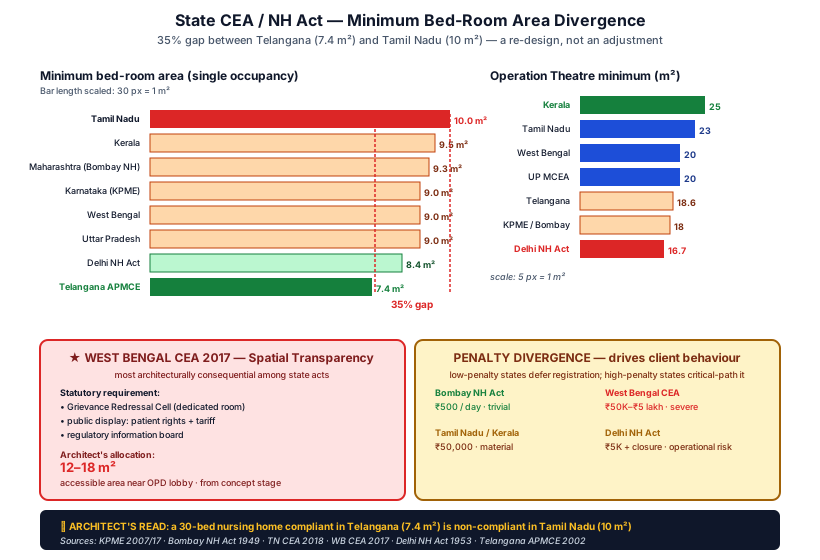
| Provision | KPME (Karnataka) | TN CEA | Bombay NH Act (MH) | Delhi NH Act | WB CEA | Telangana APMCE | Kerala CEA | UP MCEA |
|---|---|---|---|---|---|---|---|---|
| Minimum bed-room area, single | 9 m² | 10 m² | 9.3 m² | 8.4 m² | 9 m² | 7.4 m² | 9.5 m² | 9 m² |
| Minimum bed-room area, twin (per bed) | 7 m² | 8 m² | 7 m² | 7 m² | 7 m² | 6.5 m² | 7 m² | 7 m² |
| Minimum OT area | 18 m² | 23 m² | 18 m² | 16.7 m² | 20 m² | 18.6 m² | 25 m² | 20 m² |
| Recovery room | Required | Required | Required | Optional | Required | Required | Required | Required |
| Labour room minimum area | 15 m² | 18 m² | 13.94 m² | 13.94 m² | 15 m² | 14 m² | 18 m² | 15 m² |
| Mortuary / dead-body holding | Required ≥ 30 beds | Required ≥ 50 beds | Required ≥ 30 beds | Required ≥ 30 beds | Required ≥ 25 beds | Required ≥ 30 beds | Required ≥ 30 beds | Required ≥ 30 beds |
| Public-disclosure requirement | Tariff display | Patient charter + tariff | Tariff display | Tariff display | Tariff display + grievance officer (statutory) | Tariff display | Tariff display | Tariff + IPD rate card |
| Dedicated grievance redress space | Optional | Required ≥ 50 beds | Optional | Optional | Required (statutory) | Optional | Required | Optional |
| Penalty for non-registration | ₹50,000 | ₹50,000 | ₹500/day | ₹5,000 + closure | ₹50,000–₹5L | ₹2,000 | ₹50,000 | ₹50,000 |
The transparency factor (West Bengal). The WB CEA 2017 is the most architecturally consequential among state acts because it imposes statutory transparency: each registered hospital must designate a Grievance Redressal Cell with a dedicated room, a public display of patient rights and tariffs, and a regulatory information board. Architects working in West Bengal must allocate this space — typically 12–18 m² in an accessible area near the OPD lobby — from the concept stage. Other state acts treat grievance redressal as a procedural requirement; WB makes it spatial.
The minimum-area divergence. A 30-bed nursing home that meets the Telangana 7.4 m² minimum bed-room area is non-compliant if relocated to Tamil Nadu (10 m²). The compliance gap is 35% — a redesign, not an adjustment.
The penalty divergence. Bombay NH Act's penalty of ₹500/day for non-registration is functionally trivial; WB's ₹5 lakh and TN's ₹50,000 are not. Penalty divergence drives client behaviour: in low-penalty states, registration is sometimes treated as deferrable; in high-penalty states, it is a critical-path item.
9. The Stakeholder Map — Who the Architect Actually Coordinates With
A healthcare project is not a designer-to-builder bilateral. It is a coordination problem across at least 14 stakeholder categories.
| Stakeholder | Role | Architect's Interface |
|---|---|---|
| Owner / Client (trust, doctor-promoter, corporate) | Commissioning entity; decision-maker on programme & budget | Brief, design approvals, change orders |
| Hospital Planning Consultant / Healthcare Planner | Programme briefing, bed-mix, departmental adjacencies | Provides programmatic brief; reviews schematic & DD |
| HVAC Consultant — Healthcare Specialist | OT, ICU, BMT, isolation room HVAC; ASHRAE 170 / NABH compliance | Coordinates ceiling heights, shaft sizes, plant rooms |
| Plumbing & Medical Gas Consultant | Hot/cold demand calc; medical gas pipeline; manifold & LMO | Riser locations, plant rooms, alarm panels |
| Electrical & Low-Voltage Consultant | HT/LT, UPS for OT/ICU, BMS, nurse-call, fire-detection | Substation, panel rooms, conduits |
| Structural Engineer | Heavy equipment loads (CT, MRI, linac), seismic, floor vibration | Equipment plan, loading schedule, vibration limits |
| Fire Consultant | Fire scheme design, NOC documentation | Compartmentation strategy, refuge floor, evacuation |
| Radiation Safety Officer / AERB Consultant | Barrier calculations, AERB liaison | Shielded room layouts, doors, viewing |
| Sustainability Consultant — IGBC/GRIHA/LEED for Hospitals | Green building rating | ECBC envelope, materials, water |
| Biomedical Equipment Planner | Equipment selection, room sizing, utilities | Final room sheets per equipment |
| State Health Department / CEA Authority | Registration | CEA-format submission |
| NABH Surveyor (if accreditation pursued) | Pre-assessment, final assessment | Documentation, gap closure |
| State Fire Service | Fire NOC | Fire system commissioning |
| State Pollution Control Board | BMW authorisation, ETP CTE/CTO | ETP layout, BMW storage |
| AERB — Type approval & layout approval cell | Per-room and per-machine licensing | Shielded room drawings, calc reports |
| PESO | LMO and bulk gases | LMO yard, manifold |
| Drug Controller (state) | Pharmacy & narcotic license | Pharmacy layout |
| PNDT Authority (district CMO) | Ultrasound / IVF registration | Room marking, F-form display board |
| Local Municipal Authority | Building permit, completion certificate | Building drawings, occupation certificate |
| MoEFCC / SEIAA (if applicable) | Environmental clearance | EIA report, monitoring plan |
A senior architect's project log on a 200-bed hospital typically records 28–35 distinct external coordination items per month during preliminary design and 50+ per month during construction. The architect who treats coordination as a delegable secondary activity, rather than as the primary task, will not deliver on time. Healthcare architecture is, in operational terms, a regulatory choreography first and a design exercise second.
"I tell young architects who want to do hospital work: half your job is design. The other half is making sure that everyone with a stamp signs at the right time. Both halves matter equally." — Ar. M.N. Ashish Ganju (1942–2021), architect & teacher, paraphrased from public lectures
10. Common Failure Modes — Where Healthcare Projects Stall
A pattern audit of stalled healthcare projects in India reveals a small number of failure modes that recur across geographies. The architect who knows them does not commit them.
| # | Failure Mode | Root Cause | Consequence | Prevention |
|---|---|---|---|---|
| 1 | Late-stage AERB layout rejection | Architect designs X-ray rooms to general criteria; submits to AERB after construction | Re-shielding, sometimes re-cores, 4–8 month delay | AERB pre-application at concept stage; barrier calc by qualified RSO before GFC |
| 2 | EIA threshold miscount | Built-up area calculation excludes or under-counts service & basement floors | NGT objection, project halt, retrospective EIA | Conservative BUA calculation at concept; SEIAA pre-consultation |
| 3 | Fire NOC mismatch with NBC | State fire code stricter than NBC on travel distance / refuge for healthcare | Re-design of compartments | Read state fire code first; NBC second |
| 4 | State CEA minimum-area shortfall | Designed to Centre CEA / NABH; state act requires more | Re-plan of bed-rooms | State act schedule from concept stage |
| 5 | BMW storage room undersized | Storage sized for 24-hour generation only; CBWTF pickup is 48-hour | BMW spillover into corridor; SPCB notice | Size for 60-hour generation + cooling for 100-bed and above |
| 6 | OT HVAC plant ceiling height inadequate | Architect provisions service ceiling at 2.7 m; HEPA filter modules need 3.6 m | Ceiling re-detail; OT delivery delay | ASHRAE 170 + NABH HVAC review at schematic |
| 7 | Stretcher lift cabin too small | Standard lift specified; healthcare needs 1100 × 2400 mm | Lift re-procurement, shaft modification | Stretcher lift sizing fixed at concept |
| 8 | Ambulance entry conflict with main entry | Single arrival point; trauma cases mix with OPD visitors | Traffic conflict, regulatory observation, re-plan | Separate ambulance entry from concept; Delhi mandates above 100 beds |
| 9 | Mortuary access through public corridor | Body removal route through OPD / IPD lobby | Public observation; re-route through service | Service-side mortuary access from concept |
| 10 | LMO tank yard insufficient setback | Tank placed close to building or with inadequate venting | PESO refusal | PESO tank-siting norms applied at concept |
| 11 | ECBC envelope shortfall | Glazing-heavy facade designed without WWR check | Re-glazing / shading addition | ECBC compliance check at preliminary design |
| 12 | NABH signage failure | Signage system designed late, not bilingual or non-tactile | NABH non-compliance, accreditation deferral | Signage strategy at preliminary design; bilingual + tactile |
| 13 | Accessibility shortfall | Ramp gradients, grab-bar geometry, wheelchair toilet sizing not to Harmonised 2021 | Universal access certification fail | Harmonised Guidelines as design constraint, not afterthought |
| 14 | Pharmacy refrigeration / cold chain space | In-house pharmacy without dedicated cold storage | Drug license refusal | Cold-chain area planned at schematic |
| 15 | PC-PNDT room re-positioning | USG machine moved between rooms post-registration | Re-registration; in some states, suspension | Permanent USG room marking from registration |
11. Pre-Design Audit Framework for Healthcare Briefs
A 12-question audit that an architect should run on every healthcare brief at the concept stage. Three or more "no" answers indicate that the brief is not ready for design — programme work is needed first.
| # | Audit Question | Why It Matters | Required Output |
|---|---|---|---|
| 1 | Is the facility category fixed (clinic / nursing home / hospital / specialty)? | Category determines which statutes apply | Written brief with category & bed-strength |
| 2 | Has the state-specific CEA / NH Act been read against the brief? | State act overrides Centre on minimum areas | Compliance map, brief vs state schedule |
| 3 | Is the state municipal bye-law (FAR, parking, set-back) verified for the site? | FAR varies wildly by state | Site suitability report |
| 4 | Is the EIA threshold check done (BUA, plot)? | EIA is non-negotiable above threshold | EIA applicability note |
| 5 | Are the Layer 3 specialty triggers identified? (Imaging? USG? IVF? OT? Pharmacy? Gases?) | Each trigger adds approvals & spaces | Specialty audit table |
| 6 | Is fire-strategy state-specific (state fire code beyond NBC)? | State fire code may be stricter | Fire scheme outline |
| 7 | Is accessibility scope clear (Harmonised 2021 elements)? | Mandatory in healthcare | Accessibility design note |
| 8 | Is NABH accreditation a stated client objective? | Drives signage, infection-control architecture | Accreditation strategy note |
| 9 | Is BMW capacity sized for 60-hour generation? | Avoids SPCB notice | BMW area sizing |
| 10 | Is medical gas (LMO) yard pre-located on site? | LMO setbacks shape massing | LMO yard plan |
| 11 | Is ETP/STP capacity sized & located? | Consent to Operate gating | ETP/STP block layout |
| 12 | Is the regulatory consultancy line in budget (typically 1.5–3% of capex)? | Compliance is paid expertise | Project budget line |
"In healthcare design, the brief is half the project. If the brief is wrong, the building cannot be made right." — Dr. Naresh Trehan (b. 1946), cardiac surgeon and healthcare entrepreneur, paraphrased from a 2018 hospital-management address
12. The Architect's Compliance Deliverables Checklist
Across the project life cycle, a healthcare architect must produce or coordinate the following deliverables. Each is the architect's direct responsibility (not the client's, not the consultant's), with one or more regulators as the recipient.
| # | Deliverable | Recipient | Stage |
|---|---|---|---|
| 1 | Site suitability report (zoning, FAR, set-back, frontage, ambulance & fire access) | Client / municipality | Concept |
| 2 | Block plan & area schedule against state CEA / NH Act schedule | Client / state CEA authority | Concept |
| 3 | Specialty trigger audit (AERB, PNDT, BMW, gases, pharmacy, ETP, NABH) | Client | Concept |
| 4 | Departmental adjacency diagram with regulated-space markings | Client / planner | Concept |
| 5 | Fire scheme outline — compartments, refuge, travel distance, evacuation strategy | State fire service | Preliminary |
| 6 | EIA Form 1 / Form 1A submission (if applicable) | SEIAA | Preliminary |
| 7 | Building permit drawings | Local ULB | Preliminary |
| 8 | AERB shielded room layouts with barrier calculation | AERB | Preliminary–Detailed |
| 9 | ECBC compliance report (envelope, HVAC, lighting) | BEE / state ECBC cell | Preliminary |
| 10 | Accessibility (Harmonised 2021) compliance report | Client / NABH / ULB | Preliminary |
| 11 | Detailed plans, sections, elevations | All recipients | Detailed |
| 12 | Service drawings — HVAC, plumbing, electrical, medical gas — coordinated | Consultants / contractor | Detailed |
| 13 | BMW storage room and segregation plan | SPCB | Detailed |
| 14 | LMO tank siting, manifold, alarm | PESO | Detailed |
| 15 | ETP / STP layout with capacity calc | SPCB | Detailed |
| 16 | Stretcher lift specification & shaft drawings | Lift inspector | Detailed |
| 17 | Substation, panel, DG layouts | Electrical inspector | Detailed |
| 18 | Pharmacy & cold-chain layout | State drug controller | Detailed |
| 19 | Mortuary, dead-body access, cold storage room | State CEA authority | Detailed |
| 20 | Signage system — bilingual, tactile, NABH-compliant | Client / NABH | Detailed–Construction |
| 21 | Infection-control architecture plan (clean / dirty / mixed zones) | NABH / client | Detailed |
| 22 | Construction supervision records — field checks, NCRs | Client | Construction |
| 23 | Fire system commissioning report | State fire service | Commissioning |
| 24 | Lift, electrical, PESO commissioning certificates (coordinated) | Inspectorates | Commissioning |
| 25 | BMW authorisation application | SPCB | Commissioning |
| 26 | CEA / state NH registration application — full compliance dossier | State health authority | Pre-opening |
| 27 | NABH pre-assessment readiness file (if pursued) | NABH | Post-opening |
| 28 | NABH final assessment closing of gaps | NABH | Post-opening |
| 29 | As-built drawings — full set (clinical, services, equipment, AERB, fire) | Client (statutory retention) | Post-opening |
| 30 | Handover dossier — all approvals, certificates, manuals | Client (statutory retention) | Post-opening |
A well-maintained version of this 30-item checklist, kept live on the project, is the single most useful regulatory tool an architect can carry.
"Regulation is not the enemy of design — it is the precondition of trust. A hospital that is loved by patients is a hospital that has been trusted by regulators. The two are one." — Ar. Sanjay Mohe (b. 1955), architect, paraphrased from a public lecture
"The optimal hospital cannot be designed by the architect alone, by the doctor alone, by the planner alone, or by the regulator alone. It can only be designed by the four of them sitting in the same room from week one." — Edward T. White, architect & educator, paraphrased from Hospital Design Principles (White, 1987, p. 14)
References
- AERB (2016) Safety Code for Medical Diagnostic X-Ray Equipment and Installations. AERB/RF-MED/SC-3 (Rev. 2). Mumbai: Atomic Energy Regulatory Board.
- AERB (2018) Atomic Energy (Radiation Protection) Rules — Consolidated. Mumbai: Atomic Energy Regulatory Board.
- ASHRAE (2021) Standard 170-2021: Ventilation of Health Care Facilities. Atlanta: American Society of Heating, Refrigerating and Air-Conditioning Engineers.
- Bureau of Energy Efficiency (2017) Energy Conservation Building Code 2017. New Delhi: Ministry of Power, Government of India.
- Bureau of Indian Standards (2016) National Building Code of India 2016, Part 4 — Fire and Life Safety. New Delhi: BIS.
- Bureau of Indian Standards (2016) National Building Code of India 2016, Part 8 — Building Services. New Delhi: BIS.
- Bureau of Indian Standards (2016) National Building Code of India 2016, Part 9 — Plumbing Services. New Delhi: BIS.
- Central Pollution Control Board (2018) Bio-Medical Waste Management Rules, 2016 (with 2018 amendment). New Delhi: Ministry of Environment, Forest and Climate Change.
- Correa, C. (2010) A Place in the Shade: The New Landscape and Other Essays. New Delhi: Penguin India.
- Department of Empowerment of Persons with Disabilities (2021) Harmonised Guidelines and Standards for Universal Accessibility in India 2021. New Delhi: Ministry of Social Justice and Empowerment, Government of India.
- Facility Guidelines Institute (2022) Guidelines for Design and Construction of Hospitals. St. Louis: FGI.
- Government of India (2010) The Clinical Establishments (Registration and Regulation) Act 2010. New Delhi: Ministry of Health and Family Welfare.
- Government of India (1994) The Pre-conception and Pre-natal Diagnostic Techniques (Prohibition of Sex Selection) Act 1994. New Delhi: Ministry of Health and Family Welfare.
- Government of Karnataka (2017) Karnataka Private Medical Establishments (Amendment) Act 2017. Bengaluru.
- Government of Maharashtra (1949 / amended) Bombay Nursing Homes Registration Act 1949. Mumbai.
- Government of NCT of Delhi (1953) Delhi Nursing Homes Registration Act 1953. New Delhi.
- Government of Tamil Nadu (2018) Tamil Nadu Clinical Establishments (Regulation) Act 2018. Chennai.
- Government of West Bengal (2017) West Bengal Clinical Establishments (Registration, Regulation and Transparency) Act 2017. Kolkata.
- Joshi, D.C. and Joshi, M. (2018) Hospital Administration. 2nd edn. New Delhi: Jaypee Brothers Medical Publishers.
- Kobus, R.L., Skaggs, R.L., Bobrow, M., Thomas, J. and Payette, T.M. (2008) Building Type Basics for Healthcare Facilities. 2nd edn. Hoboken: Wiley.
- Llewelyn-Davies (1966 / Tata McGraw-Hill 1975) Hospital Planning and Administration. Geneva: World Health Organization (Indian edition Tata McGraw-Hill).
- Ministry of Health and Family Welfare (2022) Indian Public Health Standards 2022 — Sub-Health Centre, Primary Health Centre, Community Health Centre, Sub-Divisional Hospital and District Hospital Guidelines. New Delhi: MoHFW.
- Ministry of Environment, Forest and Climate Change (2006, amended) EIA Notification 2006. New Delhi: MoEFCC.
- NABH (2020) Standards for Hospitals, 5th Edition. New Delhi: National Accreditation Board for Hospitals & Healthcare Providers, Quality Council of India.
- NABH (2020) Standards for Small Health Care Organisations (SHCO), 3rd Edition. New Delhi: NABH.
- Nightingale, F. (1863) Notes on Hospitals. 3rd edn. London: Longman.
- NHS Estates (various) Health Building Note 00-01 — General Design Guidance for Healthcare Buildings. London: Department of Health (UK).
- Petroleum and Explosives Safety Organisation (2016) Static and Mobile Pressure Vessels (Unfired) Rules 2016. Nagpur: PESO, Ministry of Commerce and Industry.
- Reddy, K.S. (2015) Healers or Predators? Healthcare Corruption in India. New Delhi: Oxford University Press.
- Ulrich, R.S., Zimring, C., Zhu, X., DuBose, J., Seo, H.B., Choi, Y.S., Quan, X. and Joseph, A. (2008) 'A review of the research literature on evidence-based healthcare design', HERD: Health Environments Research & Design Journal, 1(3), pp. 61–125.
- White, E.T. (1987) Hospital Design Principles. Tallahassee: Architectural Media.
- World Health Organization (2008) Essential Environmental Health Standards in Health Care. Geneva: WHO.
Author's Note: This guide is the pillar reference for a ten-part series on regulatory compliance in Indian healthcare architecture. The intention is not to substitute for the source statutes — every architect must read the Act, the rule, and the state notification for the project at hand — but to map the terrain so that architects can navigate it strategically rather than reactively. Healthcare regulation in India is a moving target: the Centre Act has been adopted unevenly, several states are revising their statutes, NABH is on its 5th edition with a 6th in pre-publication review, and the Harmonised Guidelines were updated in 2021 with further revisions expected. Practitioners should verify current notifications against the project state and city before any concept sign-off. The author welcomes correction, addition, and field experience that improves the accuracy of subsequent editions.
Disclaimer: This article is for informational and educational purposes only. It does not constitute legal, regulatory, or professional architectural advice. Compliance with healthcare regulations in India depends on site, state, facility category, scope, bed strength, and applicable amendments at the time of design — all of which must be confirmed with the relevant statutory authorities and qualified consultants for the specific project. Statute references, area minimums, fees, penalties, and procedural timelines cited are indicative and subject to change. Studio Matrx, its authors, and its contributors accept no liability for decisions made on the basis of the information contained in this guide, and recommend independent verification with the state health department, state pollution control board, AERB, fire service, MoEFCC, and other applicable regulators before any binding design or construction commitment.
Interactive · Healthcare regulatory landscape
Small hospital (< 50 beds) · 10 regulators (3 mandatory · 6 conditional)
Inpatient + OT + diagnostics + 24/7 ER.
Clinical Establishments Act registration (state)
Bio-Medical Waste Mgmt Rules 2016 — CBWTF tie-up
Atomic Energy Regulatory Board licence (radiation)
PC-PNDT Act 1994 registration (for ultrasound)
State Pollution Control Board consent + STP/ETP
State Fire Services NOC (Group I per NBC)
Drugs & Cosmetics Act licence (in-house pharmacy)
State Pharmacy Council registration
Assisted Reproductive Technology (Regulation) Act 2021 + Surrogacy Act 2021
NABH accreditation (voluntary; insurer-empanelment lever)
NABL lab accreditation (path / imaging)
Digital Personal Data Protection Act 2023 — EMR / patient data
Telemedicine Practice Guidelines (MCI 2020) — if doing tele-consult
Mandatory always
CEA (most states), BMW Rules 2016, DPDP for any digital records, and Fire NOC almost always apply. Skipping these = legal risk to operations + revocable licence.
Conditional + voluntary
AERB / PCPNDT / Drug Act follow your equipment + service mix. NABH / NABL are voluntary but unlock insurance empanelment + premium pricing.
State-by-state variation: not all states have notified CEA; some require Nursing Home Act + Shops & Establishments separately. Local liaison + healthcare compliance counsel essential.
Export this guide
Related Guides — Deep-dive reading
Clinical Establishments Act + State Variations: An Architect's Compliance Map for All States
The Centre Act 2010 and the Twelve States with Their Own Statutes — Karnataka, Maharashtra, Delhi, Tamil Nadu, West Bengal, Telangana, Kerala, UP, Rajasthan, Madhya Pradesh, Chhattisgarh, Gujarat — Side-by-Side Schedules of Minimum Areas, Equipment, Penalties, and Architectural Deliverables
Healthcare ArchitectureNursing Home Design (10–30 beds) in India: A Compliance Guide
An Architect's Working Reference — State Nursing Homes Acts (Bombay, Delhi, WB), Centre & State CEA Application at Small-Hospital Scale, Scaled-Down Infrastructure, Fire Constraints on Residential Plots, Bungalow-to-Nursing-Home Conversions, and the Compliance Calendar
Healthcare ArchitectureAERB Compliance for Radiology & Imaging Rooms: Architect's Working Reference
Atomic Energy Regulatory Board Codes for Diagnostic Radiology, Mammography, CT, Cathlab, MRI, Nuclear Medicine, and Radiotherapy — Barrier Calculation Principles, Lead-Equivalent Specification, Door & Viewing Window Design, RSO Appointment, Layout Approval Process, and Per-Room Architectural Detail
Healthcare ArchitectureRelated Tools — Try Free
Acoustic Privacy (STC) Visualizer
Indian healthcare acoustic visualizer — compare wall assemblies and noise sources, see received SPL after STC attenuation, and check FGI 2018 / IS 1950 / NABH speech-privacy compliance with live dual-canvas waveform.
Acoustic ToolHealing View Impact Calculator
Evidence-Based Design dashboard quantifying the recovery impact of nature view + daylight factor on analgesic use, length of stay, and HCAHPS patient-experience uplift. Calibrated against Ulrich 1984 (Science), Park & Mattson 2008, and the CHD EBD evidence base.
EBD CalculatorCross-Ventilation Analyzer
Estimate airflow and air changes per hour (ACH) from room size, window areas, layout, and local wind — with NBC 2016 Part 8 compliance check.
Ventilation Calculator