

The Architect's Scope of Services in India
COA Conditions of Engagement Decoded — Stages, Deliverables, Fees, and What's Actually Included
The single most expensive sentence in Indian residential architecture is "I assumed that was included." Whether spoken by the homeowner six months into construction or the architect six months after invoicing, those four words capture the structural ambiguity at the heart of every project that goes wrong: nobody agreed in writing what was inside the scope and what was outside.
The Council of Architecture (CoA) — the statutory body that regulates the profession under the Architects Act 1972 — has anticipated this problem. Its Conditions of Engagement and Scale of Charges is a public document that defines, in granular detail, the seven stages of architectural services, the deliverables produced at each stage, the fee triggers, and the boundary between included and extra services.
Most practising architects in India have either never read it carefully or have read it once during their licensing exam. Most clients have never heard of it. The result is that thousands of engagements every year are negotiated from first principles — when a perfectly serviceable, statutorily-recognised template already exists.
This guide decodes that template. It is intended for practising architects who want to use the CoA framework — not as a fee floor, but as a scope-and-deliverable scaffold — to write engagement letters that hold up across an 18-month project. It also serves homeowners and developers as a translator: when an architect quotes "8% as per CoA scale," this guide shows exactly what those eight percentage points are buying.
"A contract is the price of certainty." — Lord Diplock, in dictum cited across English construction-law jurisprudence
1. The Statutory Foundation
The Architects Act 1972 is one of the few statutes in India that protects a professional title. Section 37 makes it an offence for any person not enrolled with the Council of Architecture to call themselves an "Architect" or to use the prefix or suffix in any business name. The penalty is monetary; the deeper consequence is professional indemnity insurance — most insurers will not underwrite without an active CoA registration number.
Within that statutory frame, the CoA publishes two related documents that govern the profession:
1. The Architects (Professional Conduct) Regulations 1989 — a code of conduct covering fee conduct, advertising, undercutting of fellow architects, and conflict of interest. Breach can attract removal from the register.
2. The Conditions of Engagement and Scale of Charges — the operational guide for engaging an architect and being engaged. It is the document this guide decodes.
The Conditions of Engagement was substantially revised in the 1980s and continues to be referenced on the CoA portal at coa.gov.in. What it offers is a standard — not a mandate. Architects are free to negotiate a different fee or a modified scope with a willing client. But if the engagement letter is silent, the CoA scale fills the gap.
In practice, courts and arbitral tribunals routinely treat the CoA framework as the default reference when a fee dispute is silent on the contract. The Bombay High Court in Architect's Combine v. Indian Hotels Co. Ltd. (1997) and several arbitral awards under the Indian Arbitration Act since have anchored architect-fee adjudication to the CoA scale where the contract did not specify otherwise. This makes the document the single most important text a practising architect needs to be able to quote chapter and verse from — even if the actual engagement letter departs from it.
"A profession is a calling requiring specialised knowledge and often long and intensive academic preparation." — From the legal definition adopted by the Madras High Court in P.M.A. Metropolitan v. Moran Mar Marthoma (1995), tracing professional fiduciary duty
2. The Seven Stages — At a Glance
The CoA framework breaks every architectural commission into seven sequential stages. Each stage produces a specific deliverable; each deliverable triggers a fee instalment. The full picture:
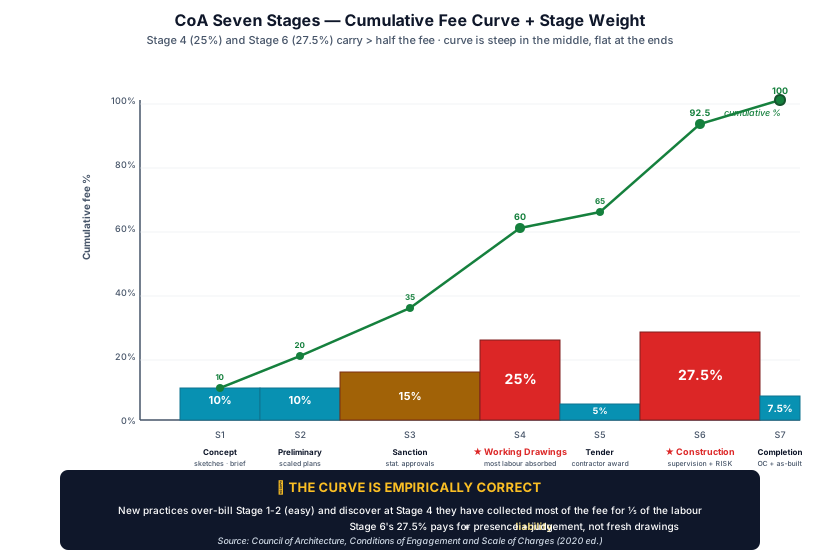
Cumulative Fee by Stage
| Stage | Stage Name | Primary Deliverables | Fee % (cumulative) |
|---|---|---|---|
| 1 | Concept Design | Site analysis, programme statement, concept sketches, indicative floor plans, mass model | 10% |
| 2 | Preliminary Design & Drawings | Scaled floor plans, sections, elevations, area statement, preliminary cost estimate, presentation views | 20% |
| 3 | Drawings for Client's & Statutory Approvals | Sanction-ready drawings, area calculations, FSI/setback compliance certificate, application package | 35% |
| 4 | Working Drawings & Tender Documents | Complete construction set: dimensioned plans, RCP, joinery, MEP coordination, schedules, BOQ, specifications, tender package | 60% |
| 5 | Appointment of Contractor | Tender evaluation report, recommendation, contract negotiation support, letter of intent / award | 65% |
| 6 | Construction Stage | Periodic site visits, RFI responses, shop-drawing review, change-order documentation, certified payment recommendations | 92.5% |
| 7 | Completion | As-built drawings, defect liability sign-off, occupancy certificate support, final account certification | 100% |
Source: Council of Architecture, Conditions of Engagement and Scale of Charges (2020 edition, in continued use), as referenced by the Architects Act 1972 §45 (Powers of Council to make Regulations).
Two patterns are worth noting in this table:
- Stage 4 alone accounts for 25 percentage points — more than any other stage. Working drawings are where most of the architect's labour is absorbed, and the fee structure reflects that.
- Stage 6 (construction) accounts for 27.5 percentage points despite involving no fresh design output. This is where the architect's liability peaks, not their drawing volume. The fee compensates for risk, supervision time, and dispute resolution — not pages produced.
The cumulative-fee curve is steep in the middle and flattens at the ends. New practices often misread this curve, billing too much at Stage 1–2 and discovering at Stage 4 that they have already collected most of the engagement fee for what is actually one-fifth of the labour. The CoA distribution is the empirically-derived correct shape.
"Architecture begins where engineering ends." — Walter Gropius (1883–1969), founder of the Bauhaus
3. Stage-Wise Deliverables in Detail
Each stage of the CoA framework has a defined output. The architect who writes engagement letters using these stage descriptions creates a contract that is enforceable against ambiguity in either direction.
Stage 1 — Concept Design (10%)

Deliverables: A site-analysis report (climate, contours, access, services, neighbourhood character), a written programme statement based on client interviews, indicative bubble diagrams and zoning, a concept sketch set (typically 6–12 hand-drawn or schematic plates), and an indicative massing model — physical, digital, or both.
What it is not: Stage 1 is not the time to commit to dimensions, materials, or cost. The deliverable is direction — a defensible answer to the question "what kind of building will this be?" If the architect commits to a 3000-square-foot built-up area and a ₹2 crore budget at Stage 1, both numbers will be quoted back through every later disagreement.
Fee trigger: On submission and client acceptance of the concept package, the 10% instalment becomes payable.
Stage 2 — Preliminary Design & Drawings (10% + 10% = 20%)
Deliverables: Scaled floor plans (typically 1:100), sections through critical conditions, elevations on all four faces, an area statement with FSI/coverage compliance preview, a preliminary cost estimate (rate-per-square-foot order-of-magnitude), and presentation views — perspective sketches or basic 3D renders.
What it is not: Preliminary drawings are not approval drawings. The information is not yet sufficient for sanction, and the cost estimate is order-of-magnitude — typically with a ±15–20% confidence band.
Fee trigger: On client sign-off of the preliminary package, the second 10% becomes payable.
Stage 3 — Drawings for Client's & Statutory Approvals (15% additional, cumulative 35%)
Deliverables: A complete sanction-ready drawing set as required by the local planning authority (BBMP, MCD, MCGM, etc.) — typically including key plan, site plan, ground floor + each upper floor, sections, elevations, area calculations, FSI computation, parking layout, drainage and rainwater layout, and the architect's compliance certificate. The architect liaises with the client's structural and MEP consultants to ensure their drawings are aligned for the same submission.
The liability boundary: Once the architect signs the FSI/setback compliance certificate and submits to the planning authority, they take on professional indemnity exposure for that certification. Errors caught after sanction — and especially after construction — are very difficult to unwind without regularisation schemes that may not be available.
Fee trigger: On submission of the application package to the authority, the 15% becomes payable. Sanction itself is not a precondition (the architect cannot guarantee a sovereign decision).
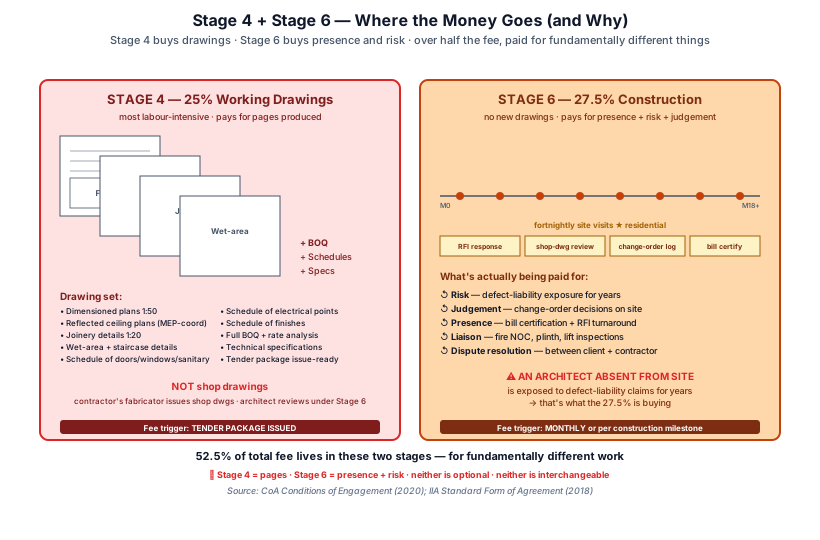
Stage 4 — Working Drawings & Tender Documents (25% additional, cumulative 60%)

Deliverables: The complete construction set — dimensioned floor plans typically at 1:50, reflected ceiling plans (RCP) coordinated with electrical and HVAC, joinery details (windows, doors, wardrobes, kitchen) at 1:20 or larger, all wet-area details, staircase details, schedule of finishes, schedule of doors/windows, schedule of sanitary fittings, schedule of electrical points, full BOQ with rate analysis, written specifications (technical), and a tender package ready for issue to contractors.
What it is not: Working drawings are not shop drawings. The contractor's fabricator will issue shop drawings for steel, joinery, and MEP — which the architect reviews under Stage 6, not produces under Stage 4.
Fee trigger: On issue of the tender package, the 25% becomes payable.
Stage 5 — Appointment of Contractor (5% additional, cumulative 65%)
Deliverables: Tender evaluation report comparing bids on cost, schedule, and prequalification; a recommendation letter to the client; support during contract negotiation; review of the contract document; letter of intent issuance.
What it is not: The architect does not select the contractor — the client does. The architect recommends and supports the decision.
Fee trigger: On contract award, the 5% becomes payable.
Stage 6 — Construction Stage (27.5% additional, cumulative 92.5%)

Deliverables: Periodic site visits (typically fortnightly for residential, weekly for larger commercial), responses to Requests for Information (RFI) from the contractor, review and stamping of shop drawings, documentation of change orders / variations, periodic certification of contractor's running bills (recommending the client pay X% of the work-done value), liaison with statutory inspections (plinth, fire NOC, lift inspection).
The largest stage by fee weight. Stage 6 is where the architect's role shifts from designer to administrator-of-the-contract. The fee is not paying for new drawings; it is paying for risk, judgement, and presence. An architect absent from the site during Stage 6 is exposed to defect-liability claims for years afterward.
Fee trigger: Stage 6 fee is typically billed monthly or in milestones tied to construction progress (slab completion, plastering, finishes), so the 27.5% spreads across the construction calendar.
Stage 7 — Completion (7.5% additional, cumulative 100%)
Deliverables: As-built drawings reflecting all on-site changes, defect liability inspection at the end of the warranty period (typically 12 months), occupancy certificate (OC) submission support, final-account certification, project handover documentation.
Fee trigger: Final 7.5% becomes payable on issue of the completion certificate or OC, whichever the contract specifies.
4. Included Services vs Extra Services
The boundary between included and extra services is where most fee disputes originate. The CoA framework draws this line clearly. Included services are those required to deliver the seven stages above on the architect's own discipline — architecture. Extra services are everything else, billed separately.
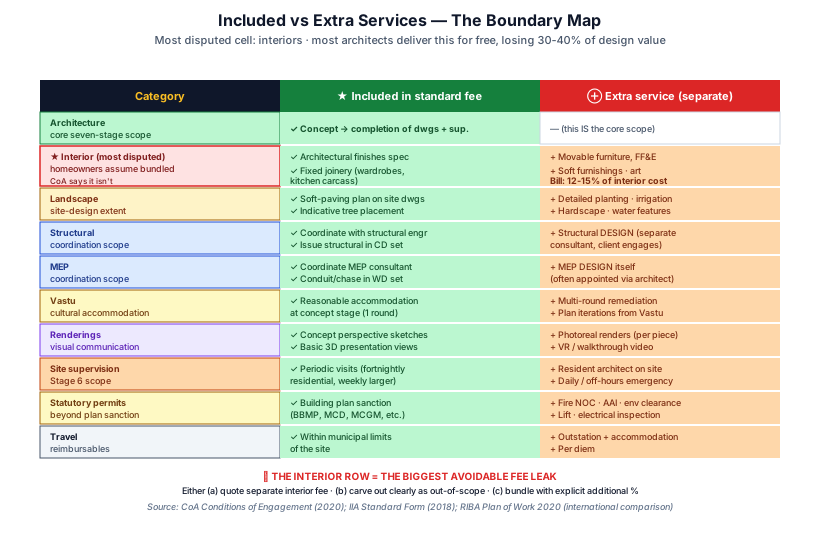
The Boundary Map
| Category | Included in Standard Fee | Extra Service (Billed Separately) |
|---|---|---|
| Architecture | Concept → completion of architectural drawings, schedules, supervision | None — this is the core scope |
| Interior Design | Architectural finishes specification, fixed joinery (wardrobes, kitchen carcass) | Movable furniture, soft furnishings, art, styling, FF&E specification |
| Landscape | Soft-paving plan in site drawings, indicative tree placement | Detailed planting plan, irrigation, hardscape design, water features |
| Structural | Coordination with structural engineer's drawings | Structural design itself (usually a separate consultant the client engages directly) |
| MEP | Coordination with MEP consultant; conduit/chase planning in working drawings | MEP design itself (often appointed by the architect on the client's behalf) |
| Vastu | Reasonable accommodation in concept stage | Detailed Vastu remediation, multiple plan iterations driven by Vastu changes |
| Renderings | Concept perspective sketches, basic 3D | Photoreal renders, walkthrough video, VR walkthrough |
| Site supervision | Periodic visits per Stage 6 | Resident architect, daily supervision, off-hours emergency visits |
| Permits beyond planning | Building plan sanction | Fire NOC, AAI height clearance, environment clearance, lift permission, electrical inspection — all chargeable |
| Post-occupancy | Defect liability inspection at warranty end | POE studies, alteration design, expansion design |
| Travel | Within municipal limits of the site | Outstation travel, accommodation, per-diem |
Source: Synthesised from CoA Conditions of Engagement (2020 edition), IIA Standard Form of Agreement (2018), and RIBA Plan of Work 2020 boundary conventions adopted by Indian practices.
The single most disputed cell in this table is the interior row. Indian residential clients overwhelmingly assume that "an architect designing my house" includes the interiors. The CoA framework does not. Architects who do not call this out explicitly in the engagement letter routinely deliver interior work for free — losing 30–40% of the project's design value.
The professional response is not to refuse interior work; it is to either (a) quote a separate interior fee in the same engagement letter, (b) carve out interiors clearly as out-of-scope, or (c) bundle interiors with an explicit additional percentage on top of the architectural scale.
"The interior is not a decoration of the architecture. It is the architecture seen from inside." — Adolf Loos (1870–1933), in 'The Principle of Cladding' (1898)
5. Sub-Consultant Coordination — The Architect's Liability
Indian residential and small-commercial projects typically involve four to six sub-consultants: structural engineer, MEP engineer, landscape architect, interior designer, sometimes acoustician or lighting designer. The architect's role with respect to these consultants is coordinator — not designer-of-record.
This distinction has substantial liability consequences.
The Coordinator's Liability Map
| Discipline | Architect's Role | Liability if it Fails |
|---|---|---|
| Structural | Receive drawings, ensure architectural coordination, issue structural to contractor as part of CD set | None for structural adequacy itself; only for coordination errors (e.g., a column placed in a doorway) |
| MEP | Coordinate sleeve/chase locations, RCP integration, equipment access | None for sizing; only for coordination errors |
| Landscape | Ensure landscape integrates with site grades, drainage, retaining structures | None for plant selection; only for coordination |
| Interior (separate consultant) | Coordinate with finishes, false ceilings, joinery | None for interior decisions; only for coordination |
| Vastu consultant | Receive guidance, advise client on design implications | None — but the architect should document any design override the client demands |
The defensible position for the architect is: "I coordinate; they design within their discipline; the client engages each consultant directly." The non-defensible position — and one that occurs by default unless the engagement letter says otherwise — is: "I appoint and pay all consultants on the client's behalf, so I am responsible for everything."
The contract solution is the principal-agent clause. If the client wants a single point of accountability (and many do), the architect agrees in writing to appoint and coordinate the consultants but does not warrant their technical decisions. The fee for principal-architect coordination is conventionally an additional 1.5–3% of construction cost, billed pro rata against the consultants' fees.
"You can delegate authority but you cannot delegate responsibility." — Byron Dorgan, paraphrasing a long-standing principle of fiduciary law
6. The Engagement Letter — Clauses to Include, Traps to Avoid

A defensible engagement letter for an Indian residential architect, drawing on the CoA template and contemporary practice, needs the following twelve clauses. Most architects use one or two pages; a well-constructed letter is closer to seven.
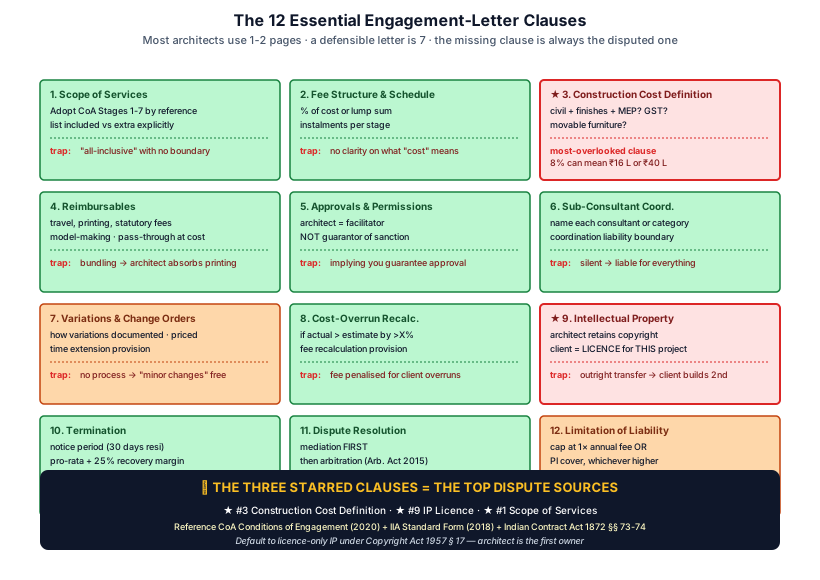
The Twelve Essential Clauses
| # | Clause | What It Does | Typical Trap |
|---|---|---|---|
| 1 | Scope of Services | Adopts CoA Stages 1–7 by reference, lists included vs extra | "All-inclusive" language with no boundary |
| 2 | Fee Structure & Schedule | Percentage of construction cost or lump sum, instalments per stage | No clarity on what "construction cost" means at signing vs final |
| 3 | Construction Cost Definition | Explicit: civil + finishes + MEP fixtures? Or just civil? Movable furniture? GST? | Defining cost only at completion — invites dispute |
| 4 | Reimbursables | Travel, printing, statutory fees, model-making — pass-through at cost | Bundling reimbursables into fee — architect absorbs printing for the project |
| 5 | Approvals & Permissions | Architect's role as facilitator, not guarantor | Implying architect guarantees sanction |
| 6 | Sub-Consultant Coordination | Names each consultant or category, coordination liability boundary | Silent — architect implicitly liable for everything |
| 7 | Variations & Change Orders | How variations are documented, priced, time-extended | No process — variations sneak in as "minor changes" |
| 8 | Construction Cost Overrun | If actual cost exceeds estimate by >X%, fee recalculation provision | Architect's fee penalised for client-driven overruns |
| 9 | Intellectual Property | Drawings remain architect's IP; client gets a licence to use for this project | Outright transfer of IP — client sells design to neighbour |
| 10 | Termination | Notice period, payment for work-to-date, deliverables on termination | Termination at will with no obligation to pay for in-progress work |
| 11 | Dispute Resolution | Mediation first, then arbitration under Indian Arbitration Act 2015 (amended 2019, 2021) | Litigation in default — slow, expensive, public |
| 12 | Limitation of Liability | Cap at 1× annual fee or PI cover, whichever is higher | Unlimited liability — uninsurable |
Source: Synthesised from CoA Conditions of Engagement, IIA Standard Form of Agreement (2018), AIA B101 Owner-Architect Agreement (2017) for international comparison, and Indian Contract Act 1872 §73–74 on damages.
The construction-cost-definition clause (#3) is the most-overlooked. A fee of "8% of construction cost" can mean anywhere between ₹16 lakh and ₹40 lakh on the same residence depending on whether "cost" includes interior work, MEP fixtures, white goods, and statutory charges. Define it precisely at signing, with a worked example.
The IP clause (#9) matters more than most architects realise. Indian Copyright Act 1957 §17 vests authorship in the architect by default, but the absence of an explicit licence-vs-assignment distinction in the engagement letter creates ambiguity that can be exploited if the client builds a second house from the same drawings. The licence model — "client may construct one building from these drawings at the address specified" — is the standard professional position.
"In every contract there is an obligation of good faith and fair dealing." — Restatement (Second) of Contracts §205, increasingly persuasive in Indian commercial-law jurisprudence
7. Termination, Variation, and the Quiet Clauses That Matter
Three categories of clause cause more disputes than the headline fee structure ever does.
Termination. The CoA framework provides for termination at any stage by either party with reasonable notice. Reasonable in context typically means 30 days for residential, 60 for larger projects. Two questions must be answered in the engagement letter: (a) what is the architect paid for work-to-date, and (b) what does the architect deliver on termination? The standard answer to (a) is pro-rata to the stage reached plus 25% of the next stage as a recovery margin. The standard answer to (b) is all drawings prepared up to date, in soft and hard copy, with the same licence as the original engagement.
Variations. Every project changes. The contract must say how changes are documented and priced. The recommended pattern: any change requested by the client after Stage 3 sanction is treated as a variation, documented in writing, and priced at either an hourly rate or as an additional percentage of the variation's construction cost. Without a variation clause, a client requesting "small changes" in Stage 4 can effectively repeat the work the architect was paid 35% to do at Stage 3 — for free.
Construction-cost overrun. If the actual construction cost exceeds the estimate by more than 15–20%, two things happen: the architect's fee (calculated as a percentage) increases, and the client objects. The defensible clause states that fees are calculated on the higher of the estimate or the actual — protecting the architect when the client adds scope, while preserving the architect's responsibility to estimate accurately.
Intellectual property. The licence model is the professional standard. The architect retains copyright in the drawings; the client receives a licence to use them for the construction of one building at the named address. Reuse for a second project, sale to a third party, or publication in a magazine without credit are all outside the licence and require fresh permission.
"Hard cases make bad law, and contracts written without hard cases in mind make hard cases inevitable." — Adapted from Justice Oliver Wendell Holmes, in Northern Securities Co. v. United States (1904)
8. Practitioner's Closing Note
The CoA Conditions of Engagement is not the most exciting document a practising architect will read. It is, however, among the most consequential. An architect who runs their practice on the CoA framework — even with bespoke modifications — has a built-in defence against the three failure modes that close more practices than any aesthetic shortcoming: scope ambiguity, fee shortfall, and IP loss.
The framework also serves the client. A homeowner or developer who receives an engagement letter that explicitly references the seven stages, lists deliverables per stage, and defines what is and is not included is contracting with a professional who has thought through the project before signing. That signal alone — separate from the technical content — wins competitive engagements against undercutters who quote a flat fee with no scope clarity.
The practical advice for a practising architect is straightforward. Read the current edition of the CoA Conditions of Engagement once, in full. Adopt the seven-stage structure as the spine of every engagement letter. Define the construction-cost basis explicitly. List the included-versus-extra boundary in a table. Use the licence model for IP. And specify dispute resolution as mediation-then-arbitration, never litigation by default.
The 8% of construction cost is the easy part of the conversation. The seven stages, the deliverables, the boundaries, the variations, the IP, and the termination terms are where the value of the document — and the durability of the practice — actually live.
"The lawyer's truest service to his client is in advising him to make the contract that does not produce the lawsuit." — Roscoe Pound (1870–1964), in The Spirit of the Common Law (1921)
Cross-References Within Studio Matrx
For deeper-dive material on adjacent practice-management topics:
- How to Win Clients — what Indian homeowners actually evaluate before signing
- Starting an Architecture & Interior Design Firm in India — entity formation, licensing, and operations
- Working Drawings & Documentation — Stage 4 deliverables in technical depth
- Architect's Site Supervision Checklist — Stage 6 ground-level routines
- RERA Guide for Homebuyers & Architects — statutory completion and handover obligations
- Building Plan Approval Process in India — Stage 3 in administrative detail
References
1. Council of Architecture (2020) Conditions of Engagement and Scale of Charges. New Delhi: Council of Architecture. Available at: coa.gov.in.
2. Government of India (1972) The Architects Act 1972. Act No. 20 of 1972, with subsequent amendments.
3. Council of Architecture (1989) The Architects (Professional Conduct) Regulations 1989. CoA Notification.
4. Government of India (1957) The Copyright Act 1957, particularly §17 (first owner of copyright in works of architecture).
5. Government of India (1872) The Indian Contract Act 1872, §§73–74 on compensation and liquidated damages.
6. Indian Institute of Architects (2018) IIA Standard Form of Agreement Between Client and Architect. Mumbai: IIA Publications.
7. Royal Institute of British Architects (2020) RIBA Plan of Work 2020. London: RIBA Publishing — referenced for international comparison of stage-based frameworks.
8. American Institute of Architects (2017) AIA Document B101 — Standard Form of Agreement Between Owner and Architect. Washington, D.C.: AIA Contract Documents.
9. Bureau of Indian Standards (2016) National Building Code of India 2016, Part 2 (Administration). New Delhi: BIS.
10. Maister, D.H. (1993) Managing the Professional Service Firm. New York: Free Press.
11. Cuff, D. (1992) Architecture: The Story of Practice. Cambridge, MA: MIT Press.
12. Government of India (2015, amended 2019, 2021) The Arbitration and Conciliation Act 1996 (with amendments).
Author's Note: The Council of Architecture framework is the operating system of professional practice in India. Architects who treat it as a reference document — not just a fee table — build practices that survive client disputes, contractor failures, and cost overruns intact. This guide is one of a Studio Matrx series on practice management; companion guides on fee structures, OC/CC submission workflow, and project failure forensics build on the foundation laid here.
Disclaimer: This article is for informational and educational purposes only. It does not constitute legal or professional advice. The CoA Conditions of Engagement and Architects Act 1972 are statutory documents — practising architects must verify current editions and any amendments via the Council of Architecture portal (coa.gov.in) and consult qualified counsel before drafting binding contracts. Fee figures and clause patterns cited reflect standard professional practice but may differ in individual engagements. Studio Matrx, its authors, and contributors accept no liability for decisions based on this guide.
Interactive · COA 5-stage scope of services
Stage 1 · Conceptual design · 10% fee · 2-4 wk
Stage 1 deliverables
- ▸Site analysis report & client brief sign-off
- ▸Two or three design options as schematic plans + 3D massing
- ▸Cost estimate (±15%)
- ▸Project programme outline
Sign-off gate: Concept option locked in writing before Stage 2 begins.
Fee slice · 10% of total
Total architectural fee on residential work in India typically lands between 5–10% of construction cost — so this stage is roughly 0.75% of construction cost (mid-range estimate).
Common pitfall
Skipping written brief sign-off here is the #1 cause of scope creep later.
Duration window
2-4 wk
Fee splits follow the Council of Architecture's standard scope (Architects Act 1972, schedule on conditions of engagement & professional fees). Actual contracts may vary by appointment letter.
Export this guide
Related Guides — Deep-dive reading
Scope Boundaries — Architect, Interior Designer & Contractor
The Architects Act 1972, the IIID Code, BOCW 1996 & RERA 2016 — Stage-by-Stage Role Map, Hot Boundary Zones, Liability Matrix, and the Tri-Party Contracting Discipline for Indian Residential Practice
ConstructionDesign/Build vs. Hiring Separately: What Indian Homeowners Should Know
The procurement-model decision behind every home project — one turnkey firm that designs and builds, or an independent designer and a separately appointed contractor — and how to choose the one that fits your time, budget, and appetite for control.
Planning Your ProjectUnderstanding Construction Contracts & Retainage in India
A homeowner-protective guide to the contract and payment structure behind every interiors or build project — the contract types and when each fits, how to stage payments so your money trails the work, and the retention clause that quietly protects you more than any other.
Cost & MoneyRelated Tools — Try Free
Interior Contract Clause Checklist
16 sections and 98 checkboxes covering scope, BOQ, milestones, penalties, warranty, and disputes.
Contract ChecklistPre-Possession Inspection Checklist
Inspect your flat before registration — 10 categories, 70+ checkpoints across legal, carpet area, structure, finishes, and deviations.
Homebuyer ChecklistConstruction Approval Checklist — 24-Stage Tracker
Track every approval, permit, and NOC from land title to occupancy certificate across 24 stages.
Approvals